
Part 3 of the interview with Fabio Golfetti concentrates on how a distant connection with the Gong family built over the years through connections with the Gong Appreciation Society, communication with Daevid Allen about the use of the Invisible Opera Company of Tibet monicker, to eventual collaborations with the man himself in a variety of guises, including playing of a central part in the first Glissando Guitar orchestra.
Part Four – The Glissando Guitar
I had a contract with Violeta with BMG – RCA in fact, a big company who gave us a big advance to buy instruments to do things. The record label were very rich at that time, (they are still rich) and that was the first time I came to UK, in 1987, in September or October. I came to UK and I bought my Telecaster, in London, in a famous shop called Andy’s on Denmark Street – many artists went there – that was a great guitar.
When I came back to Sao Paulo at the end of 1987 in November, I received a letter from GAS. I don’t know who was running GAS at that time, it was probably Rob (Ayling – later to found Voiceprint Records). Rob sent me a letter saying, ‘we’re going to do a workshop with Daevid’, because they’d (Daevid and partner Wandana Bruce) become experts in breathing therapy. In Australia in the preceding years he’d joined some people that worked with alternative therapies and one of those was breathing therapy. I was invited to participate in this Workshop because I was on a list of guests.
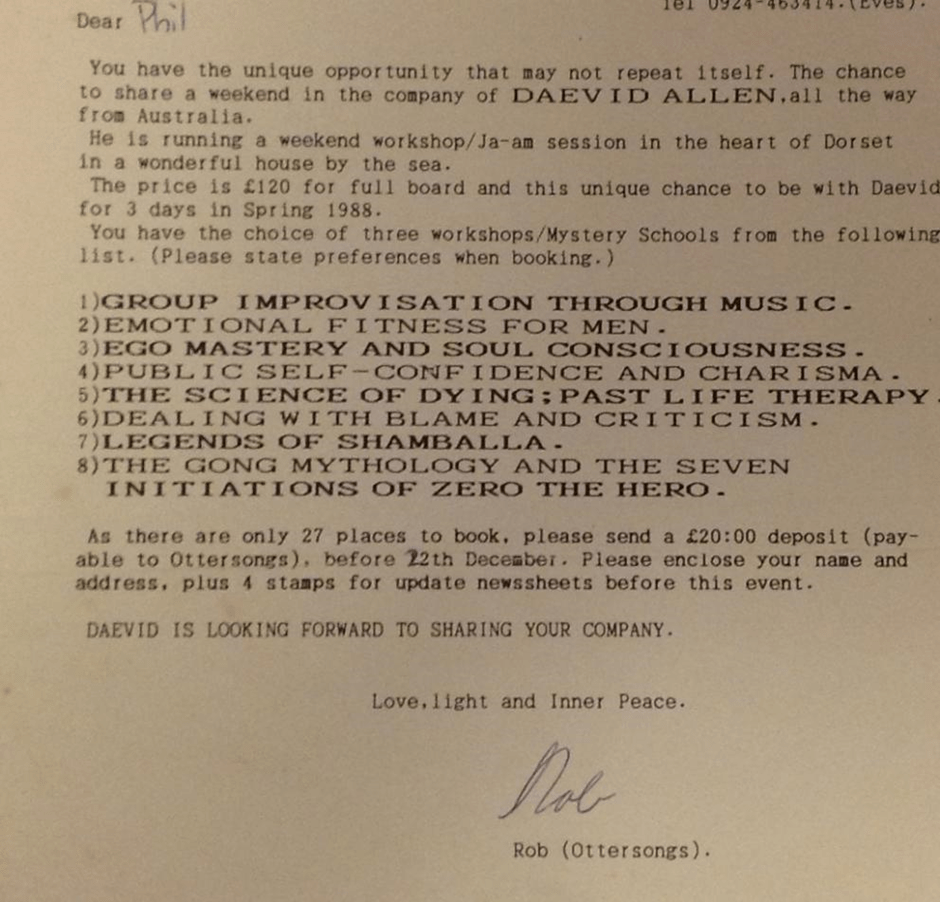
Daevid wanted to come back to UK to perform, so the idea was to do the workshop to pay his costs for coming from Australia and back to the UK. Now it’s so easy to come and go but at the time it was more expensive and complicated.
But I had just spent my money flying to UK in October, and coming back to Brazil in November, and then I received this letter to come in January so it was impossible. After that Daevid Allen come back to UK and then he started doing just his solo stuff.
I was fascinated with idea of the Invisible Opera Company, the idea of connecting people, Gong types of people, in different places and you don’t have to show your real identity and then a friend of mine called May East moved to England and then she married one of the main guys in the Findhorn Foundation (an alternative community in the North East of Scotland) called Craig Gibsone. This was in around 1989 and she wrote to me one day, ‘oh I’m here in Findhorn, I’m recording an album and I will put together an album with a guy called Mark Jenkins. And I remembered the guy that you like, Daevid Allen of Gong, he also will be releasing an album here with Mark Jenkins. It is called ‘Stroking the tail of the bird’’. She asked me if I would like her to talk to Daevid because she knew I wanted to try to use the idea of Invisible Opera in Brazil. I said it would be amazing if I could use this name in Brazil. I knew that Daevid used this name. In fact I have all the GAS newsletters and in 1985 Daevid published this newsletter which mentioned invisible Opera Company in Australia but I think it was just an idea then, it might have been called the Nuclear Mystery Temple (at that point).
In 1989 I released a flexi disk. I used the Invisibles’ name but in Portuguese – Opera Invisivel. Then, after May contacted Daevid, Daevid said I could do this but he asked me to send some music, some cassettes for him to listen to what I was doing.
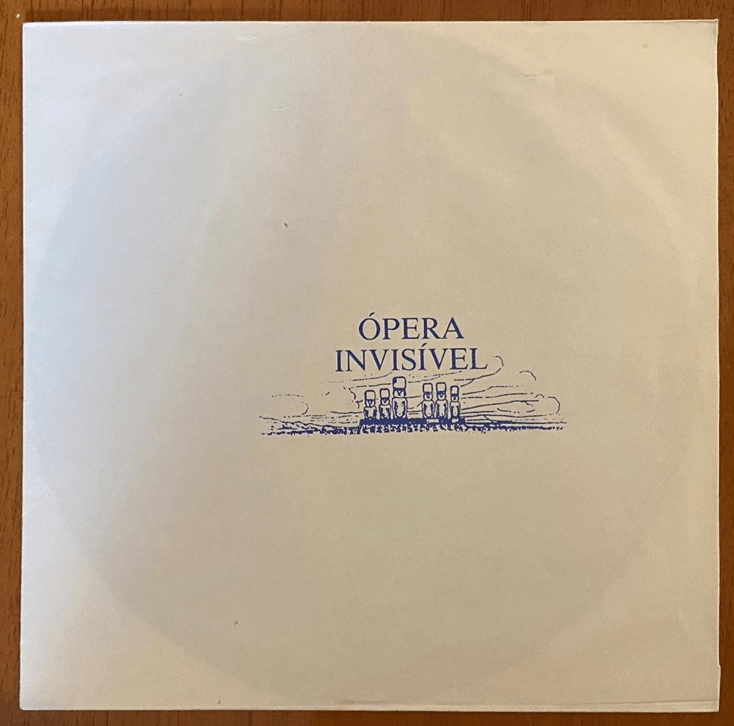
I received a letter, a letter written like a piece of art, this was in the early 1990’s. He said, ‘I have no objection to you using the name Invisible Opera because as you said it is a kind of connection’. I don’t know how many letters I wrote to GAS (in the preceding years) but he had probably read (all) my letters because they must have been in the GAS office after he arrived in 1988.
I talked to Fabio about the fact that when he sent me material across from Brazil in the 1990s, that not only was the music resonant of that of Gong, but even the accompanying artwork was clearly influenced by Daevid Allen.
I think the idea of Gong and GAS was fascinating for me – I tried to reproduce something similar in my world of Brazilian connections with Violeta and then when Daevid Allen allowed me to be part of the Gong as Invisible Opera then I started to use some imagery that was more connected to the Gong family.
I asked Fabio if he had any personal connection to the idea of an Invisible Opera Company of Tibet beyond its association with Gong music.
I have an interest in the Oriental Asian culture of China and Tibet because I had a girlfriend at that time for seven years and she also helped me to write some of my letters because she was an English teacher. She was born in Shanghai – they speak English in Shanghai but then I had also had this interest in Oriental philosophy. When I saw Invisible Opera Company of Tibet, it was for me a name that was very interesting because I like Tibetan culture. But for me it’s more complicated than that. I started with the title Invisible Opera title with the drone idea, that type of music, as I’d always been interested in spiritual and meditational aspect of like, and music is connected to this directly. I saw a point where I could focus my music in a spiritual way.
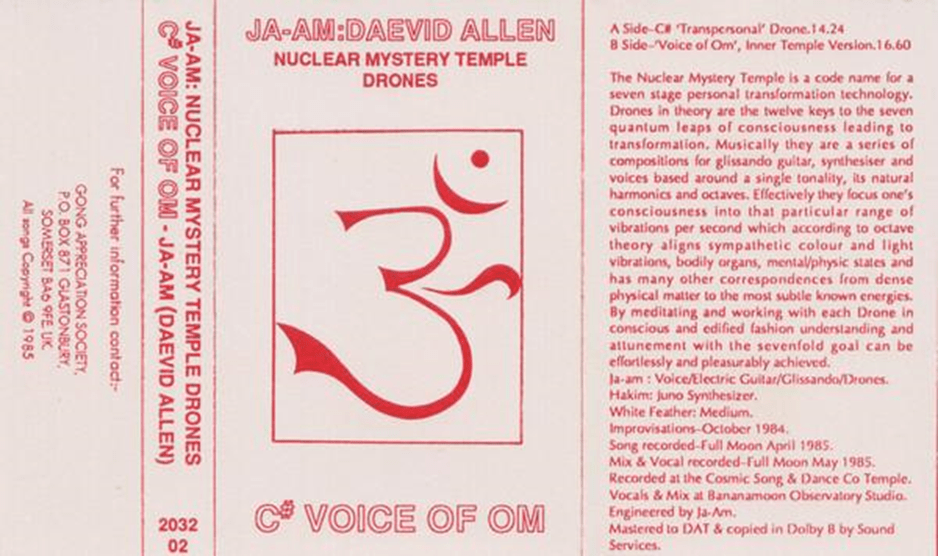
Fabio pulled out a cassette from a box recently acquired from Holland containing a couple of dozen GAS tapes, the mail order artefacts produced by the Gong Appreciation Society – this one was the ‘Nuclear Mystery Temple: Drones’ tape which referenced Daevid’s impending return to the United Kingdom at the end of the 1980s:
This is the cassette that inspired me to start the Invisible Opera Company of Tibet in Brazil.
But then (around this time) I travelled through Asia. I had a proper job working for the Mayor as an architect for poor people in the suburbs of Sao Paulo, helping people build their own houses– it was the first time the left wing party had a mayor of Sao Paulo. What they did was they went to Sao Paulo university and got the professors to try to give help with buildings for poor people in the city. First they went to the teachers and the teachers went to the students and I was connected because I accepted to be part of this big team of people that tried to bring better conditions for people who worked in the poor areas. So I had a proper job. I was never a big speaker guy, I’m a bit shy, but I had to do a lot of speaking to poor people about how to live in better conditions. I have this job until 1993. I had a day job, and then at night time I went to my small studio producing music for Invisible Opera, not so much Violeta, and then when I had to quit this job because they changed the mayor and the project was disassembled, they stopped all these social projects because the (new) mayor wanted to do this stuff. So I lost my job – I knew this would happen, Edneia (Fabio’s wife) had a nice job at this time. I had good insurance money for 4 years. We could have bought a property or maybe we could travel. We decided to travel for 3 months in Asia, We didn’t have kids at this time.
I did a tour of places that I wanted to go and see, because I am very interested in cultural history, at that time I wanted to make a connection between musical and cultures and food. I read a lot of esoteric books, philosophy, these connections of all the cultures. We decided to fly to Asia, go to Bali, then to Thailand, Nepal and India.
I went to Bali because of the Balinese gamelan, I had re-created this on the computer, so let’s go to see this music live, and how they do this.
Bali is incredible, you probably travelled to the same places I did. I stayed in a hotel in Legian, near Kuta, it was so cheap. I stayed days in Bali, watching the Balinese gamelan, then we flew to Thailand. Thailand was very interesting but they are more protective, we are just tourists there but we cannot dip into anything musically.
We stayed in Nepal for a bigger part of the trip, in Kathmandu, which was the best experience for me of the trip because stayed inside a Tibetan monastery. I have an interest in Tibetan culture, a friend of mine who is a Buddhist, the sister of May East, Kitty, Christina Pinheiro, she said if you go to Kathmandu you can stay in the same Gompa (temple) that I did because they have a place to host people that go there to study and a retreat, and you can stay there, it’s very cheap, even if you don’t go to do study, you can stay there because they need money. Kathmandu has more Hindu culture and the very poor, they have a very tough life but it is better than India. But they have a difficult life, and recently they had an earthquake which destroyed many of these beautiful buildings, and some of those buildings don’t exist any more.
Then we stayed outside of Kathmandu in a place called Boudhanath where there is an area where there was a big Stupa, the big temple, the round temple with the Buddha eyes in the top and the temple is a Mandala if you see it from the top, it is a 3D representation of a Mandala
So we stayed at this temple, because when Tibet was invaded by China, all the Buddhists fled to India or Nepal, especially Kathmandu
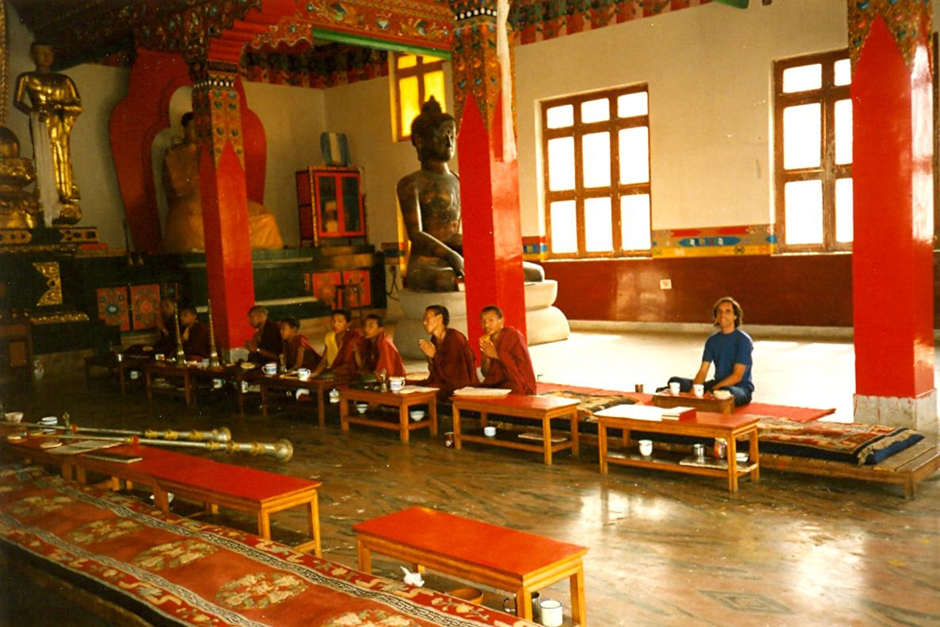
It was very interesting because we were staying inside this temple, and at 3 in the morning the Buddhists started the ritual, the horns, this Tibetan music, and the cymbals, and what is interesting is that you are in a very quiet area, no cars, it is protected by a wall, maybe mediaeval, but you could hear noise in the air, the bells, every time, in Buddhism they have different rituals in different parts of the day, you could hear noise all the time.
So when I went back to Brazil I didn’t have a job, so I stayed in a room for one month with all my ideas, and then I did this Glissando Spirit album. I went to my Atari computer and tried to compose everything I saw in this trip, on the computer, this Balinese Gamelan, all these droney things, of course they are all connected, and also to the music I was hearing at the time, all this electronic music like the Orb.
In fact we came to London after coming back from Nepal. I didn’t stop in India because India was too complicated at that time, so I changed my flights and spent extra time in Nepal. Then we flew to London and I went to the record shop, I think it was Tower Records and I bought a lot of records by the Orb. Then I had the idea to do something similar to this trancey music, it was something I was already doing but I improved this. It was very nice to do the trip, it is amazing when you do something like this it opens your mind for the rest of your life. In Nepal it was quite shocking for me because of the instruments. Some of the Buddhist instruments are made from human bones, they take the femur and turn it into a trumpet, they cut the skull to make a shaker! Because the Buddhists believe in reincarnation they regard it as a shell, so they do this just for you to remember these things. So I was in a shop and a skull was a tambourine, and this is normal there. If I took it to Brazil then it would be somebody’s head.
My friend Kitti goes to Nepal every year, she has a teacher there, and she always brings me things, she brings spices and Tibetan tea! and once she bought me a statue of a temple and inside there is a mantra in a paper, and maybe there are some ashes in here of someone because it is a sort of relic. This is a bit weird. But I was very fascinated with the Tibetan culture, this mind control, I did meditation for a couple of years, but after having children I have to decide to focus on other things.
So what is the Invisible Opera Company of Tibet? It is a universal concept originated by Daevid Allen, which according to Fabio’s own website is ‘a code name’ – which, in the man’s words, is best described as “an international ideological/ spiritual/ aesthetic communications network for artists of all kinds… who share the common vision of warm hearted, pan-stylistic, inclusive art forms which serve the drive towards conscious evolution”.
In more practical terms this equates to a number of bands around the world taking on the name: in Australia, with Russell Hibbs (an album under the IOCOT name was released on Voiceprint in 1991); a United Kingdom outfit which emerged in 1992 and has only recently disbanded, led by Brian Abbott; and an American outfit of whom much less is known, and who have no apparent direct connection to other incarnations.
On the Planet Gong it states that ‘in the 1980s Daevid used this concept to bind together a group of flexible personnel, chosen for their ability to channel a quality of music beyond their own normal capabilities’.
Brian Abbott told me back in 2019 for the Facelift blog– “I believe it’s always been a part of Daevid’s mythology and the whole Gong story. According to Daevid’s ‘Gong Dreaming 2’ book The Invisible Opera Company of Tibet are a group of ethereal lamas through which the Octave Doctors broadcast their music. They are said to reside in a cave high in the Himalayas.”, although perhaps the most comprehensive attempt at explanation comes on a website here:
https://www.ukfestivalguides.com/artists/invisible-opera-company-of-tibet/
Fabio himself refers back to a text that Daevid wrote as a commentary
I had a small notebook like this size from that time when I wrote all the concepts – something along the lines of ‘why invisible? – because they don’t have bodies’, ‘why invisible opera? – because they don’t like ballet’, ‘why Tibet? Because the Dalai Lama travels by Qantas’… this referred to the physics concept of quantum physics – remember a book called the Tao of physics, they started discovering all this taoism of the Chinese principles were very connected with new discoveries in physics. Daevid always liked to (capture) everything.
We couldn’t find this original text but Fabio forwarded something he found in his own extensive archive of Gong and related material.
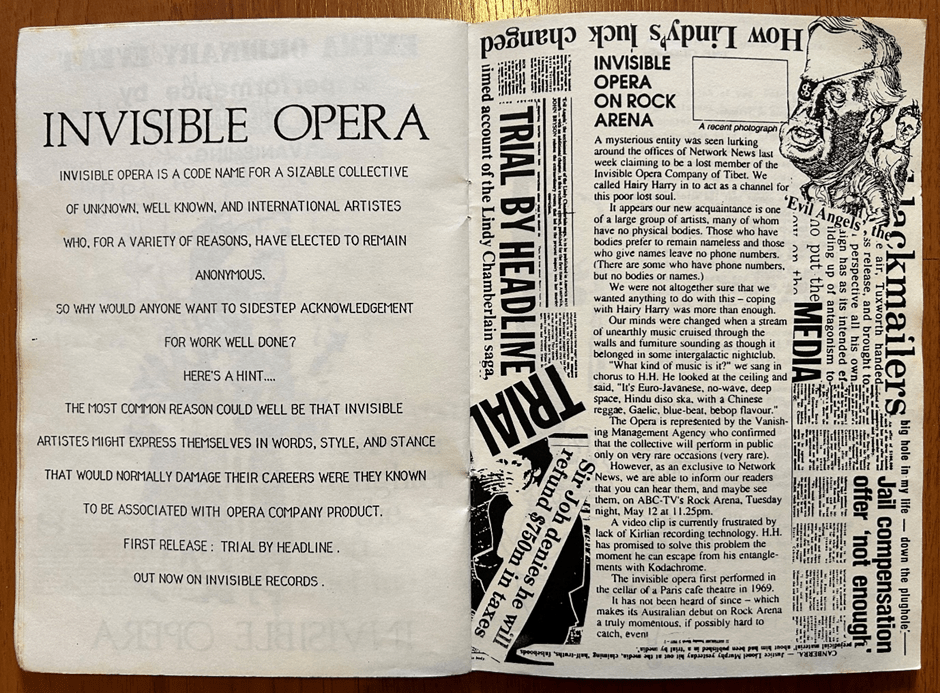
So the first thing I understood about Invisible Opera Company was exactly was what you can read in those notes. Daevid opened a kind of a portal – the Invisible Opera Company of Tibet for some reason – because he wanted to connect people in different places –he was in Australia and then he connected with people in UK like Brian Abbott who still carries the Invisible Opera spirit (the UK version of the band only concluded in 2023) and he he created a version of Invisible Opera that started in Australia with Russel Hibbs. But then I felt that I could be part of this concept of an Invisible Opera network because I like Gong music and I make music that maybe fits in to this spirit of Gong. I stayed in touch with Russell by letters in the 1990’s and I met Brian Abbott personally with Jonny Greene in the early 2000’s and the first time we played together was doing a gliss session at Nigel Shaw’s studio. My style is not exactly what Gong did in the 70s because if you listen to the music I play more naturally, it is much more Syd Barrett, more Pink Floyd than Gong, not the humour of Gong but I’m very passionate about the glissando, this for me was my instant connection with a way to play guitar.
And I also discovered glissando – I had been a Gong fan since I was 15 but there is always a question about what you really like and what you can be. I like John McLaughlin, but I would never be a John McLaughlin level musician, and I’m not interested in being John McLaughlin but the connection with Gong was with this concept of opening a kind of network through which we can exchange ideas. In fact I was already doing this with my friends in Brazil, with Renato (Mello) and also with May East. She was also was part of it because she was a famous musician she played in a very famous 80s band called Gang 90, a popular band in Brazil who did TV shows. She wanted to move from the pop scene to more new age music – she was more interested in following a spiritual path in music in the 90s. My Invisible Opera was a connection of these people in Brazil with me because she was my friend and we have a connection greater than just music.
I tried to create this Invisible Opera concept in Brazil in Sao Paulo because of my friends and my connection to what Daevid was doing with the drones. Things became clearer to my mind when I read Daevid Allen’s notes for a GAS tape. I received a cassette in 1985 (from GAS) called the Voice of Om. There was a drone, there were songs and there was a type of meditative music. This was my main catalyst in creating something similar, or at least something in this direction. I became fascinated with drone music and the way the music interacts with the body.
I’m interested in Indian music and Tibetan music, although Tibetan music itself is actually a bit different. Popular Tibetan music might be much more like Chinese music but ritual Tibetan music is a bit monstrous – it’s not music that you can stay meditating and relaxing like Indian music that you focus your consciousness on. Tibetan ritual music is much more atonal, not pleasant, and maybe in the Tibetan Buddhist ritual this make sense because they are part of the readings they call pujas like a big ritual that lasts hours.
So then I just tried to use this Invisible Opera Company concept by channelling this idea of creating music in this direction, a bit of new age music. I put a credit in French – ‘Opera Invisible’ – to acknowledge the inspiration.
So what was your direct connection with Daevid?
FB: I received a letter from Daevid and we stayed in touch for a while by letter, this was in 1991 before the internet. And then May (East) moved from the pop/rock scene into ecological and New Age causes. She came to the UK and became part of the Gaia Foundation before going to Findhorn. She stayed in London a couple of times where she met Mark Jenkins. She went to Findhorn I think in 1991. Then in Brazil in 1992, in Rio and in the capital Brasilia there was a big ecological summit they called Rio 92 or Eco-92 or Earth Summit. May was working on this, and it was connected to various governments, and she told me ‘I would like to invite Daevid to come to play with you in Brasilia – Daevid has worked as an activist (artivist) in this area.’
Daevid wrote me a letter saying, ‘it would be good if I can come, me and maybe Mark Robson (Kangaroo Moon)’ (too) because they were playing together. I didn’t know how I would be involved because at the time I was playing with Renato (Mello) but I went to another friend, RH Jackson (Jack) who was working on the programming of the album and then talked with Daevid. Because of the budget they didn’t get enough money to pay for flights, so Daevid said, ‘I’ll go anyway without any money – and they provided the hotel and he came to meet.
In fact we didn’t play exactly together. I played a set and he came to my set and from where I stopped he continued the set because we didn’t have time to improvise to do this thing – it was a bit complicated. So I did a set with my friend – I played some of my music with electronics – the thing I was doing with my Invisible Opera version and he came with his ‘Twelve Selves’ set.
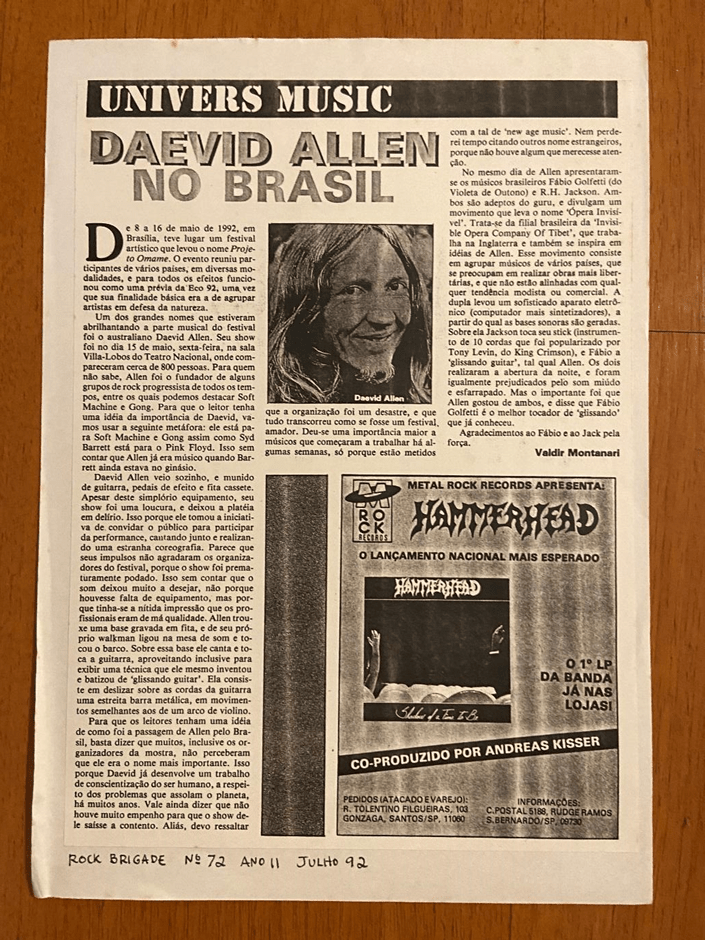
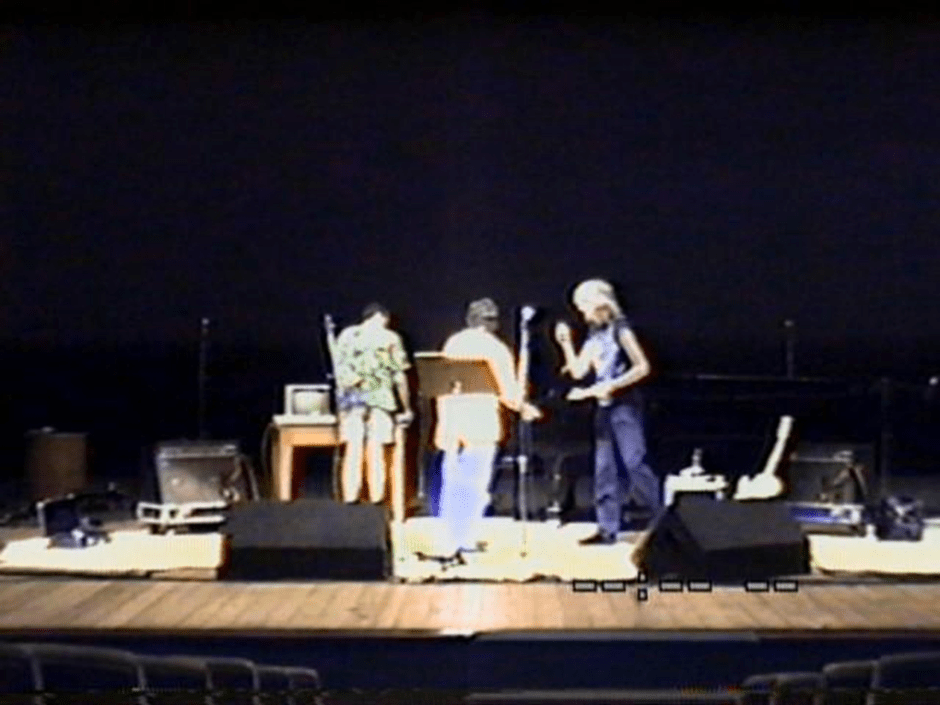
Daevid came on stage and he created this big drone with the audience. He had been doing ‘Twelve Selves’ in small clubs for 50 people and suddenly he ended up playing with this festival for more than 1,000 people – it was a big theatre. Daevid started his set and he jumped from the stage to the first row and started with other people, and made a massive circle with hundreds of people doing the circle and started singing one note – it’s an F – the first note of the drone, and everybody sang – almost a thousand people singing this note. I pressed the playback tape and then he started playing the glissando over the people’s singing. I don’t believe he did this show to a bigger audience than this – it was remarkable.
He’d travelled for the show from San Francisco and he’d bought a small guitar tuner there. It was a digital tuner, a new one and after the show someone stole the tuner. Now Daevid – he wasn’t a rich man, he lived in a very limited way. The next day he was going home and I had a digital tuner and so I wrapped it inside my whiskey velvet bags and I didn’t see Daevid because he was leaving early so I said to someone ‘can you do me a favour, wrap this in a packet and give this to Daevid but tell him not to open it because he probably will not accept’. When he opened he saw it was my tuner and he wrote me a big letter just to say thanks about. This is one of the things that solidified our relationship.
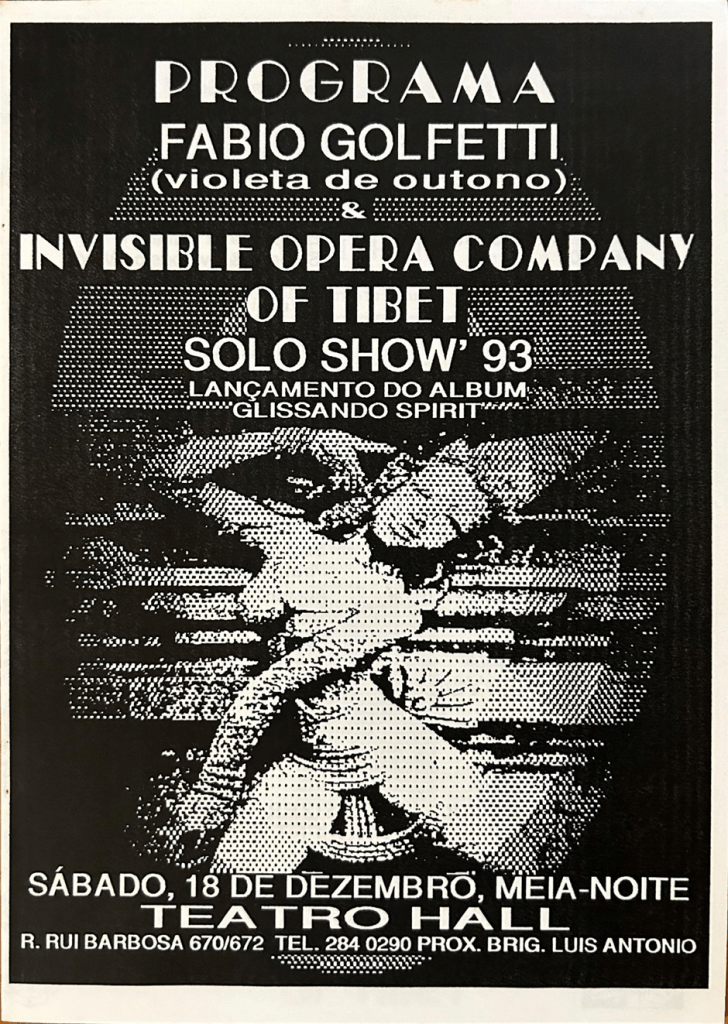
Meanwhile, Fabio’s use of the Invisible Opera Company of Tibet monicker began in earnest. A cassette jointly credited to Fabio and the Invisible Opera Company of Tibet appeared as ‘The Eternal Voice’ in 1991, a meditative piece heavy on glissando, Chinese inflections through synthesiser and guitar, and additionally input from May East and Renato Mello, with just a couple of gentle vocal pieces. ‘Cosmic Dance Co’, followed in 1992, and is even more reflective, very much building on Daevid Allen’s drone influences. But it wasn’t until 1993 that Fabio started to frame the Invisible Opera Company of Tibet into a broader, more formulated context with the ‘Glissando Spirit’ project. This initially was a series of tracks purely performed by Fabio, in his words using ‘aspects of oriental music and space-rock performed on guitars and synthesizers (including drum machines)’: This was later revisited, with welcome additional instrumentation from drummer Claudio Souza and saxophonist Renato Mello for a Voiceprint release in 1996. However, in the meantime the ‘Britannia Café’ cassette had appeared, my own introduction to the Brazilian arm of the Invisibles and as such still my own main reference point. As I wrote in my review, ‘this IOCOT use many of the classic Gong sounds (glissando guitar, discordant sax, spiritual acoustic works, tuned percussive sounds) and incorporate the into their own forward-looking music. At times it’s almost like listening to a new Gong album…’ It also mentions the liberal ‘quotes’ from New York Gong, Soft Machine, and even The Orb adding to that sense of almost eery familiarity.
That recording, we played that gig in an old cinema in Sao Paulo on a Thursday night, midnight, it was freezing, unusually, 10 degrees for us is very cold. And we had just 80 people in the gig in a big cinema. So the sound guy said to me, ‘we have just 80 people – I can never make a good mix – it is too empty, the sound is not good in any situation, would you like me to mix live for the recording’. I said, ‘do a recording, maybe we can use it later’. It wasn’t what the people heard, it was more what he heard on his headphones. I think it was the best decision.
I had an instant connection with Renato – we have a kind of chemistry. I know we could never sound like Gong because technically if you look to Gong, Pierre Moerlen drumming, Didier playing saxophone, you will never find anyone like this. Renato Mello (the saxophonist), he very much looks to Elton Dean, and John Coltrane, his sound is – he is not a professional, but for me he has a big talent and his older brother was the one that introduced us to this music, me and him.
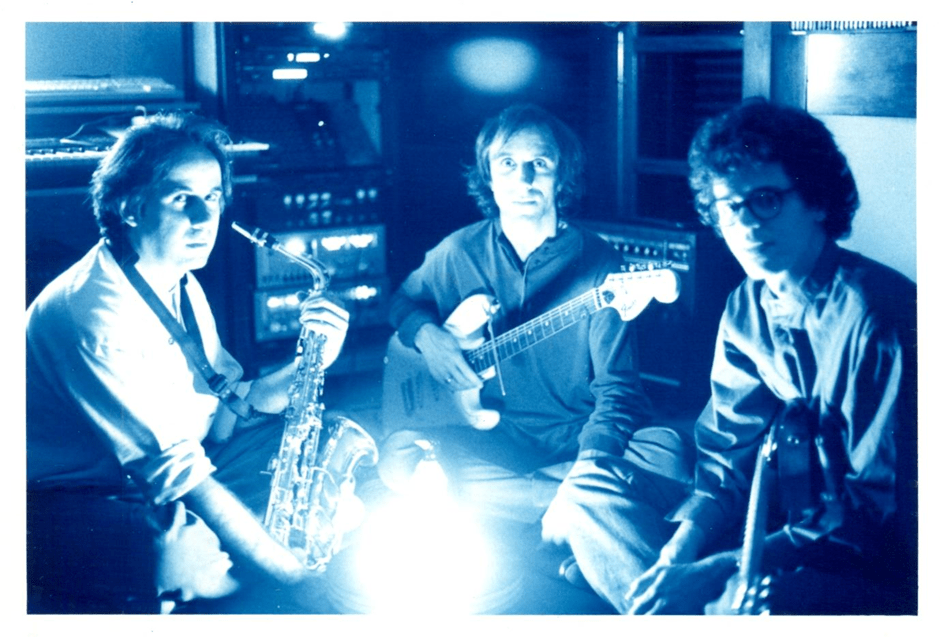
I had some press when I released the album, because I did promotion in normal newspapers and they mentioned that I had received reviews in England. This is an important story for us, for a Brazilian musician to have recognition overseas. Voiceprint did a very good job at restoration, it was by a guy called Dallas Simpson, in Yorkshire.
Just to complete the Invisibles story (for the moment at least), in 2010 Fabio sent me a copy of a newly completed album ‘UFO Planante’, the title itself a nod back towards Fabio’s first band Lux. The ambitious scope of this album is immediately apparent: around 2 hours of music, which although based, like the core Violeta project, around a trio of musicians (Gabriel Costa on bass and Fred Barley on drums) it shows clear progression from the Glissando Spirit into a fully coherent group artefact – the album’s opener ‘First Contact’ is a alternatively effusive and pulsating rambling 27 minute psychedelic jam. The album overall may be Fabio’s finest moment, recalling the warmth, groove and space of Gong’s Trilogy-era instrumentals, with some glorious guitar work on lead, rhythm and glissando throughout.
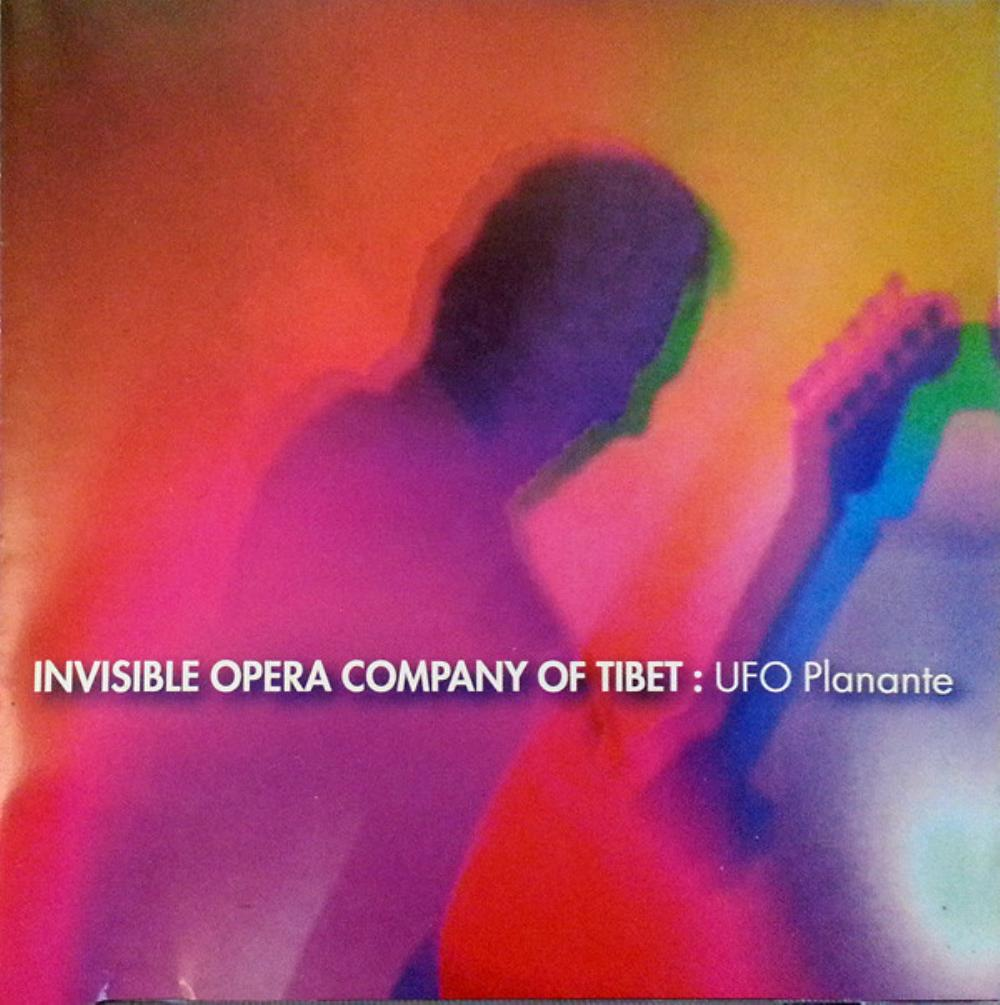
Returning to Fabio’s relationship with the wider Gong family, Fabio talks more about how his relationship with Daevid developed during the Noughties.
Daevid he told me that he had an idea for a Glissando Guitar Orchestra and that I would be the first person he contacted. I remember seeing from Jonny (Greene, from GAS) that he was doing a Gong reunion in 2005 in Glastonbury. And so I wrote and said ‘I know you are doing this Gong reunion, do you think it would be worth me joining you?’ And Jonny said ‘maybe, but wait for next year because we will be organising a big Gong reunion in 2006.’ And so the Glissando Orchestra performed in Amsterdam in 2006. It was very good to meet everybody. There were 10 guitarists. I didn’t know exactly what was going to happen because the Gong Unconvention was 3 days in Amsterdam, all the Gong family, and for me it was the first time meeting everybody. We met with Gong in Colour Sound, a big warehouse where they provided the light show. There was one bus for the artists, one bus for the crew, and a big trailer for the equipment, and we all met there and went to the Hook of Holland – it was a long ferry journey during the night and I was very sick, it was November.
So we did this gig with the Glissando Orchestra. What Daevid did was this: it was (led by) me and Daevid. He said to me, you should be the main glissando, you should stay in the centre – oh no! – He put me in the centre. I was very shy. It was Steve (Hillage), Steffe (Sharpstrings) , Brian (Abbott), Harry Williamson – he was there recording. There was Makoto (from Acid Mothers Temple), Josh Pollock (from University of Errors) the other guy was Jerry Bewley who was there with Kangaroo Moon. There was another guitarist, Steve (Higgins, from House of Thandoy) – he died recently
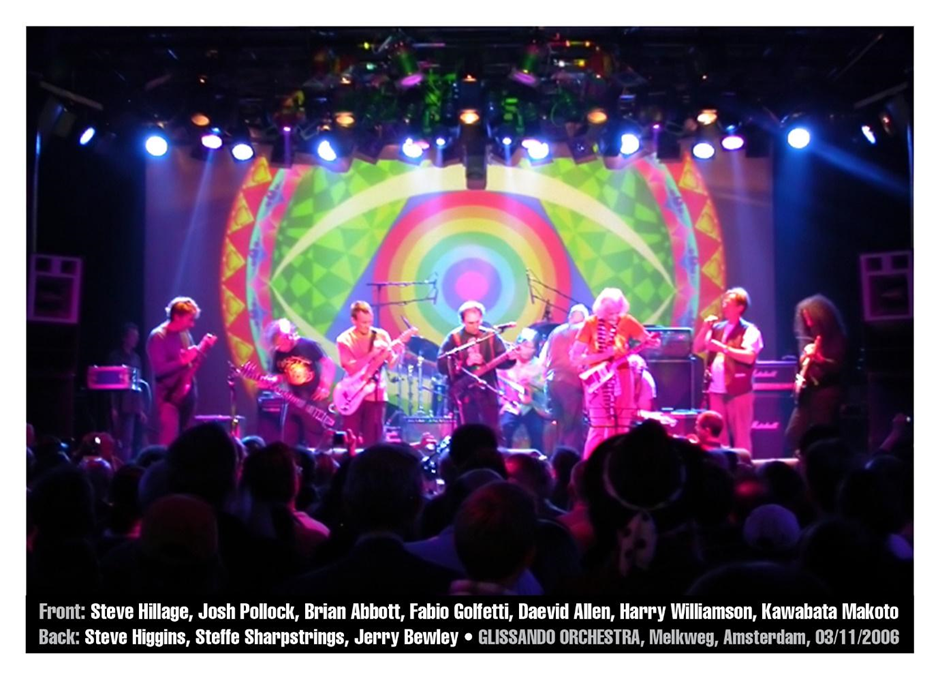
In fact it was improvised – he took all the guitars in the party, and then there was a friend of Daevid called Mic Cosmic, who conducted the glissando. We played the 7 drones, starting with C, for 7 minutes each. So Mic hit a Tibetan bell and we started and hit it again every time we were to change key. It was recorded and was the first ever Glissando Guitar Orchestra performance.
Fabio’s central role within the first performance of the Glissando Guitar Orchestra would lead to further collaborations with Daevid, this time on Fabio’s home turf:
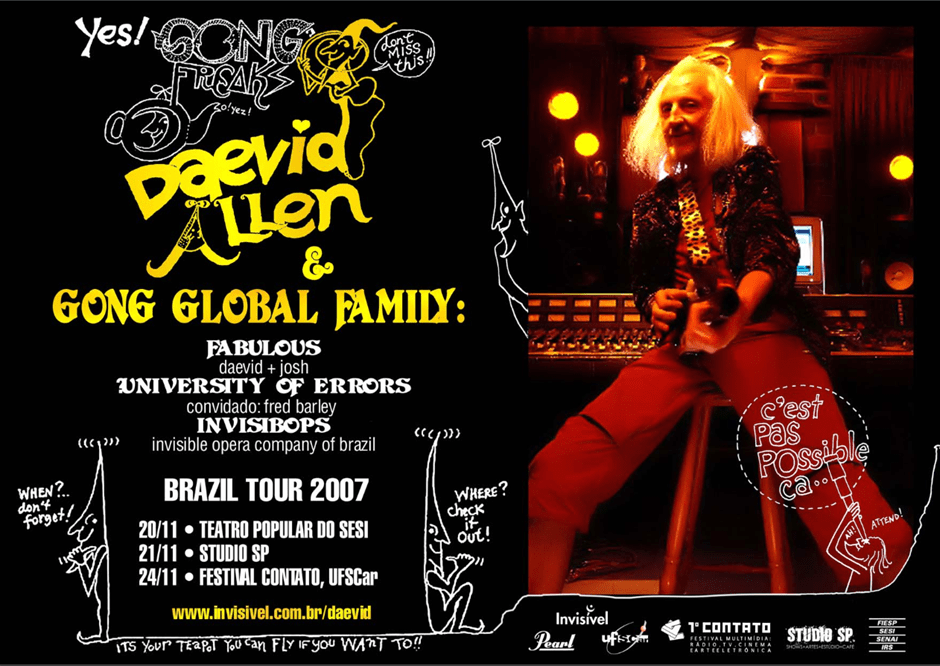
I had a very good relationship with Daevid, sometimes he was like a father for me, very protective in some ways. In 2007 I was in contact with my friends from Invisible Opera and one of them. Gabriel Costa, told me about a big festival 3 hours from Sao Paulo, the Festival Contato at the University of Sao Carlos and one of the promoters, Mauricio Martucci asked me if Daevid could come. They wanted to ask Daevid to play and asked if I could provide a support band for him to play what he wanted. So I asked Daevid, ‘do you want to come, I can arrange the musicians from Invisible Opera to play here’ and he said yes, but he wanted to bring someone, possibly because he was a bit insecure to play things by himself, so he decided to bring Josh Pollock who he was playing with at the time with the University of Errors. Michael Clare (the University of Errors bass player) also came by himself, not to play, but as he was here, we did a gig with the University of Errors playing before us with Fred (Barley) on drums, our drummer.
So it was the first time we played as Gong. Daevid said, let’s call this Gong Global Family. There was no Gong (band) at the time. We recorded the gig and Daevid loved that album, I gave that album to Rob Ayling to release (Gong Global Family – Live in Brazil, 2007, Voiceprint)
So in 2007 we spent a week together. Daevid was a very soft person, very interesting. The first I had met him in 1992 he was 50, so he wasn’t very young. Maybe when he was very young he was more punchy, but at that time after doing this meditation, this rebirthing, this kind of new age, maybe it changed him a bit.
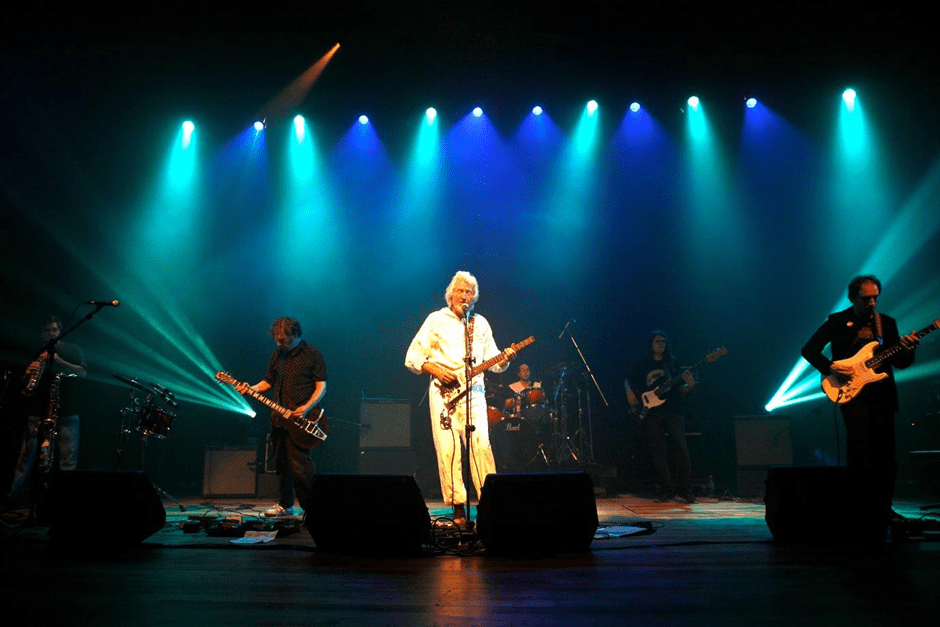
But now 5 years (sic) after he’s gone – it’s like some (of his impact is) disappearing. Nobody talks much about him. In our bubble sometimes we mention Daevid Allen but it’s something that passed so fast. I think in history you have some remarkable personalities of people who stay alive, in books or whatever… I think Daevid Allen was so important …
Fabio’s collaborations with Daevid would culminate in him joining Gong in 2012, which will be covered in the final section of these interviews. In the part 4 of the interview, however, Fabio talks more about his love affair with the glissando guitar…
Part Four – The Glissando Guitar
The music of the Invisible Opera Company of Tibet (Tropical Version) is available at https://fabiogolfetti.bandcamp.com/
For other interviews in the Canterbury 2.0 series, please click here
 The Canterbury scene(zine) continued....
5 thoughts on “Canterbury 2.3 – Fabio Golfetti interview Part 3– The Invisible Opera Company of Tibet and the Daevid Allen connection”