
Part Three – Invisible Opera Company of Tibet
Fans of Gong since 2012 will have become accustomed to seeing guitarist Fabio Golfetti standing stage right with the band, frequently adding texture to the band’s sound through his use of glissando, an open string guitar sound generated by the use of a metallic object sawing across one or more strings of the guitar against a range of amplified effects. The technique is considered to have been pioneered (or at the very least radically advanced) by Daevid Allen and has been adopted by a number of guitarists both within and outside the Gong family. This section of Facelift’s interview with Fabio looks at his ongoing love affair with glissando guitar.
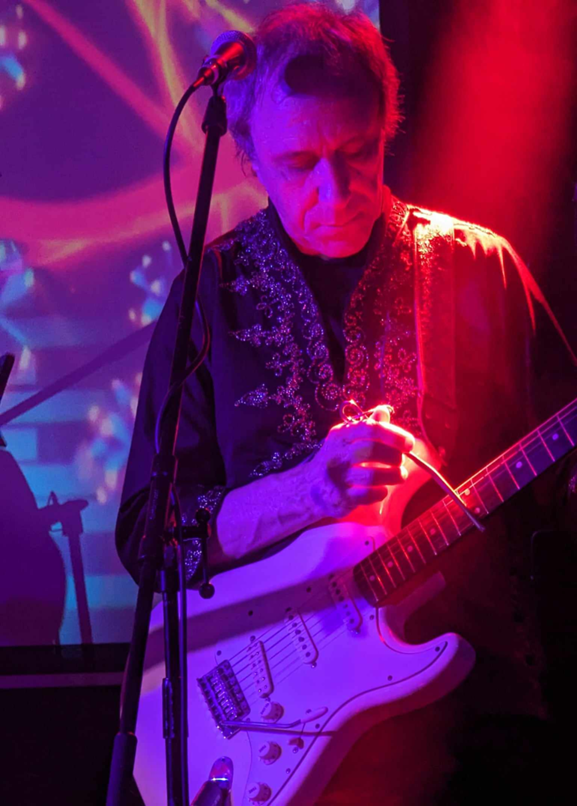
Fabio explains his fascination with the technique:
When I discovered Gong, I always looked at the album credits and said, what does this mean, ‘glissando’? And I couldn’t understand the sound. On ‘Angels Egg’, the sound that was in ‘Inner Temple’, it is amazing.
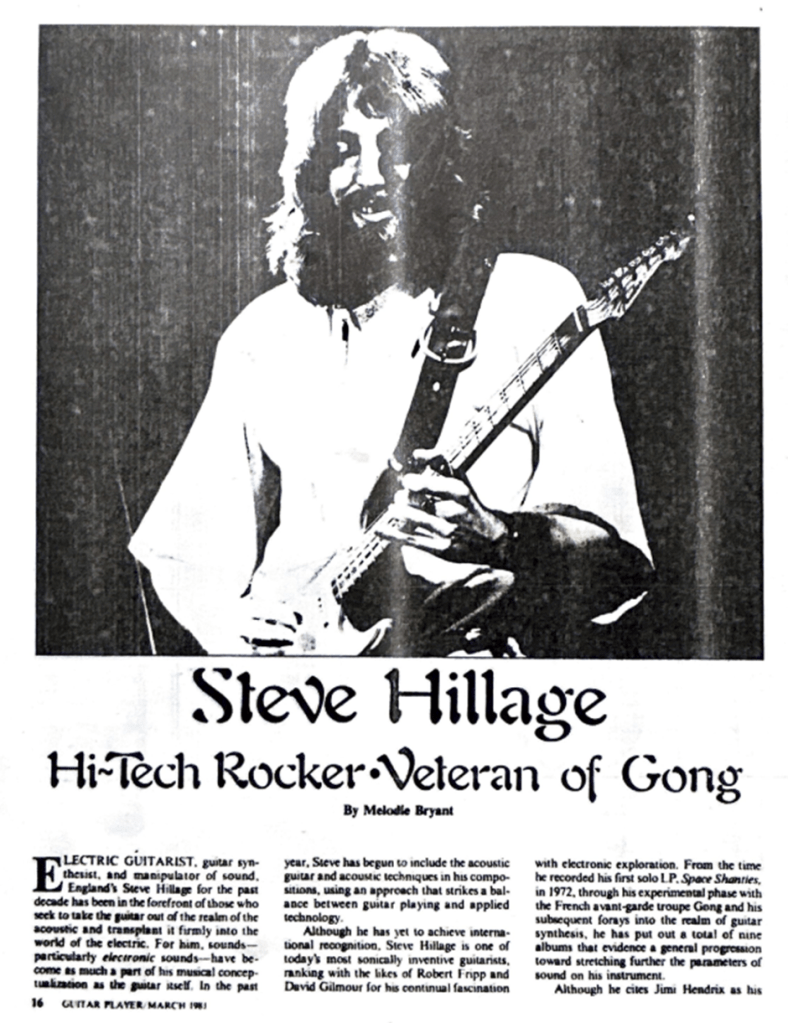
So I listened to this glissando guitar. Glissando is an Italian word, or at least Latin. I know that it means when you go from one note to another without a gap, you pass through all frequencies from one note to another. The master of glissando was Gyorgi Ligetti. You know, the soundtrack from ‘2001 Space Odyssey’, the track that has a vocal was one of his compositions although he wasn’t the composer for the film. Also there’s a famous composition called ‘Atmospheres’ by the name of the character who went to Jupiter, I forget his first name. This was also by him. Gyorgi is a Romanian name, Ligeti sounds Italian. And he was one of the inventors of this glissandi, he also composed a piece actually called ‘Glissandi’. I like the word. In 1981, I got a magazine called Guitar Player, there was an interview with Steve Hillage, and there was a picture of Steve holding something and it was the first time I saw a picture that could give me a hint. I still have this interview as a photocopy.
Stevie describes how he does the glissando, how he uses the metal bar. He doesn’t describe the equipment exactly but he mentions the harmoniser, the digital accessory that was very popular at the time to create harmony with the notes but it was more interesting, it has more capability – and he mentioned that he used the harmoniser and the echo and it sounds like a ‘choir of angels’. When I had the pedals, I took a screwdriver that I had at home and tried to do this and discovered that it worked, how it sounded and then I understood the sound behind ‘Inner Temple’.
When you play the violin you play notes and then you gliss from one to other. Glissando is similar to a slide guitar but played with the right hand. I started using a screwdriver but you can start with any metal bar just to see the sound and then you can find your own. You have to damp the strings – sometimes you can stroke the string but you must be careful not to break the strings. I will give another hint: if you have a screwdriver it’s straight but if it’s lightly bent it’s easier because if it’s straight you press too many strings at once.
On ‘Fohat Digs Holes In Space’ (from ‘Camembert Electrique’) you can hear the gliss guitar when Daevid moves (the metallic object), but ‘Inner Temple’ is different, it sounds like a keyboard or Mellotron, but then I understood that on ‘Camembert’ it was more rough, it is very well recorded, but it is also more distorted.
So I discovered the glissando and alleluia, I started exploring this. The glissando sound was dark in the beginning with Gong because Daevid played with the Telecaster, which is a very noisy guitar and when you play the high strings they don’t have much volume and when you play the lower strings it is much more dark. This is why in my version of ‘Tomorrow Never Knows’ (which launched Violeta de Outono) I only played low strings, also with my Tele. When Daevid had a Gibson Les Paul he improved his technique, certainly from ‘Flying Teapot’ or ‘Angel’s Egg’.
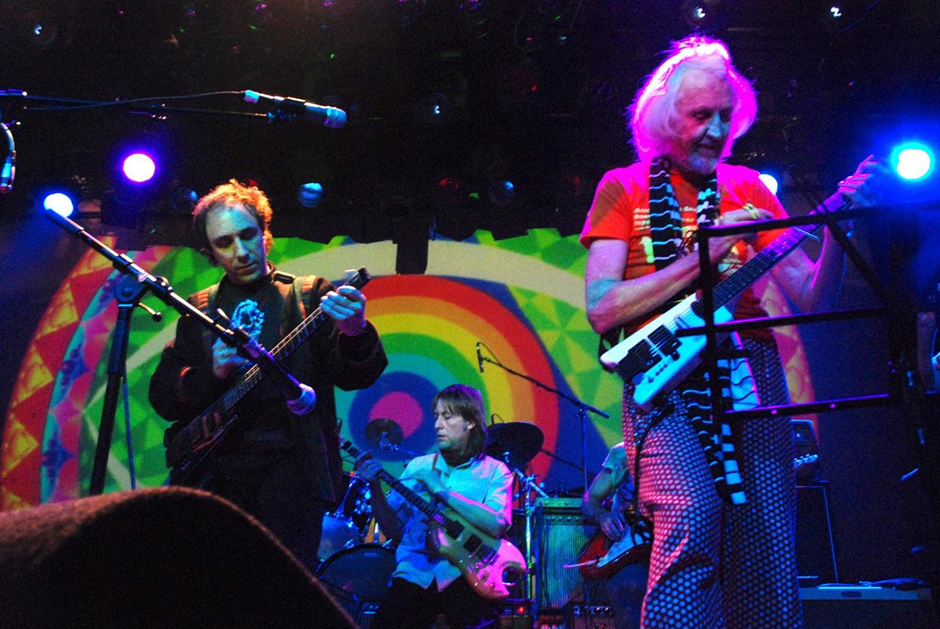
The first thing I remember Daevid mentioning about the Invisible Opera happening, he mentioned a café cellar in Paris in 1968. I met Francis Linon (the ‘Switch Doctor’ credited on many Gong albums), a couple of times with Magma. And he said ‘oh, I invented the glissando!’ He said, ‘I put an echo on Daevid’s guitar and Gilli’s voice so instantly it became the space whisper and the glissando’ and so he is part of this combination in 1968 when they played La Vielle Grille – there is a video. So possibly Francis was part of the story too.
But are you aware of ‘Bananamoon’ – a bootleg that was released in France with unreleased pieces of his previous band- there is a rehearsal of (them) playing ‘Why are we sleeping’ and Daevid playing without an echo. You can hear a raw glissando. It is a very bad recording. But he said he saw that Syd Barrett did this exploration and then he found the gynaecological instruments that he saw in a friend’s house.
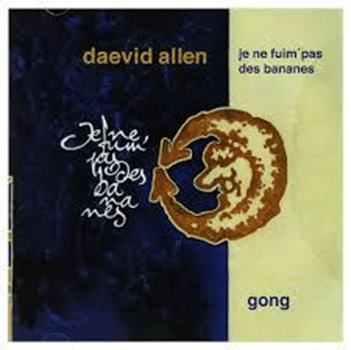
But I think that maybe this act that was in Paris in 1968, maybe was the birth of the glissando which they called the Atlantean voices of Gilli, and Daevid doing this glissando. But also they finished their career on ‘I See You’ with this track, they did this recording they called ‘Shakti Yoni and Dingo Virgin’ because this is the seed of this music, and it is really interesting because it is contemporary, avant garde, improvising, very unique – I think they invented something.
So I started with my own glissando, and then I improved the glissando with my own research and I started to discover how to improve the sound, and I am very into technology, pedals, so I went deep into this. Sometimes when I go to sleep, one of my exercises is to think about sounds in my mind, pedals and effects! So I played glissando with Violeta right from the start with ‘Tomorrow Never Knows’, but I had a band in my university years called Lux too – I have a recording of this and you will hear a lot of Gong in it.
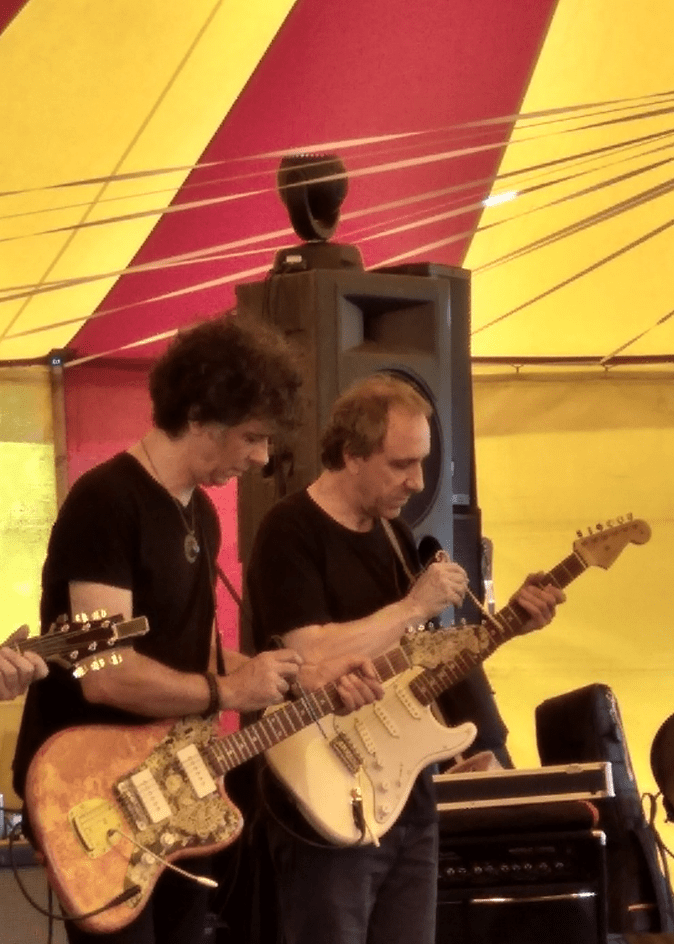
In Part three we talked about how Fabio became involved in the first performance of the Glissando Guitar Orchestra at the Gong Unconvention in Amsterdam in November 2006. It should be noted that this project has continued ever since, and makes an annual appearance opening proceedings on Sunday mornings at Kozfest. a small festival in Devon. The orchestra has a flexible line-up and in 2021 included both Fabio and Kavus Torabi as both were on site with Gong headlining the Daevid Allen stage the previous night.
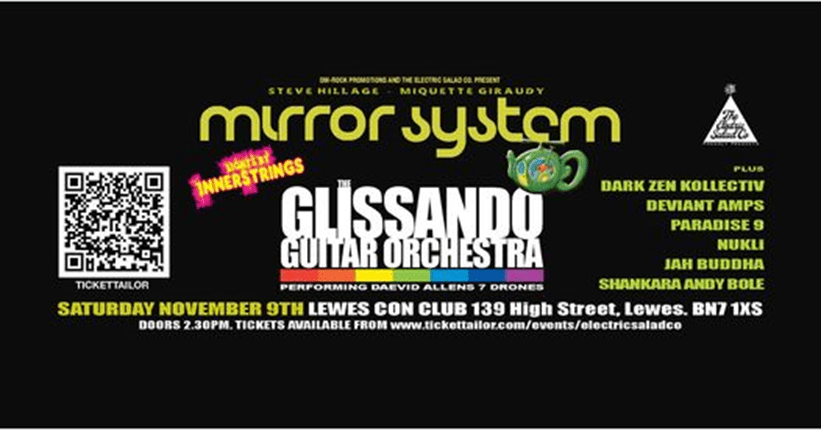
The Glissando Guitar Orchestra will play Lewes on 9 November 2024 on a bill which also contains Steve Hillage’s ‘Mirror System’, as well as performances from Dark Zen Kollectiv, Nukli, Jah Buddha, Bob Hedger and Deviant Amps, all of whom all provide members for the current Orchestra line-up.
Fabio’s glissando playing has been embedded in his playing throughout all of his projects over the last 40 years. In Part 5, the last section of this interview, we will look at how he came to be involved with Gong in 2012 and how the band has progressed since that time.
For other interviews in the Canterbury 2.0 series, please click here
 The Canterbury scene(zine) continued....
6 thoughts on “Canterbury 2.3 – Fabio Golfetti interview Part 4– the glissando guitar”