

Half a dozen or so years ago, the excellent Canterbury Soundwaves/Canterbury sans Frontieres podcast, hosted by the equally excellent Professor Raphael Appleblossom aka author Matt Watkins, had a habit of intersplicing Canterbury-influenced music in between the more recognisable Canterbury fare such as Soft Machine, Hatfield and the North and Gong. Nestled within one of the episodes was a track from ‘Second Split’ by a band called Amoeba Split which, for all its Spanish geographical origins, seemed instantly appropriate to place within the broader Canterbury genre. It was the first music I’d heard by the band, and I was instantly impressed.
Somewhat further down the line, with a very fine third album ‘Quiet Euphoria’ recently under their belts, as well as a series of gigs and a limited edition single with Richard Sinclair also just released, there appears to be no better time to speak to the band, or more particularly their bass player and bandleader Alberto Villarroya, from his base in A Coruña. Before getting into the minutae of the band’s history and Alberto’s own musical influences we had to talk about that collaboration with Richard.
Alberto Villarroya: Richard is the voice par excellence of Canterbury, one of a kind and also a great bass player. He has the honour not only of having been with Robert Wyatt in the group that originated the style, The Wilde Flowers, but also of having played in almost all its great bands (Caravan, Hatfield and the North and Camel). He’s said in many interviews that he regards himself as an ‘entertainer’, but the truth is that he is a true icon, a benchmark for electric bass and certainly currently the last active legend of Canterbury.
Our Richard Sinclair collaboration was born from a beautiful combination of chance and good luck. Richard is quite active on social media, and in mid-2023 we contacted him just to tell him that we were passionate about his work. He suggested we start a conversation via video conference, and when he asked us what we were working on, we told him that we were preparing our fourth studio album. At that time we told him that it would be a dream if he could participate in the recording, to which he happily agreed. So, we recorded two of our own songs in our studio in A Coruña and Richard added vocals and guitar from his studio in Martina Franca in Italy.
These two tracks, titled “Almost Cloudless” and “Bread for Today”, are the ones we released in September 2024 on a 45 rpm vinyl single, available on Bandcamp (https:// amoebasplit.bandcamp.com/album/almost-cloudless-bread-for-today-richard-sinclairsingle).
But the collaboration didn’t end there, as the option of doing a short tour in April 2024 in the north of Spain came up. Once again Richard agreed to play with us, and the concerts were a resounding success, with a full house at every venue we went to perform. The audience couldn’t believe they were seeing Richard in person, and many people even wondered if it was true that he was playing in Spain after 20 years without returning to these shores. The truth is that they were really emotional concerts in which we alternated songs from Amoeba Split with songs from his time with Caravan and Hatfield & The North. And in the process we were able to record the concerts in full in audio and video for a possible future recording in case anyone is interested in releasing them one day.
At the moment the idea is to continue collaborating with Richard for as long as we can, of course in the studio, but above all, if possible performing with him live. Everything will depend on whether some promoter or concert organiser is willing to organise a tour, either in Spain or in the rest of Europe: it would be great because we have already seen that it is very worthwhile and that the response from the public is frankly enthusiastic. If there is any promoter interested, you can write to us at amoebasplit@hotmail.com and we will be happy to help you!
Amoeba Split as a band dates from late 2001 and are based in A Coruña, a coastal town in the northwest of the autonomous province of Galicia in Spain. I asked Alberto a few more details about the band’s origins and how they have developed over time.
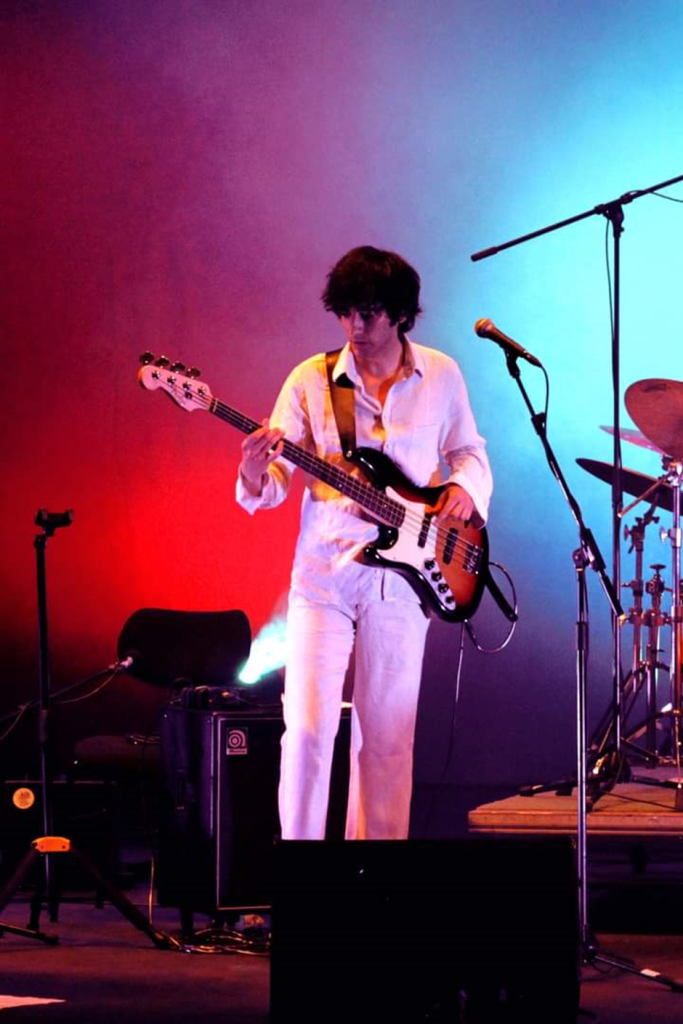
Our influences began mainly with British bands from the 70s, such as King Crimson, Soft Machine or Caravan, although we have always focused on a musical context within progressive jazz-rock. It was with the passage of time that various experts considered us to be a “Canterbury Sound” band, a label that is more or less appropriate, although not entirely accurate. At the beginning, the core of Amoeba Split was Ricardo Castro on keyboards, Fernando Lamas on drums and myself on electric bass and guitars. When we recorded our first album, “Dance of the Goodbyes”, the group was complemented by the inclusion of Pablo Añón on saxophone and María Toro on flute and vocals.
The band recorded a self-produced demo in February 2003 which is available at https://amoebasplit.bandcamp.com/album/demo-2003 However it was not until 2010 that their debut album “Dance of the Goodbyes” (which included reworked versions of the demo’s three tracks) eventually appeared. An initial impression from both releases is that the band are a worthy successor to prog/folk bands of the late 1960s: Catapilla spring to mind, as does some of the work of Julie Tippetts, thanks to Toro’s vocals. And yet even at this stage there are tell-tale signs of a Canterbury influence: “Turbulent Matrix” has Jimmy Hastings-like flute and a bossa nova finale; “Blessed Water” incorporates fuzz bass, “Qwerty” manages to be almost throwaway in its brevity but recalls the intricate scoring of Phil Miller’s “Underdub”. Plus the band incorporate a track named “Dedicated To Us, But We Weren’t Listening”.
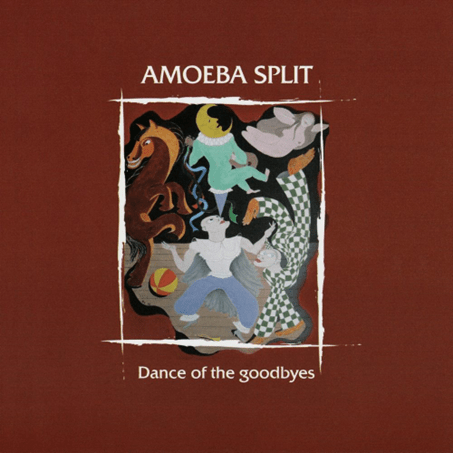
“Dance of the Goodbyes” is the work that probably covered the greatest variety of styles. There are compositions like “Blessed Water” or “Perfumed Garden” that are very close to Italian symphonic rock, but at the same time the album also includes tracks like “Turbulent matrix”, “Qwerty” or “Dedicated to Us, But we weren’t Listening” that are almost jazz-rock songs.
That last track title came about from a running joke we had during rehearsals for the album about the Matching Mole songs “Dedicated to Hugh, but you weren’t listening” and the Soft Machine song “Dedicated to you but you weren’t listening”. Although musically it doesn’t sound like either of them, we thought it was a fun title to start the album with. In the case of “Flight to Nowhere”, the 24-minute closing track on the album, we set out to build an old-fashioned suite, with numerous sections, rhythm changes and different tonalities, and that’s why in the end it ended up being essentially a classic symphonic-prog rock song.
But it’s the only album that has vocal tracks, with a female voice that reminded some people of Annette Peacock, which makes it a rarity in our discography. Even today “Dance of the Goodbyes” is our most valued and remembered album for the fans of the group. It is curious that this album has already been reissued on five occasions, the last one in 2023 on double CD, with the original album remastered and the 2003 demo released officially for the first time (https://amoebasplit.bandcamp.com/album/dance-of-the-goodbyes)
“Dance of the Goodbyes” was very well received by critics and the public and was nominated by the Italian website Progawards as “Best progressive rock debut album of 2010”. After this, in 2011 we participated in the prestigious “Finisterrae Prog Festival”, performing alongside celebrities such as Al Di Meola, Neal Morse and Jan Akkerman.
In 2013/4, the band recorded “Second Split”. The music was by now entirely instrumental, much more varied, less meandering, and very carefully constructed with a myriad of different ideas to draw on. The sound appears to be much organic in terms of its instruments used (trumpet, sax and flute are within the core sound whilst ‘Those Fading Hours’ memorably incorporates violin against a keyboard motif and dreamy atmosphere that wouldn’t have been out of place on Soft Machine’s “Third”). There’s an even more overt Canterbury reference in the title of the 5th track, “Backwards All the Time”.
By “Second Split”, María Toro was no longer with the group, but we added Dubi Baamonde on flute and saxophone and Rubén Salvador on trumpet and flugelhorn. This gave us more possibilities on a sound level and much more body and weight to the group.
“Second Split,” (eventually released in June 2016 by the Mexican label Azafrán Media) resembles much more the typical jazz-rock of groups like Nucleus or the Soft Machine septet (from the “Third” era), since we included a complete horn section (tenor sax, alto sax, trumpet and flute). Some critics also found references in this album to Chicago or Blood, Sweat and Tears, which I totally agree with, since they are bands that I love. All the compositions are measured to the millimeter, as well as the arrangements, but curiously I think that a freedom and a fluidity prevails nonetheless, which greatly benefits the final result. The album is also full of different harmonies and rhythm changes, with many ideas, and it is so melodic that almost all the songs are singable, even the solos of the respective instruments can be hummed!
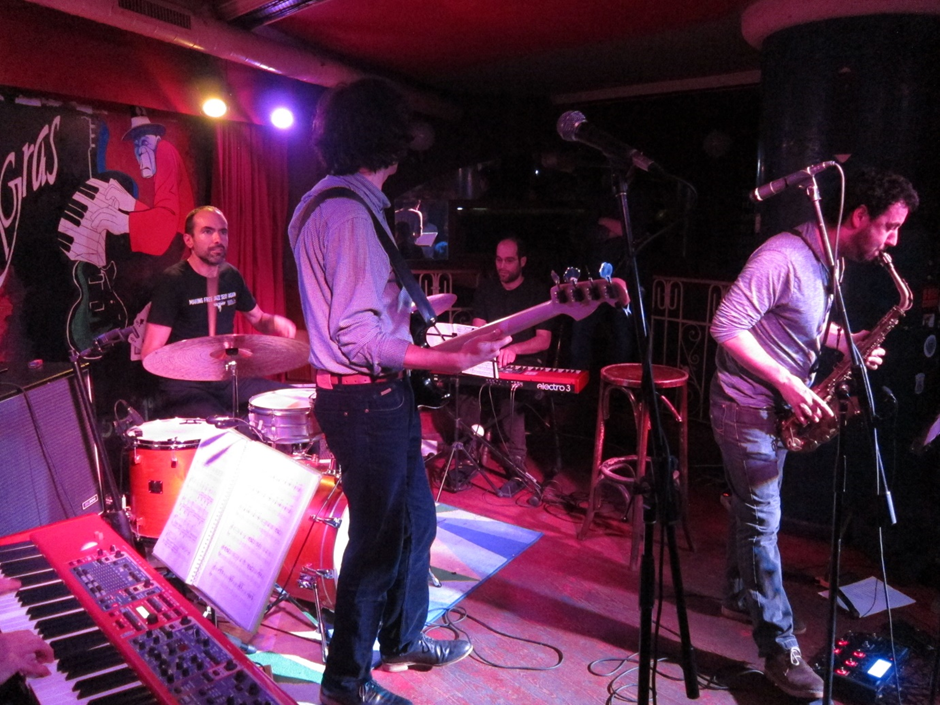
From left to right: Iago Mouriño (-hiding- keys), Fernando Lamas (drums), Alberto Villarroya (bass), Ricardo Castro (keys) and Pablo Añón (sax).
There are many songs with different atmospheres. For example, “Clockwise”, which opens the album, has three small parts linked together, and the same goes for “About life memories and yesteryears”. Something I want to highlight about this album is that there are some songs that are not very “expected” in relation to the ones mentioned above, such as “Book of Days” (recorded with a string quartet) or “Those Fading Hours”, a song that hovers in a very suggestive way and ends unexpectedly. In short, in my opinion “Second Split” is a very complete album, almost without flaws, and without a doubt it is a significant step forward with respect to “Dance of the Goodbyes”.
After the release of “Second Split” we returned to the stage to perform the album live.

“Quiet Euphoria” was recorded in 2021 and released on the AMarxe label in 2023. For me, it is the crowning glory (to date at least) of the band’s output – the scope of the band appears to be widening even further with an apparent desire to incorporate additional instruments to add to their expanding vision, whether it be the vibraphone of Israel Arranz, or in particular the incursions of Hammond organs. I’m reminded so much of vintage era Soft Machine from 68-71, whether it’s a hint of “Esther’s Nose Job” (from the keyboard motif underpinned by fuzz bass on “Inner Driving Force”); the “Virtually”-like suspension of ‘No Time For Lullabies’; or the contrast between bass, flute and bass clarinet a la “Kings and Queens” on “Thrown to the Lions”.
For “Quiet Euphoria”, Iago Mouriño joined us on Hammond and mini-moog, a phenomenal musician who is contributing a lot to the band.
I think “Quiet Euphoria” is perhaps the most mature and balanced of our three studio albums, possibly because it was written and recorded in a short period of time. It has a drive and determination that can only be achieved by a very cohesive band performing live. “Quiet Euphoria” takes up some aspects of “Second Split”, but finds new paths that we hadn’t taken before. For example, the title track is indebted to the ambient fuzz bass sound used in Soft Machine’s “Fifth”, but adding vibraphone, a wind section and a frankly inspired drum kit. “Inner Driving Force” is a song with a great exchange of solos between Hammond and trumpet, very similar to what we usually do live. I think that here we captured in the studio part of the crazy energy that we reach in our concerts. In general, all the songs are of very high quality, and also the mixing and editing done by our technician Ezequiel Orol is superb. As a composition, I would highlight “Shaping Shadows” for the constant changes in harmony and rhythm that we make, all in a very fluid way, as well as “Thrown to the Lions”, perhaps the most Canterbury-like song on the album because it includes Elton Dean-type solos and flute passages reminiscent of Jimmy Hastings, highlighted by bass clarinet. That said, I personally prefer the last song, “No Time for Lullabies”, because it is the most risky thing we have ever done in the studio. It is a guided improvisation that draws at times from elements of contemporary music, free jazz and electronic music: it is truly avant-garde and is a precursor to the next album we will release.

Alberto gave me his thoughts on a number of wider musical subjects, some of the discussion on which will appear at a later date in an academic paper, but I thought it was worth passing on a little of Alberto’s own musical background, as well as the context of Amoeba Split within a Spanish, European and wider international musical context, particularly in relation to ‘Canterbury’ music.
I am 48 years old and I have no formal musical training: my academic musical studies on harmony, melody or composition are non-existent; that is, I have no knowledge of music theory. I base everything on my instinct about what I consider most appropriate for each part or section of the song, and I do not have any specific methodology beyond trial and error. I do not think I will ever study music theory, since it might condition me or restrict the final result, but perhaps I am wrong; in any case, at the moment the tools I have for what I intend to do are sufficient. I consider myself to have a good ear and generally my first ideas are the ones that come out on top: if I try to arrange a fragment or a melody too much, the result is usually negative. In my case, my intuition about what is effective or not at any given moment works quite well. If a theme is too difficult for me, which is not usually the case, I abandon it and start a new composition.
Regardless of the group or albums that influence me, I have always focused on complete works rather than their parts, individual themes or specific instruments, which has given me a very broad vision to approach the composition of a work musical as a whole. In any case, not having had any musical training, all these influences, rather than serving me on a theoretical level, have served to influence me on an aesthetic level: the role played by the instruments, the charm of analogue sound and, above all, honesty in the artistic approach. This last point is key for me: that the final musical work that an artist conveys is not contrived or artificial. That is why Amoeba Split’s albums are above all honest, they may have their own virtues and limitations, but in the end they are authentic.
Specific influences on the music of Alberto and Amoeba Split will be apparent: Alberto elaborated on the development of his listening in teenage years from various types of rock music through to progressive music, identifying Jethro Tull, King Crimson and Zappa as having particular impact, whilst also recounting a story familiar to all Canterbury fans of discovering different bands within the genre by making connections between its different strands. In Alberto’s case this happened initially with the first two Soft Machine albums; the Virgin sampler album “V”; Caravan; then from Khan to Hillage to Gong; from Egg to Hatfield to National Health. Of course, in Spain this exploration was far from straightforward.
It was complicated since digital music distribution did not exist at the time (in the mid-90s) and access to this type of albums in Spain was frankly complicated.
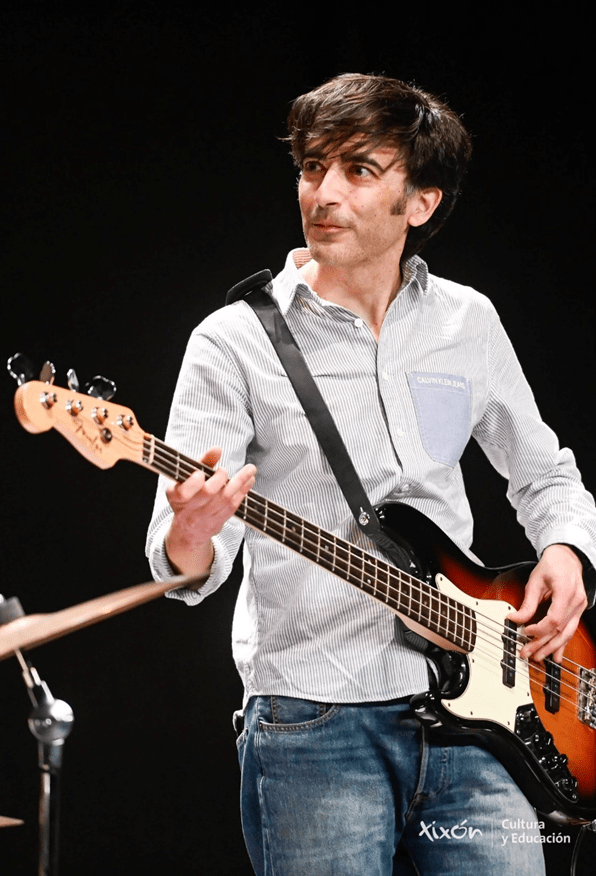
In Spain there is no coverage of any kind of minimally innovative music. Some music journalists do acknowledge progressive rock as a style from times past that had a certain impact in the 70s, but these references are completely anecdotal. We must not forget that progressive rock arrived in Spain late in the late 70s with groups such as Triana, Crack, Iceberg, Imán or Fusioon, and that after a short period of time they ceased to exist, many of them recording only a couple of albums at most.
Although our musical influences are very varied, it is evident that the Canterbury scene has had a lot to do with Amoeba Split’s musical approach, and of course we do not hide its influence. (But more generally) historically Canterbury has not had any impact on Spanish bands, perhaps because the very special and differentiating approach of this music has not been understood, or perhaps because it has not been internalised or adequately adapted to the idiosyncrasy of our country.
The only reference I can think of is the now defunct group Planeta Imaginario, but the truth is that there has never been any tradition of this sound in Spain, neither in the past nor today. Amoeba Split are of course completely unknown, and even in our own city we receive very little support. We don’t seem to exist even after a career of more than 20 years despite the impact we have had outside our borders. It’s sad, but I suppose the same thing happens to the rest of the bands in the genre for playing a type of music that is not very popular or directly anti-commercial.
It is curious that Bandcamp Daily has recently confirmed that there is a new movement called “Neo-Canterbury”, which suggests that there is in fact a Canterbury movement beyond England, although I think it’s a journalistic label to categorise a series of British bands rather than a musical movement consolidated worldwide. Nevertheless I’m proud to be labelled with such bands, and it’s a joy to see that the style is alive and has many followers.

From left to right: Iago Mouriño (keys), Richard Sinclair (bass), Fernando Lamas (drums), Alberto Villarroya (guitar), Pablo Añón (sax), Dubi Baamonde (flute) and Ricardo Castro (keys).
Photo: Pablo Roces Albalá
Aside from the plans to continue collaborations with Richard Sinclair, I asked Alberto what those future plans would involve.
Among our most immediate plans are to finish our fourth studio album as soon as possible, but before I would like to mention our what will actually be our next album, which we will release on vinyl only, called “Todos los Animales son Iguales”. It is a completely free improvisation based on George Orwell’s book “Animal Farm” for which we did not do any prior rehearsals, beyond indicating thematic segments and brief melodic lines. What makes this album unique is that it was recorded entirely live in a small jazz room in A Coruña and has no editing or subsequent arrangements. It was almost a miracle that the recording turned out so well because of how risky the idea was. We are very proud of the result and I would almost say that it is our best album to date. We hope that the public will too!

Photo: Nacho Baamonde
To finish, for those who are interested in following us, I recommend consulting our website http://www.amoebasplit.com, available in both Spanish and English, where we periodically announce all the news about concerts, new albums and other information about Amoeba Split. Although several of our works are out of print, you can still get the rest of our albums at the group’s official Amoeba Split Discogs address, in order to directly support the band.

https://amoebasplit.bandcamp.com/
https://amoebasplit.bandcamp.com/album/almost-cloudless-bread-for-today-richard-sinclair-single
https://amarxe.bandcamp.com/album/quiet-euphoria
For other interviews in the Canterbury 2.0 series, please click here
 The Canterbury scene(zine) continued....
4 thoughts on “Canterbury 2.4 – Amoeba Split – an interview with Alberto Villarroya”