
Of all the artists interviewed for the ‘Canterbury 2.0’ series, Zopp are the probably the only ones who have apparently appeared from nowhere, made an instant impression based on impeccable and clearly recognisable musical credentials (Egg, Khan, Hatfield and the North and National Health are all clear reference points), and are now starting to bring their wares to a wider audience in the progressive music field.
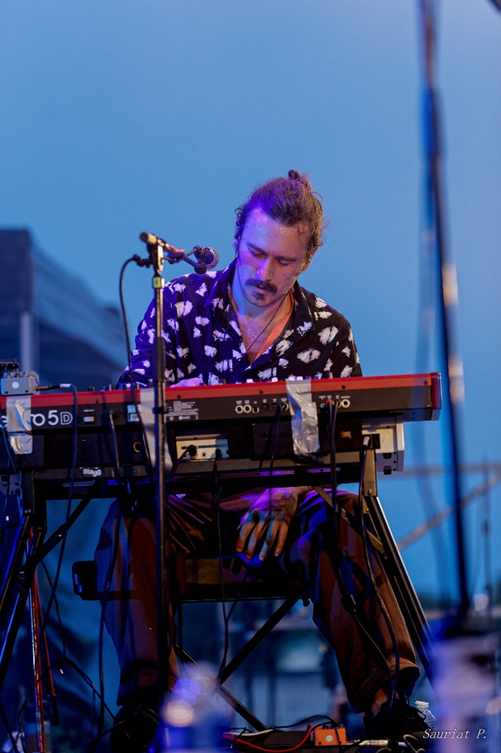
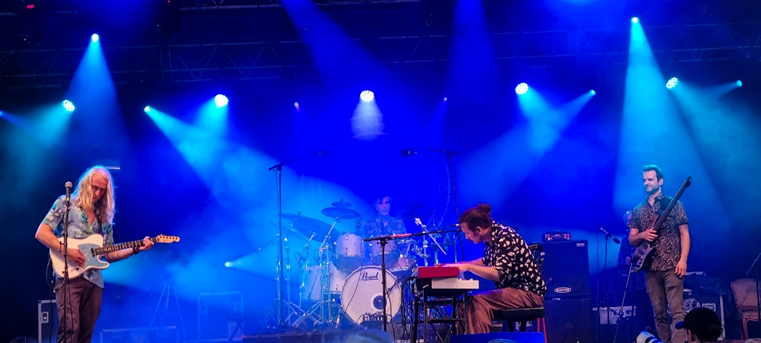
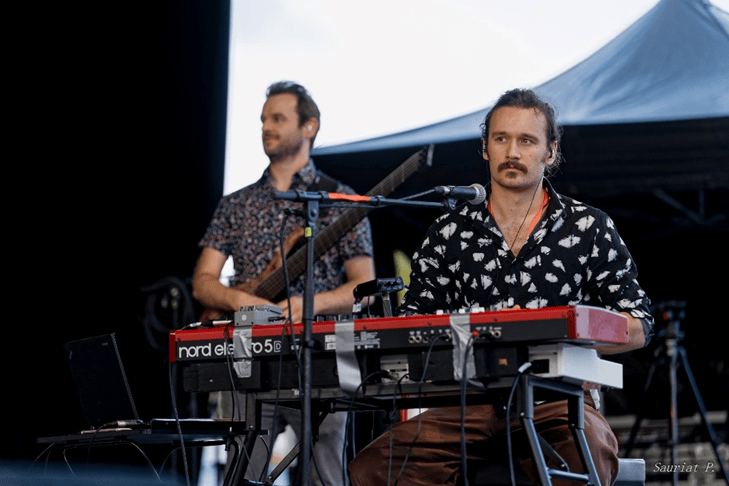
Zopp is the ongoing project of one Ryan Stevenson, a 33 year old from Nottingham, a multi-instrumentalist who has provided practically all the components bar drums on their two studio albums to date, but is also masterminding an inspired transition to live performances with his very conducive band. Since the considerable impact of Zopp’s first album in 2020, I’ve kept in touch with Ryan on a regular basis, as well as witnessing his band’s first gig in Nottingham in November 2023, and its most recent gig, arguably its finest hour, at the Crescendo Festival in France in August 2024, where we spoke at length informally the day after. This piece takes information from all those sources, as well as a 2 hour interview over Zoom earlier this month…
Ryan is a compelling character: his command of a range of instruments and production techniques is matched by a thorough approach towards the challenges of getting his music out to its growing audience in a changing musical landscape. He refutes the term perfectionist, but meticulous he certainly is. He acknowledges the introverted nature required to spend the requisite number of hours putting together albums of such musical and sonic complexity as Zopp’s first two releases. And yet he exudes a natural self-confidence and managed an easy rapport with the crowd at Crescendo (where he made a virtue of his lack of native French). This belied his somewhat mysterious presence on stage, where, side on to his audience, he often appeared to be inexorably navigating his band smoothly through new waters.
As will be revealed within the interview, Ryan acknowledges and even courts Canterbury comparisons, but provides compelling evidence that this should neither define or limit the band’s ongoing appeal and development.
I firstly asked Ryan about his own musical upbringing and influences.
Ryan Stevenson: In terms of playing music really I’m completely self-taught, I’ve never been to a music class, never studied music. I still am a bit of an autodidact, completely self-taught. Music appeared in my life when I was maybe 13 or 14 . ‘Sound of Muzak’ by Porcupine Tree was one of those watershed moments – I really resonated with that. I remember the exact moment my dad played it for me. He was into a lot of progressive rock stuff and the Canterbury scene too. My dad had them all, he still has them, Hatfield and the North records – he wasn’t a Caravan fan – but he was really into National Health and I heard some stuff from Egg and I loved it.
I got into wanting to make music. Something I think changed in the psyche or makeup. Previously I was into sport, I played cricket a lot and stuff like that, and then music came along and it became a very integral part of my identity.
The prog rock thing, I was soaking it up – Prog archives… I was just like ‘what’s Captain Beefheart’? and I remember doing a pastiche of ‘Trout Mask Replica’, recording weird stuff in my bedroom, having a whale of a time. Such a beautiful time in my life, it’s like a kid, a toddler that plays with a plastic candy wrapper and that they’re just engrossed in something that might seem banal, the novelty of the experience, it’s so beautiful.
So how did this manifest itself in terms of actually playing?
My dad had a keyboard, a Yamaha workstation, where he composed music himself. So I get something from my dad, maybe genetically. He’s been a self-taught musician himself too but I’ve taken it to another level. Within maybe a year, maybe within a few months of me listening to Egg I started to play on the keyboard, not knowing anything, (I still don’t know much!) and then same with guitar. If you have a guitar lying around – just you gravitate towards playing it.
I felt very quickly I wanted to make my own music and that’s always stayed with me. I’ve never been a massive consumer of music – I’ve always wanted to contribute my own, just to be creative. Human beings are very creative beings – I wanted to be lost in a sound world, it’s like an advanced form of playing, composing music and I was fortunate that when I was 15 or 16 my dad saw this in me and he bought me a multitrack recorder, a 16 track so I could overdub in my bedroom and record.
It’s an archetype, but I think I’m an archetype of being somebody that’s not necessarily interested in learning an instrument per se, it’s more about ‘how do I make an album?’, and I remember even at school thinking of album titles in my head and track sequences, imaginary things – that’s the archetype of who I am. I just want to make albums – a producer is probably the best word to describe if I’m going to be honest. So I’ve always had that, maybe from 14,15,16, that age, It was very powerful and then with the Zopp stuff, I wrote a lot of that in 2010 (when Ryan was still in his late teens).
I bought a bass guitar off a guy at College, again 16, 17 years old and had keyboards at home and a guitar and I’d just be overdubbing and making music, and some of the early stuff was very Canterbury-like. My dad had a fuzz organ, like a distorted organ sound and one of the first things I made was this Egg pastiche, which I still remember in my head actually. It’s never ended up on a record, compositionally it was a bit boring maybe, but I think it’s in you, something clicks at an age and you just want to make music and that’s my archetype I think…
When I studied at college I took some music technology classes and then an A level in it, and I got used to using Protools so I’m a modern musician in that sense.
I asked Ryan what it was about Egg in particular that struck him at that tender age, as well as an ongoing admiration for the work of Mont Campbell, whose writing re-emerged in possibly even more uncompromising fashion later within National Health. It seems particularly remarkable, given that he does not read music, that Ryan should be drawn towards, and eventually emulate through his own complex pieces, the music of the most compositionally complex of the Canterbury genre’s musicians.
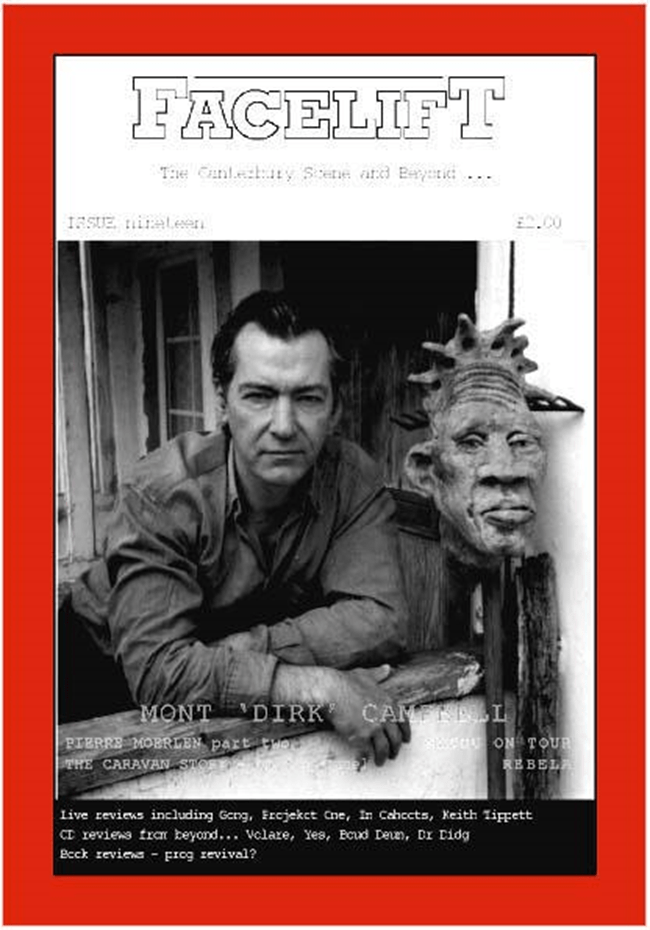
He’s a genius, an underrated genius and it’s just the way it is, isn’t it, those people that make genius compositions never get the deserved praise. I did reach out to Mont Campbell to get him to play on ‘Dominion’ but he told me that he had sold his French horns in 1975!
I don’t read music. I think I’m lazy in that sense but also I don’t need to. Obviously with a band, starting the Zopp band, I’ve had to communicate ideas to people. Andrea who drums in Zopp, he can read music, he’s taught formally but no I can’t read music, but those guys did didn’t they? Mont Campbell obviously studied the French horn, Dave Stewart (read music) and that probably allowed them to compose music to a high level of complexity. But for me being in the 21st Century I have the luxury of using a computer to overdub ideas conveniently, so the studio is almost like an instrument in a sense.
For me music is abstract, and it’s getting the ideas down from here (my head) into the material world, so the quickest way of doing that is using technology for me. If you think about it, midi is a form of musical notation in a way, you’re notating the notes on a grid, with a keyboard on the side, so in a sense like in the old days you could write on the staff and write notes but you couldn’t actually hear it unless you got musicians to play it. I can hear the notes in real time by doing that and that was an interesting exercise, but if I’m not using midi it’s a case of layering 10 seconds of a riff down, say something like ‘Before the Llight’ (sings intro) and then add more to it and then it incrementally ends up as a song.
We spoke a bit more about Mont Campbell’s unique compositional work. In our early communications back in 2020 Ryan had introduced the band as a ‘UK Canterbury prog group in the style of Egg and National Health’, and but then expressed surprise that I’d picked up on the track ‘Sanger’ being redolent of the latter band’s extraordinary retrospective album ‘Missing Pieces’, one track in particular…
‘Agrippa’! (from National Health’s ‘Missing Pieces’ retrospective album). Jesus Christ! I don’t know how that hasn’t had the praise, that’s what turns me on musically speaking. I don’t know how long ‘Agrippa’ is, it is maybe it’s seven minutes or something is it? It just seems to flow… In progressive rock they (often) stitch ideas together. I was listening to Stravinsky the other day and he also stitched things together, but there’s this flow with (Mont Campbell’s) compositions and there’s that beauty, that sort of ethereal-like beauty about it and with the complexity and the intelligence behind it and it’s just very tasteful, it’s very hard to put into words. It’s the same with one of the shorter tracks off ‘Missing Pieces’ – it’s got a really strange title ‘Croquette For Electronic Beating Group’.
Zopp’s defining characteristic is complex instrumental-based pieces whose sound is dominated by those Canterburyesque keyboard tones and whose compositions show much of the same complexity. Ryan admitted to being less familiar with the work of Dave Sinclair (with Caravan) but also eulogised about another Canterbury keyboard maestro.
I resonate with Mike Ratledge a lot – I’m not as good as him technically speaking but I resonate highly with his take on the instrument – the speed and the aggression, but from a very civilized Oxbridge approach!
Someone like Steven Wilson would explain, that he might come up with a song and he thinks it’s very unique and somebody goes ‘it sounds like Pink Floyd’! But it’s in your musical DNA somehow. People are just going to keep on saying ‘wow, it sounds just like Mike Ratledge’, it depends if I’d use something different from the fuzz organ sound in the future, but… I love those sounds and there’s not much music that I’m hearing with those sounds done in an organic way today. So that’s why I’m making this; it’s a very pure intention, I want to hear this music because I don’t hear this music today and you know that’s why artists should be making music so that they can hear the stuff in their head.
You don’t do it from an egoic point of view, you do it because you really want to make it for your own entertainment, it’s entertainment for me. You do it for yourself first and then you give it to the world, you make a bit of money off it and if people give you compliments that’s a bonus!
We moved on to specifically talking about some of the music that Zopp have produced in their short recording life. Ryan talked first about the genesis of Zopp as a project
I wrote a lot of Zopp music between 2010 and 2014/5 between the age of 19 and 25ish, and then I just parked it to one side for a while, then basically I fell out with this band – I’d played in bands for a bit. And then there was a moment when I was 27, I was working in marketing, like a pretty decent job and then I thought fuck this, I just really want to make this album, so that’s when I got Andrea on board and I really committed to making the album (which eventually appeared as ‘Zopp’ in 2020) and since then there’s been a lot of learning. When you’re making an album there’s so much learning from even when Andrea got in the room, and the dynamic between me and him and playing the songs through the PA speaker, the demos and ‘oh the song is too fast, we got to slow it down’…. Again it shows that working with people gives you that fresh perspective.
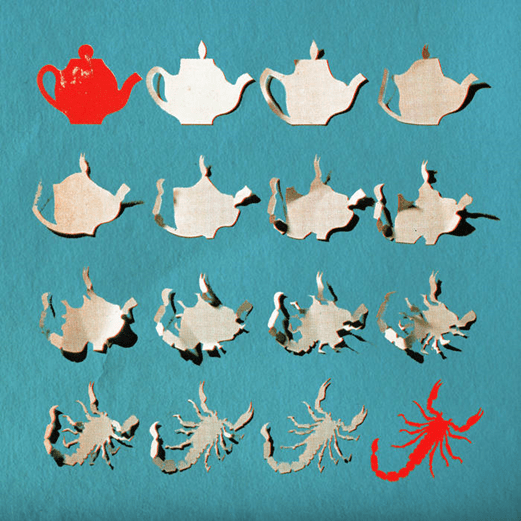
Their first album was entirely instrumental, a startling debut which was described by Facelift thus: ‘‘Zopp’ is almost a lost album in the Egg canon, albeit imbued with a fresh energy without some of that band’s austere and self-consciously classical reference points.’ ‘Whilst Stevenson acknowledges Mont Campbell as a reference point in conversation, and even more obviously so Dave Stewart in sound, there is a lightness of touch more in common with the expanded instrumentation of Hatfield and the North, the comparisons helped by the fact that Stevenson doubles (or triples) on guitar and bass respectively’. Ryan concurs but is keen to acknowledge a wider range of components:
So as I alluded to when talking about National Health’s ‘Missing Pieces’ record, it was this Zappa/Stravinsky/National Health thing – it’s like a Venn Diagram I always resonated with – that sort of crossover, and so basically I wanted to make an album that was in line with that ethos really. So the first album was a distillation of many of those elements, probably more explicitly an ode to the Canterbury thing, and again I’ll admit that. There are really good compositions on there that I’m still really proud of. Sonically – as you’ll probably find with a lot of artists, they want to go back and change things, and are still learning a lot in that, but the first album is really all about the sequence for me, getting a nice musical journey, with different landscapes and musical rooms.
So there’s some darker moments on the first one, but there’s still a lot of the good things about this music, there’s a lot of Easter eggs in there, there’s stuff under the surface- even some rhythmical bits were taken from black metal – like really dark music – so on the surface it’s Canterbury but there’s a lot things from my personality – not just Canterbury . But I suppose it’s chapter one in the music and most of it, 70% of it, was written when I was in my early 20s and late teens.
And that includes ‘Before The Light’, ‘Noble Shirker’, ‘V’. (all three have survived to the band’s current playlist). I think I wrote ‘V’ when I was 22 – that’s a long time ago. ‘Zero’ was an early track and ‘Eternal Return’ and ‘Being And Time’, those two tracks were written during the Zohmm period (this is a reference to the band that Ryan had pre-Zopp, alluded to above, more of which later) – it was this darker music.
So, the Zappa thing, the Canterbury thing, there’s also a band called Jaga Jazzist, a Norwegian band that I was really into, and that inspired a lot of ‘The Noble Shirker’ because they have so many elements in their music, you hear like sequencers, sax, guitars, synths etc. The start of ‘The Noble Shirker’ was inspired by the start of (Soft Machine’s) ‘Out Bloody Rageous’, where I looped a couple of Hohner pianets and me and Andy (Tillison) used some DJ software to manipulate the sound – some weird stereo effect. The end of ‘The Noble Shirker’ does sound a bit like the end of ‘Moon in June’ – but that wasn’t conscious! In your review actually you’re talking about the Soft Machine staccato bit at the end of the noble Shirker, just the organ chord carrying on – that didn’t come from that – but I know what you mean!
We also talked about the brief contribution of current Soft Machinist Theo Travis on the first album.
I was working with (progressive musician) Andy Tillison on the album. Theo is in The Tangent too. Apparently Theo owed Andy a favour so he played flute, he sent the song to Theo, the song ‘V’, which is one of my favourites (described by Facelift at the time thus: ‘Bass sounds wander around underneath keyboards which alternately ripple or fanfare stridently … in search of that perfect countermelody’). I like that song a lot and he played flute on it. Unfortunately I didn’t want the flute to be too loud in the mix so on the song it’s a bit buried really, he wasn’t showcased really . He did some flute loops, you probably hear on the song – I don’t know what technology he was using but manipulating the flute at the end of the song.
Although Ryan met Theo briefly at the time (this would have been in 2019), their paths have not crossed since, although this might be rectified at the forthcoming HRH Prog festival in Great Yarmouth, where both bands play on the Saturday. We also talked about the contributions of Caroline Joy Clarke on the first album, providing plaintive wordless vocals in the style of another familiar Canterburyesque identifier:
The Northettes thing was an element I’ve always liked – I mean you can’t really beat Barbara Gaskin and the other Northettes (Amanda Parsons and Ann Rosenthal) – did you hear the recent separated AI tracks of just their voices? – I heard it and it sounds amazing isolated, it was so pitch perfect.
In Part Two of the Zopp piece we move on to talking about the ‘Dominion’ album, Zopp’s emergence as a live band in 2023, news of two upcoming albums, and Ryan’s thoughts on the ‘neo-Canterbury’ tag.
All things Zopp are at https://zopp.bandcamp.com/
For other interviews in the Canterbury 2.0 series, please click here
 The Canterbury scene(zine) continued....
5 thoughts on “Canterbury 2.6 – Zopp”