
It’s probably fitting that of all the interviews carried out for the Canterbury 2.0 series to date, it is the one with Dario d’Alessandro of Sicilian band Homunculus Res which has provided the most intrigue. A band that, for all that their overt musical Canterbury influences, can appear to be so innately bizarre that there was almost a sense of relief within Dario’s emails that someone had taken time out to try and understand some of the riddles within their music.
Dario had already spoken to Facelift earlier this year about his latest project, Lunophone, a duo with Rascal Reporters’ James Strain, but it’s fair to say that my original curiosity was all about Homunculus Res, a project stretching back to 2010 with, to date, 5 albums under their belt.
The concept of the homunculus itself, a tiny but proportioned human being contained within sperm cells, is rooted within the context of 16th century alchemy. Given this somewhat abstract starting point, as well as the band’s lyrics being in Italian, I for one have always concentrated on the Homunculus Res’ ludicrous switches of musical direction, analogue keyboard sounds, and d’Alessandro’s voice which possesses an almost demonic innocence.
And yet if I tell you that, for example, that one of the band’s most memorable pieces, ‘Supermercato’ (which contains a quote from Soft Machine’s ‘Lullabye Letter’) is in fact a palindrome (its string quartet coda is actually a perfectly played performance of the first part of the piece played backwards), it gives you some idea of the as yet unfathomed depths of the band’s psyche.
Towards the end of this summer I had the chance to speak to Dario via email for a second time, this time covering a much wider range of topics. We were able to cover his own musical roots, influences and the circumstances which led up to the Homunculus Res project, before moving on to talk in detail about each of its 5 albums.
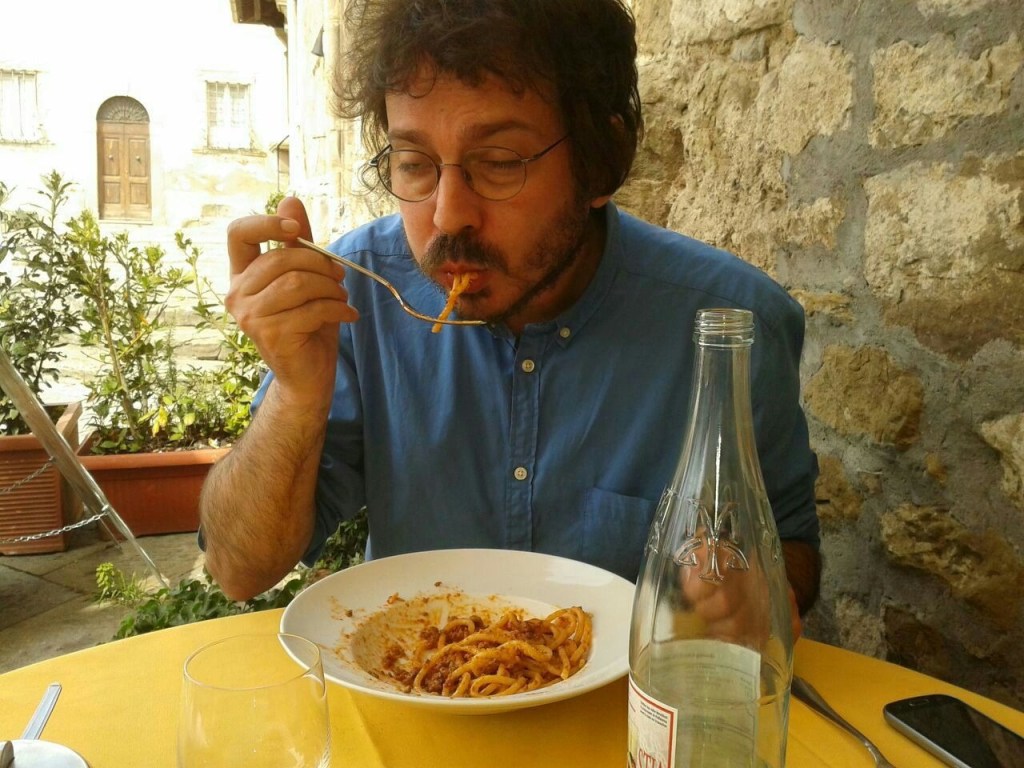
Dario d’Alessandro: I was born in ’72. My city, which I love and hate, is Palermo, in Sicily. An ideal place for those with artistic and humanistic interests because you are surrounded by history, beauty and decadence. I studied art and I (still) work in this field. Music has been a great passion since I was a child, when I put records on the turntable at my parents’ house. There were all the Beatles albums, including dozens of 45s, then classical music and American and Italian pop records.
My first instrument was a fabulous Farfisa Commander, with two keyboards, when I was 10, I think. My parents took me to lessons, but I don’t know why, the teacher unnerved me. I never studied music, like many kids I tried to learn the chords of the songs by ear following the vinyl or the cassette.
At 15 – 16 I listened to everything, from new wave to progressive rock to heavy metal. I started singing with small groups of friends in high school and started playing the guitar, even the bass when I could. But I didn’t continue.
The (prog) albums I listened to were those that the older brothers/friends, parents and especially teachers at art school had introduced me to. Among those, I was particularly struck by the first one by Hatfield & the North. This was different, it had an incredible beauty, sophisticated, never heard in progressive rock, at least by me as a young fan of Genesis, ELP etc. An album that I never stopped listening to and loving.
Like so many other kids that play for themselves sing songs with friends, I learned the riffs of rock songs that were then called “alternative”. The desire to start recording came around the age of 25-26. I made sound collages and tried to play over them, so the hi-fi system recorded from a makeshift microphone a tape sent by another tape player plus the part played over it, this could be repeated creating a brutal lo-fi. A few years later, with a small four-track tape, my partner Francesca and I – (we are still together!) started making slightly cleaner pieces, but always ultra homemade and always with pre-recorded bases. These experiments and demos flowed into an album entitled “Meat balls flying underground” under the name Mutable, published in 2001 by Snowdonia. A situationist thing, let’s say. This project led us to meet and hang out with several friends from the Palermo underground, who helped us and with whom we created a great musical and human understanding.
Immediately after, microcomputers arrived with little programs for recording and simulating instruments. It became easier to make music. We did several crazy things that I will put online sooner or later, created without pretension, just for fun.
In 2002 I, Davide Mezzatesta (of Mezz Gacano, a great avant prog band), Federico Cardaci and Domenico Salamone (both of Airfish, a historic industrial art rock band) founded Otopodo, a jazz-rock-punk improvisation group. You can find some material on Bandcamp (d’Alessandro operates under the pseudonym of McCoy Timer). This band was a training ground for me to play live. We played a few concerts.
In the meantime I was writing pieces and crystallising them on a piano roll as midi and therefore as notes on a tempo track. I was making electronic rhythm bases over which to dub guitar, bass, keyboard, voice and noises. And I had accumulated several demos. I had also suggested a first version of “Rifondazione Unghie” (which would later appear on the first Homunculus Res album) to Otopodo and we even played it live in 2009 for my last concert with them.
Also in 2009, the drummer Daniele Di Giovanni and I met through mutual friends and jokingly decided to start a prog group. His brother Davide immediately joined us on keyboards. Domenico, whom I mentioned earlier, was added on bass. From the following year onwards we met more and more regularly for rehearsals and a few pieces became dozens. Homunculus Rex was born (the name changed slightly at the time of the release of the first album, so as not to be confused with an unknown Californian group of the same name).
Our first live performance was in September 2010 and quite a few songs were already arranged how we recorded them on the first album.
I asked about Dario’s apparent obsession with the homunculus concept.
This is about all the esoteric junk I had read, and a way to make fun of it. I also read Goethe’s beautiful ‘Faust’ and got the idea from there. But it is portrayed in a mocking way, like a deformed and grotesque lens on the human being. Plus I wanted the grandiloquence of progressive rock: as a portrayal of the little man who rose from his smallness and insignificance to king.
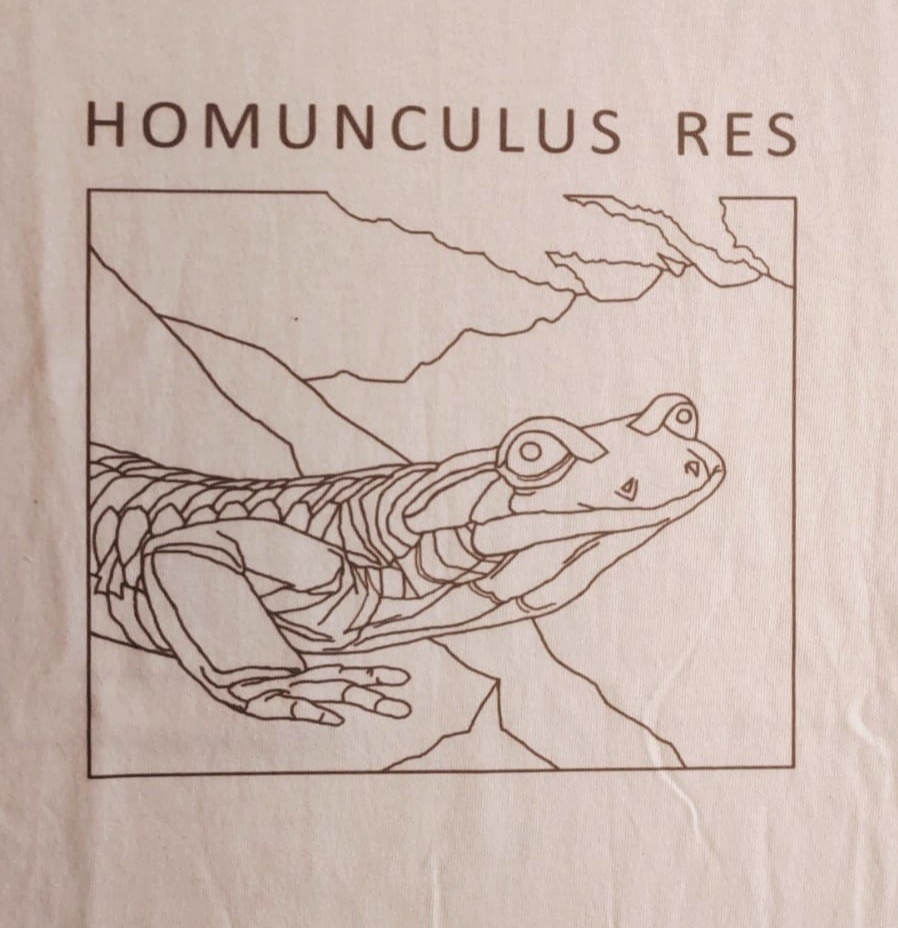
The band is the extension of my ideas, but the particular human and musical alchemy with my companions gives the peculiar Homunculus Res sound brand. In each album there are also one or two pieces composed by the multi-instrumentalist Davide.
All subsequent Homunuculus Res albums would contain a grand concept, a depiction of the homunculus in a particular environment, but the first album ‘Limiti all’eguaglianza della Parte con il Tutto’, as well as being an extraordinarily diverse musical statement (there are 18 tracks, 10 of which are less than 3 minutes long), had its own agenda.
The first album is the wild fruits of two years of experiments and fun, especially with irregular rhythms. Perhaps it should be considered album zero, a hotbed of mostly bizarre ideas, a happy exploration, a delirium, even. However, it contains some of the most representative stylistic features for us. We certainly enjoyed the idea of doing something unpredictable and cheerfully provocative. Even if it is not conceived as a whole, but as a sum of parts, it has its own internal stylistic coherence. The title of the album (a Beckett quote) might also refer to this fragmentation, as well as the difficulty of the individual (homunculus) in relating to society and nature and, for those who believe in it, to the spiritual.
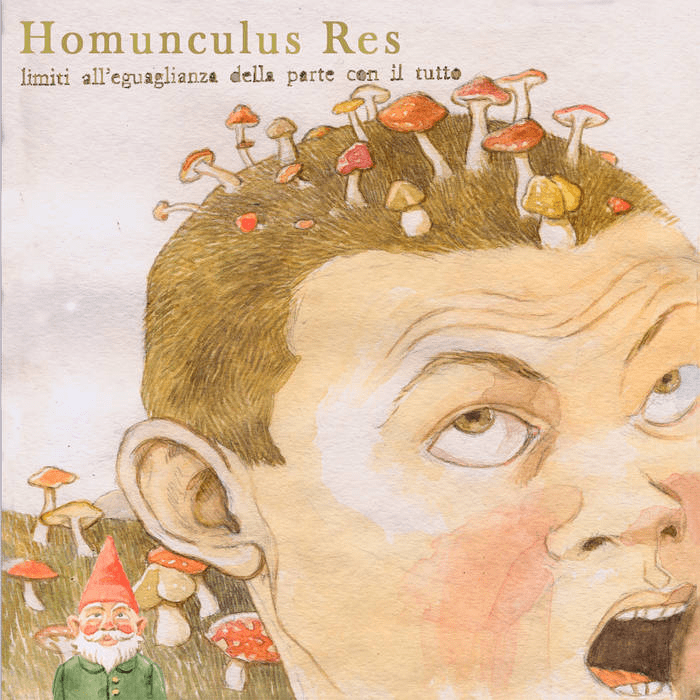
Our material was in fact fast accumulating and needed an outlet – there was even a first germ of ‘Ospedale Civico’ (the band’s opus from the second album) that we decided to postpone until later. The first version of the album, already partially skimmed by us, lasted more than an hour and, in addition to the arranged and finished pieces, contained jokes, parodies, improvisations, noises, small schizoid fragments, so it was intentionally more chaotic and disorienting. Our producer Marcello Marinone of the excellent Altrock label thinned out the material telling us that the listeners would be too disoriented and would lose the main pieces as they were dispersed in the general flow (that was maybe our crazy, perhaps self-destructive initial intention).
Dario had told me in a previous email that Limiti all’eguaglianza della Parte con il Tutto contained a ‘desire to explore irregular rhythms (with the help of mathematical tricks: Fibonacci series, triangular structures, enneagrams, palindromic pieces) and to expose the themes in a situationist form’. I’d asked for a bit of clarification on this but wasn’t quite prepared for the detail of the response. I was familiar with the ideas of palindromes being words or numbers which read the same forwards and backwards, Fibonacci as a numbers sequence (where the last two digits are continually added together to form a new one), and also the fact that ‘Enneagram’ was a track by Egg (!) but Dario gave me the full lowdown on the compositional makeup of several of the tracks and their roots. I had thought of picking out a few salient examples, but the level of complexity behind what, on the surface appear to be often jaunty, throwaway, relatively accessible ‘songs’, is absurd to the extreme and deserves to be documented.
As we delved deeper into our friendship, drummer Daniele and I fantasised about golden sections, complex geometries, palindromes, paradoxes, Möbius strips. Here are specific examples:
‘Culturismo Ballo Organizzare’ is one of the pieces inspired by the Fibonacci sequence. It is suggested by the numbers (1 1 2 3 5 8) pronounced in the first section (like progressively more intense gymnastic exercises) and settles in the central part (Ballo), deliberately composed in 13/8. The third part (‘Organizzare’) is a compendium of the entire album, a sort of summary in which fragments of all the songs that follow are mentioned and stitched together, practically self-quotations with the addition of a quote from the Beatles that appears several times.
‘ΔU’, which in physics represents the variation of internal energy in a thermodynamic system, is the title of one of our songs vaguely inspired by the idea of the Western God. The structure of the song is in fact pyramidal. (The initial idea was to use triangular numbers, then abandoned in favor of increasing odd numbers.) So we have 3 bars of 3, 5 of 5, 7 of 7, 9 of 9, (11 and 13 are missing, I don’t remember why!), then a whole series of 15 or 5×3, which however are not 15 in total, in fact the piece goes haywire, towards shapeless chaos.
‘χΦ’, which is read ‘Per Fidia’, meaning dedicated to Phidias, the Greek sculptor and architect to whom Fibonacci dedicated his study on the golden section, is another song inspired by this fascinating topic. Unlike “Culturismo Ballo Organizzare”, this is a piece with a much more rigorous structure. Positioned in the center of the album, the song lasts 89 seconds (F11) and is divided into 55 bars (F10) of 4/4. By setting the metronome to 147 bpm we obtained a bar/pattern of 0.618 seconds, that is Phi, the number of Phidias, the golden ratio (89 divided by 55). The song has another peculiarity: it is a perfect palindrome (try to invert it and you will find that it is the same the other way around). The voice sings the verses backwards (“isoc aizini” etc.) and is inverted in the second mirror part, restoring the comprehensibility of the words (“alla rovescia” etc.). Some instruments are also inverted both in the “straight” part and in the backward part, always in the name of Perfidy.
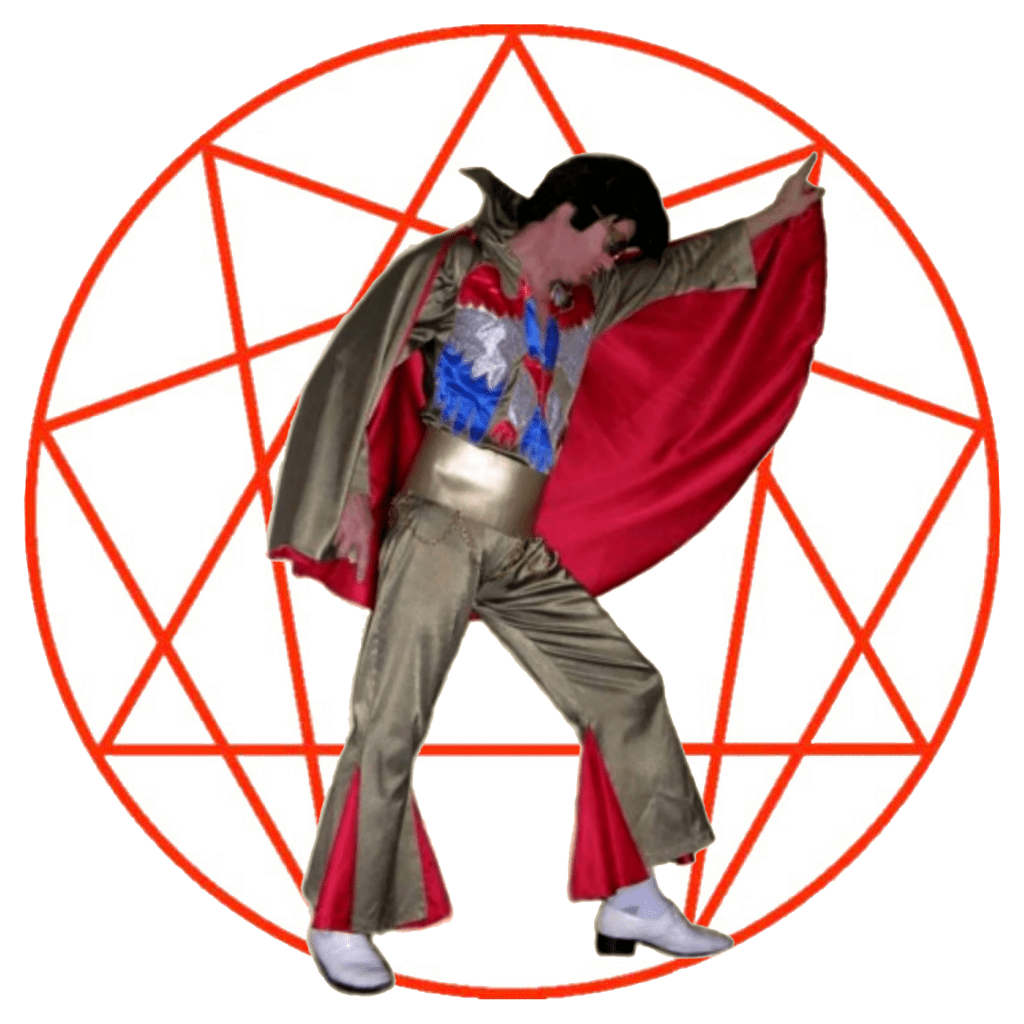
“Centoquarantaduemilaottocentocinquantasette” (142.857) is a stylistic exercise, a piece that aims to represent in some way the Enneagram, a symbol introduced by Gurdjieff, not in its mystical or psychological meanings, but simply in its form and internal succession of numbers, in order to obtain strange rhythmic passages that amused us a lot. So we have a first representation in which this sequence manifests itself in all its clarity: a note/percussion, then 4, 2 etc. in unison. In the second part these values are set in a rhythmic flow of 10/8, breaking it up. You can see this figure behind our Elvis impersonator logo, as a sort of crown, as the King (rex) of rock, or as a 9-based clock with the 1 indicated, as the number 1 of rock, but also as a representation of the schizophrenic man of the twenty-first century, a parody of Leonardo’s Vitruvian man. The song also refers to Egg’s ‘Enneagram’, which lasts 9 minutes and 9 seconds.
There are other more distant numerological references or quirks within other tracks on the album – these include references to the randomness (or ‘stochastic’ nature) of love, whilst the phenomenon of crop circles are tackled on ‘Cerchio nel Grano’
We do a version of ‘Sintagma’ live which is doubled in length, the second half is a mirror of the first, with parts of the piece where chords and riffs proceed in the opposite direction (this is captured on a compilation album available at https://www.discogs.com/it/release/9425841-Various-No-Palermo)
Crop circles are complex geometric figures and animate the conspiracy of the character who speaks. ‘Cerchio nel Grano’ also contains quotes from two great Italian singer-songwriters, Lucio Battisti and Fabrizio De Andrè, plus a ridiculous TV presenter of pseudoscientific popular programs, Giacobbo.
All these numerological references fit well with the (joking) alchemical concept of the homunculus.
We moved on to talking about the second album Come si diventa ciò che si era
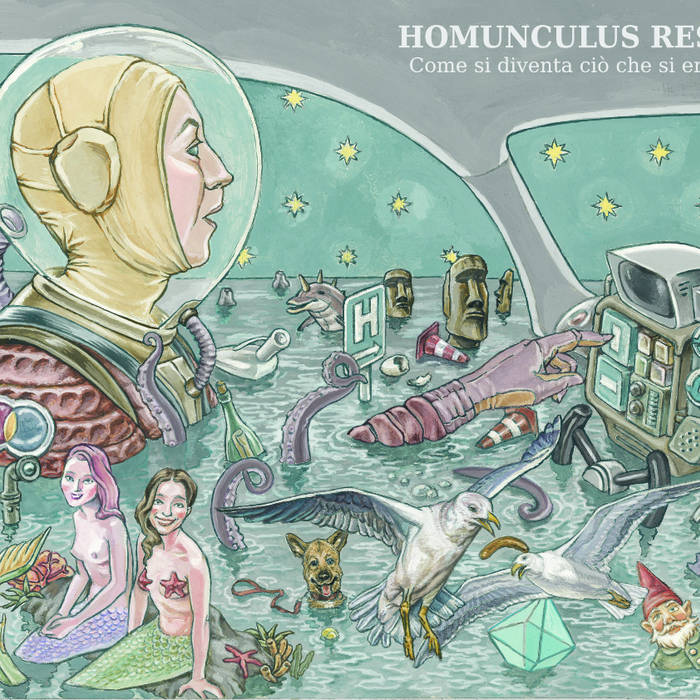
The second album is the first one that was conceived and designed as a concept, a complete and concluded work and not a sum of its parts. It follows the adventures of the homunculus who comes out of the safety of the ampoule and faces the world like any other man. And the world of men is characterised by pain and illness.
The theme is quite delicate and probably reflects some of my negative experiences (not dissimilar to anyone else’s), but it is treated with unreasonable lightness – something fatalistic that we can only accept and laugh about for its inevitability.
The cruelty of the world is expressed in the song ‘Vesica Piscis’ (an ancient Marian symbol). The characters in the song go to the sea to breathe healthy air and during the journey they see ferocious seagulls that attack and devour smaller birds. Or in the song ‘Dogface’ (which I wrote way back in 2003 or 2004) in which a dog is abandoned by its owner, whilst ‘Happiness’ (‘La Felicità’) is portrayed as being something unknown, like a term to look up in the dictionary.
“Doppiofondo del Barile” is a preview of the ‘Ospedale Civico’ suite – it was the first piece that was composed and it is around this the whole album revolves – and shares the same refrain (“Se ti senti mal devi andar all’ospedal” – “if you feel bad / you have to go to the hospital”). It is not autobiographical, it is as if someone suggested and described a song to a producer which was scraping the bottom of the barrel having had all previous proposals rejected, but finding that there is a false bottom. ‘S invertita’ is another self-quote from ‘Ospedale Civico’, the same melody played in a different way.
Undoubtedly ‘Ospedale Civico’ itself is the most ambitious and complex piece we have done. I remember with joy the amused astonishment of my companions when, every time we saw for rehearsal, I brought an extra section to attach to the previous ones. It had to be big and full of different environments, like a hospital in which to get lost, like a Dantean purgatory.
There are certainly references to National Health and Egg’s “A Visit To Newport Hospital” (my brain exploded when I first heard it). So it’s definitely a statement of intent and revelation of influences. Furthermore, one of the reasons it is so long, is to answer frequent criticisms of the pieces of the first album being too short.
‘Belacqua’ is a character from Dante’s Divine Comedy, taken up by Beckett. He finds himself suspended in the ante purgatory for his indolence, having not repented, which could be interpreted as wisdom. He does not do good or evil. ‘Opodeldoc’ is a medicinal ointment invented by Paracelsus (the inventor of the homunculus term, also the title of a National Health track), so as not to miss references to alchemy.
Come si diventa ciò che si era is also notable not just for the full-time involvement of guitarist Mauro Turdo, but for the increasing appearance of guest musicians outside of the core band. These include Dave Newhouse, who memorably adds bass clarinet to ‘Ospedale Civico’, Aldo de Scalzi of Picchio dal Pozzo, Alco Frisbass… plus Steve Kretzmer of Rascal Reporters
After asking permission to publish a small tribute for the death of Steve Gore of the Rascal Reporters on our first album, I got in touch with the other Steve (Kretzmer), who gave me one of the many unfinished pieces of the group dating back to ’75. This was a very complex piece lasting 10 minutes, we only set the beginning to music. The unreleased Rascal Reporter songs were completed later by my friend and collaborator James Strain
The Rascal Reporters are my favourite group, I put them next to Hatfield and the Beatles and Picchio dal Pozzo in my personal Olympus. When I heard ‘Happy Accidents’ for the first time I was very excited and in disbelief, it was the music I always wanted to listen to, a mystical revelation, a miracle!
In part 2 of the interview, Dario moves on to talk about a further 3 Homunculus Res albums, his thoughts about placing the band within a ‘neo-Canterbury’ context, and details his involvement in other projects.
You’ll find links below to the first two Homunculus Res albums talked about in the article:
Limiti All’Eguaglianza Della Parte Con Il Tutto https://homunculusres.bandcamp.com/album/limiti-alleguaglianza-della-parte-con-il-tutto-2
Come Si Diventa Ciò Che Si Era https://homunculusres.bandcamp.com/album/come-si-diventa-ci-che-si-era
For other interviews in the Canterbury 2.0 series, please click here
 The Canterbury scene(zine) continued....
4 thoughts on “Canterbury 2.7 – Homunculus Res”