
In the second part of our interview with Homunculus Res we discussed later albums released by the band, before moving on to talk about more general themes such as how the band went about composition, live performances, and Homunculus Res’ place within the wider Canterbury diaspora. You can read part 1 of the interview here
Dario d’Alessandro: After having dealt with the body and nature, with the third album ‘Della stessa sostanza dei sogni’ I decided to deal with the oneiric (relating to dreams) and the psychological aspect of the homunculus. Each song covers the world of dreams. Dreams are mentioned in every single song. These cover: the dream as a desire for love (“Faccio una pazzia”, ”Non sogno più”); nightmares (“Mentre dormi”, “Denti cadenti”); a revealing dream to win the lottery (“La cabala”); or as a premonition – which contains cultural prejudices (“Bianco supremo”); the dream as a comfortable place compared to reality (“Dopamine”); ways to help sleep (“Rimedi ancestrali”); and finally the cryptic dream that hides unresolved feelings (“La casa dei sogni”).
I used the image of a horse in the first three pieces just as a device to create connections. I was probably influenced by the white horse, foretelling death, in David Lynch’s ‘Twin Peaks’. However, Dario pointed out that the first track ‘La Cabala’ is actually not the Italian for horse, which is ‘Cavalla’ – ‘Cabala’ is an Italian term relating to the interpretation of dreams that correspond to numbers to play in the lottery. – Cabala also being a reference to the Jewish cabala, Qabalah or Kabbalah – a set of esoteric and mystical teachings typical of Rabbinic Judaism).
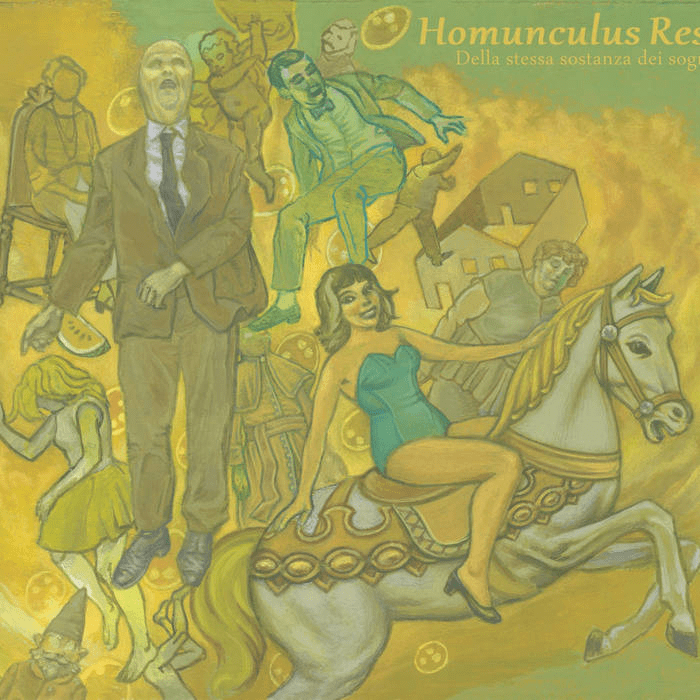
We chose a brighter overall sound than before . The best way to represent the dream, its immateriality and wonder, was the pop format. It is our ‘pop’ album, with light songs, and much more space for lyrics. It is true that the musical aspects are more subordinate to the song, even if there is no lack of large instrumental parts.
Dario also explains the increasing use of external musicians, as guests beyond the core Homunculus line-up, which had started on the previous album ‘Come si diventa ciò che si era’
Dave Newhouse (The Muffins), as well as Aldo De Scalzi (Picchio dal Pozzo), the Leddi brothers (Stormy Six, Mamma non piangere) and Steve Kretzmer (Rascal Reporters) were all great musicians of the recent past, who inspired us, who showed trust in us and enthusiasm. We are grateful to them. Just as we are grateful to all the musicians of today who have collaborated with us. The list is long, but I must mention Petter Herbertsson (Testbild!), Rocco Lomonaco (Breznev Fun Club), Regal Worm, Alco Frisbass, Paolo Botta (Ske, Yugen, who also took care of mixing a couple of times), Alan Strawbridge (Schnauser), Giovanni Parmeggiani (Accordo dei Contrari) and Sterbus.
We simply got in touch because of mutual respect. In particular Dave Newhouse was an enthusiastic collaborator, he played a lot of parts on two of our albums using many different instruments, flooding our songs with extreme elegance. For me it was a wonderful experience since ‘Ospedale Civico’ is inspired by ‘The Adventures of Captain Boomerang’ (from the Muffins’ first album ‘Manna Mirage’), for me a masterpiece of the entire twentieth century!
I had the pleasure of playing on the first pieces that Steve Kretzmer (of Rascal Reporters) composed with organ after a long period of creative pause, it was 2017, and I followed the evolution of the two Redux volumes and the album ‘The Strainge case of Steve’. I also painted two covers for Rascal Reporters, it was during this period that I met James Strain who took on all the work, from playing to mixing. (Dario and James collaborated most recently on the Lunophone album, released earlier this year, and the subject of an earlier Canterbury 2.0 interview (link))
‘Andiamo in giro di notte e ci consumiamo nel fuoco’, Homunculus Res’ fourth album was my own entry point into Homunculus Res in 2020 and arguably remains their defining statement. It appears to be their most coherent musical statement: the tracks are punchier, the ballads are sweeter, it is an album of consummate compositions. In the review in Facelift at the time, I remarked upon the convoluted changes of direction, the blazing fuzz sounds, the mediaeval feel but also the serenading of the listener through its wide-eyed innocence, before concluding that the band were as ‘mad as a box of frogs’. For all of this, in relation to the first 2 albums at least, there appears to be less of a deliberate attempt to throw the listener off track.
Yes, it’s exactly as you say. I think the fourth album is stylistically the most complete. We’d reached the perfect balance between experimentation and accessibility. Even if the provocative aspect was less present, I believe that this one, like the other albums, has in itself a whole layering of meanings, some more evident than others. And I think it has its own crypticism starting from the lizard on the cover that, with a fleeting and enigmatic look, stares at the viewer/listener, stops on a stone (it is our ‘rock’ album) in a suffocating post-apocalyptic background.
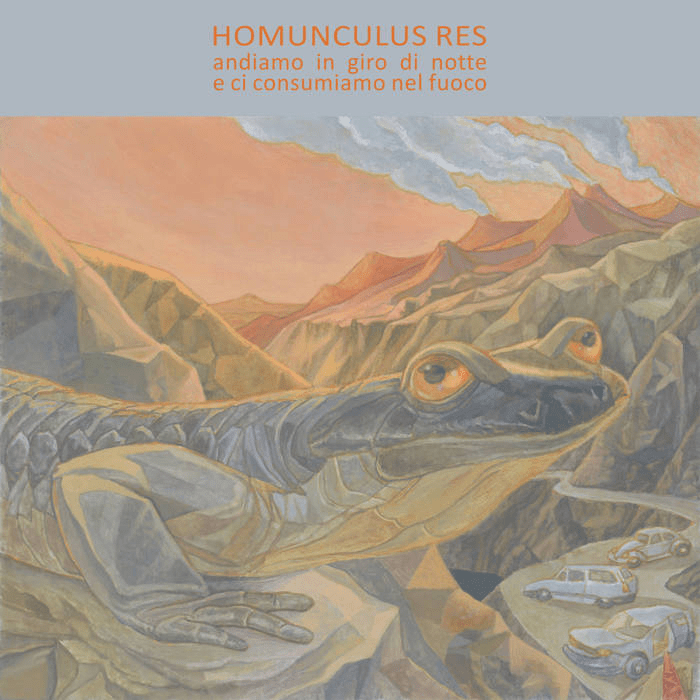
The album title is taken from the Guy Debord film, a medieval riddle applied to consumer society: we go around at night and we consume ourselves in fire. Consumerism consumes the consumer. In the first piece ‘Lucciole per Lanterne’, this is made explicit through the firefly (the solution to the riddle) attracted by the light of the lamp until it gets so close that it burns. In the song, the firefly is also a reference to prostitution and it is the light that speaks, it invites her towards itself.
All the songs in the first part of the album, up to ‘La Spia’, deal with the consumption of material goods. This includes ‘Il Carrozzone’ where we speak as a group: we have become rich with music and we buy the most expensive things while despising the poor, whilst ‘Supermercato’ is a bizarre dialogue with a supermarket clerk.
I mentioned in the introduction to the first part of this interview that ‘Supermercato’’s coda contained a rendition of first part of the piece rendered backwards, immaculately performed by the baroque sounds of French horn, oboe and viola . Dario is amused by the fact that no-one has ever spotted this even though he subsequently made a posting of the entire album played backwards on Youtube, which I saw and commented on at the time as being hilariously abstract, but it turns out was published just to give us all a bit more of a hint as to the coda’s origins. You heard it here first!
We continued on the album with ‘Buco Nero’, the black hole that devours everything, like Pere Ubu’s belly. And ended with ‘La Spia’, that is, the signal that lights up in a car when there is a problem (another reference to fire/light). It is a song about planned obsolescence. (This is the piece referred to in the Facelift review as containing ‘wideeyed whatsitallaboutery’, assuming as I did at the time that it referred to some sort of existential confusion about existence, which in a roundabout way I suppose it is.)
The second part of the album is more cryptic in its meanings. It goes from the salamander on the cover, a mythical animal that crosses the fire, indifferent and solitary, to deliberations on Pythagoras and metaphysical cosmogony; the song ‘Tetraktis’ is dedicated to the number 4, as the album is the fourth one. To arrive at the Kubrickian shining (‘La Luccicanza’) and the verbal violence of the last piece. The references to “Lullabye Letter” (in ‘Supermercato’) and “Hey Jude” (in ‘La Luccicanza’) are absolutely intentional.
I can’t remember quite how I got the impression that Homunculus Res’s fifth album ‘Ecco l’impero dei doppi sensi’ might well be their last, whether it was some throwaway remark from Dario, or just the overall mood of the album, which appears more philosophical, more stately, a project which feels it has reached a level of maturity. Dario remains cryptic on the subject.
The meaning (of the album) is not the end of the group, but the end of everything(!) Literally, so it is probably the most philosophical album. I am pleased that its solemn aspect comes out despite the catchiness of the music.
I agree that it follows the state of grace of the previous one, but the songs are deliberately simpler and more direct (apart from the album’s finale where the sounds precipitate into an increasingly frayed and shapeless sonic mix towards entropy).
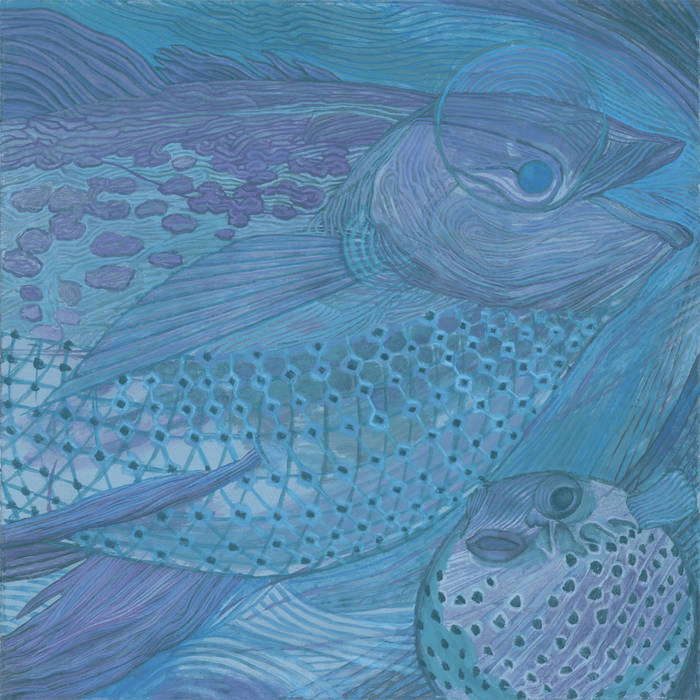
Dario pointed me towards the press release which he made for ‘Ecco l’impero dei doppi sensi‘, which he told me he regarded as an ‘exhaustive’ statement on what he hoped the album would achieve. Here it is printed in full:
<<After the ruminations on the human condition, through metaphors of the natural elements [earth water air fire], the Sicilian band inevitably arrive at transcendence, always in an inexorably nihilistic perspective and with the usual humour that here becomes darker and in some cases even absent.
Every reference to humans, society, history, is avoided as much as possible. All meanings tend to be abstract. The theme is a continuous digression on the intangible: quintessence, absence, ether, cosmic and interior void, limits of language and the universe, destroyed and recomposed monads, memories of the future, senses, non-sense, double meanings, rhetorical figures, numbers; these are suggestions that often recur in the songs.
We’ve become accustomed to songs with wide instrumental spaces, with their particular progressive melodic pop-rock style with irregular structures, which here becomes even more dry and essential, even if there is no lack of episodes of instrumental richness that reach paroxysm, thanks to the various exceptional musicians, Italian and foreign, who participate with wind instruments, voices, exotic and ancient instruments. There are many references to the number 5, not least the length of the album being fifty minutes.
There is no desire to communicate anything or, rather: there is the desire not to communicate anything – even while doing so.
Homunculus Res have nothing to say, and in fact they do not say it.>>
The music of the song “Viaggio astrale di una polpetta” (the astral journey of a meatball) was written by Davide Di Giovanni and is dedicated to the death of his beloved cat, lovingly called by him with nicknames including Polpetta (meatball). For me, it was a pretext to write a text inherent to the concept of the album (“recomposed monad / unity in form”).
The piece is very funny and in some sections it contains this kind of bizarre ancient folk – plus a quote from Camel.
With Dario being the chief songwriter and main driving force behind the band, as was outlined in part 1 of this interview, I was curious as to how his compositions took shape…
From the second album onwards, when we established ourselves as a quintet with the entry of Mauro Turdo on melodic guitar and Daniele Crisci on bass, I’ve always thought of a theme and a consequentiality between the albums, a continuum. So the theme, and the topics I want to talk about, influences the way I write the songs, for example I want a certain atmosphere of the song, more or less cheerful, more or less complicated to accommodate what will be the actual lyrics. These always come last, when the song is defined, and are modelled around the various accents of the music.
Usually I bring the pieces to the rehearsal room already quite structured, with an idea of the arrangements for each instrument.
First of all I have to relate to the drummer, with him we decide the rhythmic progression and the bar lengths, then he is free to fill in as he wants. However, if there are accents that I cannot do without, these have to be respected. In the meantime, the others, perhaps with notes or chords to refer to, begin to familiarise themselves with the piece.
The same goes for Davide’s pieces, but it often happens that he records almost all the instruments for his pieces. For my pieces also interprets the chords and always inserts nice connections or cheerful rhythms and counterpoints. All the keyboard solos are written by him.
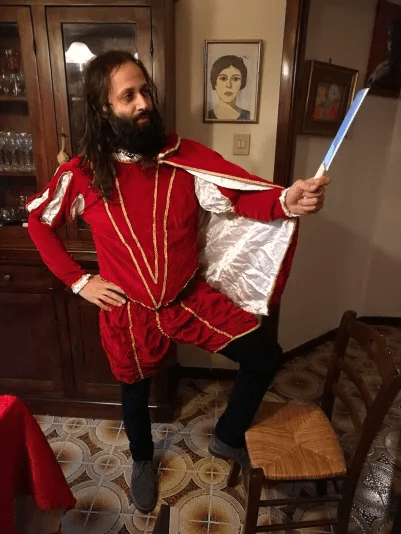
Daniele Crisci and Mauro Turdo have perhaps the most demanding tasks because, in most cases, they have to follow the most obligatory, written melodies.
The experience of forced confinement due to Covid was not a big shock for me. I continued to write songs and record. And I continued to collaborate remotely with other musicians. So my way of making music did not suffer any major shocks. Homunculus Res even managed to play live in December 2020 for an online prog festival in Japan. By contract we cannot show the video until December 2025!
We moved on to talking about how Homunculus Res materialised in a live context
We do few live performances, an average of one or two a year. The more time passes, the less we perform, because each of the 5 of us has his own work commitments, family commitments and commitments with parallel musical groups or long-distance collaborations. And also nobody calls us! However, we have met at least once a week for 14 years, maybe just to talk, or listen to music, or plan something, or play board games.
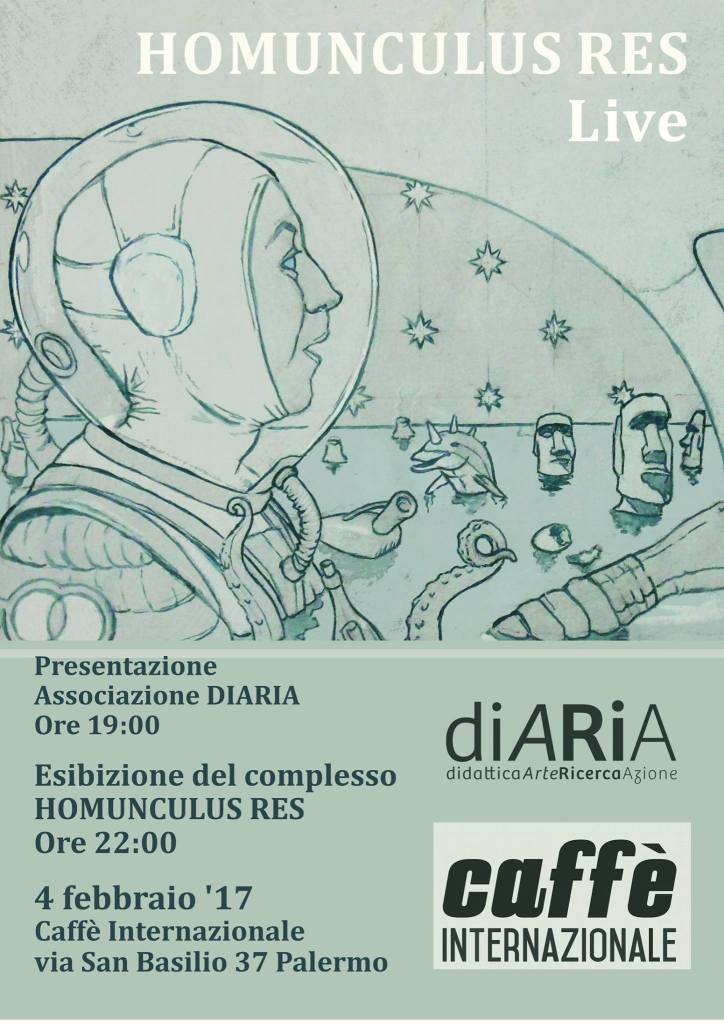
There are videos online (which give an indication of what Homunculus Res are like live). We play like a rock quintet and often have a friend to guest on wind instruments, for example. The songs with complex arrangements, like those on the second and third albums, are reduced to this rock formula. So we are more fundamental on stage.
We have played mainly in Palermo and Sicily. Twice we were invited to play in Milan, more than a thousand kilometers from here. We have played on both large stages and small clubs with average audiences of over a hundred people.
One of the motivations for the Canterbury 2.0 series of interviews has been to seek the views of musicians, particularly in climes a good distance from Canterbury itself, to assess the nature of what Canterbury music is, and how it is perceived in their country. Some of this will appear in a PhD project, due to be completed in 2025, but it felt appropriate to include here too. Dario is uniquely placed to judge this, both as a fan of the genre, but also because he has been particularly proactive (like Dave Newhouse of the The Muffins) in seeking out other similarly influenced musicians for guest work or collaborations.
The first Hatfield and the North record had a profound effect on me at 16 or 17, but I didn’t know about the connections between the musicians and the so-called scene. For me it was a progressive jazz rock record, a rare find among the records I knew. A few years later I discovered Soft Machine and Robert Wyatt and I began to feel the connections, the common taste. I used to read alternative rock magazines and the Canterbury scene was never mentioned. At the end of the 90s, thanks to magazines that did retrospectives of 70s groups and thanks to friends and music catalogs and above all the spread of the internet, I delved into everything.
In addition to the usual names of the “scene”, some of which I have already mentioned, I had fun and was amazed to discover the “minor” ones or those that can be grouped together or those of the second wave of the late 70s and early 80s such as Supersister, The Ghoulies, Moving Gelatine Plates, The Stubbs, Supply Demand & Curve, Cos, Nanu Urwerk, Grits, Master Cylinder, Massimo Giuntoli, French TV, Radio Piece III, Volaré etc.
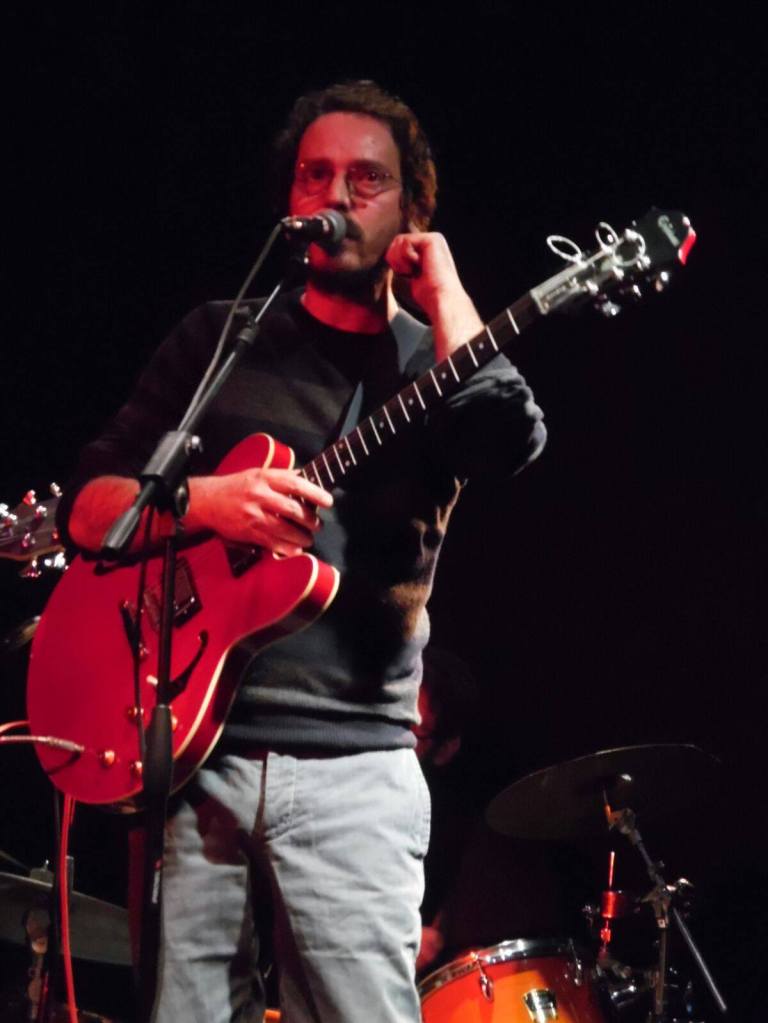
I think that the traits that can be recognised and that were certainly born from those few English musicians at the end of the 60s are a certain elegance and lightness of composition that is jazzy and psychedelic and progressive. Warm and soft sounds and a lot of musical and textual intelligence and irony.
My understanding is that the Canterbury scene or sound is perceived benevolently in Italy, but only by a few people, as a gem – something for connoisseurs. And this is quite transversal among listeners and critics. The Italian press, more or less independent, since there was punk and post punk, has shown maximum contempt for progressive rock, but the most enlightened have distinguished the Canterbury sound as something precious and refined. A few books are dedicated to it. However, it seems to me that the term “canterburyan” has returned to music magazines and blogs in general – apart from those specialized in both prog and Canterbury or Rock in opposition and “other” music. I think that the greatest credit goes to Wyatt’s ‘Rock Bottom’, an album appreciated by many, which has overcome the limits of the niche and has acted as a portal to delve into the scene.
I can only be happy if critics and listeners include us in the neo-Canterbury genre. For us it is the main influence and it came out naturally, if there is some wink or citation, these are happily accepted. When we met we were super fans of Soft Machine, Hatfield and Egg. I am also happy that there is a sort of community of musicians scattered in Europe, the Americas and Japan who renew this type of music, as you are demonstrating with this series of interviews.
Given that later Homunculus Res albums in particular showcase guest appearances by members of a number of the projects mentioned above, I wondered if Dario had reciprocated in terms of his own collaborations and credits. In addition to the collaborations with James Strain and Steve Kretzmer of Rascal Reporters, discussed elsewhere, he mentioned the following:
I played on some records by Maisie, an Italian pop group. I produced with my phantom label Budella Records an album for Calogero Incandela (a name taken at random from a phone book), a “melancomic” singer-songwriter friend of mine from a town in Palermo, -all the Homunculus Res play on it. (https://www.discogs.com/label/1110952-Budella-Records?page=1)
I also played a small synth part on a record by Sterbus, a delightful Roman duo who are fans of Cardiacs, and who are present on two of our albums.
I have collaborated and still collaborate with Luciano Margorani, founder of the duo LA1919, a rock in opposition duo from Milan in the 90s. I sang and played keyboards on several of his albums and during the pandemic we made an entire album remotely! and I’m also more than happy with my parts on one of his albums released last year, I wrote all the lyrics and played keyboards.
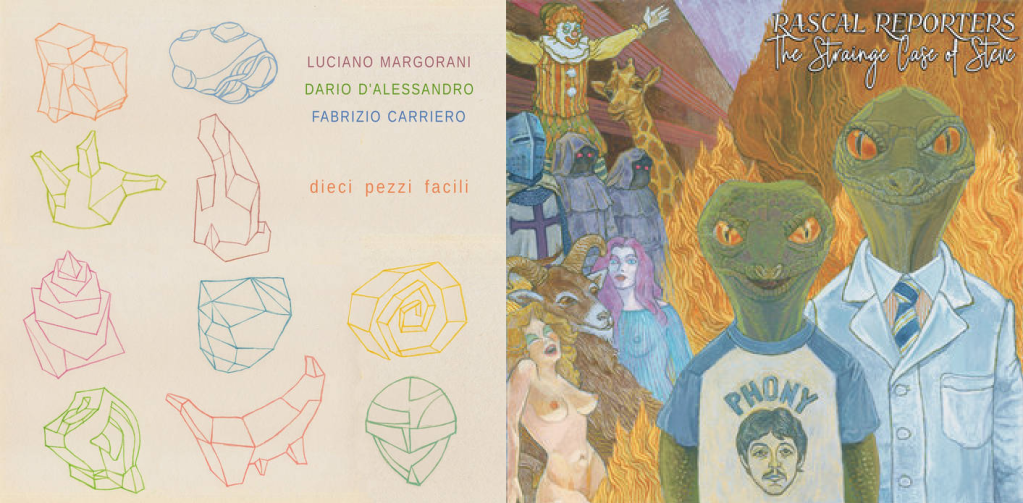
I haven’t done anything since the Lunophone album came out, it’s been a hot and lazy summer that hasn’t encouraged me to do anything. A few days ago I started writing songs again, I’ve done three so far. And I think it’s my usual style, a little sweet, dissonant and complicated. And a few days ago I got involved in a very interesting project that I can’t talk about at the moment!
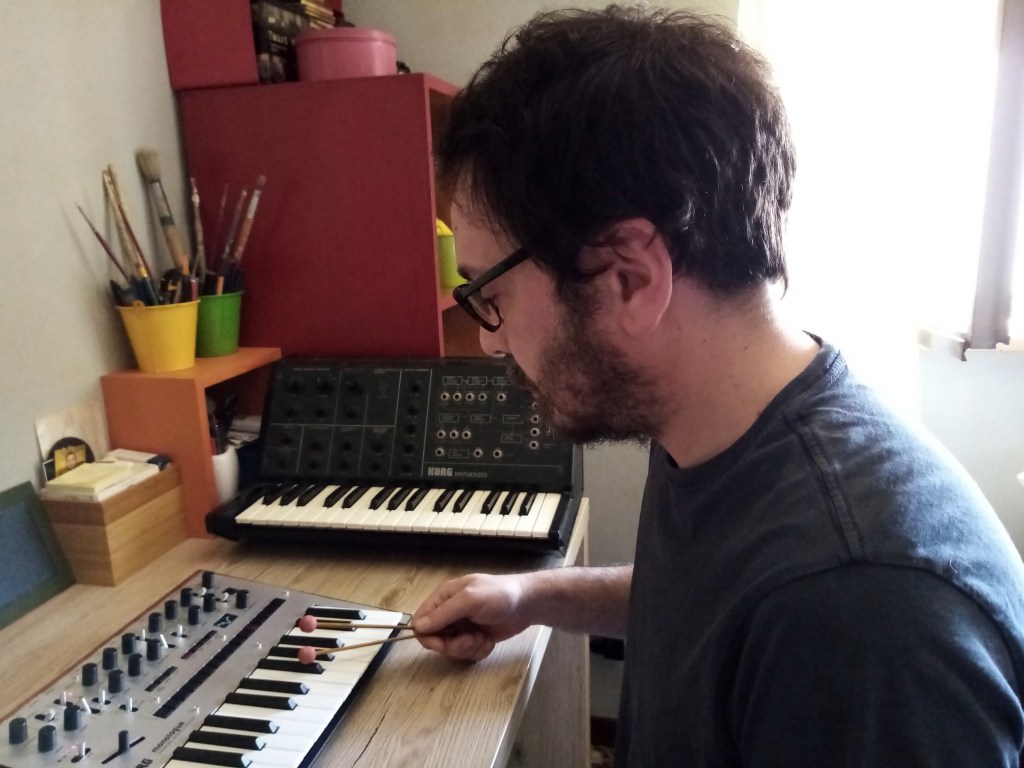
Huge thanks to Dario d’Alessandro for his hugely informative and detailed responses to my interview questions
Albums covered in this article
Homunculus Res
Della stessa sostanza dei sogni – https://homunculusres.bandcamp.com/album/della-stessa-sostanza-dei-sogni
Andiamo in giro di notte e ci consumiamo nel fuoco – https://homunculusres.bandcamp.com/album/andiamo-in-giro-di-notte-e-ci-consumiamo-nel-fuoco
Ecco l’impero dei doppi sensi – https://homunculusres.bandcamp.com/album/ecco-limpero-dei-doppi-sensi
with Luciano Margorani
Luciano Margorani – Dario d’Alessandro https://lucianomargorani1.bandcamp.com/album/luciano-margorani-dario-dalessandro-album-2021
Diece Pezzi Facili – https://lucianomargorani1.bandcamp.com/album/dieci-pezzi-facili-by-luciano-margorani-dario-dalessandro-fabrizio-carriero-album-2023
guesting with Rascal Reporters
The Strainge Case of Steve – https://rascalreporters.bandcamp.com/album/the-strainge-case-of-steve-2
Part one of the interview can be found here:
For other interviews in the Canterbury 2.0 series, please click here
 The Canterbury scene(zine) continued....