
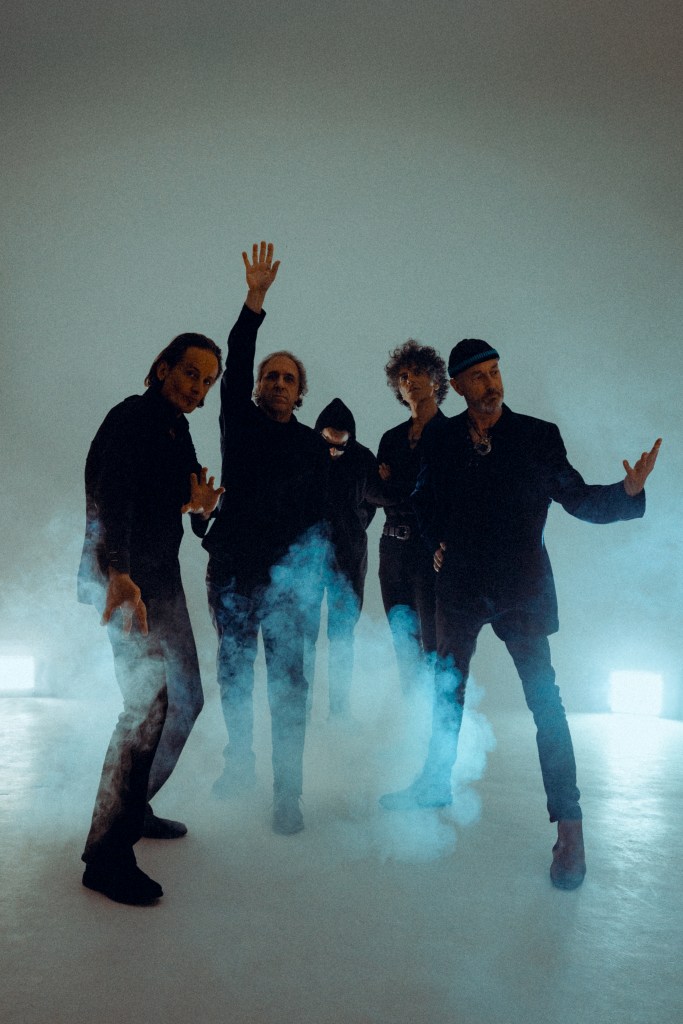
We finished off Part 1 of the interview with Gong about their new album with Kavus Torabi and Fabio Golfetti talking about the second single from ‘Bright Spirit’, namely the glissando guitar-heavy track ‘The Wonderment’. What follows in part 2 is, in the musicians’ own words, a consideration of some of the musical components which make up the Gong sound.
Glissando guitar
As part of the interview with Fabio Golfetti for the Canterbury 2.0 features on Facelift back in 2023-24, we talked at length about the glissando guitar, the textural technique inherited from Daevid Allen which has permeated, largely uninterrupted, into the history of Gong and its wider family. A treasured personal memory is the following of Gong’s performance at Kozfest in 2022 of both Fabio and Kavus featuring with the Glissando Guitar orchestra on the traditional Sunday noon performance. I asked them both about the role of this patent ingredient within the overall Gong sound
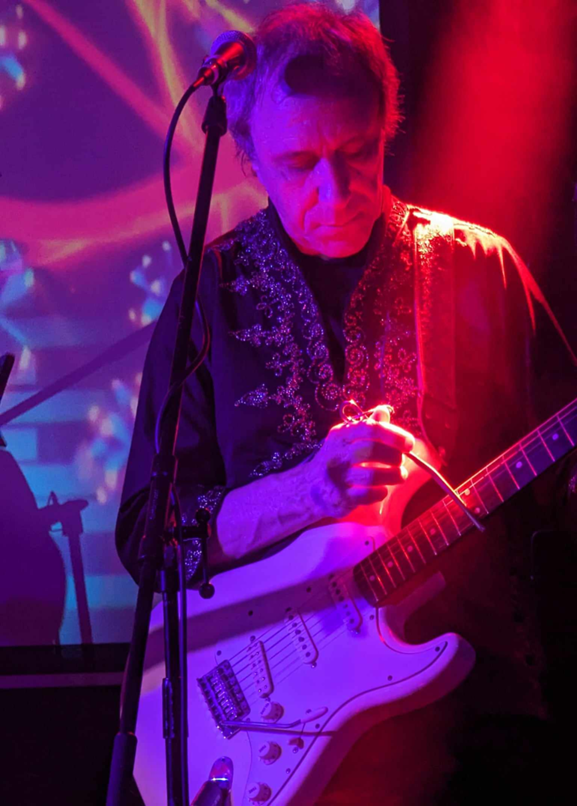
Fabio: Once when we were rehearsing with Steve Hillage for his tours, I was checking the arrangements as to where I should play guitar and where the gliss would be, and I asked him: “where would you play the gliss in these tracks?”, and he said: “I play gliss in all tracks!!!” So the gliss is a powerful sound weapon, it has the ability to transform the mood of a song in many ways. So as we have two guitars in the band, I recorded glissando everywhere I felt it deserved.
Kavus: For the uninitiated, glissando guitar is the bowing of a guitar with a metal rod and it was developed by Daevid Allen having seen Syd Barrett do it with a Zippo lighter. He developed it. Steve Hillage then took that and went even further. I’m not calling anyone out here, but both Steve Hillage and Daevid Allen said, and I quite agree, that Fabio is the best glissando player they’ve ever heard. I think Fabio’s glissando playing is extraordinary. So, there is no point in me playing glissando on the records. I do a bit live. I do it in Utopia Strong quite a lot and I do it on my solo stuff, but you know when it comes to recording glissando, no one does it like Fabio. He’s really gone deep into it and has this extraordinary understanding of that technique.
It gives us a sound that no one else has. It’s instantly recognisable as Gong. And it does tie us in with the classic sound of Gong. Of course it’s a beautiful sound. It’s like the sound of angels singing.
In terms of it in the band I mean I know Fabio loves playing glissando and generally speaking when it comes to the riff side of things I’ve kind of got that locked down. You know I’ve always played riffs. So I think Fabio loves doing the gliss and I love the sound of it and it gives us it gives us a great way to work because you because it does take up sonically quite a lot of bandwidth. So it means just Fabio doing the gliss will affect how we arrange the music around it.
Saxes and woodwind
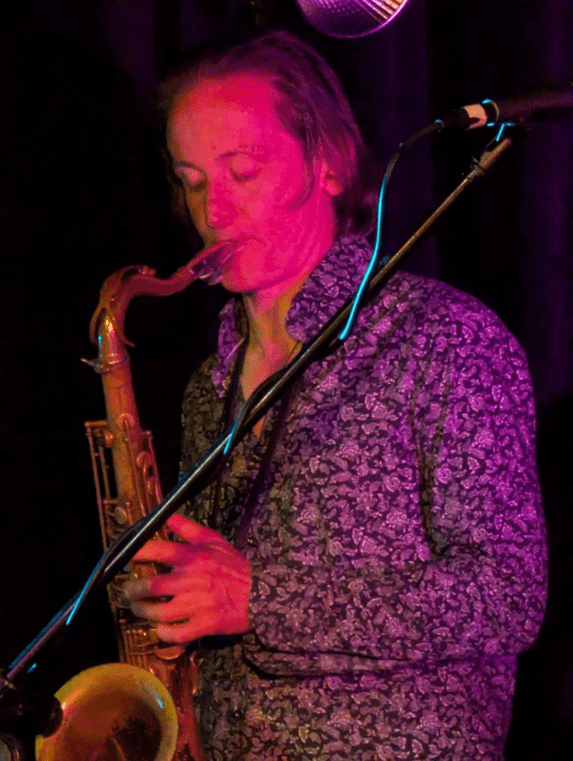
The music of this 5-piece is characterised not just by the sonic landscape embedded by the glissando guitar but through its sheer intricacy in adding additional lines to existing melodies and riffs produced by the band’s two guitarists. Much of this is down to the effervescent work of the highly underrated sax and flute player Ian East, who explains the process:
Ian: If, for example, I play along with an existing guitar part I begin by doubling it, then drop some notes out (so I can breathe!) and so that the phrase can flow nicely on my instrument, then I’ll add some harmonies and then maybe counter melodies, or a combination of all these things.
Then when we record I’ll decide which horn should play which part and then maybe add some more instruments if it feels that the song needs more weight at that point or a different flavour (the cooking analogy is a nice way to think about this for me!). Or if I write the part myself the process is much the same as above.
Multi-part harmonies
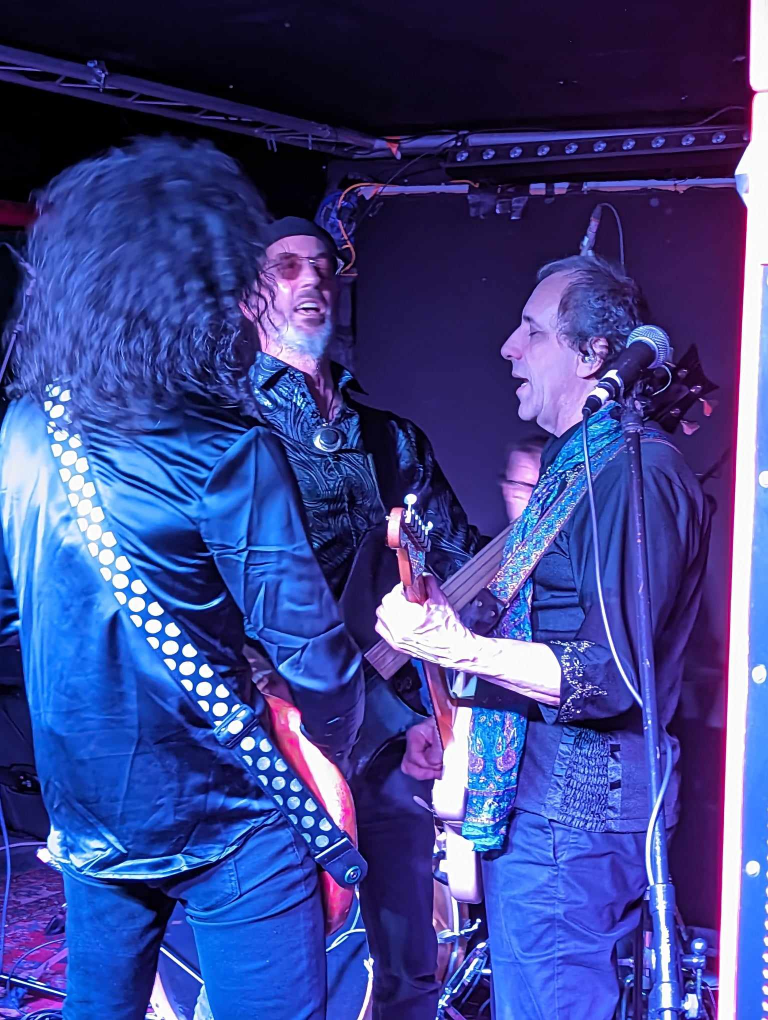
Whilst the glissando is an indelible part of the Gong sound past and present, one feature the current Gong have made their own, is the extraordinary use of vocals, extending to three or four part harmonies. Their accuracy and impact of this on stage is stunning.
Kavus: We discovered this when Daevid was still alive when we first started touring this. We did a version of ‘I’ve been Stoned Before’ but we did it as a barbershop style rather than just me singing it, because we wanted to do something different and it was just great to do. So on that first tour we were doing this barber shop. And that’s when we realised that “hang on a minute, our voices sound nice together!” All of us really like harmony vocals. And we have we have very capable singers: Cheb is always the high voice because he can reach up there but more often than not, Cheb is the arranger because he just has such an ear for this. Gong has never really done this before. You almost only ever really have the top line of Daevid. You don’t even get even just one harmony – Gilli was doing Space Whisper and Daevid was doing the topline, but this is something we all like doing. What’s really good is that this is something we can actually pull off live, especially now with the technical side of things with in-ear monitoring. We’re able to really buzz in with one another and pull this off live. And while we won’t deliberately put in harmonies arbitrarily, I love it and I love not having to lead the thing. I love just being part of the choir!
The lyrical path of the new Gong trilogy
Much consideration, or at least attention, has been given to the lyrics of Daevid Allen which propel a mythology started back in the 1960s through until his death in 2015. Less-examined is Kavus’ own lyrical path through the Gong albums since he took on the role of lead singer.
Kavus: Well, just to quickly touch on why we think of it as being a trilogy is that ‘Rejoice! I’m Dead’ was very much our response to losing Daevid and trying to keep elements of Daevid in there. Obviously we had Didier, and old Gong in there on ‘Model Village’ and a bit of Steve Hillage on there, and Graeme Clark played some violin and we used some recordings of Daevid and we also had bits of songs that Daevid had written and a couple of his lyrics. It was a transition. Whereas ‘Universe also Collapses’ was really when it felt like it became “okay this is our Gong”. That’s why I think of this as being the start of the cycle in terms of lyrics for that.
I suppose over all three albums I’m trying to, in a poetic and hopefully non-specific way, to talk about my understanding of existence and I think a big one for ‘The Universe Collapses’ was this idea, I’m not alone in this, that everything is happening at once. Everything is happening in an instance and just this single moment and time and space is an illusion. Although that said, ‘My Sawtooth Wake’ was inspired by a guy called Crowhurst. He was a sailor, a British sailor. In fact, I was talking to Peter Hammill of all people about it. He’s a big Crowhurstian as well. So, it was inspired by that, but I wanted it to feel like a sort of spell or a ritual. It wasn’t exclusively about that, but it has this like spell-like ritual quality as well, but it was also about just the idea of drowning and dying and accepting one’s death as well.
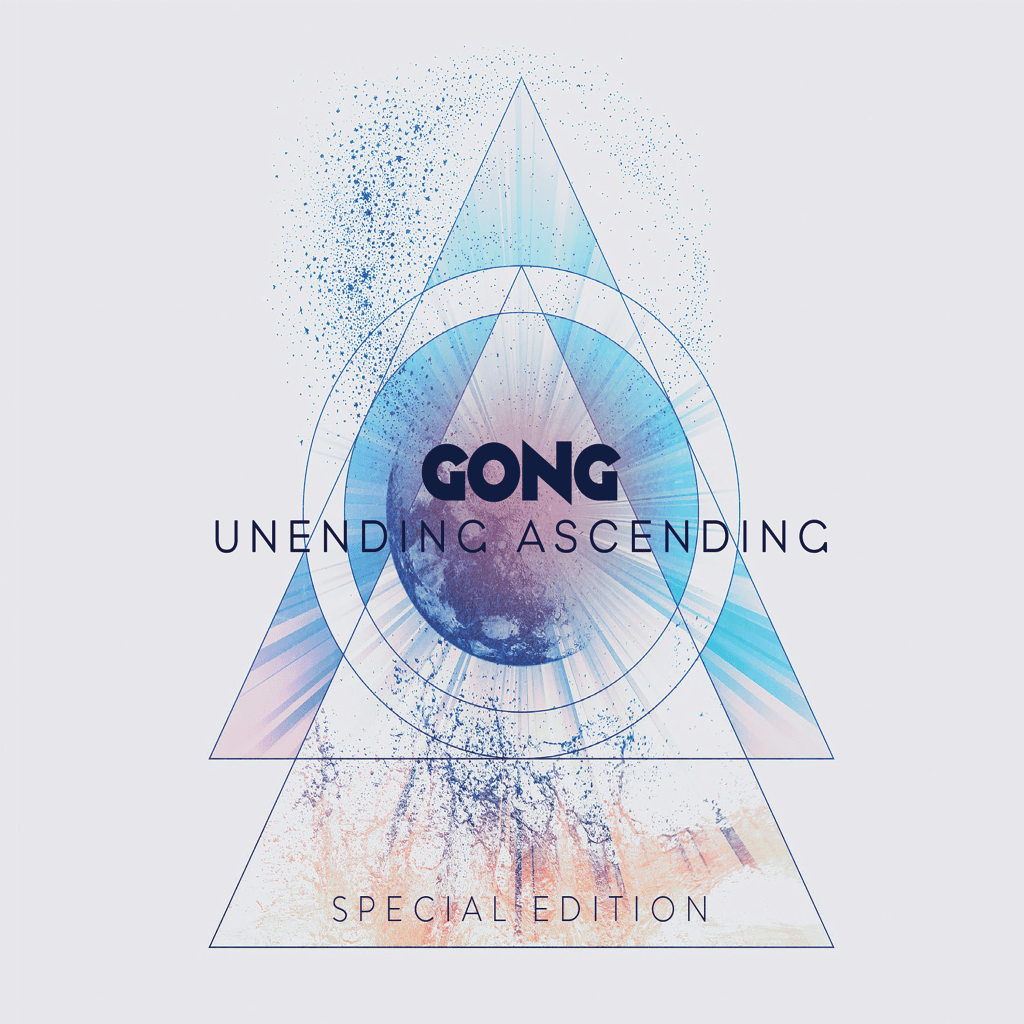
But then ‘Unending Ascending’ became more being in praise of the moon goddess and keeping with what Daevid had told me that Gong should always be going upwards. It should always feel like it was something propulsive. And I think I think with this album I’ve been touching on, in ‘Eternal Hand’, talking about fate; talking about dreams in ‘Dream of Mine’ and ‘Fragrance of Paradise’. I’d sort of say it’s my first love song, but really it’s the first blatant love song to the universal goddess to all women, to the universe, to the feminine power – whatever you want to call it.
I think over the course of these three albums it’s been for me a realisation of something I’ve been thinking about most of my life and it’s been coming more and more together for me. I started to really articulate this a bit better when I wrote that memoir ‘Medical Grade Music’ with Steve Davis a few years ago. I think when you write something down, be it text or lyrics, once you start articulating something, writing it down, you realise things about it that you didn’t perhaps realise when they were just going around your head as circular thoughts. And what will often happen, and I know I’m not the only person to say this, is that your you’ll write words and they’ll seem like the right words, but maybe afterwards you’ll read them back six months or a year later and go, “Oh, I know what that was about there”. It’s almost like a memory of the future, or you were able to articulate something that you didn’t quite think you were doing when you were writing it. And I think I’d from a young age been really obsessed with death. Death had been a big big obsession for me. And coming to terms with, making peace with mortality has always been throughout my life, the number one project of being alive is to make peace with mortality.
And for a long time, I was an atheist. I’m not now. I had a Salvia Divinorium inspired mystical experience in my mid-30s which absolutely just dissolved all atheism and that was it. I’d made my peace with mortality and then felt it was my responsibility in a way to be able to try and write about that, if anything for my pre-35 year-old self that was terrified of the inevitability of losing this fleshy avatar. And you’ll hear me go on about it every single gig we do. I’ll just remind people of this: don’t worry about death – it’s no big deal because I’m telling the pre-enlightened me this as well. It’s because I would have loved to have said to the terrified 12-year-old me, look, don’t worry, you will figure this shit out!
And so I’d always had a thing about the things that seemed to have this kind of charge which was dreams. There seem to be something in dreams. There’s something to them. I think that there is something more than just playing out a little film, because you can feel sadness or anger or happiness or laughter in a dream. And that’s very real. You know, when you feel sadness in a dream or when you feel anger in a dream, that’s real anger, it’s not like pretend. And when you’re visited by a friend who either you haven’t seen for ages or a dead friend in a dream, it’s like you’re with them again. Let me talk about Tim Smith from Cardiacs, losing him. Even though I think about him every day and even though I can remember what it was like hanging out with him and what his voice was like, it’s not until he appears in a dream that you’re like, “Oh, no, it was this. It was this thing.” And there’s another dimension to it that you your memory will not give you. So I can’t say what there is to dreams, but there’s something to them. And the same thing with psychedelics and with music, when you get music that absolutely glows with a fluorescence, you’re going, well, there’s something to this. There’s more to the wider thing of art. There’s more than mere entertainment. And I started to realise this whole thing about like time only happening at once and that we are merely atrophying vessels of time. And it’s good that we are because we get to experience memory and music and we get to enjoy a narrative that if we were just in that single moment where time doesn’t exist we wouldn’t do.
So music can be experienced only through these atrophying decaying bodies. And that’s why death is inevitable and death is as just as natural as birth and not something to be frightened of. I’m really really rambling here, but I’m starting to see over the course of doing these Gong albums and writing that book I’m starting to make more and more of a connection between these dreams, all these things that had a charge to me that really attracted me. Dreams, music, art, death, time, consciousness, they’re all part of the same thing. There’s something to them, I think. I can’t necessarily articulate this. Well, I can’t at all articulate it in a scientific way. And I can’t particularly articulate it in any kind of great philosophical ways. I’m just some stoned goofball musician with a guitar. But I am at least able to articulate it with some poetic lyrics and some music.
We thought around the time we were coming up with Unending Ascending, I think we started to see that we should we should we should make our trilogy. Part of that second album was already having three symbols on the cover. The stars, the moon, and the water. So we saw ‘The Universe Also Collapses’ as the stars. We saw ‘Unending Ascending’ as the moon with the lunar invocation on it and we see this one as the water. And those are themes that have been going through all of them: ‘My Sawtooth Wake’ about drowning, and there have been lyrical themes hence calling it ‘Bright Spirit’ because there’s been this thing of spirit bright or bright spirit going through Gong. We’re working with themes – it’s definitely seeing this as a cycle and now with this taking a little break in taking a year off in 27. It is part of that. At least at this point I feel like we’ve said everything that we can say with this current dynamic that we have… which isn’t to say that we’re not going to say something different…
In Part 3 of this interview feature the band chat about life touring with Henge, the annual psychedelic dream festival that is Kozfest, and plans with current and future solo projects
Buy Bright Spirit at https://www.planetgong.co.uk/ or https://gongband.bandcamp.com/album/bright-spirit-4
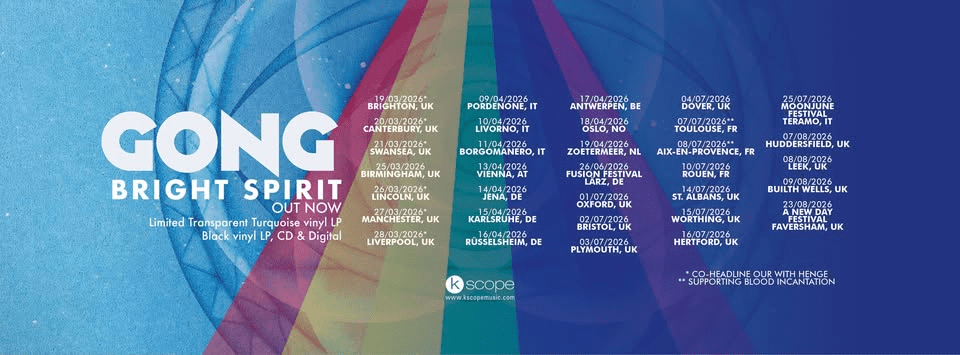
Upcoming tour dates are below:
 The Canterbury scene(zine) continued....