Canterbury 2.3 – Fabio Golfetti interview Part 5– Gong

The final section of the Fabio Golfetti interview will look at his involvement with Gong, how he came to join the band, changes in circumstances as Daevid Allen became ill and how the current line-up has evolved.

Introduction

Part One – Formative Years

Part Two – Violeta de Outono

Part Three – Invisible Opera Company of Tibet

Part Four – The Glissando Guitar

I asked Fabio about how he came to join Gong and how the current line-up (with Dave Sturt on bass, Kavus Torabi (guitar/vocals), Ian East (sax/flute), Cheb Nettles (drums) and Fabio himself) had evolved.

Joining Gong

Mike Howlett left the band after they toured the ‘2032’ album. Theo Travis was the saxophone player and he said, ‘I have my friend Dave (Sturt) that can replace him’ – Dave and Theo had worked together on the Cipher album ‘One Who Whispers’ with Daevid guesting on glissando. The same happened to Theo – he had to leave in the middle of a tour and he said ’I have a friend’ which was Ian East.

And they kept going until Daevid decided to reform the band, turn back to his roots, play more gigs in small venues, and also bring his son Orlando to play.

Daevid and me became friends after Daevid came to Brazil in 1992 (see previous section). We kept in touch. For some reason in one of my communications, in 1998, I said, ‘if you need a guitarist I am available’. He replied that for the next tour they already had a guitarist, which was Mark Hewins.

For the ‘2032’  tour Gong played in big venues arranged by Steve’s manager, Dan Silver of Value Added Talent. There was a lot of love between Steve and Daevid and they had a very good relationship, but at some point Daevid decided to make a new band, and thought about Orlando (his and Gilli Smyth’s son). This was in 2011 and he asked me whether I could join – he said ‘the tour will be next year, would there be a problem if you have to be away from your family for 2 or 3 months. Gabriel (Fabio’s son) was 11, so it would not be a problem, Victoria (his daughter) was older. He said, ‘You will have a lot of fun. I will guarantee your money’. At the end of the tour, Daevid paid us but he didn’t take any money, he took a loss. I said ‘this is not right’. ‘No, this is my project’, he paid us, I don’t remember how much, but this was his project, and he was happy. Most of the time he only played because he wanted to continue. I wrote him a letter, but he said, end of story…. So I officially joined Gong in 2012, although some people consider 2007 (The Gong Global Family) to be a Gong thing because it was a time when Gong didn’t play.

So Daevid started reforming the band, which is why he invited me to come but on the other hand I wasn’t his first choice, his first choice was Adrian Belew from King Crimson, but when he talked about budgets it never happened because it was impossible to play for very little money considering all the costs involved.

The first time I had met Gilli (Smyth) was at the Gong Unconvention. I loved Gilli. It was kind of special for me because the first time I met Orlando was in the Gong Unconvention (in Amsterdam, 2006) and his girlfriend was a girl from Venezuela and I’m from Brazil. Daevid said ‘you must meet my daughter in-law,  she’s from South America too’ so Gilli was very warm with me. On the tour in 2012, many times I came down for breakfast and Gilli was always up.

The first time I saw Fabio play (although we didn’t meet on that particular occasion) was in 2012 when the band played at the Band on the Wall in Manchester.

Gilli was due to play but she didn’t. Gilli started the tour in France and in one of the those early shows in trying to get out of the van she broke her ankle or some similar injury. So she had to stop the tour and stayed with Luc Pilmeyer (Gong fan and webhost for the Didier Malherbe website) – she was staying in his house in Belgium for two weeks at least and then when we came to London to finish the tour I think Gilli joined a few gigs with us. Gilli did her last gig with Gong in Tokyo, Japan at the end of the 2012 tour.

Daevid’s illness

We did a last show in Brazil in 2014 – the last Daevid gig with Gong was in Sao Paulo, in a very small club, the Na Mata Cafe, 10 March). I arranged that gig at the last minute because a gig in Santiago, Chile was cancelled, and to fill the date I contacted a friend,  who was the owner of the venue. On a Monday normally it is not open but we did a gig for 100 people maybe – it was most almost like a private party. It was announced three days before. And then we all left and Daevid I think flew direct to Australia.  The rest of the band, Kavus , Ian (East) and then Dave (Sturt) came back to the UK. Orlando also flew with Daevid. We were working on the album ‘I See You’. We had finished the recording but we were working on the mixes to release at the end of the year. With the album there was a big plan, a tour of about 50 to 60 dates in many places across Europe including the UK and we had a plan to release the album in September, I think, just before the tour started. Everything was planned for a big Gong return with a new album. Daevid knew that this would be his last album because he said, ‘I have a very big composition called ‘Thank you’ ‘which should be the last composition on the album.’ He did a kind of a thank you for everything he passed during all his career.

original tour poster 2014

So probably this was going to be his last tour too. But he’d gone back to Australia and we had Glastonbury to play and then he wrote , ‘I don’t have very good news because I fell on the veranda outside my house in the garden, I fell and I broke my (collar bone) and I don’t know if I can play guitar for Glastonbury. But now as we have Kavus playing guitar we have three guitars, so I can just play the glissando, so let’s see.’ He put a kind of (support) to keep things in place but this caused friction on his skin and because Daevid had a certain skin sensitivity, (he had a lot of problems with the sun because was very white), there was a problem – it wasn’t healing because of the friction.

And then he went to a doctor and discovered that underneath there was a kind of skin cancer which became worse and then discovered that the cancer was in a part of the neck – so he needed surgery. He had to remove all his hair on one side. So we were starting to think that the tour wasn’t happening, but we still had the album to finish. He was up to doing this, even with this all this treatment – he had chemotherapy – and more than one surgery. So was he recording his bits even when he was ill, and he was doing more work, with Orlando doing the mixing.

So before he discovered the cancer he was up to doing this last tour but then as his illness progressed this was the point that he wrote us a few emails. So we started pulling out of all the dates because without Daevid … But his attitude was that  you have to do it ….

I suggested this idea to continue the tour might  have been because there was some sort of business contract which required fulfilling. Fabio disagreed..

Daevid said ‘you have to do it because you are Gong’. Gong had had a similar situation (when Daevid quit the band in the Seventies) and the band carried on, ‘so you have to carry on because I put this band together. The first thing that was suggested was that maybe we could try a singer – and mentioned some names like Tim Hall (the singer in the UK Invisible Opera Company of Tibet), but then it was so confusing with his health situation that he stopped communicating. So what happened at the end is that he persuaded us to do the gigs and we did the tour but only two dates in the UK. There were six or seven gigs in France.

At the time there was still a hope that Daevid would recover – this was in October/November and Daevid was still was in treatment. The album was released in November.

But I remember when we played in London we had a message on the phone and during the show we talked with Daevid direct from Australia! We stopped the show to chat to Daevid online! The gig was at the Garage in London, a kind of celebration because Steve Hillage came to play, Mike Howlett came to play, Keith the Bass came to play, Theo Travis came to play, Mark Robson…  so we had a lot of Gong family supporting that version of Gong and we had a very nice gig. At the end we did a big jam with everybody on stage. We played ‘Fohat’ which is the one that’s possible with three basses! Mike, Keith the bass, and  Dave Sturt.

amended tour poster 2014

All the gigs went very well, the audience was very receptive to us but we weren’t sure if we should continue without Daevid. We just did these gigs because we were asked to, but Kavus was unsure whether he should continue as a front man for the band.  But then there was a gap until Daevid wrote to us – it was in December or January 2015. Then we received an email he said, ‘well I did everything that I could, I tried all the therapies, I had a lot of operations, I did everything but the cancer has now come back very strong and the doctor has said I only have 6 months. But he died two months later because he said ‘I will stop all medicines, I will stop everything because if I only have 6 months there’s no point for me to make this longer’ and then he died in March of 2015.

Post-Daevid Gong

I don’t remember if  we had any gigs  in 2015 but I think this was the point that we decided to continue the band because he had written in this letter that we should continue. We didn’t know if it was feasible to make it happen because I’m in Brazil and we all had different projects but then we decided to try to put an album together which was ‘Rejoice! I’m Dead!’ I don’t remember exactly how we started the album because we had individual ideas. We have a rule in this new Gong that none of us have to come with a finished song – that’s the new rule but at that point we only had a few ideas.

The first track on the album was based one of my Violeta tracks that was a demo of one of the Violeta albums. I don’t remember what I called that track in Violeta but it became  ‘Thanks George’ because of George Harrison – the lyrics I wrote were based on George Harrison’s lyrics on that song ‘Inner Light’ – it has short lyrics that say ‘without going out of my door I can know the ways of Heaven’ (sic) – I think it wasn’t on any Beatles album, I think it is a B side of a single. So I had that track and also another one with many temporary names that became ‘Model Village’ after Dave’s intro and middle part which he also had previously, and his lyrics –  it was one of my tracks that was recorded with Violeta but not released.

I pointed out that there was also ‘Kapital’, the spiky revved up track which the band still play live, which had had some input from Daevid before he died.

FB: ‘Kapital’ is a similar story. Daevid had a demo – it was the first part of the song, a kind of blues demo just playing with the guitars, no drums, nothing. He played the guitar and during this process of trying to find some ideas I got the second part of the song, through Cheb Nettles’ suggestion of joining both ideas. This part I found in my 80’s demos, from Lux times, and for me is was much more inspired by New York Gong or ‘Playbax 80’ (the solo Daevid Allen album which used snippets of the New York Gong album ‘About Time’ as its basis). New York Gong is good but ‘Playbax’ is one of the my main albums because Daevid did a lot of loops.

live version of Kapital from the ‘Pulsing Signals’ album

There’s plenty of Daevid in the album, samples of his voice, and poems, including the title of the album that came from one of his poems. Other tracks have the seeds of what we are doing now, in ‘Unspeakable Stands Revealed’ you can hear Kavus riffs which were the start of the song, the combination of sax and gliss which recalls the Gong vibe and identity of the 70’s. In ‘Insert Yr Own Prophecy’, which was a track by Cheb, it demonstrates how great he is as a singer and composer. We all started making use of our personal sonic arsenal, Dave with his EBow ambient fretless bass made a lot of unique inputs with unusual sounds.

Gong fans

I asked Fabio about what his perception was of how Gong fans had accepted himself and others within the current line-up as a legitimate continuation of the Gong story

What was interesting was back in Sao Paulo a couple of weeks ago. We were booked to play in Chile and I said to the promoter, ‘well let’s try to make Sao Paulo’, because to go to Chile you have to stop in Sao Paulo – it seems there are few or no direct flights from London to Santiago.  And we did that show – it was in a very beautiful place called Casa Rockambole – I knew the place but had never been inside.  The promoters were 28 to 30, my daughter’s age. What was interesting is that they have connections with lot of young people and these people they were not coming to see (the Seventies) Gong or Steve Hillage – they want to come just because of the legend.  There is a legacy in the name of this band. Same when you play in China for example, we played for an audience in their 20s and 30s keen for new experiences. When you play all these different places, people go just because of what they read in magazines and now the internet. But they’re not expecting to see Daevid – in the Sun Ra band for example there will be not be Sun Ra or John Gilmore but the band are still carrying on the legacy with Marshall Allen (who turned 100 this year).

It’s a matter of opinion. You might have a friend that is interested in what Gong was in the 70s but now the 70s is 50 years ago! The name is still Gong – it is a different band but we have a bit of its spirit because we all learned with Daevid, we all played with Daevid Allen. We are not trying to be Gong as it was, we are trying to continue music and develop music with the name of Gong. Musically I think we are far away from what they did before but also we are not doing a kind of tribute – we are not deceiving anyone doing this music, we are just being ourselves. Kavus is not similar to Daevid Allen in the way that he sings, his voice and everything, and I believe this is one factor that Daevid considered in leading this band in a new direction.

But I have been a fan of this scene since I was 14. I like the trilogy (‘Flying Teapot’, ‘Angel’s Egg’, ‘You’), I was inspired by this Gong philosophy. I’m not sure when Dave and Ian had a connection with Gong philosophy before, nor Cheb. But when Ian plays his saxes it’s instantaneously Gong, Cheb could play Pierre’s parts perfectly, Dave is an amazing bassist that could be in any incarnation,  Kavus is a Gong fan, but, the same as Tim Smith (Cardiacs), loves the ‘Om Riff’ because of the riff itself, as he says: the best riff ever written! But this Gong has nothing to do with the mythology (although we love it), without Daevid Allen it is not the thing to do to continue (or perform) the trilogy.

On the  ‘I See You’ album, we were a bit shy because well – we had Daevid the master –  we composed with him – so that album has tracks from everybody, but we gradually became more confident in our abilities to make music. I think Daevid Allen would be supportive to continue the direction are going. We can’t stay the same, life is changing constantly, it’s never the same..

It’s difficult to please all fans because a fan likes that one thing – they don’t want changes , they dig their heels in. But when you see a music act more like an artist you are much more open to evolution. Even King Crimson evolves from the first album to the last album – they are completely different bands – well there’s one member because Robert Fripp was the main guy, but even Pink Floyd carried on when Syd Barrett left.

I just don’t think you can please people all the time. You’re the creativity, you’re the inventors, they take it or they leave it and some people will never be pleased.

One thing that I’m thinking and I always discuss this with the band is that the many people who saw Gong in the’ 70s don’t come to gigs anymore, some are now older than me,  only the true old fans come.  So now I think if we have this mission to continue this band and we accept this challenge to do so, I think we should make this band our band to a new generation too.
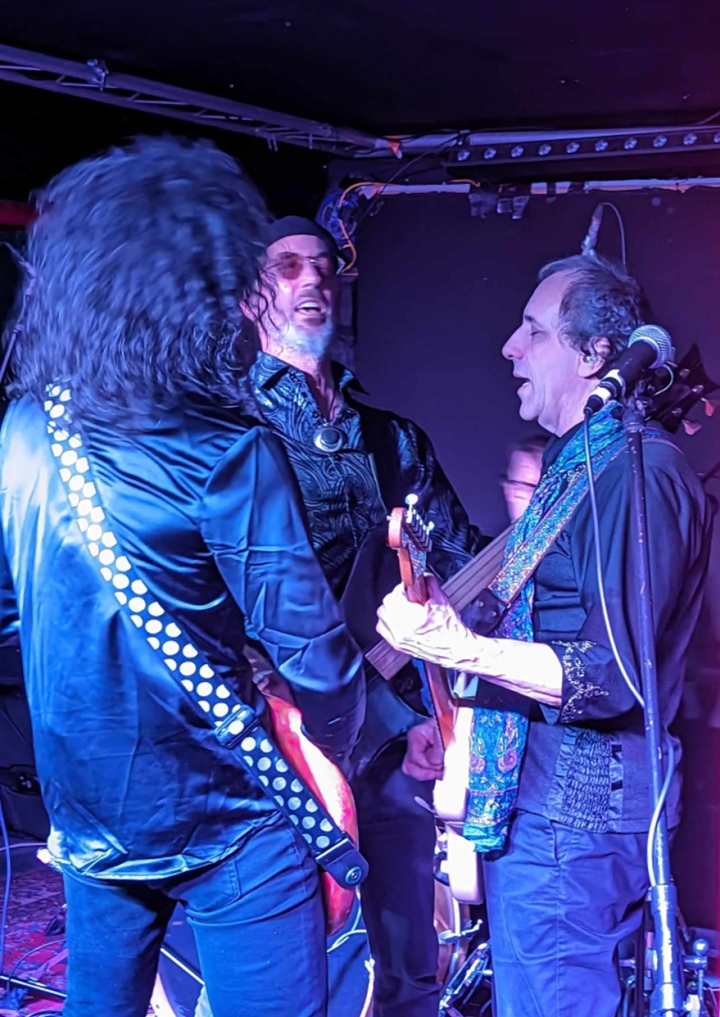
Gong at Sidney and Matilda, Sheffield, 2023 – Kavus Torabi, Dave Sturt, Fabio Golfetti. Photographer: Phil Howitt
Revisiting ‘I See You’

Fabio had mentioned to me earlier in our conversation that the band were working on a remixing of the last Daevid Allen solo album ‘I See You’

It is the 10 year anniversary of ‘I See You’. The process of the album was a bit chaotic –  we were in three different continents and Daevid was ill, Orlando was under a lot of pressure. We thought that we could remix the tracks for this anniversary special edition. We asked Orlando recently to send me the backup of the files, the sessions, he sent me a hard drive with the sessions.

I like the ‘I See You’ album, the songs. For me it was an honour to make an album with Daevid Allen – we had done that album in Brazil before (The Gong Global Family), but this one we composed and created. But we all were a bit shy of what we could do with Daevid Allen, because he’s a genius. The first track, ‘I See You’ was one of the indicators – we went to the studio in Brazil, my friend’s studio, and said ‘let’s try to make some recordings as we are all together’, the same studio we recorded with Violeta, the MOSH Studios of Oswaldo Malagutti Jr. (famous in Brazil with his band Pholhas in the ’70s). And then Orlando started playing on drums, a jam with Dave on bass. We only had drums and bass – like a free jam. Daevid took that thing to his place (in Australia and created an amazing track over that drums/bass. So that was quite intimidating! He did everything with the glissando, it was amazing. But we understood that we should all contribute in some way. On ‘Eternal Wheel’ again I had a Violeta track I had never used, I have some demos of that track and in the studio we played the track and jammed. Orlando edited  and wrote the lyrics. We recorded the album and it came to the mixing process, it was very complicated, Daevid was too ill to give his input.

We recorded two extra tracks that were unfinished and weren’t published, a version of ‘Change The World’ (from the Magick Brother Mystic Sister album) and ‘What A Revolution That Will Be’ which was decided to be left off because of “inappropriate” lyrics.

We had this idea to remix the album as if it was a previous version of the album, to have a special approach, different from the original mix, something similar to the Beatles ‘Let It Be Naked’, without the strings, without less post-production. When Yes released the 30th and 40th anniversary albums, at the end of the CDs they put extra tracks, what they called ‘run throughs’. I really enjoyed them, they went to the studio and just played live with no overdubs. It was very good to hear those tracks in their early incarnations. So we will (for ‘I See You’) use everything that was in the tape but the mix will be rougher, but with a good sound. We have already sent all of the tracks to Frank Byng, the producer/sound engineer that has been doing our recording since ‘The Universe Also Collapses’.  He’s doing an amazing job. I think it will end up being released in late 2024/early 2025.

We also will release a special edition of the album ‘Unending Ascending’ with bonus live tracks from the last tour.

Fabio also mentioned that the band were preparing to record a new studio album and he regarded this as the third in a series which had started with ‘The Universe Also Collapses’, with ‘Rejoice! I’m Dead!’ standing apart somewhat as Gong members had contributed individual tracks, whereas ‘Universe’ and ‘Unending Ascending’ had been more of a collaborative effort. Fabio talked a little about both of the latter two albums

On the album ‘The Universe Also Collapses’, we had already started developing our own sound. I think this album has a lot to please the old fans and the new. Side One features a long twenty minute track, our ‘Close To The Edge'(!) and has a lot of what we have been distilling in the last few years, lots of ambient gliss loops, big angular riffs, complex horn arrangements, powerful drums and bass. 

We all felt confident about this album and were very happy with it – we felt it reflected the potential of this band. It was at the time when we had decided to create all music collectively (apart from the lyrics which Kavus took care of – I think it’s much better to sing what you write, I think it’s a much truer reflection of your writing).

The interaction of ideas always leads to something new, Kavus can suggest a riff, then Ian plays the opposite of what Kavus had in mind, Dave looks on with his producer’s eyes, and this creates something unexpected and original.

I like the last song on the album, ‘The Elemental’. For me it was a step towards making this version of Gong closer to pop music, even with the discordant middle part, which is cool. It came from the first chord sequence that Kavus brought to the first day of writing sessions in the studio. We played ‘Elemental’ a few times at the beginning. When we released the track, it should have been the promo, single. And we have a video clip for that but Kavus didn’t feel comfortable singing this track live, some tracks work best in the studio.

‘The Elemental’ single

I commented that ‘Unending Ascending’ had seemed more punchy, a selection of often sharper, shorter pieces than this line-up had recorded previously

When we decided on a new album, we already knew that would be a continuation of what we started in ‘The Universe Also Collapses’. But this time we opted to make an album of short songs. The album called Unending Ascending revealed to us that we could do our trilogy, a bit more loose and abstract than a linear story, but something that has a lead line connecting. We have the same team working, Frank Byng of Snorkel Studio, our producer/engineer, Steve Mitchell of 57 Design who has redesigned the current Gong logo and created all imagery identity and the personnel from Snapper (Gong’s record label) that have been very supportive too.

Two of the singles from the album appeared very quickly, during a rehearsal Kavus started the riff of ‘My Guitar Is A Spaceship’. In a few minutes we’d already written the main part of the song singing funny nonsense lyrics. At some point Kavus said, can you imagine us playing this riff at Glastonbury Festival? Two days later Jasper (Jones) of Fruit Salad Lights, our lighting engineer, rang us asking if we could play at the Glade Stage in Glastonbury 2022 (he normally does the light show for that stage). It was magic!

The other song ‘Tiny Galaxies’ had shape just after I played three chords with a Leslie simulator, very 60’s and Kavus instantly played a spacey sound that he discovered on his new pedal.

Cheb always contributes many riffs, on this album the powerful riff of ‘Choose You Goddess’ is his contribution.

Some of the highlights in this album that I could mention are Ian’s parts, including the flute that appeared more on this album than previous ones. Or Kavus’ voice , the way he sings in combination with the vocal harmonies is one of the characteristics of this Gong. And one interesting track is ‘Ship Of Ishtar’, a kind of sound sculpture, where we had lots of space to put our personal preferences, Dave’s EBow bass, my ambient gliss loops, Kavus’ lydian melodies, Ian’s meditative flute and Cheb’s incidental drums. Saskia Maxwell is guesting on this track, an idea that appeared during the Gong/Ozric Tentacles tours recently, when Saskia joined us on stage. 
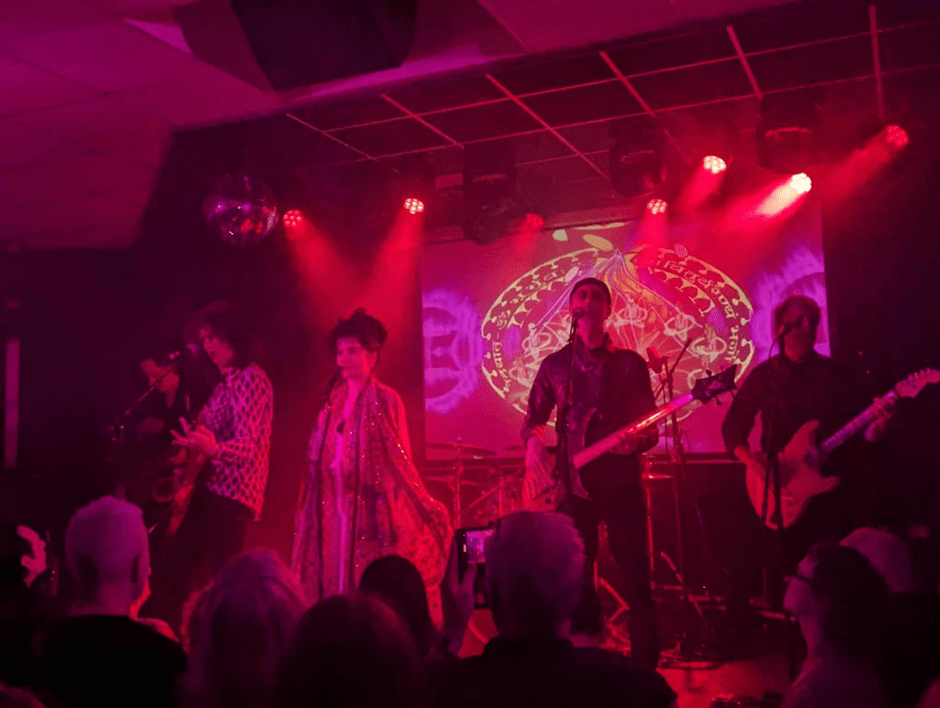
Gong at Leeds Brudenell 2024: Ian East, Kavus Torabi, Saskia Maxwell, Dave Sturt, Fabio Golfetti (hidden – Cheb Nettles) Photographer: Phil Howitt
Future Gong projects

Finally I asked Fabio about the band’s touring work with Steve Hillage and also about future projects

This line up had the honour to perform as the Steve Hillage Band, in 2019 and 2023. Steve & Miquette recruited us to perform a series of shows playing music from his classic albums, ‘Fish Rising’, ‘L’, ‘Motivation Radio’ and ‘Green’. It was a fantastic experience to see these two amazing artists at work. We played in many nice places, including Loreley in Germany, where they used to do Rockpalast, memorable gigs at Shepherd’s Bush Empire and Friars Aylesbury, and also recently at a festival in Poland where we had the pleasure to meet Nick Mason in person. Nick is a very sweet person and has a long connection with Gong/Steve, producing ‘Shamal’, ‘Green’, as well as, of course, ‘Rock Bottom’ by Robert Wyatt.

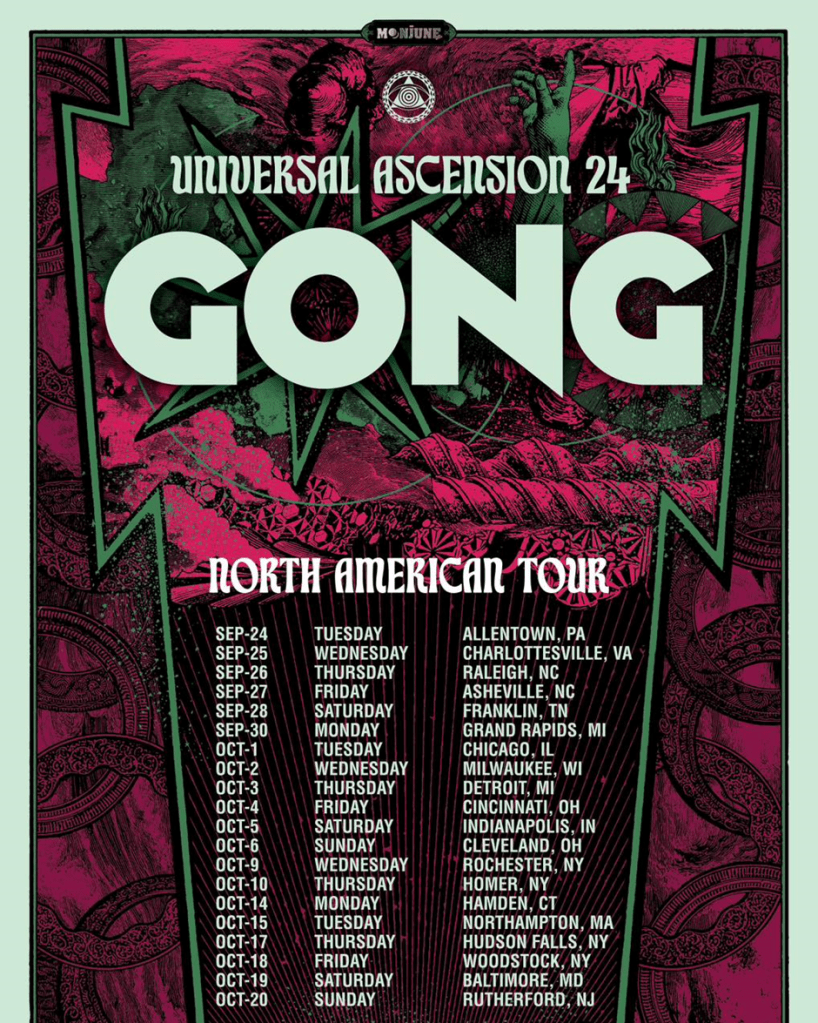
Gong are going to have a pretty intense next three years touring the UK, Europe, the Americas, and sometime hopefully we will go back to Asia. At the moment many Gong projects are lined up: tour in North America in September/October, Europe in November/December, and possibly a return to the US in the Spring of 2025. We will release a Special Edition of ‘Unending Ascending’ with live bonus tracks from the last tour, we are working on the anniversary edition of ‘I See You’, and start writing new material for the next studio album to be released in 2025.

On the solo side, I’m writing a new album following the previous album ‘Songs & Visions’, which for me is a return to my formative years in the 70’s, when I started listening to contemporary music and jazz, especially ECM, with plenty of atmospheric and organic sounds.

Thanks to Fabio for being such a willing, informative and engaging interviewee and for providing the exhaustive discography below which spans a career now stretching back over 40 years.

Gong play their first extensive tour of the United States for a number of years, starting in September.
Fabio Golfetti Discography and bandcamp links

https://fabiogolfetti.bandcamp.com/

https://violetadeoutono.bandcamp.com/

https://invisivelrecords.bandcamp.com/

Solo and with Invisible Opera Company of Tibet

1989: Ópera Invisível – Numa Pessoa Só – Single (Wop Bop)
1993: Glissando Spirit (Low Life / Voiceprint)
1994: Glissando Spirit Live / Live at Brittania Cafe (Voiceprint)
1996: Cosmic Dance Co. (Nova Sampa)
2010: UFO Planante (w/ Invisible Opera Company of Tibet) (Voiceprint)
2022: Songs & Visions (Music Magick)

Violeta de Outono

1986: Violeta de Outono – EP (Wop Bop)
1987: Violeta de Outono – LP (RCA)
1988: The Early Years – EP (Wop Bop)
1989: Em Toda Parte (BMG)
1995: Eclipse (Record Runner)
1999: Mulher Na Montanha (Voiceprint)
2001: Live at Rio ArtRock Festival ‘97 – CD/DVD (Rock Symphony)
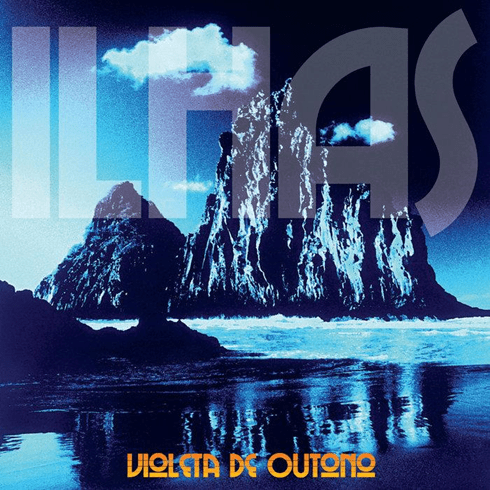
2005: Ilhas (Voiceprint)
2006: Violeta de Outono & Orquestra – DVD (Voiceprint)
2007: Volume 7 (Voiceprint)
2009: Seventh Brings Return – A Tribute to Syd Barrett – DVD (Voiceprint)
2011: Theatro Municipal, São Paulo, 03.05.2009 – DVD (Voiceprint)
2012: Espectro (Voiceprint)
2016: Spaces (Voiceprint)
2020: Dia Eterno (Music Magick)
2022: Outro Lado – CD (Music Magick / Voice Music)

Gong

2009: Gong Global Family – Live in Brazil 2007(Voiceprint)
2014: I See You (Snapper / Madfish)
2016: Rejoice! I’m Dead! (Snapper / Madfish)
2019: The Universe Also Collapses (Snapper / KScope)
2022: Pulsing Signals – Live (Snapper / KScope)
2023: Unending Ascending (Snapper / KScope)

Lux Æterna – Gabriel Golfetti

2021: Lux Æterna : Dream (Music Magick)

Other artists

1983: Zero – Heróis/100% Paixão – Single (CBS)
1984: May East – Caim e Abel – Remota Batucada (EMI)
1986: Kafka – Tribos da Noite – Musikanervosa (Baratos Afins)
1990: Dialeto – Vermelha – Will Exist Forever (Faunus)
1992: IRA! – Um Dia Como Hoje – Meninos da Rua Paulo (Warner)
1994: Angel’s Breath (w/ Suba – Mitar Subotic) (Imago Records)
1994: Taciana – Janela dos Sonhos (Natasha Japan)
1995: Concreteness – Squinting Look – Pircórócócó (Banguela)
1996: Barella & Frippi – Danza – Alvos Móveis (Suck my Disc)
2000: IRA! – Ao Vivo MTV (Abril Music)
2001: Pacto Social – Final do Mês – Cantar /Protestar (CD You)
2002: Momento 68 – On/Off – Tecnologia (Voiceprint)
2002: Jupiter Apple – … So You Leave the Hall – Hisscivilization (Voiceprint)
2007: Torture Squad – Hellbound – Hellbound (Wacken)
2008: Daevid Allen And The Glissando Guitar Orchestrae – The Seven Drones (Dakini Records)
2008: Arco Duo – In Space Rock (Voiceprint)
2010: 48 Horas – Cidades – Cidades (48 Horas)
2013: Spirits Burning & Clearlight – Healthy Music In Large Doses (Gonzo)
2014: Kaiambá – Made in Brazil (New Music / Green Tree)
2015: Dr Fantástico – Sweet Opium Music (Voiceprint)
2015: Spirits Burning – Tripping With The Royal Family – Starhawk (Gonzo)
2015: Dave Sturt – Unique & Irreplaceable – Dreams and Absurdities (Esoteric Antenna)
2017: Vespas Mandarinas – Carranca e Expresso (Deck)
2021: The Frame Of Life – w/ Renato Mello (Music Magick)
2021: Alex Antunes & Death Disco Machine – Acaba Lá Com Isso (Ultra Gash)
2024: Frame Of Life – 2 – w/ Renato Mello (Music Magick)

For other interviews in the Canterbury 2.0 series, please click here
Canterbury 2.3 – Fabio Golfetti interview Part 4– the glissando guitar

Introduction

Part One – Formative Years

Part Two – Violeta de Outono

Part Three – Invisible Opera Company of Tibet

Part Five – Gong

Fans of Gong since 2012 will have become accustomed to seeing guitarist Fabio Golfetti standing stage right with the band, frequently adding texture to the band’s sound through his use of glissando, an open string guitar sound generated by the use of a metallic object sawing across one or more strings of the guitar against a range of  amplified effects. The technique is considered to have been pioneered (or at the very least radically advanced) by Daevid Allen and has been adopted by a number of guitarists both within and outside the Gong family. This section of Facelift’s interview with Fabio looks at his ongoing love affair with glissando guitar.

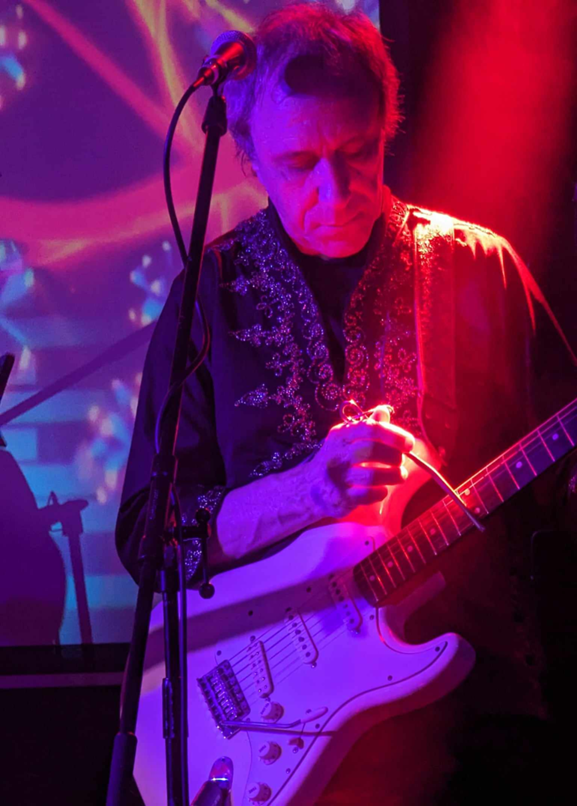
With Gong, Leeds Brudenell, March 2024. Photographer: Phil Howitt

Fabio explains his fascination with the technique:

When I discovered Gong, I always looked at the album credits and said, what does this mean, ‘glissando’? And I couldn’t understand the sound. On ‘Angels Egg’, the sound that was in ‘Inner Temple’, it is amazing.

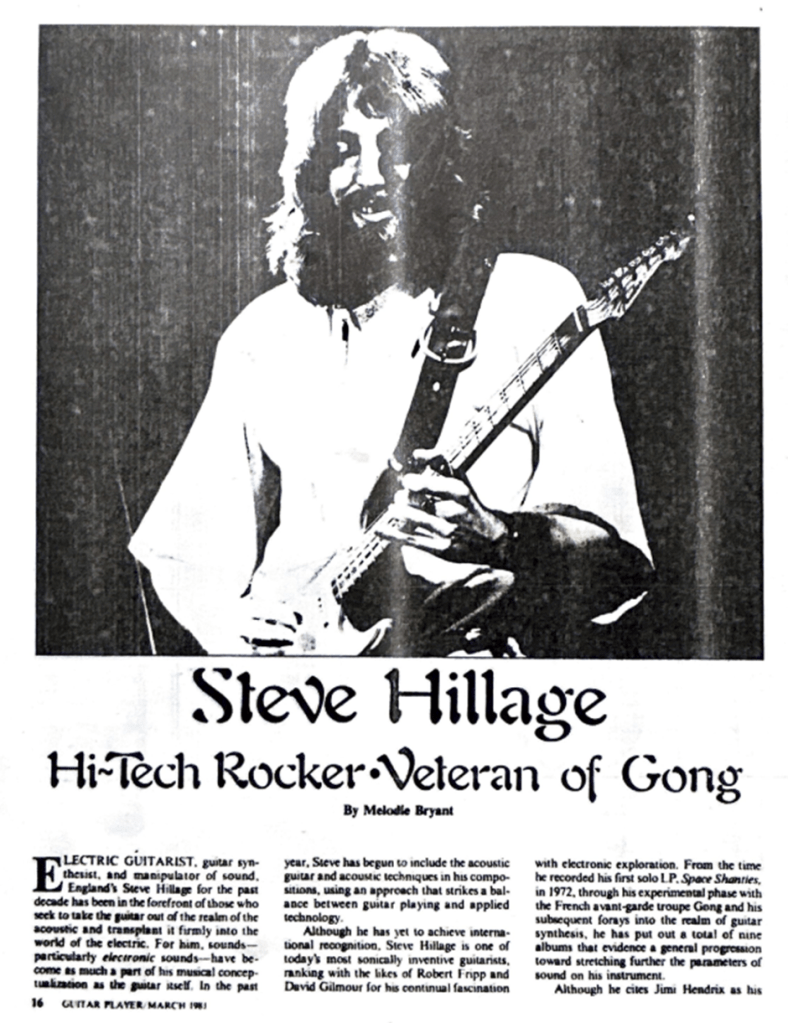
So I listened to this glissando guitar. Glissando is an Italian word, or at least Latin. I know that it means when you go from one note to another without a gap, you pass through all frequencies from one note to another. The master of glissando was Gyorgi Ligetti. You know, the soundtrack from ‘2001 Space Odyssey’, the track that has a vocal was one of his compositions although he wasn’t the composer for the film.  Also there’s a famous composition called ‘Atmospheres’ by the name of the character who went to Jupiter, I forget his first name. This was also by him.  Gyorgi is a Romanian name, Ligeti sounds Italian. And he was one of the inventors of this glissandi, he also composed a piece actually called ‘Glissandi’. I like the word. In 1981, I got a magazine called Guitar Player, there was an interview with Steve Hillage, and there was a picture of Steve holding something and it was the first time I saw a picture that could give me a hint. I still have this interview as a photocopy.

Stevie describes how he does the glissando, how he uses the metal bar. He doesn’t describe the equipment exactly but he mentions the harmoniser, the digital accessory that was very popular at the time to create harmony with the notes but it was more interesting, it has more capability – and he mentioned that he used the harmoniser and the echo and it sounds like a ‘choir of angels’. When I had the pedals, I took a screwdriver that I had at home and tried to do this and discovered that it worked, how it sounded and then I understood the sound behind ‘Inner Temple’.

from Guitar Player 1981

When you play the violin you play notes and then you gliss from one to other. Glissando is similar to a slide guitar but played with the right hand. I started using a screwdriver but you can start with any metal bar just to see the sound and then you can find your own. You have to damp the strings – sometimes you can stroke the string but you must be careful not to break the strings. I will give another hint: if you have a screwdriver it’s straight but if it’s lightly bent it’s easier because if it’s straight you press too many strings at once.

On ‘Fohat Digs Holes In Space’ (from ‘Camembert Electrique’) you can hear the gliss guitar when Daevid moves (the metallic object), but ‘Inner Temple’ is different, it sounds like a  keyboard or Mellotron, but then I understood that  on ‘Camembert’ it was more rough, it is very well recorded, but it is also more distorted.

So I discovered the glissando and alleluia, I started exploring this. The glissando sound was dark in the beginning with Gong because Daevid played with the Telecaster, which is a very noisy guitar and when you play the high strings they don’t have much volume and when you play the lower strings it is much more dark. This is why in my version of ‘Tomorrow Never Knows’ (which launched Violeta de Outono) I only played low strings, also with my Tele. When Daevid had a Gibson Les Paul he improved his technique, certainly from ‘Flying Teapot’ or ‘Angel’s Egg’.

Glissando Guitar Orchestra, Gong Uncon 2006. Photographer: Edneia Golfetti

The first thing I remember Daevid mentioning about the Invisible Opera happening, he mentioned a café cellar in Paris in 1968. I met Francis Linon (the ‘Switch Doctor’ credited on many Gong albums), a couple of times with Magma. And he said ‘oh, I invented the glissando!’ He said, ‘I put an echo on Daevid’s guitar and Gilli’s voice so instantly it became the space whisper and the glissando’ and so he is part of this combination in 1968 when they played La Vielle Grille –  there is a video. So possibly Francis was part of the story too.

But are you aware of ‘Bananamoon’ – a bootleg that was released in France with unreleased pieces of his previous band- there is a rehearsal of (them) playing ‘Why are we sleeping’ and Daevid playing without an echo. You can hear a raw glissando. It is a very bad recording. But he said he saw that Syd Barrett did this exploration and then he found the gynaecological instruments that he saw in a friend’s house.

Daevid Allen / Bananamoon Band – Je Ne Fum’ Pas Des Bananes

But I think that maybe this act that was in Paris in 1968, maybe was the birth of the glissando which they called the Atlantean voices of Gilli, and Daevid doing this glissando. But also they finished their career on ‘I See You’ with this track, they did this recording they called ‘Shakti Yoni and Dingo Virgin’ because this is the seed of this music, and it is really interesting because it is contemporary, avant garde, improvising, very unique – I think they invented something.

So I started with my own glissando, and then I improved the glissando with my own research and I started to discover how to improve the sound, and I am very into technology, pedals, so I went deep into this. Sometimes when I go to sleep, one of my exercises is to think about sounds in my mind, pedals and effects! So I played glissando with Violeta right from the start with ‘Tomorrow Never Knows’, but I had a band in my university years called Lux too – I have a recording of this and you will hear a lot of Gong in it.

Kavus Torabi and Fabio Golfetti with the Glissando Guitar Orchestra, Kozfest 2021. Photographer: Phil Howitt

In Part three we talked about how Fabio became involved in the first performance of the Glissando Guitar Orchestra at the Gong Unconvention in Amsterdam in November 2006. It should be noted that this project has continued ever since, and makes an annual appearance opening proceedings on Sunday mornings at Kozfest. a small festival in Devon. The orchestra has a flexible line-up and in 2021 included both Fabio and Kavus Torabi as both were on site with Gong headlining the Daevid Allen stage the previous night.

The Glissando Guitar Orchestra will play Lewes on 9 November 2024 on a bill which also contains Steve Hillage’s ‘Mirror System’, as well as performances from Dark Zen Kollectiv, Nukli, Jah Buddha, Bob Hedger and Deviant Amps, all of whom  all provide members for the current Orchestra line-up.

Fabio’s glissando playing has been embedded in his playing throughout all of his projects over the last 40 years. In Part 5, the  last section of this interview, we will look at how he came to be involved with Gong in 2012 and how the band has progressed since that time.

Part Five – Gong

For other interviews in the Canterbury 2.0 series, please click here
Canterbury 2.3 – Fabio Golfetti interview Part 3– The Invisible Opera Company of Tibet and the Daevid Allen connection

Part 3 of the interview with Fabio Golfetti concentrates on how a distant connection with the Gong family built over the years through connections with the Gong Appreciation Society, communication with Daevid Allen about the use of the Invisible Opera Company of Tibet monicker, to eventual collaborations with the man himself in a variety of guises, including playing of a central part in the first Glissando Guitar orchestra.

Introduction

Part One – Formative Years

Part Two – Violeta de Outono

Part Four – The Glissando Guitar

Part Five – Gong

I had a contract with Violeta with BMG – RCA in fact, a big company who gave us a big advance to buy instruments to do things. The record label were very rich at that time, (they are still rich) and that was the first time I came to UK, in 1987, in September or October. I came to UK and I bought my Telecaster, in London, in a famous shop called Andy’s on Denmark Street – many artists went there – that was a great guitar.

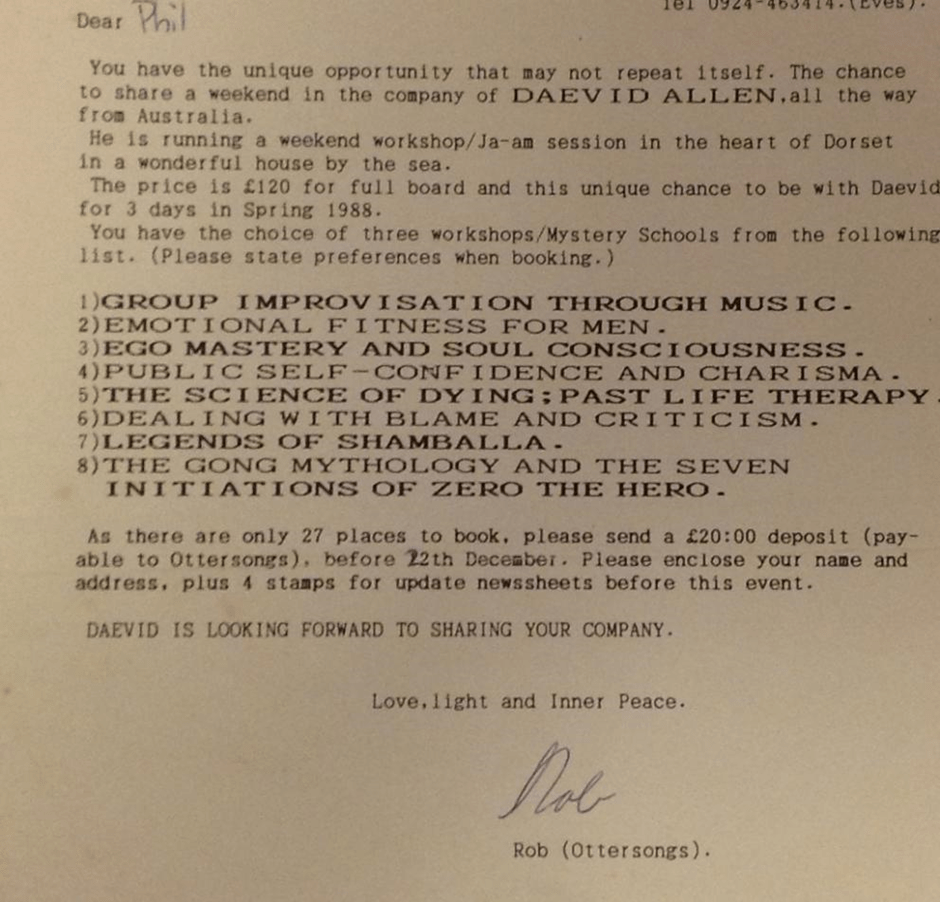
When I came back to Sao Paulo at the end of 1987 in November, I received a letter from GAS. I don’t know who was running GAS at that time, it was probably Rob (Ayling – later to found Voiceprint Records). Rob sent me a letter saying, ‘we’re going to do a workshop with Daevid’, because they’d (Daevid and partner Wandana Bruce) become experts in breathing therapy. In Australia in the preceding years he’d joined some people that worked with alternative therapies and one of those was breathing therapy.  I was invited to participate in this Workshop because I was on a  list of guests.

GAS letter, 1987 – received both by myself in Manchester and Fabio in Brazil!

Daevid wanted to come back to UK to perform, so the idea was to do the workshop to pay his costs for coming from Australia and back to the UK. Now it’s so easy to come and go but at the time it was more expensive and complicated.

But I had just spent my money flying to UK in October, and coming back to Brazil in November, and then I received this letter to come in January so it was impossible. After that Daevid Allen come back to UK and then he started doing just his solo stuff.

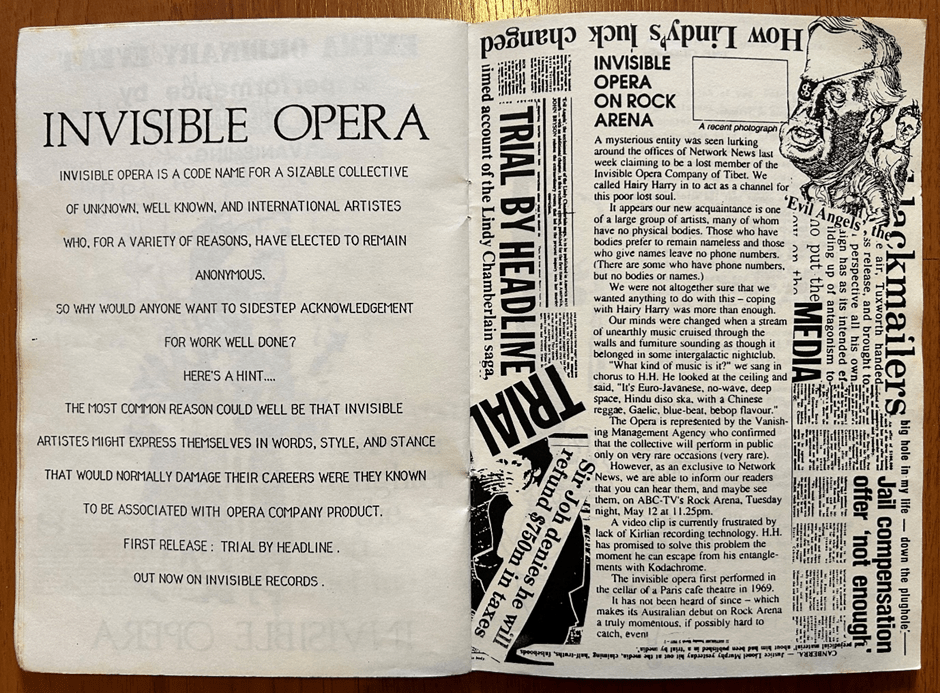
I was fascinated with idea of the Invisible Opera Company, the idea of connecting people, Gong types of people, in different places and you don’t have to show your real identity and then a friend of mine called May East moved to England and then she married one of the main guys in the Findhorn Foundation (an alternative community in the North East of Scotland) called Craig Gibsone. This was in around 1989 and she wrote to me one day, ‘oh I’m here in Findhorn, I’m recording an album and I will put together an album with a guy called Mark Jenkins. And I remembered the guy that you like, Daevid Allen of Gong, he also will be releasing an album here with Mark Jenkins. It is called ‘Stroking the tail of the bird’’. She asked me if I would like her to talk to Daevid because she knew I wanted to try to use the idea of Invisible Opera in Brazil. I said it would be amazing if I could use this name in Brazil. I knew that Daevid used this name. In fact I have all the GAS newsletters and in 1985 Daevid published this newsletter which mentioned invisible Opera Company in Australia but I think it was just an idea then, it might have been called the Nuclear Mystery Temple (at that point).

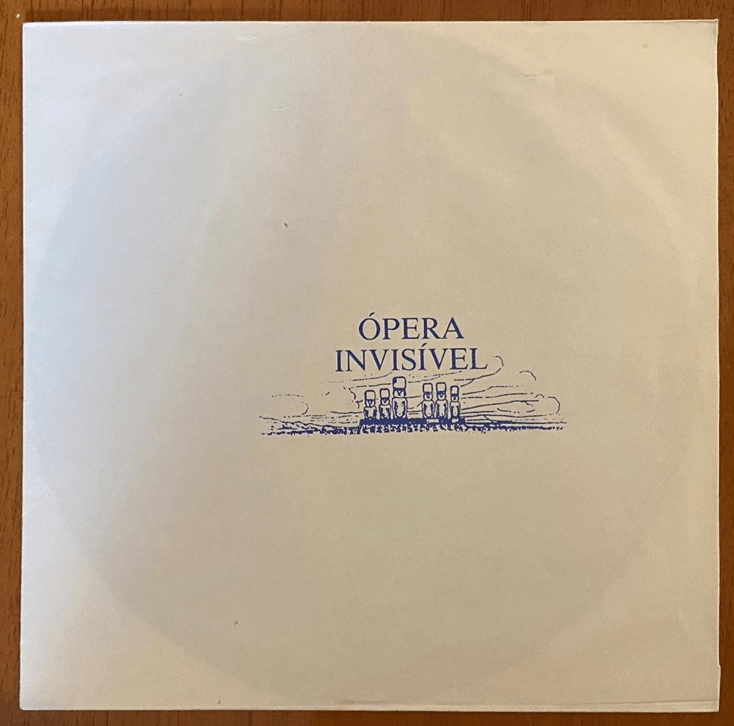
In 1989 I released a flexi disk. I used the Invisibles’ name but in Portuguese – Opera Invisivel. Then, after May contacted Daevid, Daevid said I could do this  but he asked me to send some music, some cassettes for him to listen to what I was doing.

Opera Invisivel – Numa Pessoa So, released on flexi-disc, 1989, Wop Bop

I received a letter, a letter written like a piece of art, this was in the early 1990’s. He said, ‘I have no objection to you using the name Invisible Opera because as you said it is a kind of connection’. I don’t know how many letters I wrote to GAS (in the preceding years) but he had probably read (all) my letters because they must have been in the GAS office after he arrived in 1988.

I talked to Fabio about the fact that when he sent me material across from Brazil in the 1990s, that not only was the music resonant of that of Gong, but even the accompanying artwork was clearly influenced by Daevid Allen.

I think the idea of Gong and GAS was fascinating for me –  I tried to reproduce something similar in my world of Brazilian connections with Violeta and then when Daevid Allen allowed me to be part of the Gong as Invisible Opera then I started to use some imagery that was more connected to the Gong family.

I asked Fabio if he had any personal connection to the idea of an Invisible Opera Company of Tibet beyond its association with Gong music.

I have an  interest in the Oriental Asian culture of China and Tibet because I had a girlfriend at that time for seven years and she also helped me to write some of my letters because she was an English teacher. She was born in Shanghai – they speak English in Shanghai but then I had also had this interest in Oriental philosophy. When I saw Invisible Opera Company of Tibet, it was for me a name that was very interesting because I like Tibetan culture. But for me it’s more complicated than that. I started with the title Invisible Opera title with the drone idea, that type of music, as I’d always been interested in spiritual and meditational aspect of like, and music is connected to this directly. I saw a point where I could focus my music in a spiritual way.

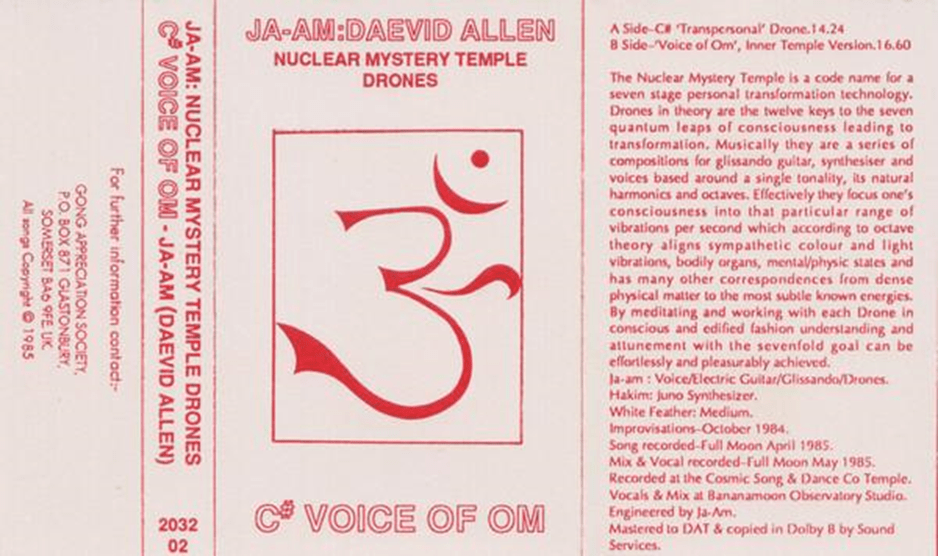
Fabio pulled out a cassette from a box recently acquired from Holland containing a couple of dozen GAS tapes, the mail order artefacts produced by the Gong Appreciation Society – this one was the ‘Nuclear Mystery Temple: Drones’ tape which referenced Daevid’s impending return to the United Kingdom at the end of the 1980s:

This is the cassette that inspired me to start the Invisible Opera Company of Tibet in Brazil.

But then (around this time)  I travelled through Asia. I had a proper job working for the Mayor as an architect for poor people in the suburbs of Sao Paulo, helping people build their own houses– it was the first time the left wing party had a mayor of Sao Paulo. What they did was they went to Sao Paulo university and got the professors to try to give help with buildings for poor people in the city. First they went to the teachers and the teachers went to the students and I was connected because I accepted to be part of this big team of people that tried to bring better conditions for people who worked in the poor areas. So I had a proper job. I was never a big speaker guy, I’m a bit shy, but I had to do a lot of speaking to poor people about how to live in better conditions. I have this job until 1993. I had a day job, and then at night time I went to my small studio producing music for Invisible Opera, not so much Violeta, and then when I had to quit this job because they changed the mayor and the project was disassembled, they stopped all these social projects because the (new) mayor wanted to do this stuff. So I lost my job – I knew this would happen, Edneia (Fabio’s wife) had a nice job at this time. I had good insurance money for 4 years. We could have bought a property or maybe we could travel. We decided to travel for 3 months in Asia, We didn’t have kids at this time.

I did a tour of places that I wanted to go and see, because I am very interested in cultural history, at that time I wanted to make a connection between musical and cultures and food. I read a lot of esoteric books, philosophy, these connections of all the cultures. We decided to fly to Asia, go to Bali, then to Thailand, Nepal and India.

I went to Bali because of the Balinese gamelan, I had re-created this on the computer, so let’s go to see this music live, and how they do this.

Bali is incredible, you probably travelled to the same places I did. I stayed in a hotel in Legian, near Kuta, it was so cheap. I stayed days in Bali, watching the Balinese gamelan, then we flew to Thailand.  Thailand was very interesting but they are more protective, we are just tourists there but we cannot dip into anything musically.

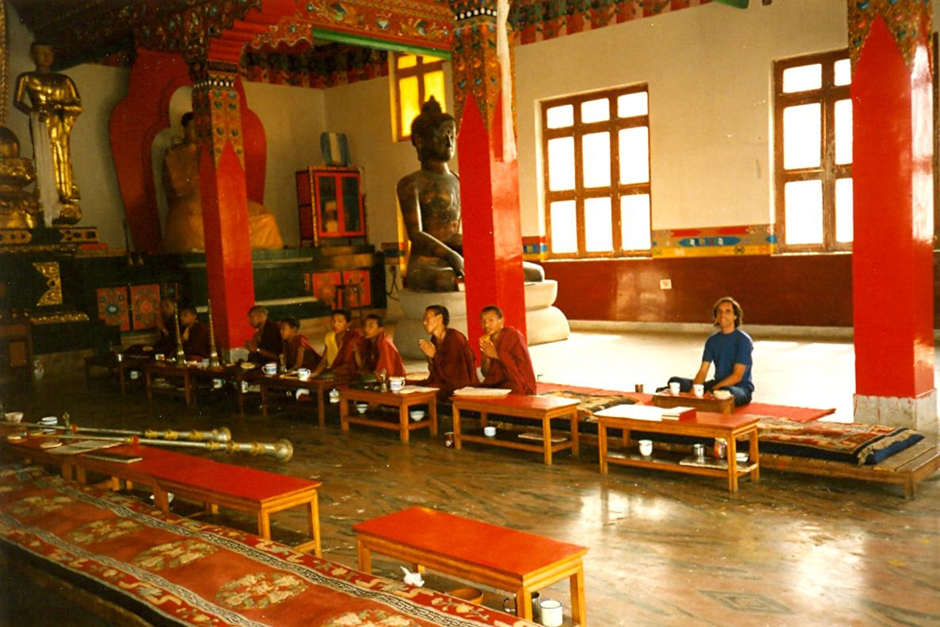
We stayed in Nepal for a bigger part of the trip, in Kathmandu, which was the best experience for me of the trip because stayed inside a Tibetan monastery. I have an interest in Tibetan culture, a friend of mine who is a Buddhist, the sister of May East, Kitty, Christina Pinheiro, she said if you go to Kathmandu you can stay in the same Gompa (temple) that I did because they have a place to host people that go there to study and a retreat, and you can stay there, it’s very cheap, even if you don’t go to do study, you can stay there because they need money. Kathmandu has more Hindu culture and the very poor, they have a very tough life but it is better than India. But they have a difficult life, and recently they had an earthquake which destroyed many of these beautiful buildings, and some of those buildings don’t exist any more.

Then we stayed outside of Kathmandu in a place called Boudhanath where there is an area where there was a big Stupa, the big temple, the round temple with the Buddha eyes in the top and the temple is a Mandala if you see it from the top, it is a 3D representation of a Mandala

So we stayed at this temple, because when Tibet was invaded by China, all the Buddhists fled to India or Nepal, especially Kathmandu

Kathmandu (May 1993, photographer: Edneia Golfetti)

It was very interesting because we were staying inside this temple, and at 3 in the morning the Buddhists started the ritual, the horns, this Tibetan music, and the cymbals, and what is interesting is that you are in a very quiet area, no cars, it is protected by a wall, maybe mediaeval, but you could hear noise in the air, the bells, every time, in Buddhism they have different rituals in different parts of the day, you could hear noise all the time.

So when I went back to Brazil I didn’t have a job, so I stayed in a room for one month with all my ideas, and then I did this Glissando Spirit album. I went to my Atari computer and tried to compose everything I saw in this trip, on the computer, this Balinese Gamelan, all these droney things, of course they are all connected, and also to the music I was hearing at the time, all this electronic music like the Orb.

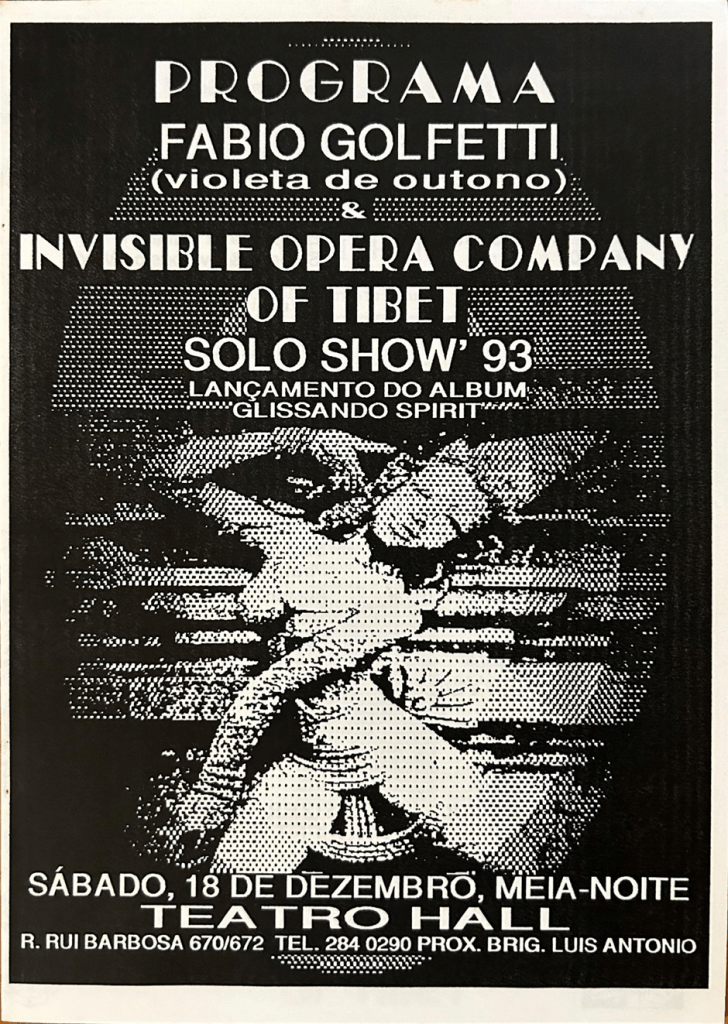
Solo gig for release of Glissando Spirit, 1993

In fact we came to London after coming back from Nepal. I didn’t stop in India because India was too complicated at that time, so I changed my flights and spent extra time in Nepal. Then we flew to London and I went to the record shop, I think it was Tower Records and I bought a lot of records by the Orb. Then I had the idea to do something similar to this trancey music, it was something I was already doing but I improved this.  It was very nice to do the trip, it is amazing when you do something like this it opens your mind for the rest of your life. In Nepal it was quite shocking for me because of the instruments. Some of the Buddhist instruments are made from human bones, they take the femur and turn it into a trumpet,  they cut the skull to make a shaker! Because the Buddhists believe in reincarnation they regard it as a shell, so they do this just for you to remember these things. So I was in a shop and a skull was a tambourine, and this is normal there. If I took it to Brazil then it would be somebody’s head.

My friend Kitti goes to Nepal every year, she has a teacher there, and she always brings me things, she brings spices and Tibetan tea! and once she bought me a statue of a temple and inside there is a mantra in a paper, and maybe there are some ashes in here of someone because it is a sort of relic. This is a bit weird. But I was very fascinated with the Tibetan culture, this mind control, I did meditation for a couple of years, but after having children I have to decide to focus on other things.

So what is the Invisible Opera Company of Tibet? It is a universal concept originated by Daevid Allen, which according to Fabio’s own website is ‘a code name’ – which, in the man’s words, is best described as “an international ideological/ spiritual/ aesthetic communications network for artists of all kinds… who share the common vision of warm hearted, pan-stylistic, inclusive art forms which serve the drive towards conscious evolution”. 

In more practical terms this equates to a number of bands around the world taking on the name: in Australia, with Russell Hibbs (an album under the IOCOT name was released on Voiceprint in 1991); a United Kingdom outfit which emerged in 1992 and has only recently disbanded, led by Brian Abbott; and an American outfit of whom much less is known, and who have no apparent direct connection to other incarnations.

On the Planet Gong it states that ‘in the 1980s Daevid used this concept to bind together a group of flexible personnel, chosen for their ability to channel a quality of music beyond their own normal capabilities’. 

Brian Abbott told me back in 2019 for the Facelift blog– “I believe it’s always been a part of Daevid’s mythology and the whole Gong story. According to Daevid’s  ‘Gong Dreaming 2’  book The Invisible Opera Company of Tibet are a group of ethereal lamas through which the Octave Doctors broadcast their music. They are said to reside in a cave high in the Himalayas.”, although perhaps the most comprehensive attempt at explanation comes on a website here:

https://www.ukfestivalguides.com/artists/invisible-opera-company-of-tibet/

Fabio himself refers back to a text that Daevid wrote as a commentary

I had a small notebook like this size from that time when I wrote all the concepts – something along the lines of ‘why invisible? – because they don’t have bodies’, ‘why invisible opera? – because they don’t like ballet’, ‘why Tibet? Because the Dalai Lama travels by Qantas’… this referred to the physics concept of quantum physics – remember a book called the Tao of physics, they started discovering all this taoism of the Chinese principles were very connected with new discoveries in physics. Daevid always liked to (capture) everything.

We couldn’t find this original text but Fabio forwarded something he found in his own extensive archive of Gong and related material.

Invisible Opera ‘explanation’, GAS Mag, 1988

So the first thing I understood about Invisible Opera Company was exactly was what you can read in those notes. Daevid opened a kind of a portal – the Invisible Opera Company of Tibet for some reason – because he wanted to connect people in different places –he was in Australia and then he connected with people in UK like Brian Abbott who still carries the Invisible Opera spirit (the UK version of the band only concluded in 2023) and he he created a version of Invisible Opera that started in Australia with Russel Hibbs. But then I felt that I could be part of this concept of an Invisible Opera network because I like Gong music and I make music that maybe fits in to this spirit of Gong. I stayed in touch with Russell by letters in the 1990’s and I met Brian Abbott personally with Jonny Greene in the early 2000’s and the first time we played together was doing a gliss session at Nigel Shaw’s studio. My style is not exactly what Gong did in the 70s because if you listen to the music I play more naturally, it is much more Syd Barrett, more Pink Floyd than Gong, not the humour of Gong but I’m very passionate about the glissando, this for me was my instant connection with a way to play guitar.

And I also discovered glissando – I had been a Gong fan since I was 15 but there is always a question about what you really like and what you can be. I like John McLaughlin, but I would never be a John McLaughlin level musician, and I’m not interested in being John McLaughlin but the connection with Gong was with this concept of opening a kind of network through which we can exchange ideas. In fact I was already doing this with my friends in Brazil, with Renato (Mello) and also with May East. She was also was part of it because she was a famous musician she played in a very famous 80s band called Gang 90, a popular band in Brazil who did TV shows. She wanted to move from the pop scene to more new age music – she was more interested in following a spiritual path in music in the 90s. My Invisible Opera was a connection of these people in Brazil with me because she was my friend and we have a connection greater than just music.

I tried to create this Invisible Opera concept in Brazil in Sao Paulo because of my friends and my connection to what Daevid was doing with the drones. Things became clearer to my mind when I read Daevid Allen’s notes for a GAS tape.  I received a cassette in 1985 (from GAS)  called the Voice of Om. There was a drone, there were songs and there was a type of meditative music. This was my main catalyst in creating something similar, or at least something in this direction. I became fascinated with drone music and the way the music interacts with the body.

GAS Tape: Nuclear Mystery Temple Drones, 1985

I’m interested in Indian music and Tibetan music, although Tibetan music itself is actually a bit different. Popular Tibetan music might be much more like Chinese music but ritual Tibetan music is a bit monstrous – it’s not music that you can stay meditating and relaxing like Indian music that you focus your consciousness on. Tibetan ritual music is much more atonal,  not pleasant, and maybe in the Tibetan Buddhist ritual this make sense because they are part of the readings they call pujas like a big ritual that lasts hours.

So then I just tried to use this Invisible Opera Company concept by channelling this idea of creating music in this direction, a bit of new age music. I put a credit in French – ‘Opera Invisible’ – to acknowledge the inspiration.

So what was your direct connection with Daevid?

FB: I received a letter from Daevid and we stayed in touch for a while by letter, this was in 1991 before the internet. And then May (East) moved from the pop/rock scene into ecological and New Age causes. She came to the UK and became part of the Gaia Foundation before going to Findhorn. She stayed in London a couple of times where she met Mark Jenkins. She went to Findhorn I think in 1991. Then in Brazil in 1992, in Rio and in the capital Brasilia there was a big ecological summit they called Rio 92 or Eco-92 or Earth Summit. May was working on this, and it was connected to various governments, and she told me ‘I would like to invite Daevid to come to play with you in Brasilia –  Daevid has worked as an activist (artivist) in this area.’

Daevid wrote me a letter saying, ‘it would be good if I can come, me and maybe Mark Robson (Kangaroo Moon)’ (too) because they were playing together. I didn’t know how I would be involved because at the time I was playing with Renato (Mello) but I went to another friend, RH Jackson (Jack) who was working on the programming of the album and then talked with Daevid. Because of the budget they didn’t get enough money to pay for flights, so Daevid said, ‘I’ll go anyway without any money – and they provided the hotel and he came to meet.

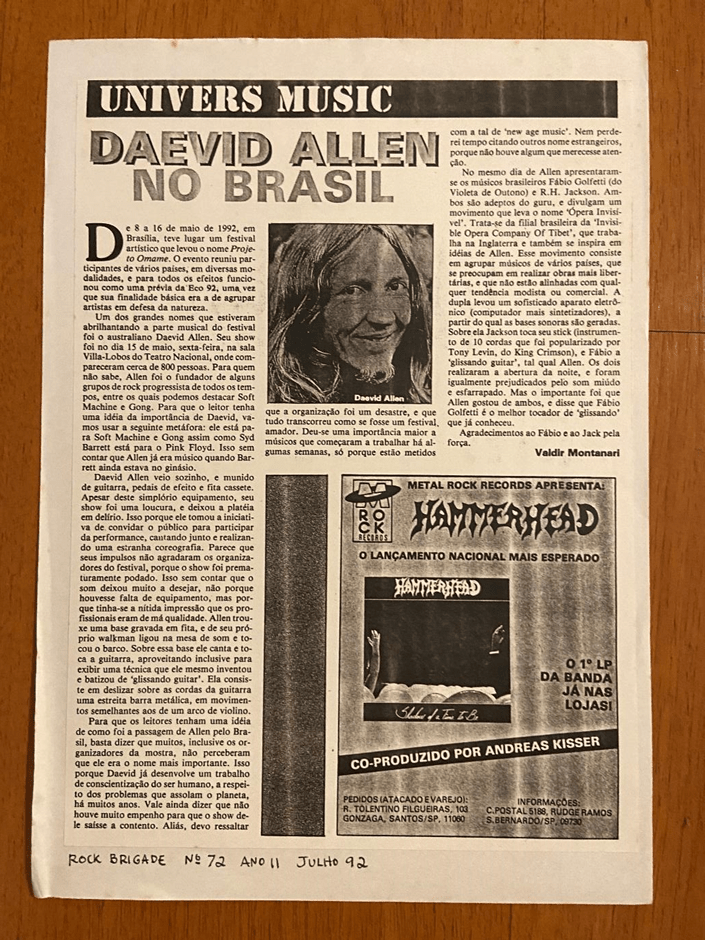
In fact we didn’t play exactly together. I played a set and he came to my set and from where I stopped he continued the set because we didn’t have time to improvise to do this thing – it was a bit complicated. So I did a set with my friend – I played some of my music with electronics – the thing I  was doing with my Invisible Opera version and he came with his ‘Twelve Selves’ set.

Review of Daevid Allen’s appearance in Brazil, Rock Brigade, 1992

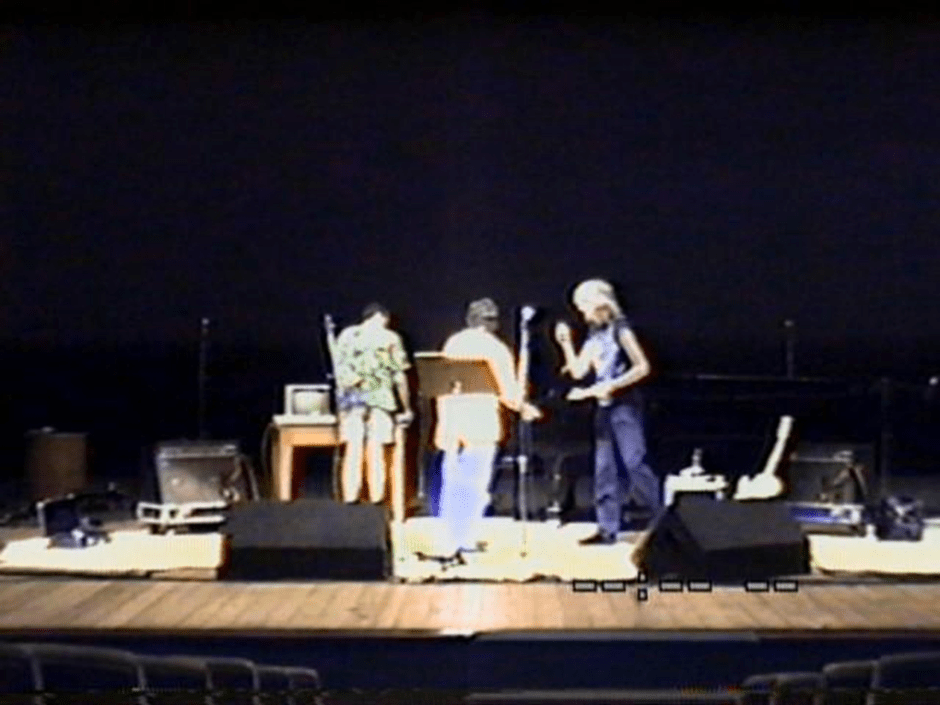
Daevid came on stage and he created this big drone with the audience. He had been doing ‘Twelve Selves’ in small clubs for 50 people and suddenly he ended up playing with this festival for more than 1,000 people – it was a big theatre.  Daevid started his set and he jumped from the stage to the first row and started with other people, and made a massive circle with hundreds of people doing the circle and started singing one note –  it’s an F –  the first note of the drone, and everybody sang  – almost a thousand people singing this note.  I pressed the playback tape and then he started playing the glissando over the people’s singing.  I don’t believe he did this show to a bigger audience than this – it was remarkable.

Jack, Fabio and Daevid in Brasilia, 1992 (photographer: unknown)

He’d travelled for the show from San Francisco and he’d bought a small guitar tuner there. It was a digital tuner, a new one and after the show someone stole the tuner. Now Daevid – he wasn’t a rich man, he lived in a very limited way. The next day he was going home and I had a digital tuner and so I wrapped it inside my whiskey velvet bags and I didn’t see Daevid because he was leaving early so I said to someone ‘can you do me a favour, wrap this in a packet and give this to Daevid but tell him not to open it because he probably will not accept’. When he opened he saw it was my tuner and he wrote me a big letter just to say thanks about. This is one of the things that solidified our relationship.

Meanwhile, Fabio’s use of the Invisible Opera Company of Tibet monicker began in earnest. A cassette jointly credited to Fabio and the Invisible Opera Company of Tibet appeared as ‘The Eternal Voice’ in 1991, a meditative piece heavy on glissando, Chinese inflections through synthesiser and guitar, and additionally input from May East and Renato Mello, with just a couple of gentle vocal pieces. ‘Cosmic Dance Co’, followed in 1992, and is even more reflective, very much building on Daevid Allen’s drone influences. But it wasn’t until 1993 that Fabio started to frame the Invisible Opera Company of Tibet into a broader, more formulated context with the ‘Glissando Spirit’ project. This initially was a series of tracks purely performed by Fabio, in his words using ‘aspects of oriental music and space-rock performed on guitars and synthesizers (including drum machines)’: This was later revisited, with welcome additional instrumentation from drummer Claudio Souza and saxophonist Renato Mello for a Voiceprint release in 1996. However, in the meantime the ‘Britannia Café’ cassette had appeared, my own introduction to the Brazilian arm of the Invisibles and as such still my own main reference point. As I wrote in my review, ‘this IOCOT use many of the classic Gong sounds (glissando guitar, discordant sax, spiritual acoustic works, tuned percussive sounds) and incorporate the into their own forward-looking music. At times it’s almost like listening to a new Gong album…’ It also mentions the liberal ‘quotes’ from New York Gong, Soft Machine, and even The Orb adding to that sense of almost eery familiarity.

That recording, we played that gig in an old cinema in Sao Paulo on a Thursday night, midnight, it was freezing, unusually, 10 degrees for us is very cold. And we had just 80 people in the gig in a big cinema. So the sound guy said to me, ‘we have just 80 people –  I can never make a good mix – it is too empty, the sound is not good in any situation, would you like me to mix live for the recording’. I said, ‘do a recording, maybe we can use it later’. It wasn’t what the people heard, it was more what he heard on his headphones. I think it was the best decision.

I had an instant connection with Renato – we have a kind of chemistry. I know we could never sound like Gong because technically if you look to Gong, Pierre Moerlen drumming, Didier playing saxophone, you will never find anyone like this. Renato Mello (the saxophonist), he very much looks to Elton Dean, and John Coltrane, his sound is – he is not a professional, but for me he has a big talent and his older brother was the one that introduced us to this music, me and him.

Opera Invisivel,  Renato, Fabio, Nelson, 1991 (photographer: Zico)

I had some press when I released the album, because I did promotion in normal newspapers and they mentioned that I had received reviews in England. This is an important story for us, for a Brazilian musician to have recognition overseas. Voiceprint did a very good job at restoration, it was by a guy called Dallas Simpson, in Yorkshire.

Just to complete the Invisibles story (for the moment at least), in 2010 Fabio sent me a copy of a newly completed album ‘UFO Planante’, the title itself a nod back towards Fabio’s first band Lux. The ambitious scope of this album is immediately apparent: around 2 hours of music, which although based, like the core Violeta project, around a trio of musicians (Gabriel Costa on bass and Fred Barley on drums) it shows clear progression from the Glissando Spirit into a fully coherent group artefact – the album’s opener ‘First Contact’ is a alternatively effusive and pulsating rambling 27 minute psychedelic jam. The album overall may be Fabio’s finest moment, recalling the warmth, groove and space of Gong’s Trilogy-era instrumentals, with some glorious guitar work on lead, rhythm and glissando throughout.

UFO Planante, 2010

Returning to Fabio’s relationship with the wider Gong family, Fabio talks more about how his relationship with Daevid developed during the Noughties.

Daevid he told me that he had an idea for a Glissando Guitar Orchestra and that I would  be the first person he contacted. I remember seeing from Jonny (Greene, from GAS) that he was doing a Gong reunion in 2005 in Glastonbury. And so I wrote and said ‘I know you are doing this Gong reunion, do you think it would be worth me joining you?’ And Jonny said ‘maybe, but wait for next year because we will be organising a big Gong reunion in 2006.’ And so the Glissando Orchestra performed in Amsterdam in 2006. It was very good to meet everybody. There were 10 guitarists.  I didn’t know exactly what was going to happen because the Gong Unconvention was 3 days in Amsterdam, all the Gong family, and for me it was the first time meeting everybody. We met with Gong in Colour Sound, a big warehouse where they provided the light show. There was one bus for the artists, one bus for the crew, and a big trailer for the equipment, and we all met there and went to the Hook of Holland – it was a long ferry journey during the night and I was very sick, it was November.

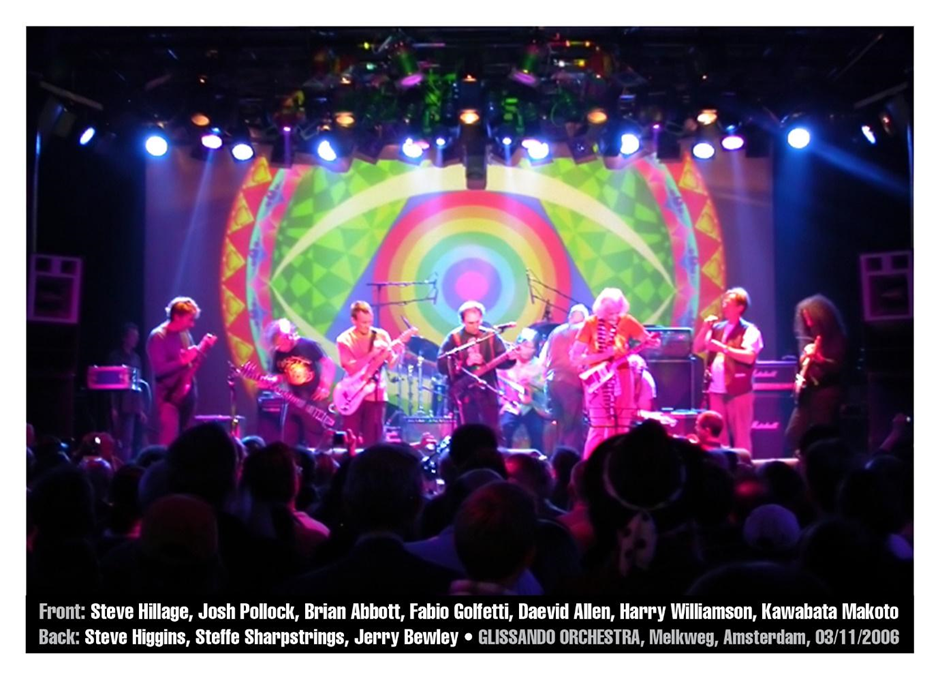
So we did this gig with the Glissando Orchestra. What Daevid did was this: it was (led by) me and Daevid. He said to me, you should be the main glissando, you should stay in the centre – oh no! – He put me in the centre. I was very shy. It was Steve (Hillage), Steffe (Sharpstrings) , Brian (Abbott), Harry Williamson – he was there recording. There was Makoto (from Acid Mothers Temple), Josh Pollock (from University of Errors) the other guy was Jerry Bewley who was there with Kangaroo Moon. There was another guitarist, Steve (Higgins, from House of Thandoy) – he died recently

The Glissando Guitar Orchestra, Gong Unconvention, Amsterdam 2006 (photographer unknown)

In fact it was improvised – he took all the guitars in the party, and then there was a friend of Daevid called Mic Cosmic, who conducted the glissando. We played the 7 drones, starting with C, for 7 minutes each. So Mic hit a Tibetan bell and we started and hit it again  every time we were to change key. It was recorded and was the first ever Glissando Guitar Orchestra performance.

Fabio’s central role within the first performance of the Glissando Guitar Orchestra would lead to further collaborations with Daevid, this time on Fabio’s home turf:

Gong Global Family 2007, Brazil

I had a very good relationship with Daevid, sometimes he was like a father for me, very protective in some ways. In 2007 I was in contact with my friends from Invisible Opera and one of them. Gabriel Costa, told me about a big festival 3 hours from Sao Paulo, the Festival Contato at the University of Sao Carlos and one of the promoters, Mauricio Martucci asked me if Daevid could come. They wanted to ask Daevid to play and asked if I could provide a support band for him to play what he wanted. So I asked Daevid, ‘do you want to come, I can arrange the musicians from Invisible Opera to play here’ and he said yes, but he wanted to bring someone, possibly because he was a bit insecure to play things by himself, so he decided to bring Josh Pollock who he was playing with at the time with the University of Errors. Michael Clare (the University of Errors bass player) also came by himself, not to play, but as he was here, we did a gig with the University of Errors playing before us with Fred (Barley) on drums, our drummer.

So it was the first time we played as Gong. Daevid said, let’s call this Gong Global Family. There was no Gong (band) at the time. We recorded the gig and Daevid loved that album, I gave that album to Rob Ayling to release (Gong Global Family – Live in Brazil, 2007, Voiceprint)

So in 2007 we spent a week together. Daevid was a very soft person, very interesting. The first I had met him in 1992 he was 50, so he wasn’t very young. Maybe when he was very young he was more punchy, but at that time after doing this meditation, this rebirthing, this kind of new age, maybe it changed him a bit.

Gong Global family, Brazil 2007, photographer: Angelo Pastorello

But now 5 years (sic) after he’s gone – it’s like some (of his impact is) disappearing. Nobody talks much about him.  In our bubble sometimes we mention Daevid Allen but it’s something that passed so fast.  I think in history you have some remarkable personalities of people who stay alive, in books or whatever…  I think Daevid Allen was so important …

Fabio’s collaborations with Daevid would culminate in him joining Gong in 2012, which will be covered in the final section of these interviews. In the part 4 of the interview, however, Fabio talks more about his love affair with the glissando guitar…

Part Four – The Glissando Guitar

The music of the Invisible Opera Company of Tibet (Tropical Version) is available at https://fabiogolfetti.bandcamp.com/

For other interviews in the Canterbury 2.0 series, please click here

Canterbury 2.3 – Fabio Golfetti interview Part 2– Violeta de Outono

Introduction

Part One – Formative Years

Part Three – Invisible Opera Company of Tibet

Part Four – The Glissando Guitar

Part Five – Gong

Violeta de Outono have been playing in Brazil for almost 40 years, and have recorded a dozen or so ‘core’ albums (the picture is slightly muddied by Fabio’s extensive restoration of early material, live performances, special projects including orchestral interpretation of their works, and reworkings of their classic material). But as we hinted at in the previous episode, Violeta de Outono evolved from a number of other bands in Sao Paulo in the early Eighties.

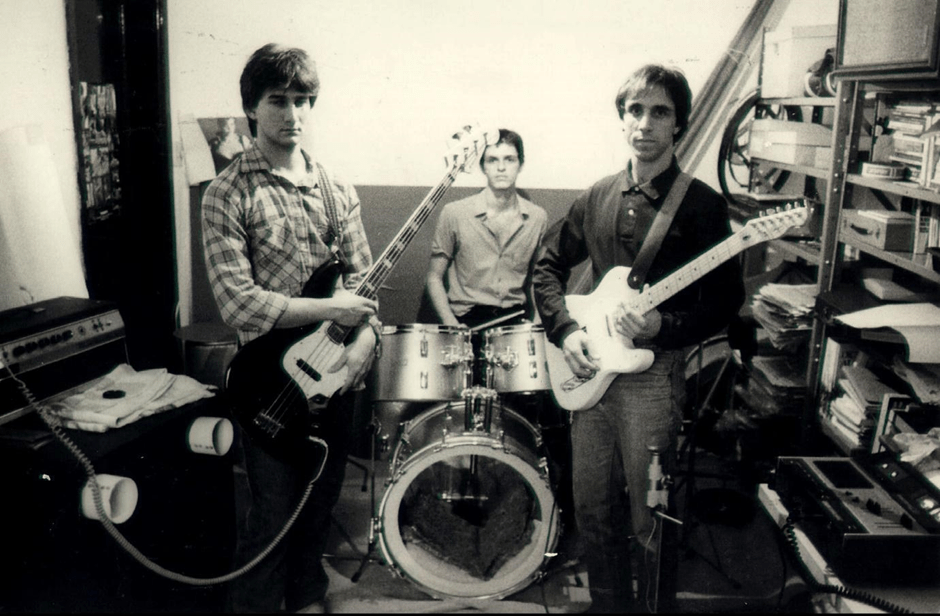
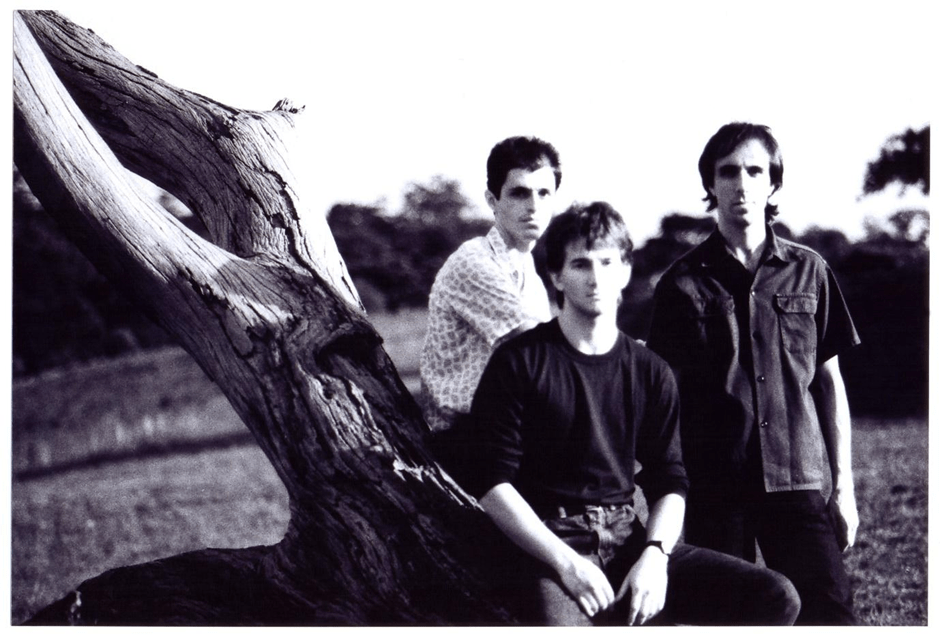
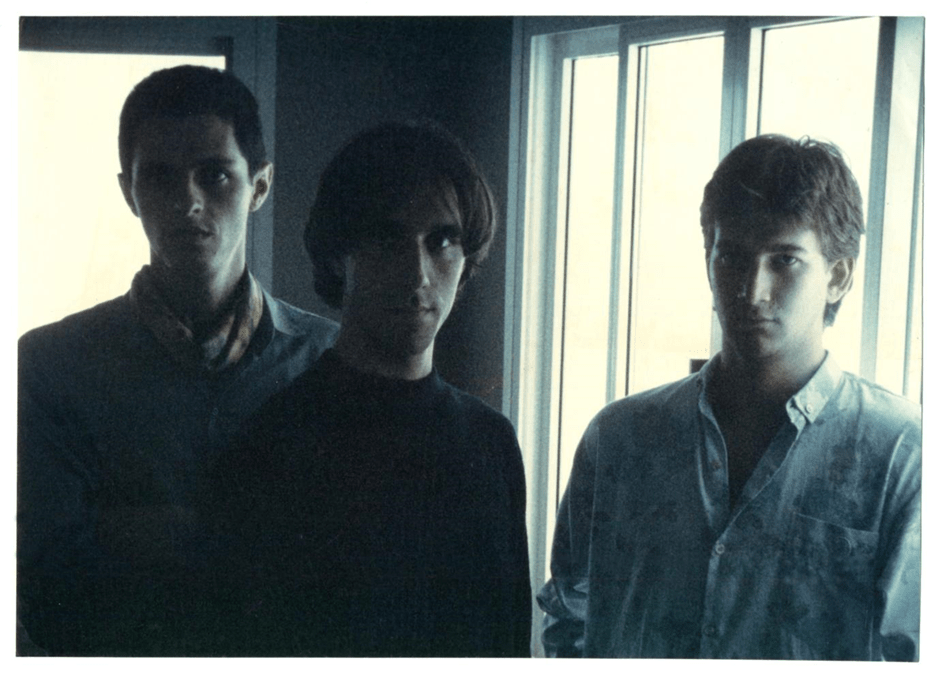
Fabio Golfetti with Violeta de Outono (photographer unknown)

I had a band called Lux (in 1981/2), then we changed the name to AMT-1, because it is an abbreviation of one of those things in the film 2001: A Space Odyssey, and then for the third time we changed the name of the band, because when we changed a member we changed the name of the band, so we changed the name to Ultimato when Claudio Souza joined. This was the band in which we started to develop the sound of no wave, the mix of punk and jazz, we were more instrumental, this was in 1982. After this the band became Zero, because we decided if we were instrumental, we wouldn’t get anywhere, and we needed a vocalist to become more popular, and play in different places, and then we found the singer for Zero.

We wanted to see what could happen as we were inexperienced. The drummer Claudio (Souza) had been with me since Ultimato, then we continued with Zero, then we started doing Violeta de Outono in parallel. By then I was already playing glissando, I already had the equipment to play glissando properly, and the first thing we played with Violeta was ‘Tomorrow Never Knows’. We wanted to play psychedelic music, and decided to play this simple song I could play on the gliss. I always say, that with the Beatles, if you go to ‘The White Album’ you can see all the styles of rock on this album. ‘Tomorrow Never Knows’ was actually on the previous album but it defined a style. If you have ‘Helter Skelter’ you have a band that can play music in this style. So I decided that ‘Tomorrow Never Knows’ was the style of band I wanted.

The two friends that I started the band with (Claudio Souza and Angelo Pastorello) were friends from our teenage years and they never became professional musicians. We became a professional band but only for three years in the first era of the band. We didn’t make money enough to survive, so Angelo continued with photography and the drummer Claudio has a company selling stones for floors – granite marble. 

I formed Lux with my friend I was 20 years old and when I formed this band me and Claudio the drummer we said, well let’s go back and try to learn music, like try to learn how to write a pop tune, and try to write a song. This is how I found my friend the bass player Angelo – he wasn’t a musician, he’s a photographer, but I said,  ‘Angelo can you just play two notes on the bass – just play!’ –  so I gave the bass to him – we borrowed a bass and he just started to make this most simple thing and this was good because then we start learning again how to how to make music.

Violeta was a very healthy band because me, Angelo and Claudio, this three piece band, we formed because of our friendship. I read one Robert Fripp article saying that for a band to exist there are three ingredients: money, friendship and good music – so you need to have two of these to make a band be successful. For example you make a lot of money and you are friends but you play shitty music – that’s one scenario.  The other one – you play good music, you make a lot of money but you hate each other!

But with Angelo and Claudio we were very good friends from our teenage years so the band – we like the music we play, and we have a very good friendship, so if we make money it’s okay but it’s not necessary. We still meet every week when I’m in Sao Paulo, to play, jam, and eat pizza!

Violeta de Outono, 1985 (photographer: Massarico)

The opening track on the first album, ‘Outono’ (Portuguese for autumn) also did much to set out a benchmark for future material by the trio – a simple strident guitar motif based around 2 notes which ushers in a thundering bassline. Fabio gives the back story to the origin’s of the band’s name.

An interesting story is the lyrics, I grabbed the lyrics from Chinese poetry – that poem, defines the style of the lyrics I wrote – the Chinese write a lot about exile from their Homeland and the poem is about exile in autumn. This is a very old poem from the 12 century translated by my girlfriend Irene Sinnecker. As this method went well I felt I was on the right direction and then I discovered the way to write – normally I write the songs and the lyrics I always write after. I have a melody in my head and then I start – normally I use  disconnected words. Sometimes we do this the same way with Gong – we create a melody and then we start singing anything just to feel the words. It develops from there.

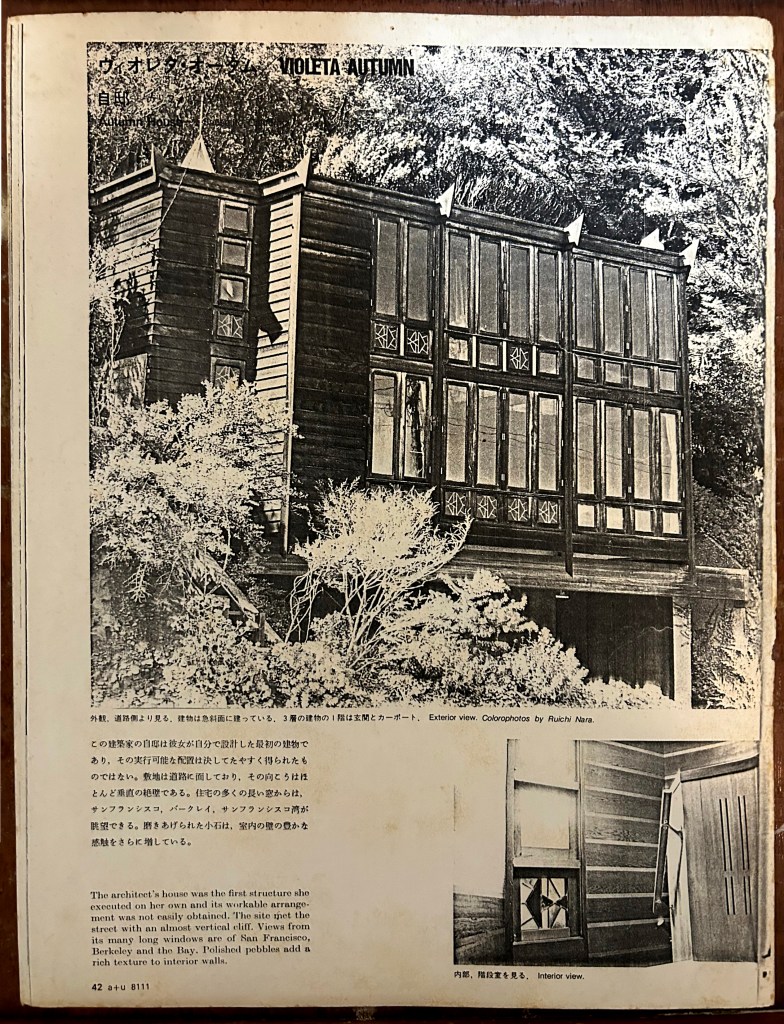
reproduced from https://au-magazine.com/

Another clue as to the origins to the band’s name is from the scan shown above

When I was at the library of the Architectural School, I discovered this article in a nice Japanese magazine called AU . Violeta Autumn is the name of an American architect, and I was very interested in discovering more about it, because we already had the Violeta de Outono name. Now I can find her!

I’ve always been interested in what impact Violeta de Outono had in their homeland – whilst practically unknown in the United Kingdom they are often mentioned, in their own publicity at least, as being movers and shakers in the independent Brazilian music scene. But I’d always got the sense from talking to Fabio that when Violeta started, they reached a large audience relatively quickly and so I asked about how this process came about.

FG: it’s interesting because normally when we play – if we play too many gigs in the same area then sometimes people will not come, but normally if we play in Sao Paulo for example then after a year without playing we have around 500 to 600 people, which is good.

But what is interesting is the renewal: it’s people that heard about the name of the band, some young people. The same happens with Gong. It is not something pre-determined, it is natural and spontaneous.

We were in the right place at the right time. We spent one year (before) playing privately, in rehearsal rooms, because we weren’t confident about playing live and Angelo was learning to play the bass. We composed most of the first album in this first year in 1984, and we continued into 1985. At the end of 1985 my friend Nelson who played with me in Zero, he also had a project and he said he had a date for us to play in Sao Paulo, in a basement, a very nice place, it was for underground music in Sao Paulo for avant garde music. The venue was Lira Paulistana (a name from a famous Brazilian writer, Mario de Andrade), a cult venue where many avant-garde jazz/ experimental artists played, and they opened for the emergent Paulistano (from Sao Paulo city) rock bands. When we played there it was on the 12th December 1985, it seems that we were one of the last bands playing there before they closed.

(This gig is captured at https://invisivelrecords.bandcamp.com/album/lira-paulistana-12121985)

We didn’t have a name at this point, but we decided to use these words, Violeta and Outono. Outono means autumn, Violeta because of the light, the colour. Autumn, all the lyrics were all based on this melancholic Chinese thing. But also autumn we all liked, maybe it was because it was the season I was born.

The gig was for about 100 people, a very small place, but there was a journalist for the main rock magazine called Bizz, and she liked what we did, and she said, I will write a review, I want it to be a feature, and we went to the studio of this big magazine, it was related to a big pub chain in Brazil.

Parallel to this I had an idea around the same time in December (1984).  We were rehearsing in a room, a bedroom, in a friend’s house, it was not a studio, it was just a room with a lot of books, we rented the place and we put our stuff in there. So there’s a drum here, a guitar facing, and a bass here, it is a tiny room. So I had my cassette recorder, an Akai, and I had a very good microphone my friend Nelson lent me, a stereo mic – it captures stereo in a very nice way. Due to my inexperience and based on my intuition, I placed the microphone at a certain height, it is almost between the kick and snare so it captures the guitar on one side, the drums on the other side, the bass in the centre.

original video for Dia Eterno

So I captured this live rehearsal. We did a demo, I overdubbed the vocals with my reel to reel. It was recorded with empathy, we could hear the guitar, drums and bass, and then I overdubbed the vocals with lots of echo, I had this echo pedal. It was just after the gig, and before we released the interview. I sent it to a big radio station with an alternative network which was trying to find an audience for these new trends. They had a good signal – a big area in Sao Paulo and a bit outside. It was called 89FM, which still exists as Radio Rock.

So when we sent the music to this radio, there was one of the guys there who loved the songs. And we were lucky to record in the way we had done, because when you put this in the radio system, because they have a big valve amplifier, and a big compressor, you find that if you have music that has few instruments, like the Police, then they sound big, the drums sound big, so because of this low technology when it was amplified on the radio, it sounds amazing, like these old 60s bands because it was recorded not in a dry studio, a live room, so it sounds amazing on the radio.

So on this radio, with a very big reach, in one month we became popular, they started playing 4 of our songs, they alternated, played more than once in a day, and after a few weeks we were popular on the radio on one of the emergent radio stations. Then we had a gig in March. The radio play  happened January to February, and all the people came and we had a big audience of 600, there was another band, it was a kind of festival, but people already knew our songs, they sing them together, this was after only  3 months! This is why I say we were in the right place. It was spontaneous. Then I realised I had discovered the way to record the jazz drums, if you look at the Dave Brubeck quartet, there is a video of them playing Take Five, if you look at the drums you will see that they put the microphone in the same position!

I believe in intuition, I don’t know what the scientific explanation is, but I think you should trust your instincts.

Nowadays when I record an album I try not to have more than 3 takes. After the third one, for safety, after it becomes more mechanical, you lose the musicality. When you go to intuition you have the best result

So how did things evolve with the band from here?

FG: the first gig was in March, and then the word started to spread. We started connections to magazines, newspapers and these people spread the name of the band and we had a contract with an independent label. The label was Wop Bop, a small record collector shop that decided to start a label, I think maybe I still have 3 copies of this release. We went to the studio and recorded 3 songs because they wanted to do an EP and we said, ‘Violeta has different aspects, let’s do a pop song, ‘Outono’, because it’s very poppy, another song with more instrumental parts, and then we choose a Gongish one, 7 minutes in which I play a lot of gliss, ‘Reflexos da Noite’. That song is very Gonglike, there is a long section like ‘Inner Temple’ with glissando, not well recorded.

(This EP is still available to hear at https://violetadeoutono.com/music/violeta-de-outono-ep/)

Just after recording, we played a lot, in 1986-87, we played maybe 40 gigs, for a band in Brazil this is quite unusual, it is complicated because it is a big country. Gigs were more like for 300-400 people but because we were a new band we were invited to play festivals, radio festivals. We even played in a festival for 4000 people in Rio with all the famous bands in Brazil, As our songs were broadcast on the radio in Sao Paulo, very quickly they spread also into Rio where all the labels were based. The equivalent of 89Fm was Radio Fluminense. Following the example of 89Fm in Sao Paulo, they played our songs and to celebrate their anniversary they organized a big festival in a sports ballroom with bands that already had a big audience, and we were invited because we were considered a promising band, like the youngest child!

Violeta de Outono, 1986 (photographer: Bob Wolfenson)

Most of the bands were 2 years younger than us, because we started with Zero but then we decided to start again, so we were older than most of the bands of my generation

In Brazil at that time there was a very popular rock scene, Rock in Rio (the biggest Brazilian festival, which still exists today)  or Hollywood Rock (which existed between 1988 and 1996) – ‘The festival was cancelled when the Brazilian government prohibited tobacco and alcohol companies from sponsoring cultural and sporting events’) Record labels saw they could make a lot of money, this is why they invested in bands like us.

When I first heard Violeta de Outono, which arrived at Facelift HQ on cassette at some point in the early 1990s, it appeared to be slightly outside my sphere of usual listening. Tracks were short, punchy, stripped down in terms of sound. It had obviously been sent to me because of the Gong connection, and I could hear the glissando, and I could hear the Gong references, but there were other clear influences there, most notably early Pink Floyd, most certainly the Beatles, even elements of Caravan. But in other respects it was almost indie. I was living in Manchester at the time and could hear almost an Oasis-like edge. I wondered if that was deliberate?

Well, we didn’t know about Oasis. It was still the 80s. I like Oasis, but didn’t know about them until 1995, just after my daughter were born. We listened to them a lot, also Kula Shaker. At that time in Brazil there was the birth of MTV, MTV never played British bands, only the American grunge bands, like Pearl Jam, which dominated Brazilian coverage. Oasis played in Brazil in 1998. But Violeta were definitely considered more indie than prog. The band became prog rock after by ‘Volume 7’ like a classic 70s and, but in the beginning they called us a ‘grey psychedelic’ band, it’s not flowery, but more like Syd Barrett’s ‘Pipers At The Gate of Dawn’, Pink Floyd were more grey than colourful. Here and Now was also a big reference point for Violeta because we all loved ‘Give and Take’, Here and Now is closer to what we can do, the songwriting, and the way we played.

Violeta was connected to Gong aside from the glissando because of the first Gong album, ‘Magick Brother’, in fact we did a recreation of ‘Pretty Miss Titty’ (Lírio de Vidro (Glass Lily)) and on our demo we included part of ‘Prostitute Poem’.

I felt with Violeta de Outono that  I had a band, I should work with the material the band were able to produce. The band had a very good chemistry, because when we played we could understand what musically everyone could contribute. I like the drummer Claudio    he’s never dedicated his life to being a professional drummer, but when we play we have an interaction. At the Invisible Opera live at the Britannia, he played – we have an instant connection so this is about what I like, we have a kind of chemistry, but I know we could never sound like Gong because technically if you look to Gong, Pierre Moerlen drumming, Didier playing saxophone, you will never find anyone like this. Renato (Mello – from the Invisible Opera Company of Tibet) he very much looks to Elton Dean and John Coltrane. He is also not a full-time musician but for me he has a big talent, and his older brother was the one that introduced us both to this music.

So for Violeta I thought we should do the music with the skills everybody had, playing this simple organic music, and I was trying to learn how to create chords to create a proper song.

Violeta de Outono, 1985 (photographer: Duda Oliveira)

Despite the fact that we talked for half a dozen hours, and much of that conversation appears in various guises in this set of articles, I realised in retrospect that we hadn’t talked in depth about the development of Violeta de Outono or dissected their many fine albums, so here’s a brief guide as to their development:

Their debut album ‘Violeta de Outono’ (1987) is the album which captured my listening attention back in the early Nineties and set the groundwork for most of the subsequent work for the next few years – these are accessible rock tunes with simple guitar riffs or motifs, occasional eastern inflections, punchy, exposed bass lines and clean drum accompaniment, overlayed with an understated, slightly dreamy vocal delivery. There are plenty of semi-recognisable musical motifs: ‘Declinio de Maio’ recalls Richard Sinclair’s falling vocal line on ‘Winter Wine’; ‘Luz’ or ‘Sombras Flutantes’ revisit the atmosphere and menace of Pink Floyd’s ‘Ummagumma’ excursions, and ‘Noturno Deserto’ inserts those gamelan influences picked up via Fabio’s interest in Asian cultures (further complemented by a trip to Bali). And of course, there is the telltale use of glissando, most notably on the concluding cover of ‘Tomorrow Never Knows’, the most obvious nod to Fabio’s own Beatles influences.

‘Em Tode Parte’ (1989) follows a similar template to the first album if the end result is not quite as striking: there is even more overt reference to some of the band’s influences as Soft Machine’s ‘Joy of a Toy’ is quoted on the opening track ‘Rinoceronte na Montanha de Geleia’, whilst the ‘Flying Teacup’ chant is channelled on ‘Aqui e Agora’. A highlight however, might however be the very Beatlesesque title track, or the ethereal Indian vibes of ‘Terra Distante’.

The third album ‘Mulher na Montanha’ very much constitutes a return to form with its bass-heavy, riffy, driving songs – from the slide guitar on the opening title track with staccato batterie, through to two magnificent pulsing tracks in ‘Outro Lado’ and ‘Crème Gelado, Desculpe’. In many ways this album constitutes perhaps the full realisation of this line-up’s ambitions, complete with a number of raga-like pieces (‘Sonho’, ‘Ilusao’) to acknowledge the link also with Daevid Allen’s post Gong solo work. ‘Espelhos Planos’, meanwhile is notable for containing the original slide guitar riff from Gong’s ‘The Thing That Should Be’, which launched their post-Daevid Allen album ‘Rejoice! I’m Dead’. In fact this album was originally a collection of demos the band presented to BMG – much of the material was eventually recorded as ‘Outro Lado’ (see later).

Cover for Ilhas, 2005

‘Ilhas’, from 2005, contains the most overt references to Fabio and the band’s influences, partly through its titles: ‘Echoes’, ‘Mahavishnu’ and the opener ‘Linguas de Gato em Gelatina’ (Google translate this for a very clear reference point!), but also within the music itself (‘Blues’ hints at Pink Floyd’s ‘Money’ and ‘Mahavishnu’ and ‘Cartas’ Gong’s towards  ‘And You Tried So Hard’).  Less ambiguous is the superb ‘Eclipse’, a gloriously augmented interpretation of the bass line from Gong’s ‘Fohat Digs Holes In Space’, where Fabio’s evocative Gilmouresque guitar chords, pristineness personified, add a whole new dimension to the original. ‘Ilhas’ also sees  the first appearance of Fabio’s beautiful ballad ‘Jupiter’.

‘Volume 7’ and ‘Espectro’, released in 2007 and 2012 respectively, provided a tangible change of direction for the band.

Live studio recording, MOSH, 2013

Recruiting Gabriel Costa on bass and critically, for their new sound, Fernando Cardoso on keyboards ( Jose Luiz Dinola  had also joined on drums for the ‘Espectro’ album), these are the albums Fabio alluded to as satisfying his proggy alter ego: expanded pieces, more extravagant arrangements, with room for exquisite soloing on Hammond organ, more expansive basslines, and overall a more stretched-out method of composition not seen since AMT. Track names such as ‘Caravana’ are indicative of a wider brief than the trio version of the band, and allow Fabio chance to explore more jazzy, progressive territory both as a rhythm and lead guitarist with a hint in many places of bands such as Khan. These are both very fine albums, augmented in 2016 by ‘Spaces’, before Fabio called time on this expanded version of the band.

One should also mention Outro Lado, released in 2022 a celebration of the reformation of the original three piece of the band – these are reworked versions of many of the best of the Violeta early repertoire.

A full discography including all Violeta releases will be included in a later part of this interview series but all things Fabio can be found at http://www.fabiogolfetti.com

In part 3 of this interview series with Fabio, we explore Fabio’s relationship with the Gong network of bands, his own Brazilian interpretation of the Invisible Opera Company of Tibet concept, and how his slowly forging of an enduring relationship with Daevid Allen.

Part Three – Invisible Opera Company of Tibet


For other interviews in the Canterbury 2.0 series, please click here
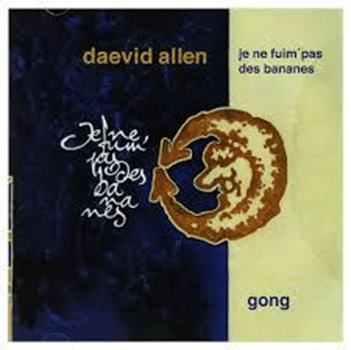
Canterbury 2.3 – Fabio Golfetti interview Part 1– The Formative Years

for an introduction to this series of features on Fabio, click here

Part Two – Violeta de Outono

Part Three – Invisible Opera Company of Tibet

Part Four – The Glissando Guitar

Part Five – Gong

Fabio Golfetti with AMT-1 – 1982 (photographer: Zico)

Fabio Golfetti will be best known to readers of this blog as the guitarist with Gong since 2012, but he has an association with a whole host of music written about here, not just as a collaborator with Daevid Allen since 1992, but also as a purveyor of music with clear Canterbury and Gong influences stretching back to his first bands in the early 1980s. A key part of the first parts of our conversations were to establish how on earth music of this ilk permeated into his consciousness in Brazil in the 1970s.

Fabio Golfetti, as his surname suggests, is of Italian extraction, and the collaborations of both himself and son Gabriel (Stratus Luna) with others with Italian-sounding names, had led me to believe that they might be part of an expat community. In fact the Golfetti family has had roots in Brazil since the late Nineteenth century:

Fabio Golfetti: I think Sao Paulo is the biggest Italian community outside Italy. There were two immigration waves into Brazil by Italians. The first was after Italian unification (in the 1870s). In fact Garibaldi lived in Brazil, weirdly.  But then the Italians came to work on the land, they were mostly farmers. This is why in the south east of Brazil there are a lot of Italians, because of the climate. The climate there is more similar to the European below the tropics.

So my father’s family were already in Brazil before the First World War. The other part of the family came after the war, a lot of Italians tried to go to North America but it was more complicated, but there are a lot of American Italian people in New York and Chicago, the mafioso, there are a lot of stories about this.

Some of my mum’s family went to New York, I probably have family but I lost contact.

So which part of Italy did Fabio’s family originate from?

My father is from Tuscany, in Livorno, which is on the coast, I’ve never been there, they say it is a very beautiful place. My mother is from the south, a region called Calabria, but my grandmother, there is a weird story, she has Albanian ancestry, and she spoke a completely different dialect. She lived with us when my grandfather died, she came to live with us.

And she had a lot of words that are very weird, like Greek, she dressed like a Greek, she had a lot of superstitions, when there was a thunderstorm, she went to her room, like in Asterix, where they have a fear of the sky falling on their heads, I think my grandmother thought the same! But I didn’t have much chance to talk to my grandmother because she died when I was 12, but probably she had a lot of interesting stories.

But my other grandmother lived until she was 90 – she died when I was 25, she had a lot of stories, she saw Halley’s Comet, for example. They tried to move back to Italy.

Lux / AMT performing in 1982 at Architectural School in Sao Paulo (photographer: Zico)

So does Fabio regard himself as Brazilian or Italian?

I feel like a Brazilian. But in fact most Brazilians, especially in my area, now maybe it is different, but my generation are mostly of European descent, many are Portuguese, Spanish, Italians and Germans. When I lived in Sao Paulo, in the beginning I lived in a more central area. My parents moved to a place that I lived until I was 18, it was the German area, it appeared like you were in a European place. It was an emptier area, and we lived in a modest family house, many houses were similar – there were a lot of people around and we all played together, football – there was an integration, all races, no difference between the children. In Brazil we have never had a problem with racism, only more recently, because people need to militate about this maybe because of the propaganda on the internet.

So did Fabio grow up in a musical household?

My father loved music, he loved jazz, he was a very happy person, but nobody (in the house) played any instruments. My father listened to classical jazz like Benny Goodman and other things from this era, I think he stopped at Miles Davis. He listened to only jazz, Brazilian music not so much. Lots of jazz from the late Fifties. He listened to the generation 10 years before him. Like me – in the Eighties I was in my twenties, it was the time I could express myself as a musician, but I was into the music of the Seventies.

So what sort of music was Fabio listening to himself?

When I was 13, I had a cousin older than me, very left wing, radical, we lived together until I was 6, they lived on the ground floor, we lived on the upper floor, I have a very good relationship with this cousin, he was 6 years older than me, when I was 13, I went many times to his house, and he had all these albums, the first album he showed me was Pink Floyd’s ‘Meddle’, Led Zeppelin ‘3’, Rolling Stones, the Beatles not so much. He preferred the Rolling Stones, he said the Beatles was more children’s music. Rolling Stones was more aggressive.

My cousin introduced me to rock music, if you want to know my first albums, I can tell you my first 5. Alice Cooper’s ‘School’s Out’, The Hollies, (I don’t know why I ended up with the Hollies) – ‘Distant Light’, there is a famous song called ‘Long Cool Woman (in a Black Dress)’, this song was playing on the radio when I was 12/13, the third album – I had the Who album, a Ten Years After album, Alvin Lee and the Company.

I had a big stereo. I had complaints from everybody!

Then I started buying, or my father bought them for me. At university I started doing little jobs and I started buying vinyl, most I still have. I have kept 400 albums.

When me and Renato (Mello – later of the Invisible Opera Company of Tibet) got into Soft Machine it really changed our lives. We only had a cassette with ‘Moon in June’ on one side and ‘Slightly All The Time’ on the other side – only these two tracks. I think we were 14, and at the time I only listened to Yes, Genesis, a little bit of ‘Selling England by the Pound’, Gentle Giant. Van der Graaf  Generator I started to listen to later with a friend, but then suddenly we knew about the Soft Machine which was odd music compared to this classic prog. For some reason this caught us in a way that we said, ‘wow, this is the best music’, because we were moving towards jazz a little bit at that time.  I didn’t know about Canterbury or anything related but then one day a friend of mine said well ‘you know Soft Machine ‘Third’?’ Did you listen to Soft Machine ‘One’, it’s completely different!.’ It’s another band and then I found a copy of Soft Machine ‘one’ and then I was, not a shock but I said wow, what is that, it’s more like the ‘Piper at the gates of Dawn’. This  was when I was 15 to 16, in 1975.

I put it to Fabio, that like myself, he was coming to Canterbury music somewhat after the event.

In 1975 I was on holidays with my family, my Dad and my Mom in a place very far away from everything at a beach between Sao Paulo and Rio. We heard some short wave radio from Rio because at that time FM was wasn’t going to this places and they played (Steve Hillage’s) ‘Fish Rising’. I recorded it on a cassette but I couldn’t hear the name of the artist but I had the recording of this amazing music. I didn’t know about Gong at that time.

But then my friend Angelo (Pastorello) from Violeta had a rock encyclopedia and he looked up Soft Machine and Soft Machine mentioned Daevid Allen, and then that was the link – Daevid Allen, ‘oh he formed Gong’, but there was no album with Daevid Allen and then it was a mystery.  Then I tried to hear Daevid Allen anyway. Angelo’s uncle was a famous doctor in psychiatry in Brazil in Sao Paulo, and he went to France and he brought the ‘Angel’s Egg’ album – it was 1976 and then it was for me and Angelo a kind of shocking music because we never heard anything, sounds like that, that with that synthesiser. And then that caught me, Gong – that sound, that music

This came from Soft Machine but it’s more complex than Soft Machine, this is amazing music… The boss of my father was a French guy, a Gong fan. When my father said, ‘oh he’s going to France, do you want to ask him for an album?’ and he bought me Soft Machine ‘Volume One’ and ‘Two’ and ‘Camembert Electrique’ – he bought these three albums.

When I listened to ‘Camembert’  this changed everything. This was 76-77  –  I started earning money at university in 78 and 79 I started working. One day I went to the record shop there was a big import of albums and I saw the gong trilogy – all these albums had appeared on the shelves of the record shop. I bought Angels Egg, I bought You, I bought all these albums.

Was this in Sao Paulo?

FG: this is in Sao Paulo,  there was a very big shop called Museu do Disco  – it was like a record Museum and they did lot of importing. Caravan I discovered later, again from reading this English book called encyclopedia of rock-  It was A4 with plenty of biographies – it was not that complex, but was enough for me to start tracing the path of Gong because of Soft Machine and then I discovered Kevin Ayers and Robert Wyatt.

Fabio Golfetti, Faculdade de Arquitetura, University of Sao Paulo,1978 (photographer: Zico)

So what was it about the Canterbury scene that appealed to Fabio?

FG: Robert Wyatt mainly, because the first album that I listened was ‘Rock Bottom’, my father brought it me from France in 1980, and when I listened, I think ‘wow this is a kind of Soft Machine continuation because there the second track (‘A Last Straw’) sounds to me like it’s ‘Slightly All The Time’ with Hugh Hopper. Because when you are a fan you want to hear the same. I had an instant connection. I liked instantaneously Robert Wyatt’s voice so when I found Caravan in a shop I bought the first Caravan album with Pye Hastings singing like Robert – they have almost the same type of voice. I was in love because it also has a guitar!

And then what I decided to do which was interesting was because of Gong I ended up writing to Charly Records. And then they sent me a lot of information, catalogues, they sent me a Daevid Allen  biography, written on a typewriter. I still  have all of this.

Surely buying from Charly was incredibly expensive

No, vinyl cost £4 at the time. The problem was Brazil has always had a protective trade system, so you have to pay a lot of import tax to buy. At the time in the early 80s, even in Seventies, to send money outside of the country was too complicated, especially in small amounts. Today, it’s no problem, you can use a credit card, Paypal, so I did a lot of tricks to try and send money. One of the tricks was to take a letter, inside the letter I put some cash wrapped in carbon paper, because an Xray will not catch it exactly. The other problems was to find pounds – I remember sending US dollars..

So what about Fabio’s own musical background? We spoke previously about him starting to play the guitar only at 15, but at what age did the my first band happen?

I started playing acoustic guitar with an aunt at the age of 13, she taught me the very basics. Then when I was 14 I switched to Renato’s older brother, Odilon Mello Jr., who was a virtuoso of Brazilian music , from whom I learned how to listen and trained my ears to grab a song. He was an intuitive musician which gave me the ability to understand complex harmonies without knowing theory.  Right after Odilon I met a classical guitarist and contemporary composer Luiz Henrique de Bragança, and with him I was trained to play Renaissance and Baroque music and Contemporary, like Dowland, Bach, Vivaldi, Leo Brouwer. I learned more about understanding music, theory and concepts than properly becoming a classical guitarist. He was a person that could cross the music of Gyorgi Ligeti and Debussy with Archie Shepp and Jimi Hendrix. I had lessons with him for 2 years. Afterwards, I bought my first electric guitar in 1978 and then I was at university, meeting new people and forming bands.

At 19 I had my first recording and was in a proper band. At university we were more into Brazilian culture, we were more in an art school, we wanted to create music as art so we had some improvised elements. When I was 19, I loved Sun Ra, loved Soft Machine, some Brazilian avant-garde artists, all this crazy music.. But I didn’t have the ability to play that music and we tried to play music that we couldn’t play! There was a big wave of jazz, in Sao Paulo especially, because the Montreux Jazz Festival happened in Sao Paulo in 1978-79, and all these big artists came to play this festival. It was amazing to see these people like Chick Corea, Dizzy Gillespie and George Duke.

Nelson Coelho, Fabio Golfetti, 1979 (photographer: Zico)

It was very hard to be like all those musicians – we didn’t have the instruments or the technique to play this important stuff! This is why I decided to do Violeta de Outono later, starting from the basics. 

A number of early musical explorations have appeared in recent years on Fabio’s Invisivel label, these include projects such as:

 Lux from 1981/82, evidence of which is captured on bandcamp (https://invisivelrecords.bandcamp.com/album/lux)  a rambling, effects-laden series of explorations where Fabio played for the first time alongside fellow guitarist Nelson Coelho;

Cover for the Lux album, released posthumously on Bandcamp

AMT, from 1983 (https://invisivelrecords.bandcamp.com/album/amt-1) , which was much more structured, jazzy and musically ambitious and featured Fabio’s long-term friend and collaborator Renato Mello on saxophone, again alongside Coelho;

Ultimato, also from 1983 https://invisivelrecords.bandcamp.com/album/ultimato – was a stripped down, spiky no-wave outfit recalling the dissonance of Daevid Allen’s Playbax project from his time in the United States in the early 1980s;

There was also  Zero (from 1984), who, on the surface at least appeared to be a much more overt attempt to crack the airwaves: fronted by a different lead singer and powered by crisp, contemporary drumbeats – Fabio was nothing if not prolific during these university years – I asked him if the band name Zero was a deliberate reference towards the ‘Zero the Hero’ of Gong mythology.

We had a band called Zero –  it was more pop (music) but was still quite complex.  I don’t remember exactly how the name appeared but my friend the singer in Zero (Guilherme Isnard) was interested in using of a logo of barcodes. Barcodes were a new thing at the time. So he designed a logo with a bar code.  I liked Zero the Hero and we had this barcode so we both agreed in different ways.

Fabio’s time at university, of course, may have been an opportunity to hone his music skills, but ultimately his studies (he did a 5 year architecture course) were his priority. He did, however, find an innovative way to blend both:

Nelson (Coelho, the guitarist) my friend, was in a team with me. We met in 1978 at The Architectural School in Sao Paulo. We played together in our early bands in the University until the end of the band Zero that we all left in early 1985. We continued to play in projects like Stereotrips, and he joined me in one incarnation of Invisible Opera. I’ve guested with his band Dialeto (https://dialeto.bandcamp.com/album/pandelirium) several times, including producing his albums.

drawings, Faculdade de Arquitetura, late Seventies

The utopian idea of Planet Gong inspired us to do a project, a small village, based on this surreal idea of Gong as an imaginary planet. At the last stage at university you have to present something, but this was the previous year. In the 4th year we had an opportunity to plan a village with a lot of elements inspired by the Gong mythology. Of course we didn’t have the pot head pixies (!)  but we combined these ideas with those of Asterix, the village in France. We incorporated concepts of high technology and sustainability to build an economical system in the world which has village connections. The planning and design of the city is very inspired by psychological communication and telepathy. , We made an advanced technological village, inspired by Gong, but also old concepts of village community, like Asterix where you live surrounded by nature.

drawings, Faculdade de Arquitetura, late Seventies

Fabio took me through some images he still has on his phone of the project.

FG: it was an utopian idea. I was really inspired by this Gong trilogy, people living in a community, this vision of a better world. Look, this is one of the drawings of the village, with a Bananamoon Observatory, to catch  telepathic waves, this is the top of the houses, a type of organic integrated system. We chose a site, it was a real site in the hills. The designs consisted of houses but also common places. It wasn’t a physical project, it was only ideas. I drew this in watercolours. Architecture, it is different from art, it has an art but the way you draw is symbolic, to pass an idea.

drawings, Faculdade de Arquitetura, late Seventies

In the next part of the interview, Fabio talks more about the events which led to the formation of Violeta de Outono, the band which he is best known for in Brazil as well as the history of that particular band, now well into their fourth decade of existence.


Part Two – Violeta de Outono

For other interviews in the Canterbury 2.0 series, please click here
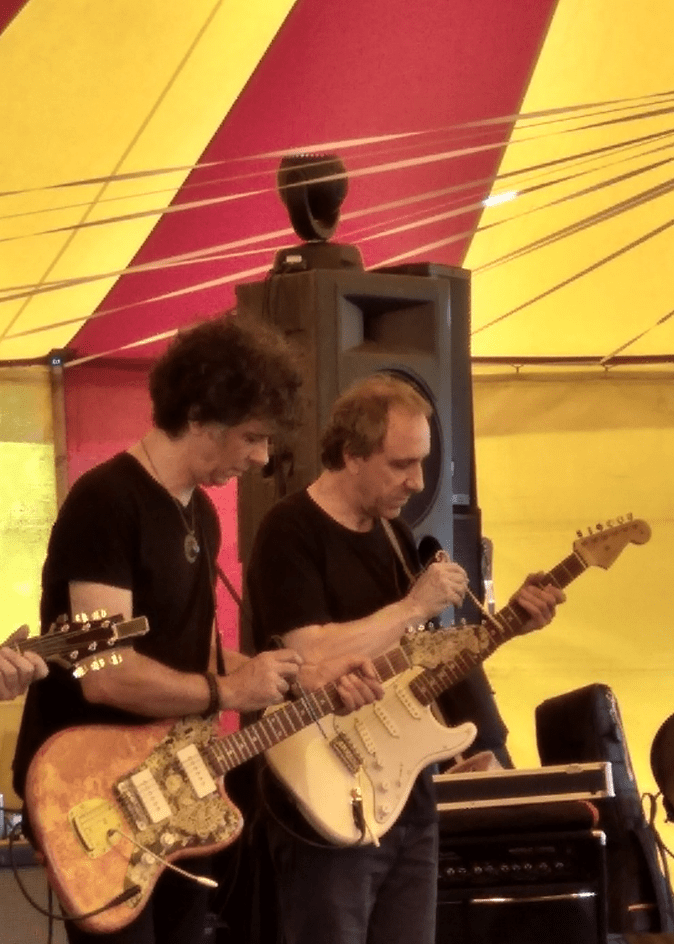
Canterbury 2.3 – Fabio Golfetti – an introduction

An interview with Fabio Golfetti – May 2024 – the backstory

Part One – Formative Years

Part Two – Violeta de Outono

Part Three – Invisible Opera Company of Tibet

Part Four – The Glissando Guitar

Part Five – Gong

Fabio Golfetti 2007 (photograph: Angelo Pastorello)

Over the next couple of weeks I will be publishing, as part of the Canterbury 2.0 series (an exploration of largely international musicians who have been influenced by Canterbury scene music), a multi part series on Fabio Golfetti.

Fabio is a Brazilian guitarist who has been a member of Gong for the last 12 years, but who prior (as well as alongside his time in Gong) has devoted the last 40 or so years of his life to projects very much within the compass of these pages, not least as bandleader with Violeta de Outono and the Invisible Opera Company of Tibet (Tropical Version). His association with Daevid Allen had also stretched back 20 years prior to Daevid inviting him to join Gong in 2012.

A little background to this interview and its origins. At some during the first iterations of Facelift the fanzine, probably in the very early 90s, I received my first ever correspondence from Brazil. Memories are sketchy, but I am guessing the package contained a single cassette, entitled Violeta de Outono, and the music performed by what turned out to be a guitar-based trio was bite-sized, punchy, stripped down, and I wasn’t entirely sure where it fitted into what I was writing for Facelift. There were clear Beatles influences, early Pink Floyd too, but also something more akin to the contemporary indie sounds coming out of the city I was living in at the time, Manchester. It slowly ate into me, I found myself listening to it more and more and picking up on more obvious references: the glissando guitar, hints at Gong and Caravan… Then further correspondence followed – there were more cassettes, a flexidisc entitled Opera Invisivel, and packs of promotional material including some very Daevid Allenesque artwork, a Pete Frame-style family tree – I was hooked!
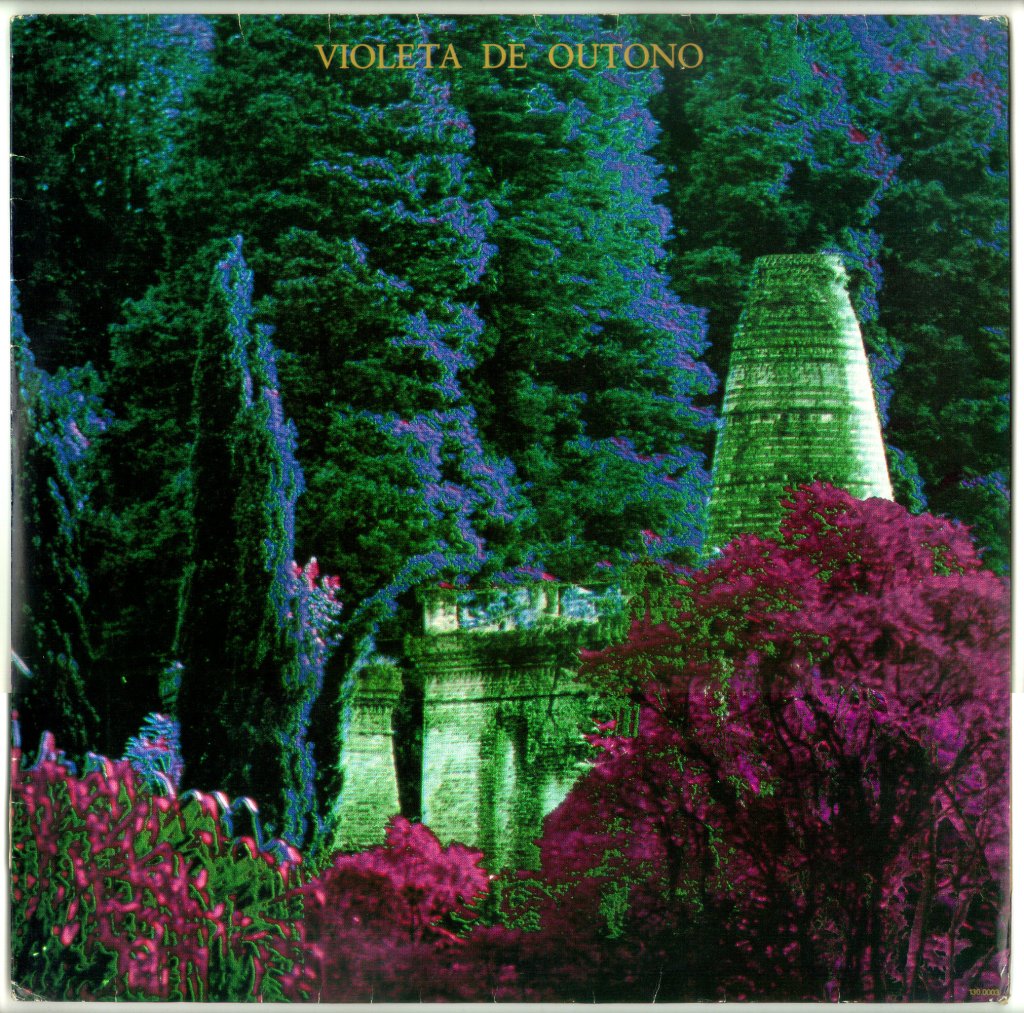
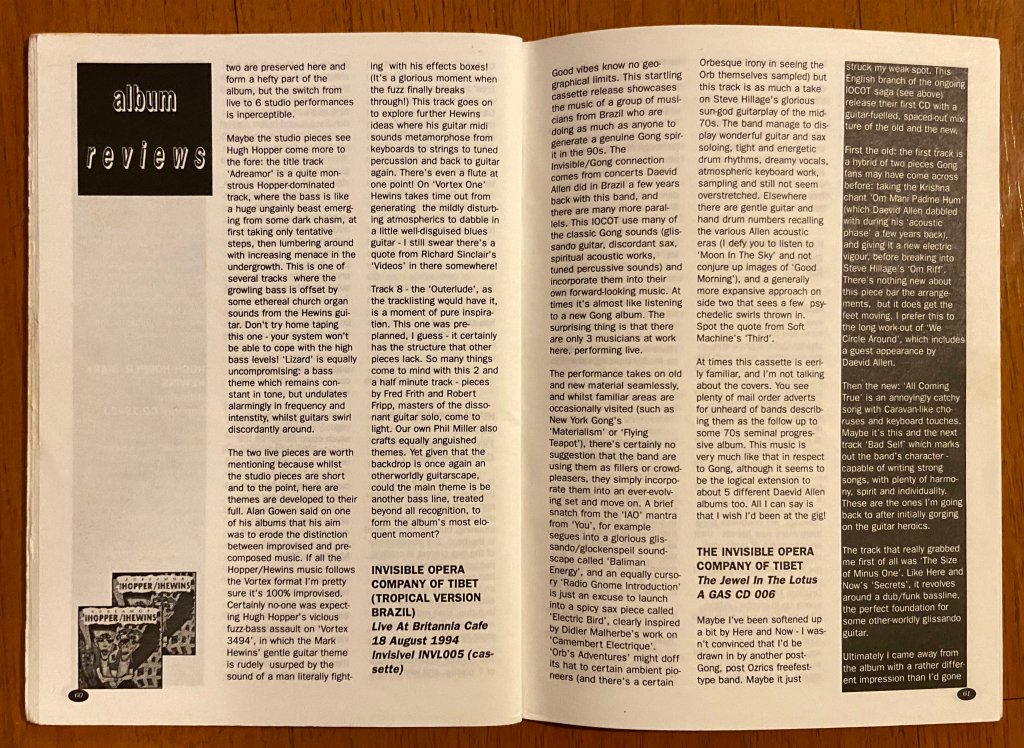

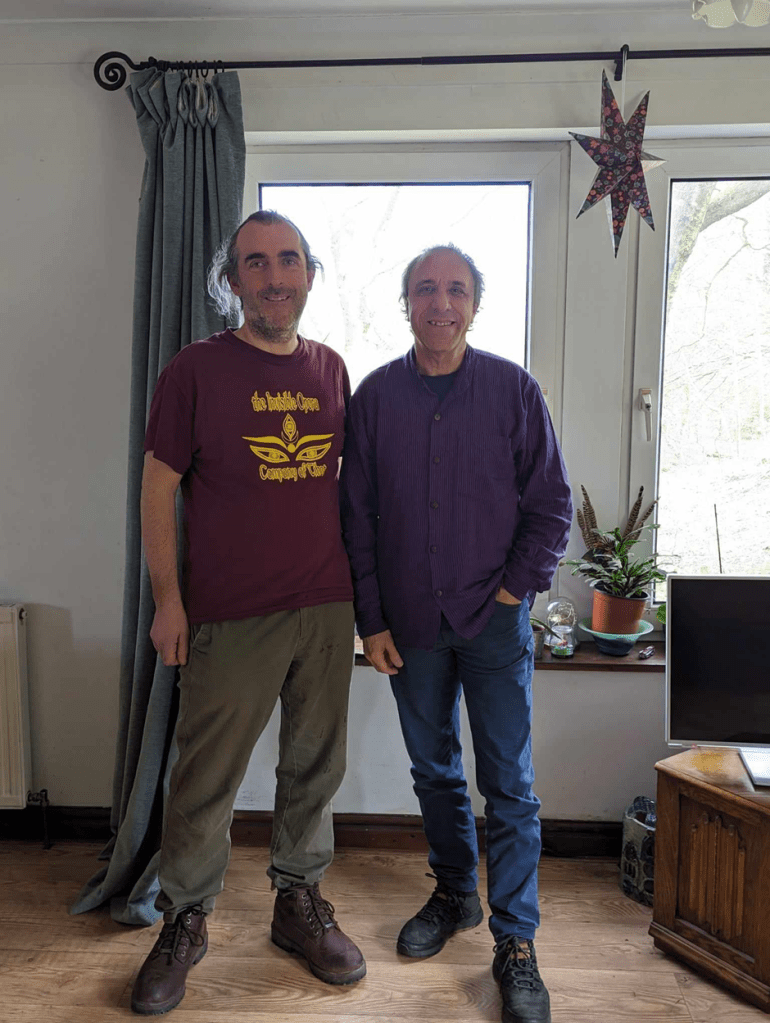
The first Violeta de Outono album, released on LP and cassette in 1987

One of the many pieces of music Fabio sent me in around 1995 really made me sit up and listen – it was another cassette, this time of the band Invisible Opera Company of Tibet performing live a set of eerily familiar music (‘Live At Brittania Café’). I raved about it in Facelift issue 15 (a review which started with the sentence ‘Good vibes know no geographical limits’, which could almost be the byword for the Canterbury 2.0 set of interviews Facelift is currently publishing.

Review of ‘Live At Britannia Café’, Facelift issue 15

This review which ended up as the album’s sleevenotes when it appeared on CD through Voiceprint in 2004, by which time Facelift was dormant and myself and Fabio had lost touch… But that release triggered new correspondence, and we’ve been back in touch ever since. Fabio joined Gong in 2012, initially with the band still led by Daevid Allen and Gilli Smyth, recording ‘I See You’, and then he has become a key member of the current line-up which has carried the torch for Gong fans following the death of both Allen and Smyth.

Cover for the Britannia Café CD release, 2004

I finally met Fabio in 2016, at my first ever Kozfest, appropriately enough just inside that festival’s Daevid Allen stage, and we grabbed a quick chat. That’s been a tradition we’ve continued after the dozen of so subsequent Gong gigs I’ve been to – which has encompassed gigs in northern powerhouse venues in Manchester, Liverpool, Leeds and Sheffield, as well as more unusual locations – a Northumberland village hall in Allendale, the ‘Perfumed Garden’ at Beatherder, back at Kozfest and a few miles down the road in Hebden Bridge.

There’s a bit of personal significance for me here: the 2016 Kozfest catalysed me to start writing again after a 18 year break, and the first ever Facelift blog article mused about, amongst other things, Fabio’s version of the Beatles’ ‘Tomorrow Never Knows’, which not only, as we will see, launched the career of Violeta de Outono, but, at the time of that blog article was exactly 50 years since the original.

Since joining Gong, Fabio’s movements have become increasingly complex with him flitting backwards and forwards between Brazil and the United Kingdom (and wherever the band’s gigs might take them). The band recorded that initial album with Daevid Allen before carrying forward the Gong torch with a further 3 studio albums with further live performances also catalogued (some released, some pending); they have been the backing musicians for Steve Hillage’s highly successful resurrection of his 1970s band; Fabio also works as a producer (including for the astonishing Brazilian progressive rock band Stratus Luna, which includes his highly talented son Gabriel); whilst continuing projects with Violeta de Outono, the Invisible Opera Company of Tibet and solo work with Renato Mello (‘Frame of Life’ volumes 1 and 2), and son Gabriel (Lux Æterna), plus further solo work of his own.

Whenever we met, we always talked about spending time undertaking a proper interview, which would encompass his career with Violeta, The Invisibles, the Gong Global Family, solo work, his love affair with the glissando guitar; and a new lease of life with the resurrected Gong; but also upbringing, musical influences, and the realities of being a Canterbury/Gong fan and musician in Brazil in the 1970s.

This became reality in May 2024 when Fabio stayed with us for 24 hours in our home in West Yorkshire. He demonstrated the art of glissando guitar for our son, Joe; and performed a number of songs for our daughter, Ella, including her favourite Violeta track ‘Jupiter’. As for the interview, well we just let the tape machine roll, forgot all about it and what transpired was around 8 hours of conversation which has been distilled into a few separate sections: Fabio’s upbringing, his musical education and first steps in the music business; the stories behind his major projects Violeta de Outono and the Invisible Opera Company of Tibet; his study and love of the art of glissando guitar; and his relationship with Daevid Allen that helped to shape the last dozen or so years spent with Gong. We hope you’ll enjoy what he has to say…

The author with Fabio Golfetti, Todmorden May 2024

For Part 1 of the interview click here