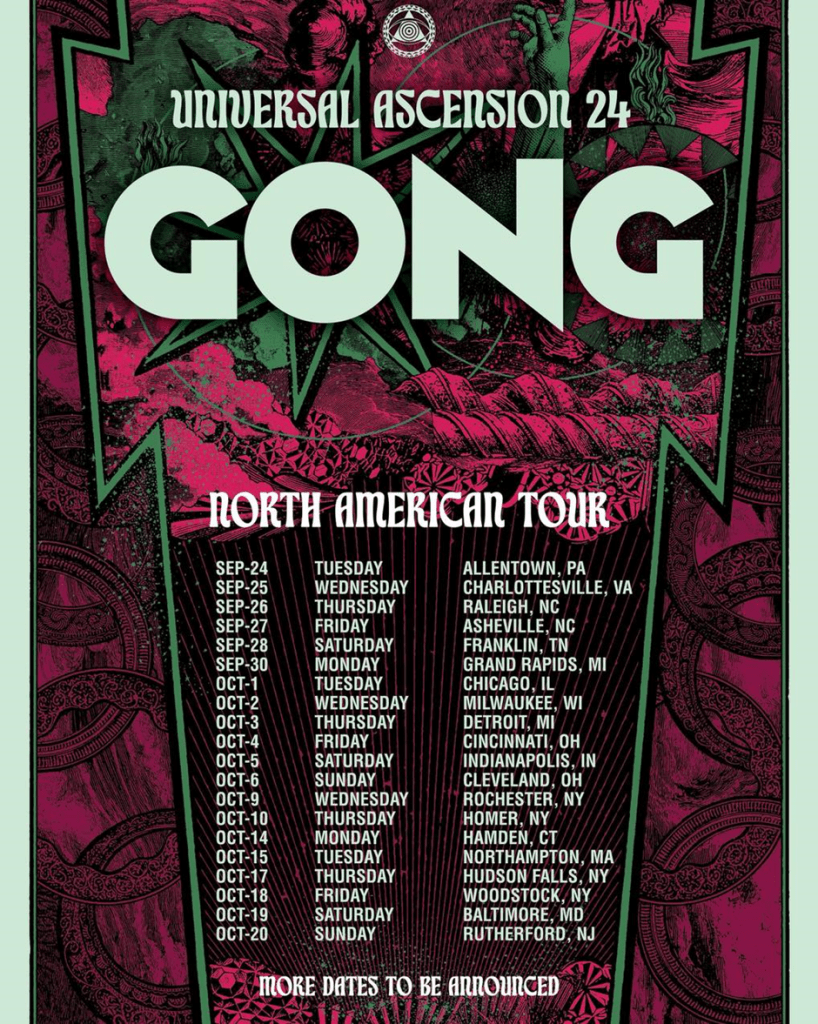
Kavus Torabi might have had his busiest ever musical year, but it shows no signs yet of abating. A hectic schedule with Gong (soon to set off again on a US tour), gigs with The Utopia Strong, touring with Miranda Sex Garden and now this, a significant series of solo gigs which saw him landing once again just down the road in Todmorden, scene of a triumphant gig with The Utopia Strong a few years back.
Much has happened since then. Kavus’ changing personal circumstances are captured in somewhat heartfelt manner on his second solo album ‘The Banishing’, a collection, as was ‘Hip To The Jag’ of acutely portrayed songs backed by harmonium, guitar (or both). It’s the first time I’ve seen him perform his solo act, its resonance amplified by the fact that it was Kavus performing from his (former) living room which was my first experience of live gig streaming, broadcast as it was at the dystopian height of the first COVID lockdown.
The solo set is intense and intimate. A quite bewildering series of effects boards covers the stage, but as these rest at eye level for those of us seated front of stage, it helps to provide a visual explanation of the sounds as they build up before us. There is the Selenish choir of the opening track, all multi-tracked vocals, whilst elsewhere songs are backed by waves of harmonium or loops of guitar arpeggios. The songs are stark and bittersweet. Highlights are ‘Push The Faders’, (‘I write sad songs with happy chords’, explains Kavus), the mesmeric guitarloops of ‘Heart the Same’, or the affirmatory ‘You Break My Fall’, whilst perhaps the most striking piece was an old Knifeworld number ‘The Skulls We Buried Have Regrown Their Eyes’, with its author effortlessly moving around the fretboard Frippian style whilst his voice soars above.
It’s difficult to gauge the crowd: normally ‘Camembert’ T-shirts give the game away, but on this Bank Holiday Monday the audience seemed a bit more difficult to pin down: old hippies certainly, some sharper dressed younger types, and definitely the odd Cardiacs emigree. Any reverie induced by Kavus’ more absorbing pieces was broken a little by a little inter-song banter, and in particular from one left of stage mobile ringtone, luckily only heard between tracks, although the fact that the call was eventually answered (somewhat loudly) mid-patter led to some sharp intakes of breaths around me: Kavus was relatively implacable but I witnessed for the start of the next track what could be the first ever instance of passive aggressive harmonium – its volume seemed to rise almost instantly!
This blip aside, it was a memorably immersive gig. Kavus was keen to emphasise once again that the Golden Lion remained his favourite British pub (he’s visited here in a number of guises in recent years), and proceeded to play 2 encores, a ‘prog epic’ and a ‘short pop’ number, in his own words. Neither were anything of the sort, of course, which rather sums up his own eclectic songwriting and particularly personal appeal.
‘Here’s another epic. We only provide epics. That’s what we do!’.
Andrea Monetti/Ryan Stevenson
Ryan Stevenson’s words just before he launched into the band’s last piece ‘Toxicity’ from the acclaimed ‘Dominion’ album. A little tongue in cheek perhaps, but the crowd would have found it hard to disagree after 90 minutes of being pummelled by the most gloriously intricate, intense keyboard heavy compositions by a very tight four piece who finally found the audience they deserved by the seaside on the West Coast of France.
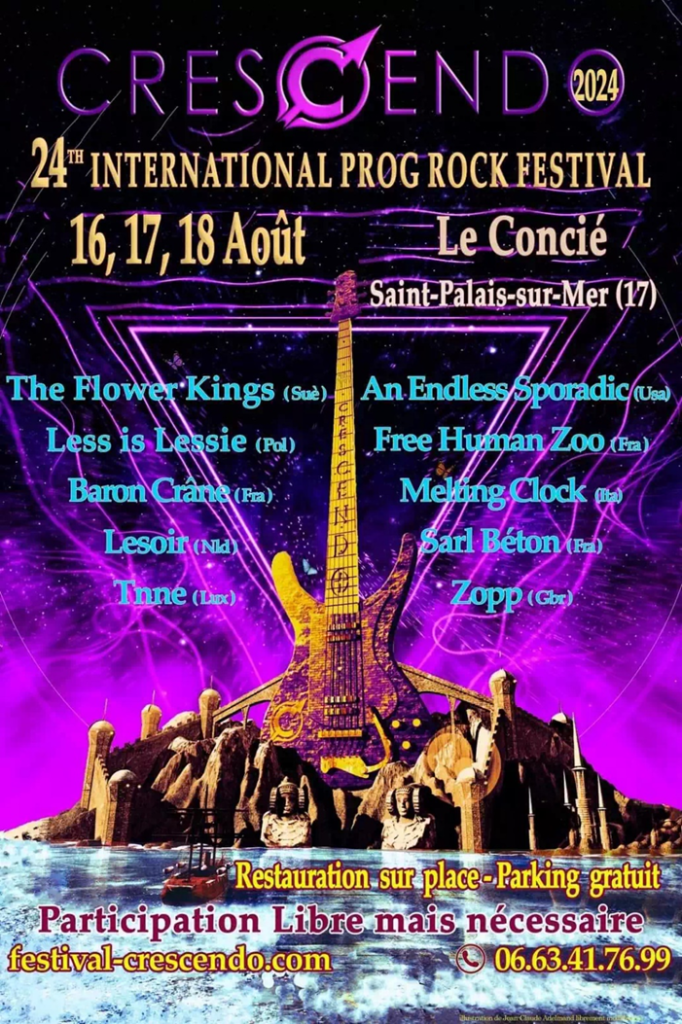
Zopp were playing on the middle evening of Crescendo – a progressive rock festival, in its twenty-fourth incarnation, which takes place over 3 evenings each August under the moonlit skies of the Atlantic in Palais-sur-Mer, north of Bordeaux on the west coast of France. Remarkably, it is free, testament presumably to a fairly far-sighted cultural funding mechanism within the town. It’s contained within a small fenced area between main road and seashore, and you could quite easily drive past it unaware (there was no signage and remarkably little fuss – some people had clearly travelled a distance to be there, but others had literally wandered in on spec). It starts each evening at 5pm, late enough to miss the often oppressive day time heat but also for the last band or two to perform their sets under the stars. The audience is in the upper hundreds (although one stall holder said previous years had been busier), and there are an impressive array of stalls, selling both refreshments (coffees for 1 Euro) augmented by more specific music-related offerings – including one for the French progressive rock fanzine Highlander (whose current issue features Zopp), booths for each of the day’s bands selling merch, and various well stocked second hand record stores.
Just 11 bands span the 3 days’ performances, allowing for lengthy sets. Soundchecks take place during the day, meaning that gaps between each set are minimal. The bands chosen to play appear to vary each year, and looking at the display wall featuring posters for all the editions of the festival, there seems to be little overlap between years. There is clearly a deliberate policy to extend invitations far and wide, with no Frankocentric approach – there were appearances for example by The Flower Kings (Sweden), Lesoire (Netherlands), TNNE (Luxembourg) and An Endless Sporadic (USA). The genre of progressive rock is indeed a broad church, if the bands on display are anything to go by – we saw all 3 bands on Friday who ranged from the messy, funky trio of Baron Crane (France), the pristine, slow anthems of Less is Lessie (Poland) and the grandiose operatic tones of Melting Clock.
Free Human Zoo
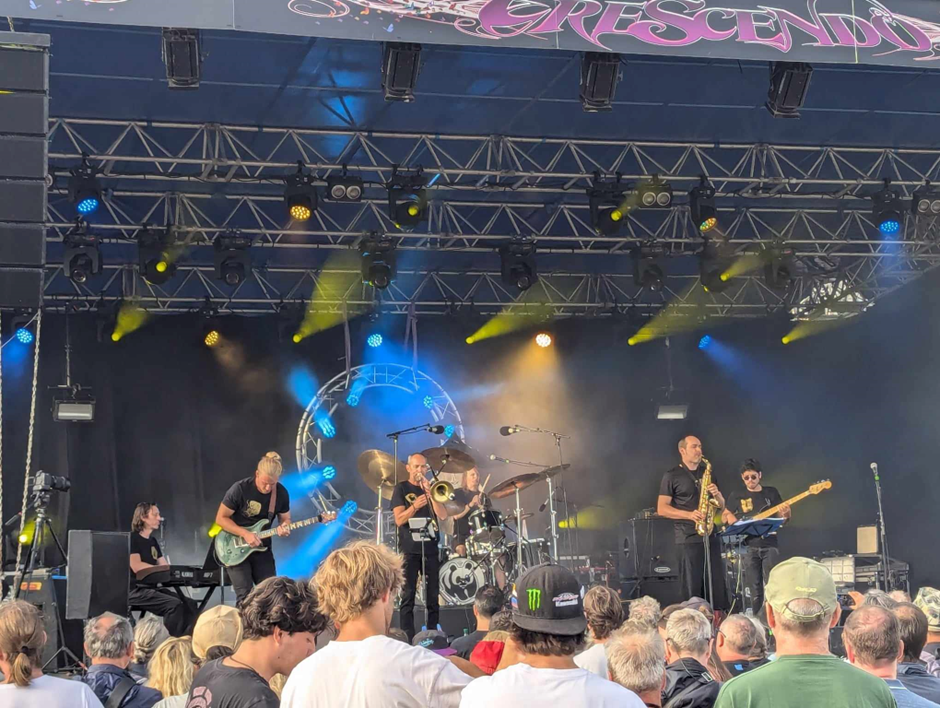
All had their merits, none entirely grabbed me, but I’d been looking forward to seeing Free Human Zoo on Saturday, who I realised in the days leading up to the festival had a connection to music covered in these pages: guitarist Alexis Delva is the son of Jean-Max Delva and Emmanuelle Lionet, the duo behind Anaid, the unusual French band who for a while featured Hugh Hopper on bass (as well as, on occasion Sophia Domancich, Patrice Meyer and, later, Rick Biddulph in the late Eighties and early Nineties. Jean-Max turns out to be one of the curators of the festival, and having been so generous with his thoughts for the Hugh Hopper biography a few years back, it was a lovely moment to meet both him and Emmanuelle briefly before the Zopp set. Free Human Zoo, meanwhile, are a Zeuhlish (even down to the black T-shirts) band from Paris, all pounding bass, staccato keyboard motifs and female voice, but augmented unusually by trombone and soprano sax, as well as the blistering guitar work of the highly talented Delva. There was a lightness of touch in their compositions which softened the initial dark overtones. Highly recommended.
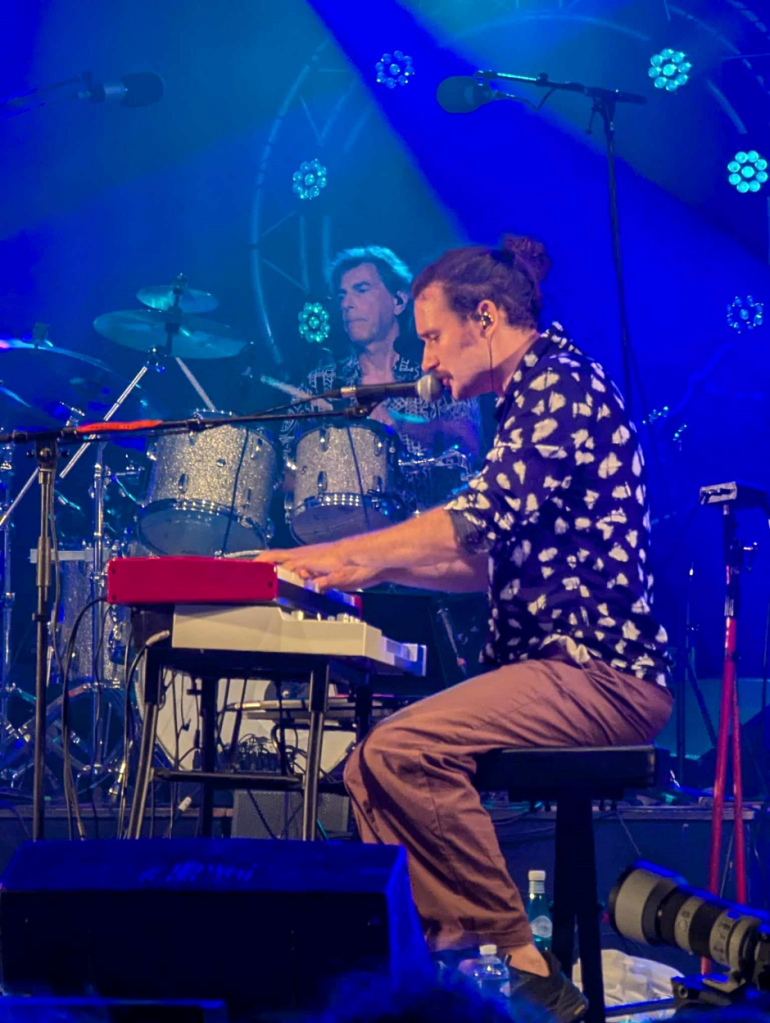
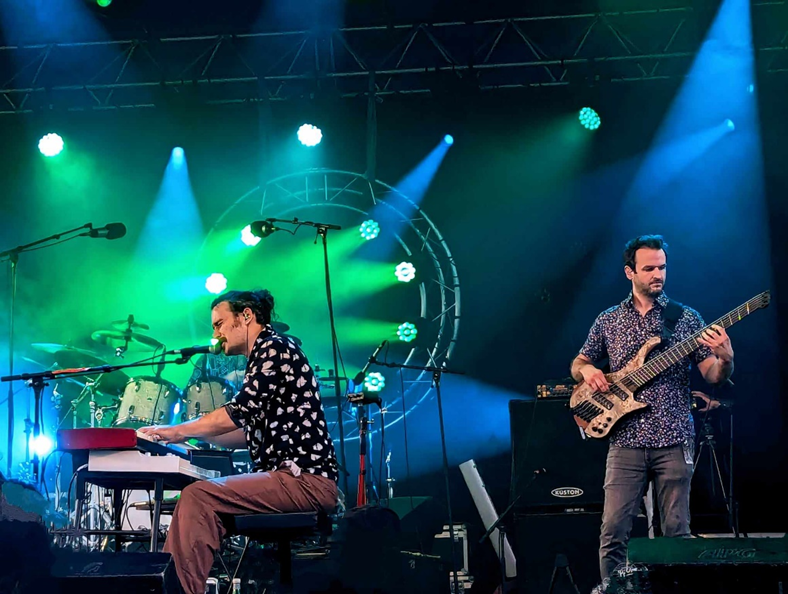
And so to Zopp. This was, I would think, by far the highest profile gig of their embryonic career of a gigging band (still less than a year), and the band seemed more excited than nervous. Ryan Stevenson sits centre stage, with a microphone and couple of banks of equipment in front of him emulating the full gamut of Canterbury keyboard sounds. Unlike the first gig I saw him place he is sideways on to the audience rather than facing them, presumably because it’s better for interaction with his band. It still seems a refreshingly unusual to see the leader of a band playing keyboards.
I’d been introduced to a member of the audience by Jean-Max, who was standing next to another punter of advanced years who was also, like me, wearing a ‘Camembert Electrique’ T-shirt – the first fan talked to me eloquently about seeing Soft Machine, Caravan and Gong at the Amougies Festival in 1969 (he didn’t look old enough!) then professed his excitement at getting to see Zopp (‘this guy is Mike Ratledge, Dave Stewart and Dave Sinclair all rolled into one’). Quite a billing to live up to! But the comparisons are far from implausible: Stevenson possesses much of the fluency of the former, and some of the range and technique of the second, and the lyricism of the latter – it’s uncanny hearing such familiar sounds unfold in front of you.
Andrea Monetti
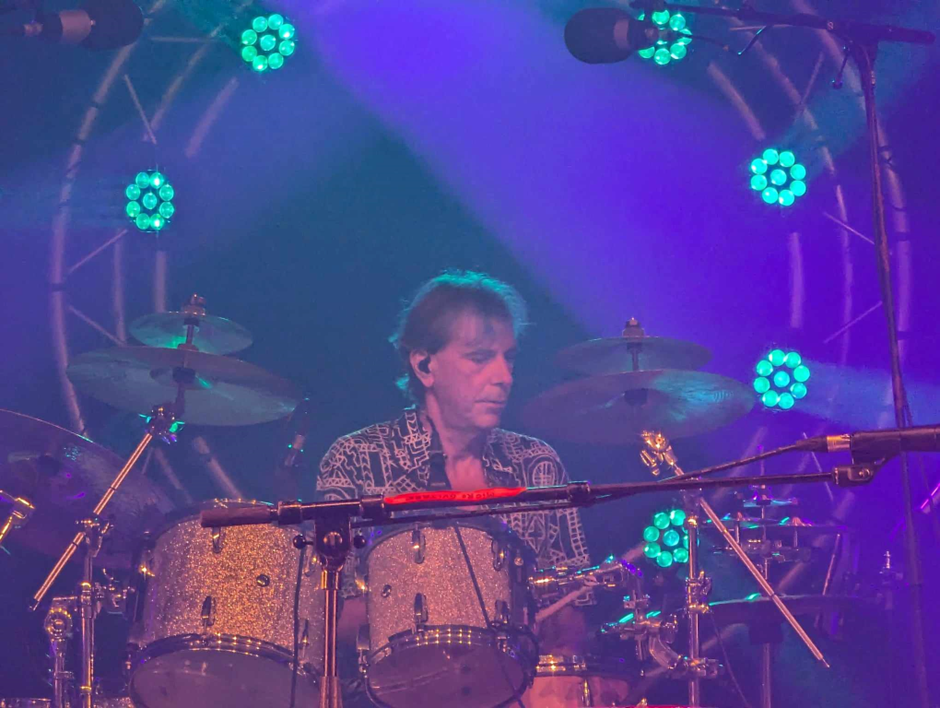
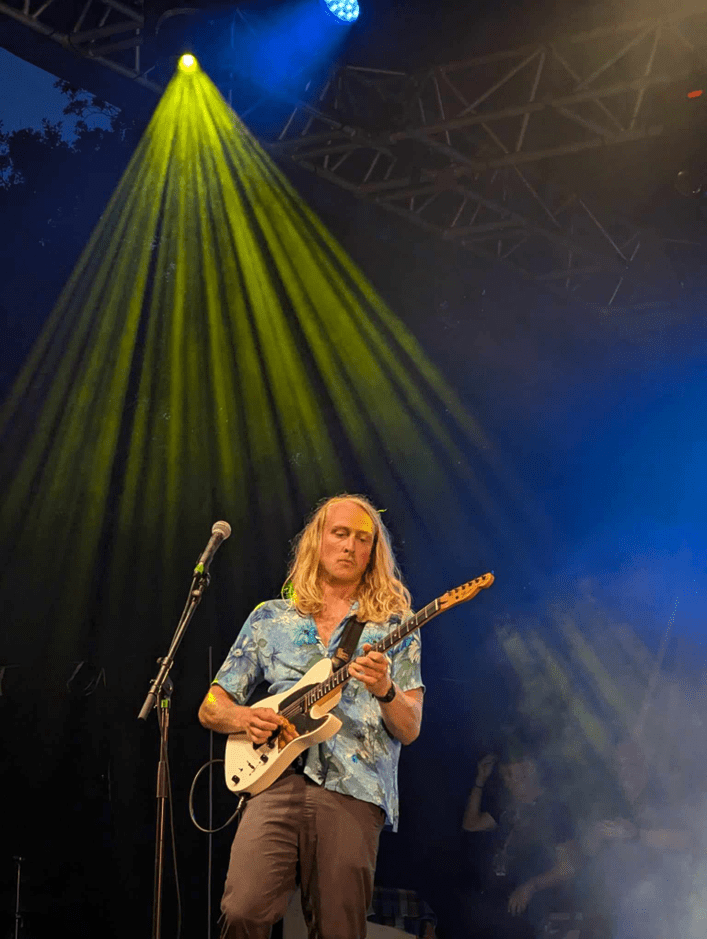
It’s also been a mild stroke of genius to expand the project into band format: Stevenson still composes all material, and recorded most of the first two album’s instrumentation alone, with only Italian Andrea Monetti a mainstay alongside him on providing a real drumbeat. Yet on stage this band is one of total cohesion – with the contrasting sights of the seemingly unflappable Ashley Raynor on 6-string bass, effortlessly working his way around Stevenson’s fiendish compositions, whilst the much more animated Richard Lucas on guitar is attentiveness itself, adding a lick here, a solo there, aping the lead keyboard lines with utter synchronicity to the vibe of the project – I suspect he doesn’t quite appreciate what an important cog he is to the band, although his confidence visibly grew as the audience response became obvious. Monetti sits partly hidden by an extensive kit – he is a powerhouse, but deft enough to provide the perfect foil to the ever-changing music.
Richard Lucas
We’d been promised an extensive set with some surprises and the performance didn’t disappoint – the band started with probably their most acclaimed piece ‘You’, where time seems to stand still in the aching middle section in what is fast becoming a iconic part of the neo-Canterbury canon. The instrumental first album was represented by superb renditions of its best 3 tracks, the fanfarish opener ‘Before The Light’, with memorably its Oldfeldian cyclical guitar theme at its conclusion, the rousing concluder ‘The Nobel Shirker’, and, wonderfully, the track ‘V’, probably my own favourite from the first album, as the staccato keyboard rhythms hang almost like a reverb for the melodies to circle around. The band also resurrected ‘Sellenra’ for the album, a radically reworked version with a hint of drum ‘n’ bass rhythms as well as ‘Echoes’ style keyboards. From ‘Dominion’, in addition to ‘You’ and ‘Toxicity’, there was ‘Uppmarksamhet’, which, as I’d seen live previously, extends from its album incarnation to a gloriously gentle improvisational groove, showing another interesting facet of a band who generally concentrate on interpreting Stevenson’s tight scores.
Richard Lucas/Ryan Stevenson
There were also two new tracks, so new in fact that Stevenson was struggling during our chat the next day to given them definitive names (he settled on ‘Living Man’, another ‘epic’; and ‘Intuition Made It’ ( also known as ‘After the Light’) a surprisingly confident encore for an early airing, including a tasty guitar/keyboard motif as its intro – they are still apparently in stages of development and Ryan alluded to both third and fourth albums being in production – lucky us! Both, like ‘You’ and ‘Toxicity’ interweave vocals. When I first heard ‘Dominion’ I wasn’t entirely sure about this element: after all, when you’ve struck gold with a range of compositions seemingly melding the best of Stewart, Campbell and Gowen, why change a winning formula? But that voice, with its clean, precise delivery has become integral to the band’s signature sound (aided by similarly delivered backing harmonies from Lucas above or below the melody). I’ve seen comparisons with Richard Sinclair, but that’s perhaps a little unfair (aside from the burbling introduction to ‘The Noble Shirker’): the clarity is there for sure, but Stevenson’s voice is much more imploring, almost strident. Either way, vocal lines are weaved in and out of the ‘epics’ so easily that they’ve become the new DNA of the band’s sound, it’s another meticulously manicured and integral facet of a very fine band, and I’m sure, for all Zopp’s avowed Canterbury influences, this will stretch their audience further afield.
Ryan Stevenson/Ashley Raynor
It’s so difficult to be subjective when you feel so personally invested in a performance (this was the longest distance I’d ever travelled specifically to see a band) but I got the impression from the outpouring of cheers, whoops and general excitement around me that Zopp had gone down as well as anyone at Crescendo. I might not regard myself as a natural progressive rock fan in all its multifarious manifestations, but if Zopp represent the genre then I’m probably all in! And mid set a fellow audience member caught my eye when I glanced behind me – the Amougies veteran was beaming from ear to ear …
I’m currently staying near Royan on the west coast of France, specifically to see Crescendo, an international progressive rock festival which, amazingly provides free music for any who venture to see it (or stumble upon it, as had some spectators last night, for the opening of this 3-evening event). At the end of a 4 week stint travelling round France with family, we’ve primarily ended up here because it’s a chance to see Zopp but being at a festival in France got me reminiscing: the last time I saw music back in France was at a very different music festival.
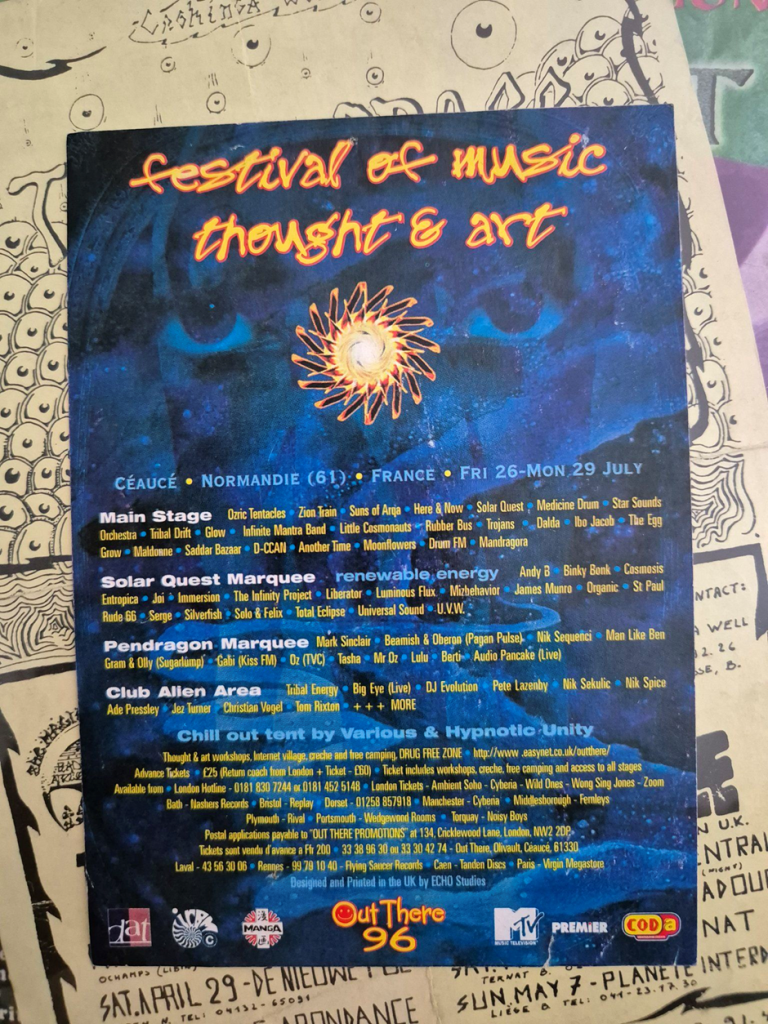
‘Out There’ was a 3 day event which took place in Ceauce at the bottom end of Normandy in 1996 (and I believe had had other incarnations in previous years). I’d been drawn there by the billing of various personal festie favourites such as Ozric Tentacles and Here and Now and had taken the rather unlikely decision to cycle there directly from the previous week’s WOMAD festival, then at its riverside site in Reading, at the last of 5 consecutive visits there from 1992 onwards. I’d gone to WOMAD with a number of Manchester friends, as much to see the Whirlygig ambient dub sideshows featuring the likes of Banco de Gaia, Time Shard, Tribal Drift etc, as the undoubtedly excellent main world music events, which I’d probably appreciate a lot more now… WOMAD at that site was great – there were regular trips to the Thames through the festival fence for a dip (probably somewhat unwisely, given now-known pollution levels), and at one point you could have campfires on site, but gradually this wilder side of site got reined in, no doubt not helped by a friend who at a previous edition had had a flip out at the increasing pruriousness of the audience, downed the best part of a bottle of whisky and left a Black Sabbath tape on repeat booming from his hire van. Other skinter members of the group shared tickets through an elaborate exchange scheme where wristbands could be loosened once inside the inner security enclosure and shuttled back to others back in camp – the most innovative variation of this was where the orange bands, secured by a metal tag, was syndicated (successfully) through the use of a long strip of carrot peeling bound together with tinfoil!
For this edition I’d arrived at Reading on train with my bike, had had the foresight to pack a passport and on Monday afternoon had left site bound for the south coast and beyond it to France. A camp overnight somewhere in the UK, probably near the ferryport of Portsmouth and by Tuesday daytime I was making my way down through France, finding the familiar rhythm of my regular bike trips away at that time: where the only pressures of the day were to navigate in roughly the right direction, stay hydrated, pick up a baguette, cheese and tomatoes en route for lunch, maybe quaff a patisserie (purely for energy, of course), and find some fresh veg to fry up alongside some rice in the billy tins on a small camping gaz stove for dinner. And of course be able to pitch up somewhere in the evening, probably camped at that town’s economically priced ‘municipal’ campsite.
I think I’d picked up details of the Out There festival from a newsletter somewhere on the internet, I can vaguely recall some brief information in courier font downloaded and printed, probably from a computer at work, and stuffed somewhere in the bike panniers for when it was needed. I do remember avoiding main thoroughfares and very much pootling down Normandy’s D and C roads and ending up eventually somewhere very much ‘a la campagna’, probably on Thursday afternoon. The price of the festival seemed ridiculously cheap, perhaps 30 pounds or 300 francs (one of the first things that struck me was that you could pay in either currency, more of which later…) and there was a designated camping area – I locked my bike up to a tree, pitched my tent and had a good look around.
The site was pretty big and several things became obvious. Firstly, even though it was only Thursday evening, the organisers seemed to be expecting far more punters than appeared likely to arrive – there were food and clothes stores galore in particular with practically no-one in attendance. Secondly, the predominance of dance tents (with only 1 outdoor live music stage) and the various signage around the site (along with the dual currency policy) illuminated the fact that this was very much a London ravers’ away day event. Thirdly, the ‘freeer’ aspect of the festival seemed to be mainly evident that this point through the presence of a large pack of untethered dogs running hectically through site, presumably mainly interested in the one which was on heat – her owner somewhat disengagedly chucked a bucket of water on it when it got irretrievably ‘attached’ to its suitor. And then the whole process repeated itself.
I spent the Thursday evening wandering around site, had pitched up in a fairly quiet spot and so got a reasonable amount of sleep, then awaited Friday’s events with anticipation. There must have been programmes or at least billboards knocking around as I knew the Ozrics were headlining that day with Here and Now the day after. The area in front of the main stage was vast: so much so that when some of the afternoon bands were playing it seemed like I was witnessing almost a personal performance – I felt bad for the musicians at the lack of apparent interest. Keith Bailey from Here and Now recalls ‘it was on a weird, spongey feeling reclaimed waste tip as I recall – like a sprung dance floor underfoot ‘. Watching one band during Friday afternoon I remember looking behind me and seeing Ozric Tentacles having an impromptu game of football of notably good quality (it was only many years later I found out about ‘Jumping’ John’s sporting prowess – he apparently had trials with Queens Park Rangers). The music was pretty good, although I can’t tell you whether I saw Mandragora or not, who I would certainly have been aware of, but I do remember a most glorious Ozrics performance, set against wonderfully clear night skies, with what may have been a full moon illuminating proceedings. I associate this performance and line-up with the marvellous extended Arabic wig-out ‘Vibuthi’ from ‘Become The Other’, Jon Egan’s flute weaving up and down in front of him, and Ed Wynne’s blistering guitar solos. For me this was probably the last great Ozric Tentacles line-up in a perfect setting.
My other main memory of this night was of the on-site circus – it was called Baobab and even as a seasoned circus-goer was like nothing else I’ve witnessed before or since – from memory, I think it was partly opened to the elements, unlike the enclosed tents one normally views performances within, was based around a fairly monstrous and quite trippy alien invasion theme and featured the heavy use of motorbikes – it was anarchic and an assault on a multitude of senses.
I think the circus probably followed at the conclusion of the live music for the evening, and for me probably seemed like a reasonable way to bring down the curtain on a pretty full day – when you are travelling on your own days seem so much longer, with every thought and experience amplified. What I found however, on returning back to base, was that my tent had become the epicentre of an entire circle of London ravers, just ‘coming up’ and about to embark on their own evening of frivolity. No issue with their intentions, their attitudes (they seemed friendly enough) but the vibe was not for me, and somewhat freaked out I slunk off next morning, long before any of them resurfaced, in the direction of Brittany. A little myopic perhaps, as I’d end up missing Here and Now, plus a band I’d subsequently grow to adore (The Egg), but the time was right for me.
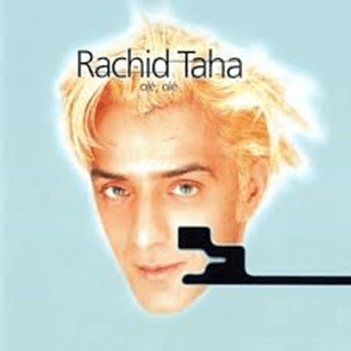
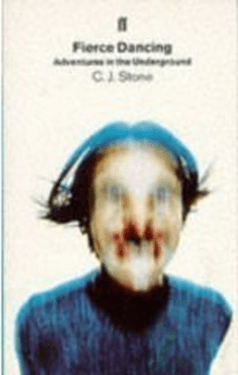
A couple of postscripts: whilst travelling through one town on the way to my next port of call, I popped into a local music shop, discovered and purchased a CD by Rachid Taha, featuring lavish credits to Steve Hillage – ‘Ole Ole’ became a favourite album on my return to the United Kingdom and a nice bridge between his solo guitar work and his newer work with System 7. Secondly, on a campsite in Brittany, I met some fellow cyclists, one of whom slipped me my first smoke of the trip and talked to me enthusiastically at length about a book called ‘Fierce Dancing’ by journalist and author CJ Stone, a fabulous autobiographical piece which starts off searching for the underground, and ends up almost accidentally in a confluence of rave culture and the road protest movement. Stylistically it remains a major influence on my own writings and coincidentally Chris now lives in Whitstable, birthplace and place of death of Hugh Hopper, whose biography I am currently researching. I’ve also recently been made aware of some of Hugh’s own cycling diaries (we talked about some of his trips the last time I saw him at the Marsden Jazz Festival with Soft Machine Legacy) and so, although I didn’t make any notes whilst in Normandy (I did on later cycling trips) it’s good to be able to recall some of the details now so clearly.
Thanks to Keith Bailey and Mark Curtis for supplying memories and those elusive details of dates, location and artwork!





 The Canterbury scene(zine) continued....