
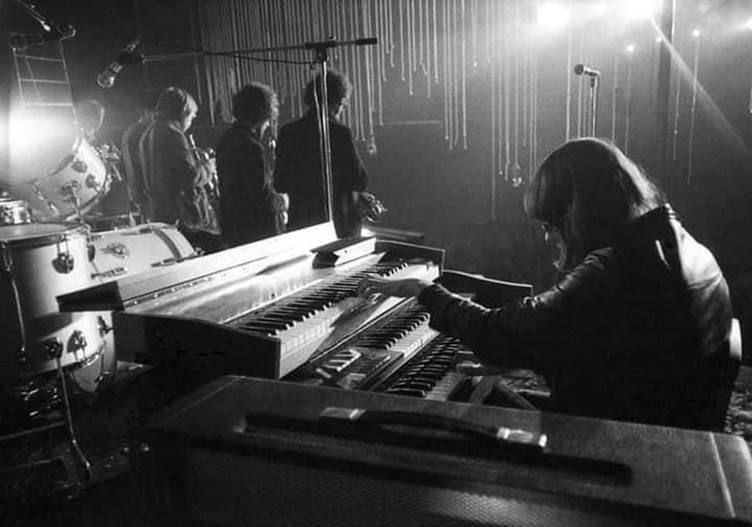
How do you begin to pen a tribute to someone who has been such an essential part of your musical listening for 40 years? Keyboard player Mike Ratledge died yesterday after a short illness, leaving a huge musical legacy. Whilst he had essentially stepped back from the Soft Machine by 1976, as the then last original member, his body of work prior to that with the band was considerable with today’s discography spanning in excess of 20 live releases to accompany a dozen or so studio recordings. Classically trained on piano, his poise had been evident even from the Soft Machine’s earliest demos (‘That’s How Much I Need You Now’ from ‘Jet Propelled Photographs’), and was arguably captured most eloquently on the 1969 version of ‘Memories’ (on ‘Wilde Flowers – Tales of Canterbury’). At the other end of the scale was the extraordinary complexity of his written pieces (the starkest example being perhaps ‘Teeth’ from ‘4’). Much has also been written elsewhere over the years about the fluidity of his soloing technique on the Lowrey organ being born from technical issues requiring a continuous stream of notes to be played – either way his style became a trademark adopted by subsequent Soft Machine-influenced bands.
Perhaps his crowning glory is the Soft Machine ‘Third’ album, my own introduction to the group. In fact it would have been Ratledge’s extraordinarily nihilistic intro to ‘Facelift’ that greeted me on a scratchy library-borrowed version of the band’s groundbreaking double album, complete with its minimalist cover. The band members morosely stare into space inside the cover, Ratledge typically impassive behind dark shades and moustache, and the ambience is framed by the record’s antiquated, yet somehow timeless sound quality. For all the collective alchemy of the band’s four members, each adding a unique component, be it Robert Wyatt’s defiant ‘Moon in June’, Elton Dean’s distant solos or the Hopper glue that bound the project together, it is perhaps Ratledge’s album more than anyone’s: two definitive compositions in ‘Slightly All The Time’ and ‘Out-Bloody-Rageous’, as well as sculpting that detached ambience which prevails throughout.
Personnel, musical styles and group dynamics changed thereafter, but Ratledge remained a constant until after the ‘Bundles’ album in 1975. Thereafter he was consistent in wanting to put his Soft Machine days behind him, both in terms of his music, and the chronicling of his output – his move into library music and world of advertising in the late Seventies was only occasionally interrupted – by the disquieting and underrated ‘Riddles of the Sphinx’ soundtrack for example, or a programming credit on the hugely commercially successful classical piece ‘Adiemus’. Even prior to this, during the Karl Jenkins’ axis of the Soft Machine, personal interviews had reduced to a trickle. In the 1990s Facelift somewhat disingenuously claimed a Mike Ratledge interview when Mike King was carrying out research for his Wyatt biography Wrong Movements – in reality this was little more than details of a conversation the two Mikes had had, the most telling quote being ‘I’ve buried my past’. Rob Chapman’s quotes from Mike for a Mojo Soft Machine article in 1997 represent a rare contemporary insight into former pursuits.
As I never got to meet Mike personally, I’ll post here some thoughts from someone who most certainly did: his fellow classmate at Simon Langton Grammar School and first musical collaborator, Brian Hopper. Some of their musical experiments together, sampled for the Canterburied Sounds CDs represent the first known Ratledge recordings, and as Brian told me: “Mike Ratledge’s household was very studious, – his father was a headmaster. Mike was quite an intellectual even at that stage, a very serious individual but very willing to take part in all sorts of multimedia things we did, photography and tape recordings. He was just exploring things in the same way that I was but maybe on a slightly different level. I think probably his father had an interest in technologically up to date things, which Mike seemed to have quite exclusive use of. Mike was one of the brightest people I’ve ever known. He challenged me all the time but it was stimulating nonetheless, he would never let you get away with half an argument – you always had to justify what you said! Obviously that laid the foundation for what he did later on musically.“
“He has left a great legacy of musical compositions and musical performances which were often radical especially with his ‘stream of consciousness’ solo technique of keyboard playing, but also his compositions often featured very lyrical themes as well as complex rhythmical patterns. He will be greatly missed.“
As for his musical impact outside of the ‘Canterbury’ bubble, I’ll leave the last word to one of a number of fans who encountered the music of the early Soft Machine, and had their lives changed forever: Jeff Sherman of US progressive trio Glass who witnessed the full glory of the band’s sound in 1968.
“Seattle Center Coliseum was packed with people. This was like Hendrix’s homecoming. We’re in there and before Soft Machine play, they douse the lights – it was pitch black, and we hear this rumble. I mean, it literally was shaking. It was Mike Ratledge doing the bass pedal intro to ‘Why Are We Sleeping’. We can see they had this thing called the revolving stage, a round stage, and it’s backlit, but we can’t see the members. And we see this guy, somebody climbing over the amps to get on the drum set with just a vest and a hat on. And Mike’s playing the bass pedals. And the lights still haven’t come on. And then we hear this voice – Kevin steps up to the mic and says, this is called ‘The Rise and Fall of the American Empire’. Then there’s like a little laughter. And he goes. ‘We’re not kidding’. And then boom, they launched into it. The lights come on. You couldn’t have had more impact on us. They sounded like nobody we would have ever heard before. They looked like nobody we would ever heard before…. They were freaking loud – hell! But where we were sitting it was just perfect – it is not hyperbole to say that moment literally changed our lives…’
Mike Ratledge 06 May 1943 — 05 February 2025
(thanks to Jeff Sherman of Glass and Brian Hopper for providing quotes for this article)
 The Canterbury scene(zine) continued....
One of the keyboard greats. He influenced many others, not least of which was Dave Stewart. Thanks for sharing this sad news.
LikeLike
Phil……., great reflections…….
As you say, how could one do justice to such a unique and wonderful musician/composer?
Somehow he took Hendrix’s intensity and married it to his virtuosic keyboard skills.
The result was alchemical, powerful, tantric, particularly during the 1969-71 trio to septet to quartet phase, cerebral yet visceral, abrasive yet very tasteful, muscular yet gossamer.
The sheer drive to create something with balls as well as fascination, filled me with the urge to emulate it, in creating the band Snowfish (1969-72).
Unprecedented, he left impressions on my compositional approach to scoring and playing that were permanent and adored.
Mike Ratledge gigantic gratitude
from Lawrence Ball, composer
LikeLiked by 1 person
This is not directly about Mike (certainly one of my greatest musical icons who sadly left us the day before my birthday/ such a HUGE loss). I greatly enjoyed this tribute to him. // Phil, I`m not involved w/ Facebook any longer , so was just looking for another way of reaching you . If this doesn`t work I`ll get in touch with my friend Mark Hewins. Being a life-long Softs acolyte , I have some interesting bits to share with you. One is a cassette sent (OCT 1992) to us by Robert Wyatt , recorded at home, in which he answers our questions for a fanzine I was involved in with a listener & friend ,Terry Valderas, (which was called OLD ROTTENHAT). I found that interview tape recently and had it transferred to two CDs, AND it`s now digitized. I can send that file to you, if you wish ?
On another note… I once had both Richard Sinclair & Mark Hewins to my home for dinner (I cooked Indian) & afterwards they were both guests on my radio show (THE LISTENING ROOM) on KERA-FM Dallas . I still have those tapes too
Thanks for helping to keep the scene alive.
Best wishes,
Craig Shropshire (Dallas, TX)
LikeLike
Thanks so much for getting in touch Craig. I’ve emailed you directly.
LikeLike