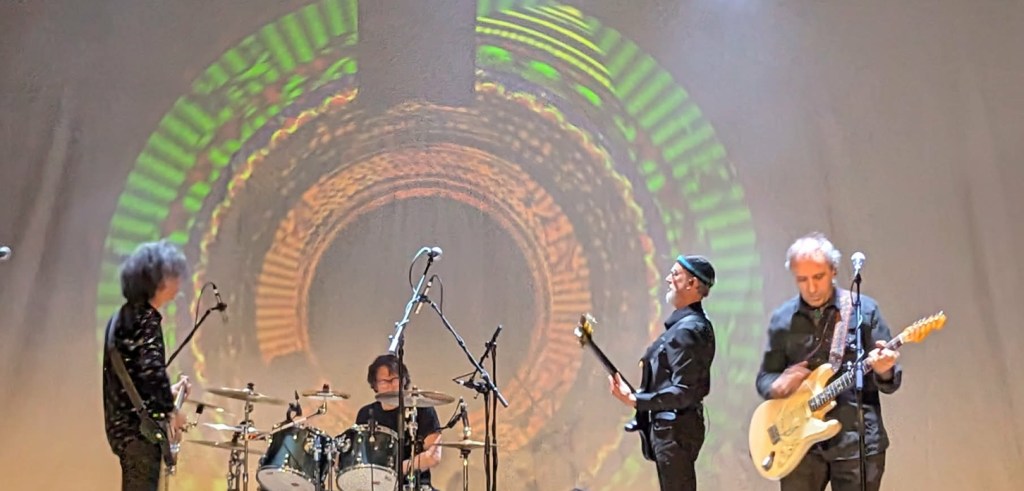
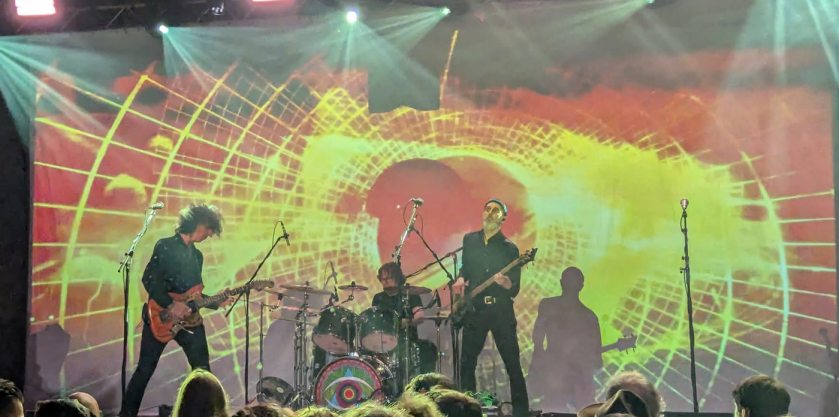
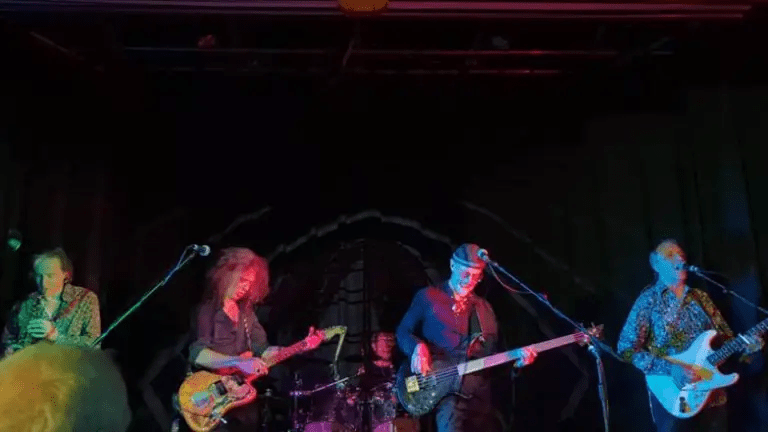
Gong at the New Century Hall – Photo: Phil Filby Howitt
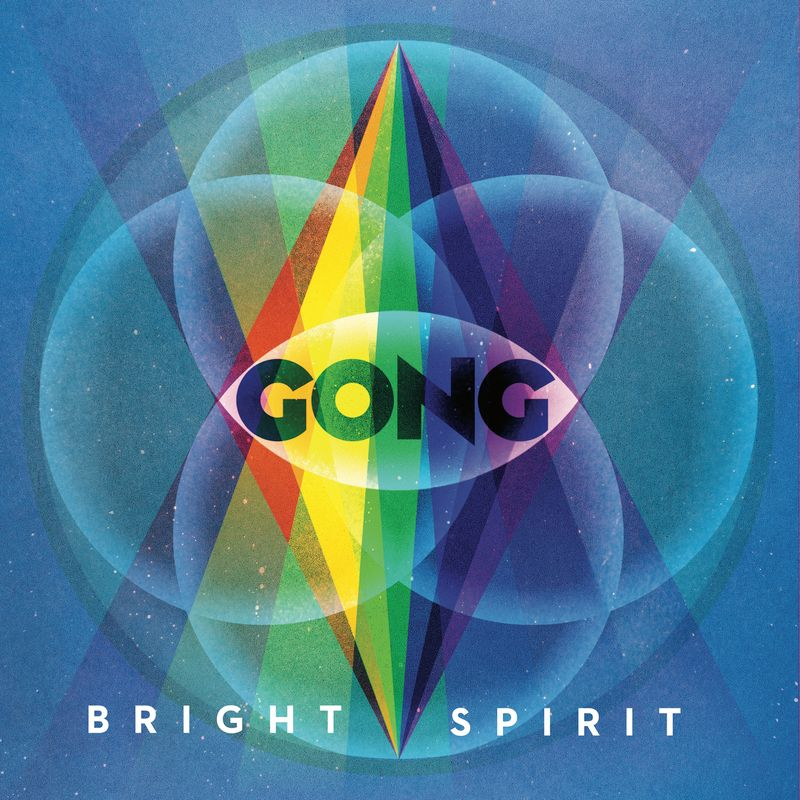
As readers of Facelift will know, I’ve been immersed over the last week in putting together a selection of pieces looking deep into the curation of Gong’s latest album ‘Bright Spirit’, and one of the recurring themes is that it marks the beginning of the end of a particular cycle for the band.
Photos: Georgina Filby Howitt
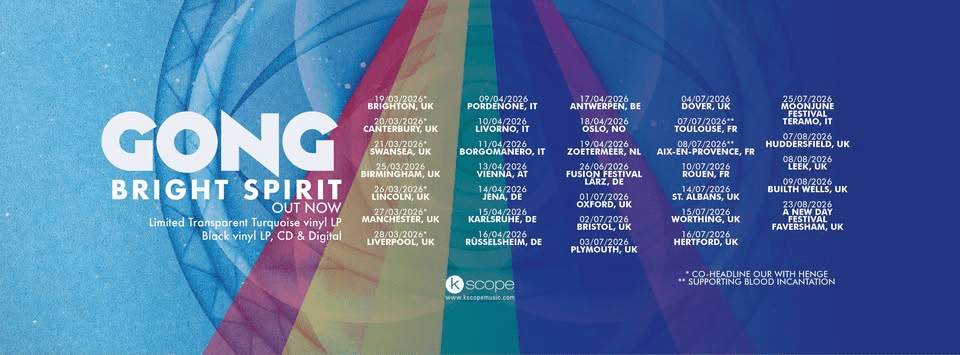
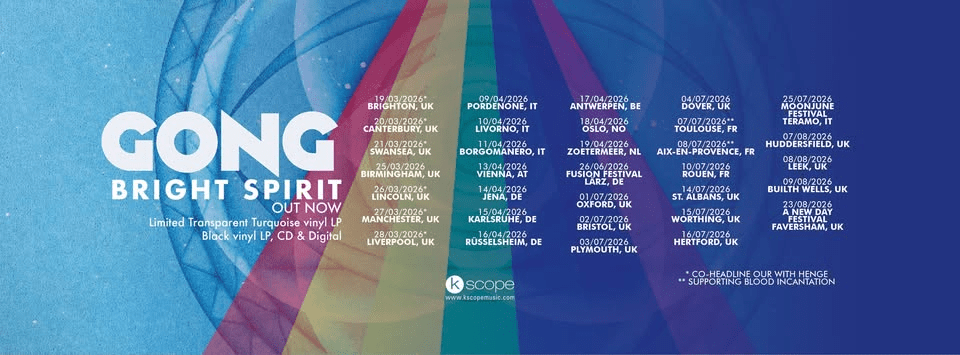
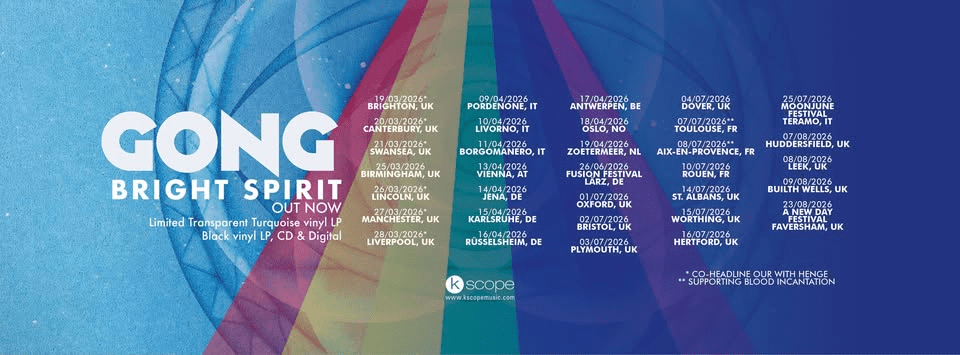
Although the cycle is still some way from its conclusion (luckily the band have a series of tours and festivals to complete before the year’s end) there was still a sense of release, with the shackles being off for the latest gig as part of their co-headlining tour with highly entertaining ravey-spacerock-infathomables Henge. Possibly it was the febrile atmosphere within the Manchester’s New Century Hall, a cavernous, buzzy venue, created the band’s hometown crowd, dominated by tie dyes, wild beards, deelyboppers and illuminated mushroomed accoutrements, not to mention a certain joie de vivre.
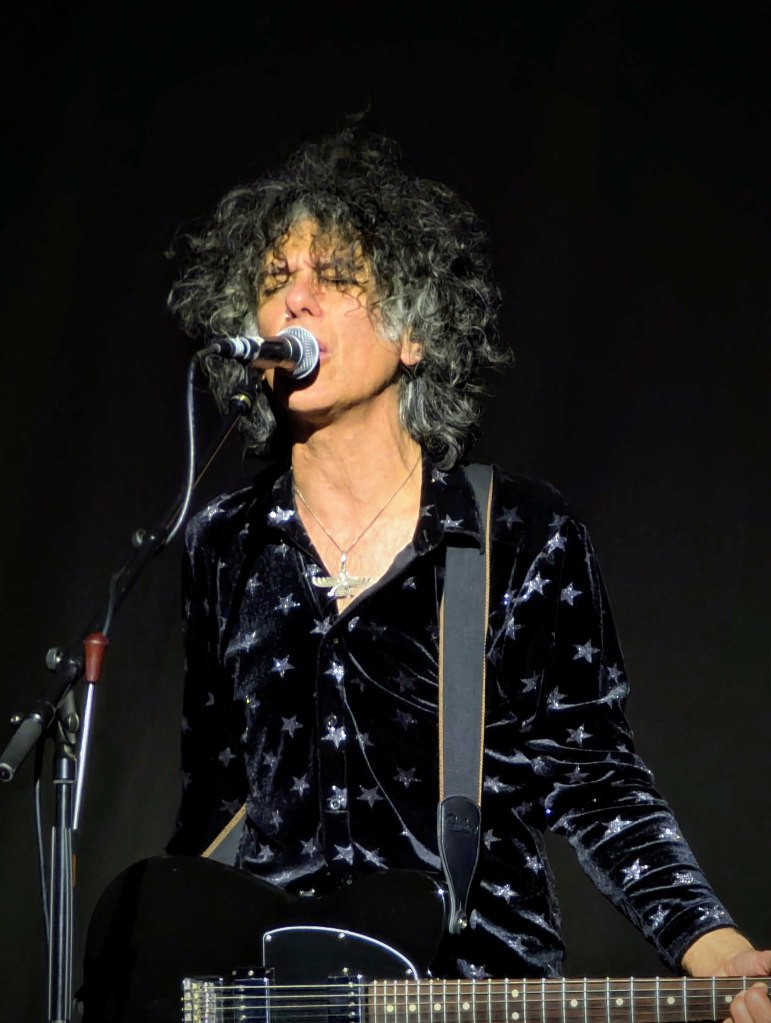
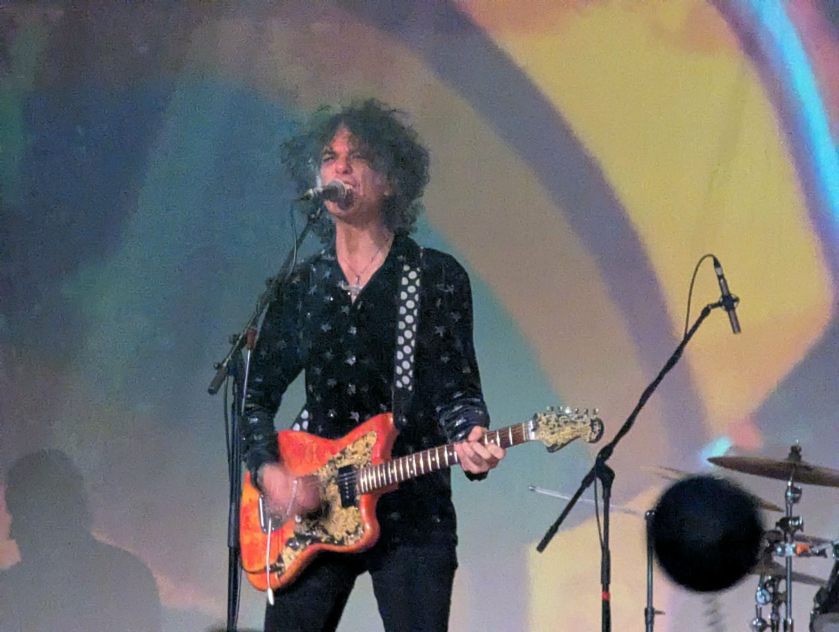
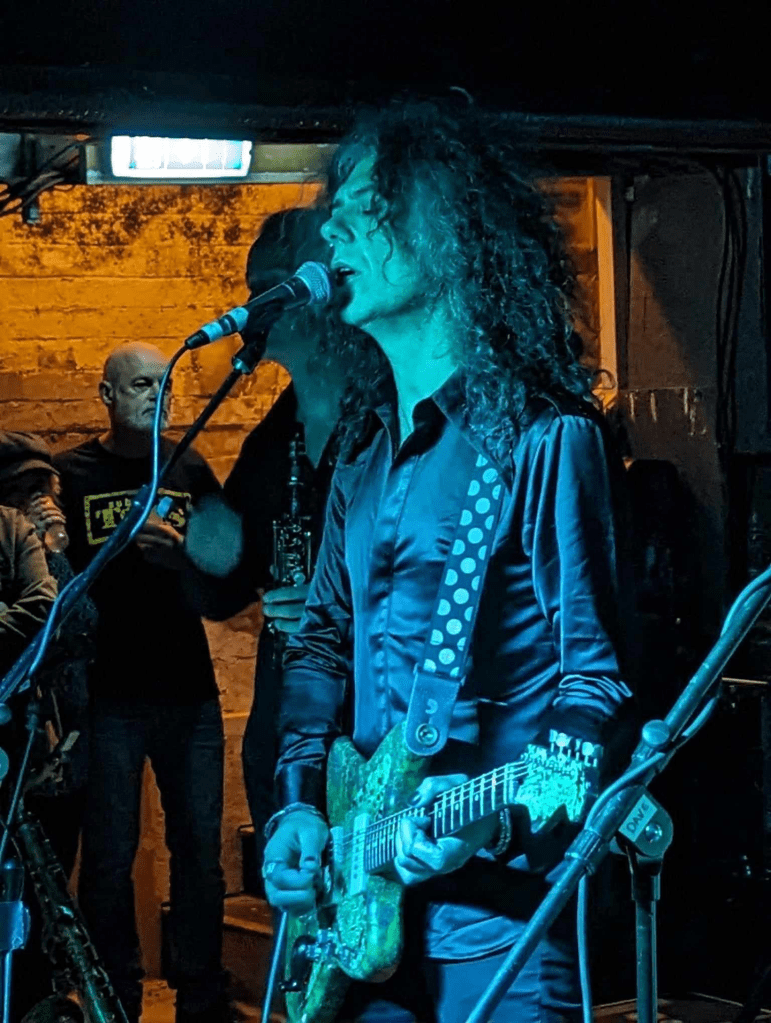
Kavus Torabi – Photo: Phil Filby Howitt
Gong were opening tonight, at the incongruously random (and early) start time of 6.50pm, and if Kavus told Facelift in his interview in January that one of the features of joint tours was to ‘pick your best champions’ for your shortened set, then firstly, they got their selection spot on, and secondly, it still didn’t feel particularly truncated, with the band’s performance extending to an hour and a quarter.
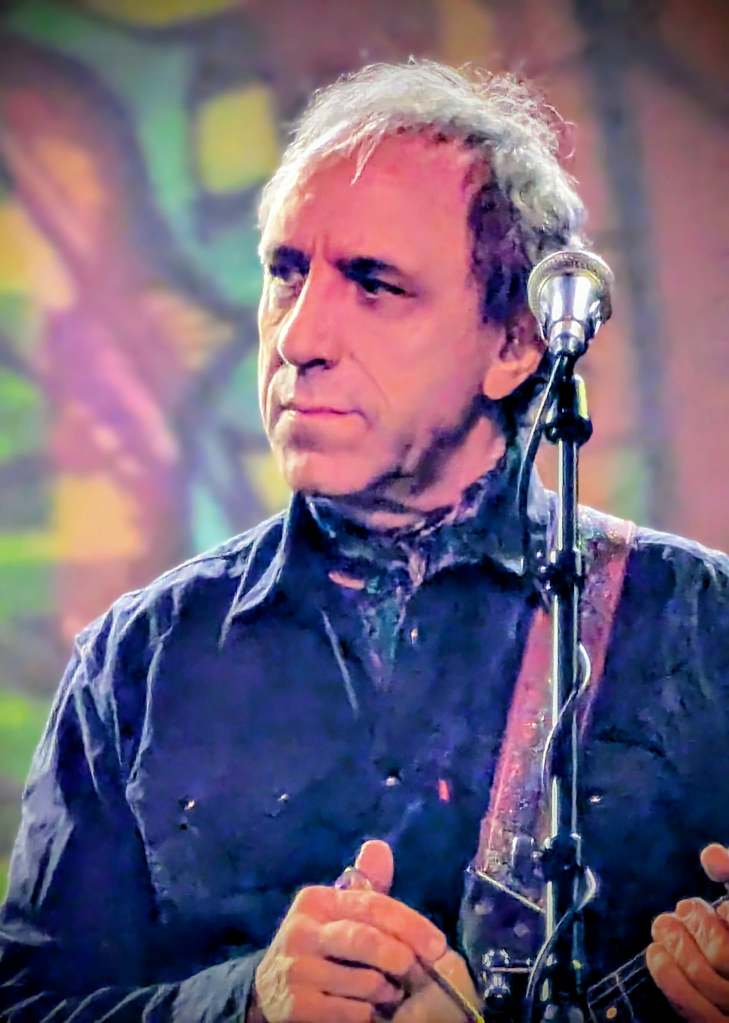
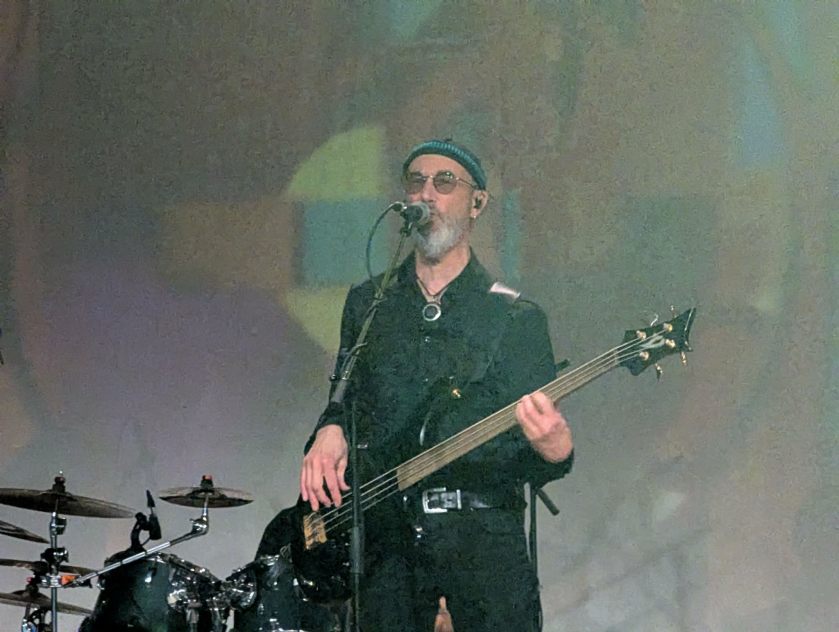
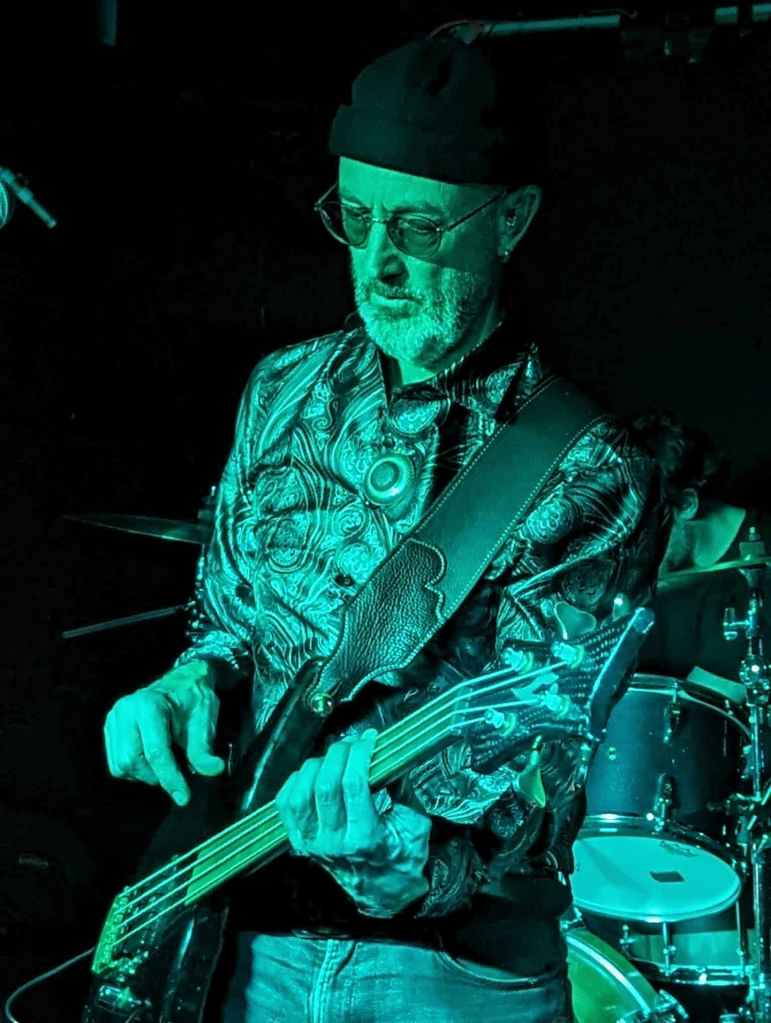
Dave Sturt – Photo: Phil Filby Howitt
The repertoire somehow managed to incorporate this current band’s greatest hits whilst the best bits of ‘Bright Spirit’ infiltrated appropriately: the uncoiling snakes of saxophonist Ian East heralding the quite startling eastern-inflected riff of ‘Dream of Mine’, whilst, as promised ‘Mantivule’, the ‘dotting’ instrumental so reminiscent of System 7 and Ozric Tentacles has made its first appearances on this tour, Kavus Torabi’s repeating motif setting off all sorts of responses from around the band.
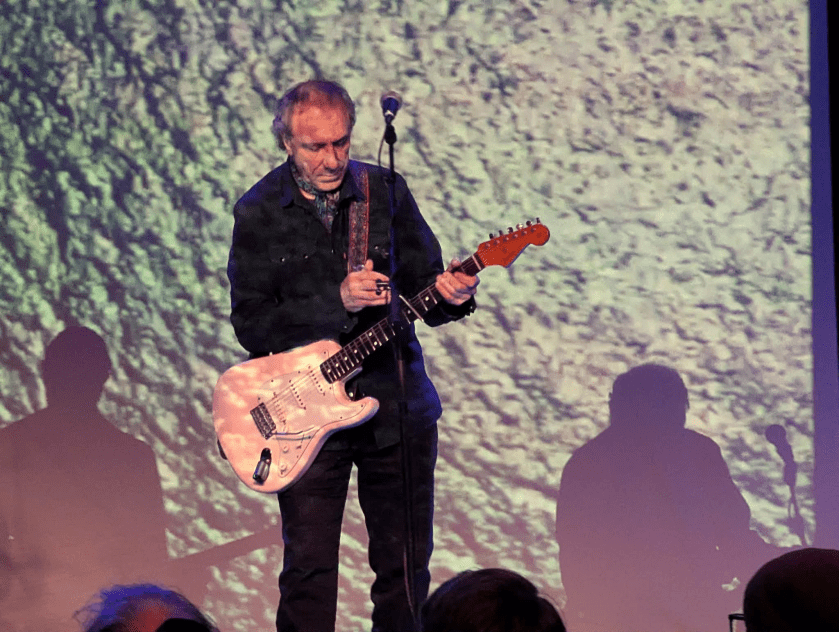
‘Rejoice!’, I was informed to my right, had been on the point of retirement the previous summer at Manchester PsychFest, but here it was again, benefitting from yet further new angles on the dual solos from Kavus and fellow guitarist Fabio Golfetti. ‘Tiny Galaxies’ too, purveyed its own Sixties sounds, drenched in vast swirling swathes of sound.
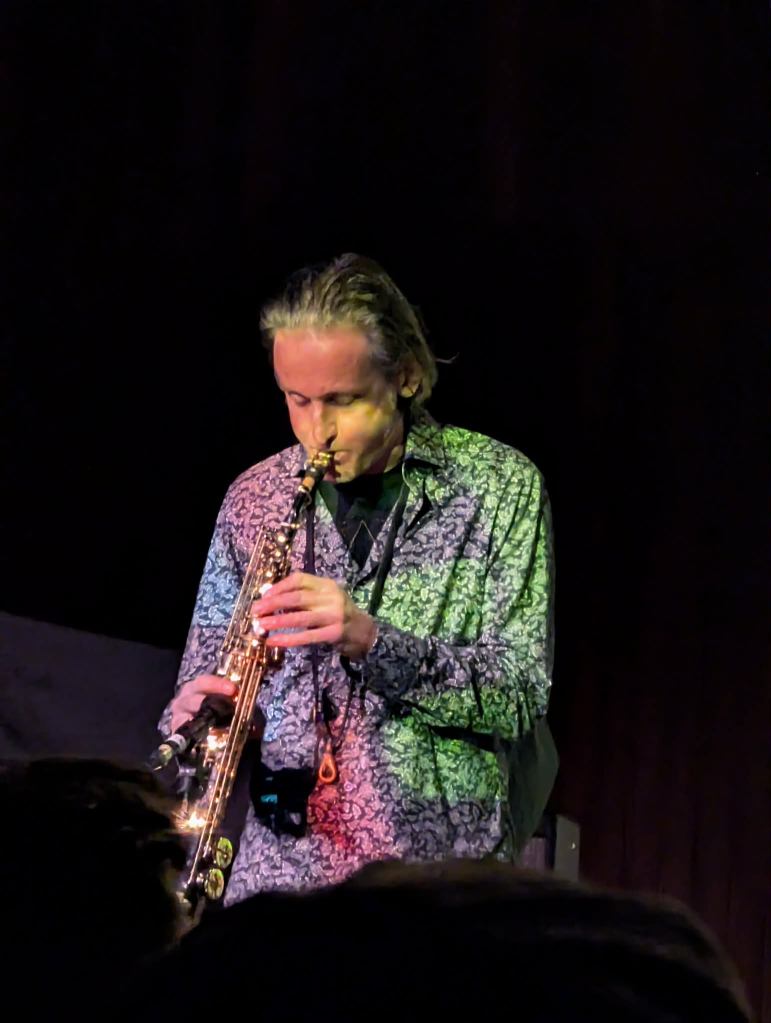
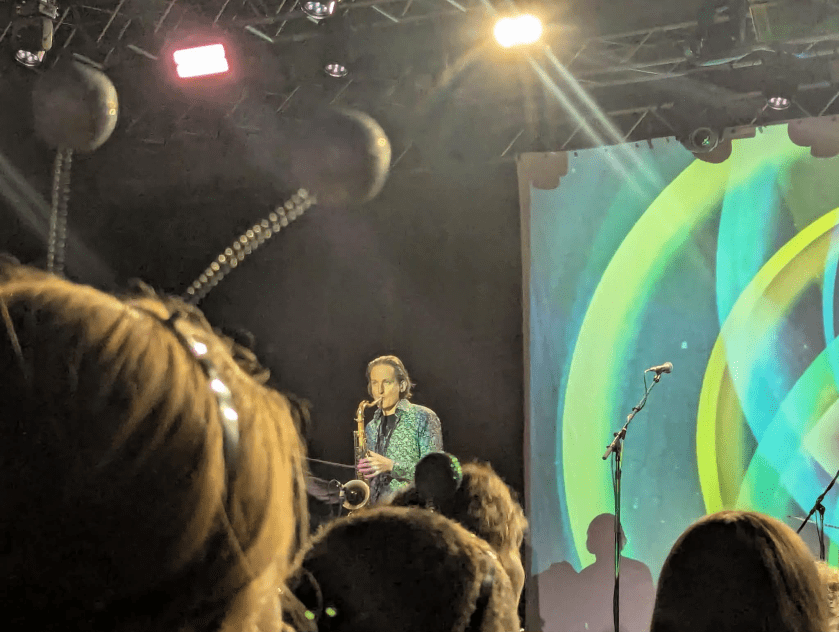
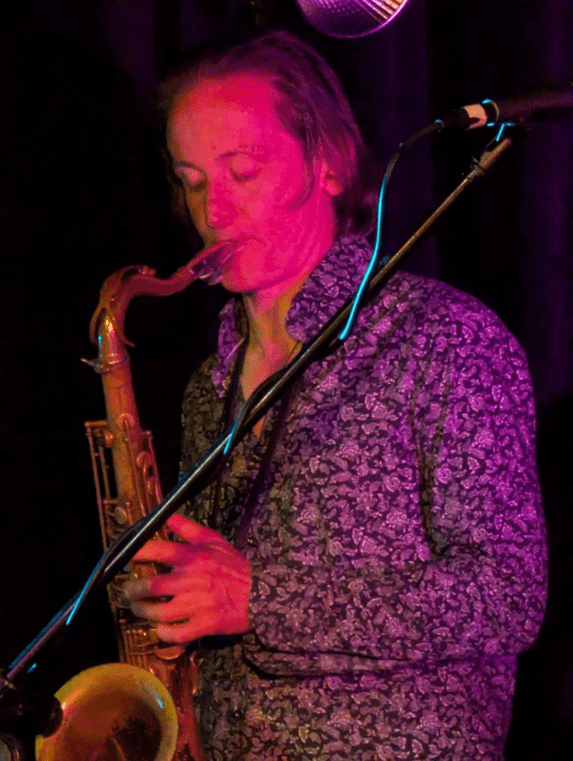
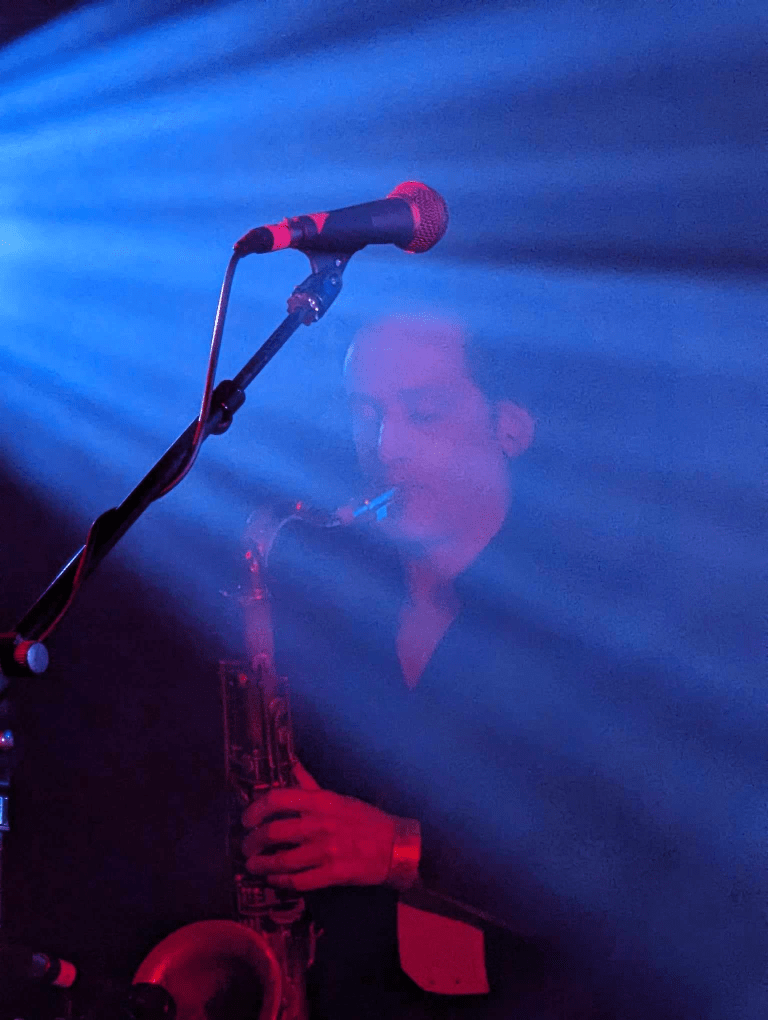
Ian East through the deelyboppers – Photo: Phil Filby Howitt
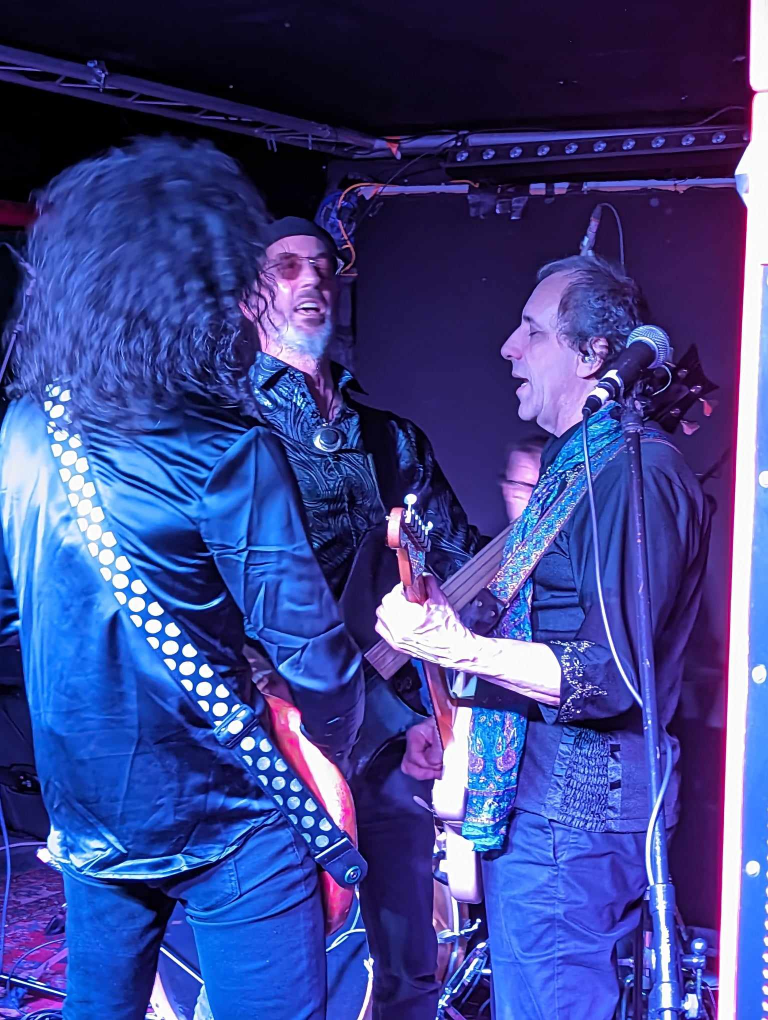
My notes throughout this gig are punctuated by words such as ‘joyous’, ‘upbeat’, ‘celebration’, and indeed the gait of the band was infectious: Dave Sturt beaming throughout, his head often raised to the roof in exultation; Fabio the rock, creating the bedrock of sound on glissando; Kavus a bundle of energy, circling constantly the vast stage, circuiting behind the drum kit, popping up on either side of his sidemen at will. Ian East felt like a maestro tonight, with so many telling incursions as counterpoint or full-throated solos. With such a vast stage, drummer Cheb Nettles was unusually exposed, giving full visibility not just to his highly dextrous, powerful drumming, but an insight into the passion behind his own screaming, high end backing vocals. A colossus.
Highlight of the evening for me was an astonishingly vibrant ‘My Sawtooth Wake’, which, since becoming aware of secrets of the track’s origins (it is inspired by the story of revelatory madness of the 1960s lone British sailor Donald Crowhurst) has added, for me, a whole new layer of significances: it’s pounding, unremitting rhythms; its undulating, rocky tempos; even the brief hint of a seagull’s call from saxophone.
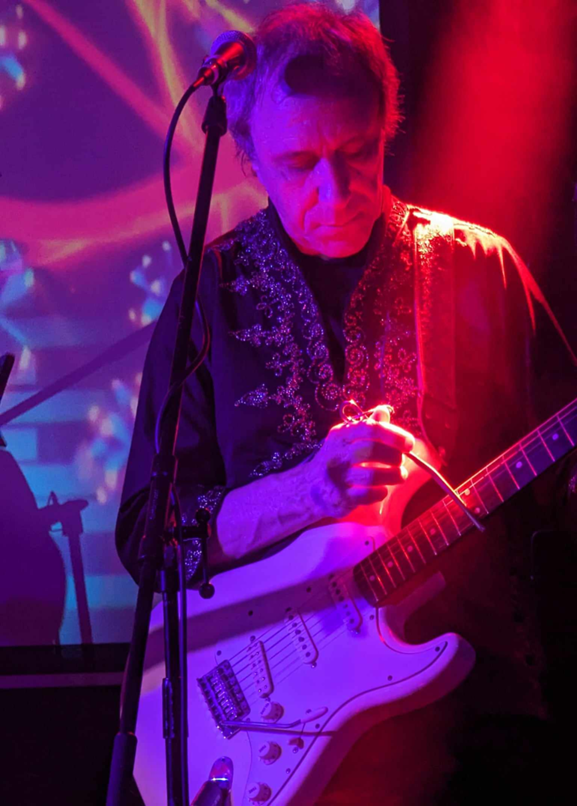
Fabio Golfetti – Photo: Phil Filby Howitt
‘The Wonderment’, the band’s latest single, recalls Steve Hillage’s ‘Rainbow Dome Music’, not just through its oscillating keyboard bedrock, but the glissando which underpins it, whilst soprano sax and lead guitar solo beautifully.
Gong at the New Century Hall – Photo: Phil Filby Howitt
And yet there’s still time for the band’s new/old epic: the previous album’s ‘Lunar Invocation’, (with Kavus’ exhortative vocals against a minimal backdrop which allows Dave Sturt’s bass to find its own meandering voice) melding into ‘Master Builder’ with its usual riot of incantation, incessant rhythm and stop-start conclusion. ‘Stars in Heaven’ rounds things off in grandiose style. There’s a sense that the crowd have been subjected to enough of a wealth of experiences and emotions for the entire weekend… but for many of tonight’s crowd it’s merely an aperitif for the somewhat different, but equally arresting Henge. The tables turn in Liverpool tonight where the running order changes once more…
In Parts 1and 2 we talked to Gong about the placing of their new project ‘Bright Spirit’ within a new trilogy of albums, as well as some of the components, musical and lyrical of the current Gong band. In the final part of this interview feature, conducted back in January, we talk about a few external things: touring with Henge, playing at the annual Kozfest, and what band members get up to musically away from the band.
Henge
Gong have just started on the second part of a tour date process which seems them paired with galactic space-nutters Henge, in a similar arrangement to previous billings with Ozric Tentacles, whose ‘joint’ tours with Gong saw the bands alternating opening and concluding slots. Unfortunately I missed the autumn tour, which introduced the bands’ audiences to each other (and their music), but it means that Gong themselves have had time to reflect on the experience of touring with a somewhat different outfit
Dave: It was very interesting. Very different to the Ozrics too – it’s like a pick and mix musically. Different tracks are inspired by different eras of dance music – with this overall space theme. I think that because we’re kind of presenting different things. With us, it’s obviously more of a musical mystical experience. And with them, it’s like a fun dancing event in a way. But they’re great musicians and the music’s not simple. And they’re really really good in what they do. And the physical effort, the bass player and the drummer wearing bloody masks and all of those costumes are like made of really heavy like curtain material. So they come off drenched in sweat and those masks are really heavy. Their bass player is a lovely guy – but he says he can’t see – the eyes are up here somewhere. Luckily, there’s a few slots that appear. So, he can sort of see about this much, you know, his keyboard and his bass. He can’t see the audience!
Ian: The tour with Henge went very well, we all get on nicely and have some shared interests and a sense of humour. It’s really nice to do the joint tours, it makes the shows more of an event and we all get to play to new listeners.
Kavus: it’s really good fun touring with them. They have a different audience – more than when we were touring with Ozrics, where I think there is a big crossover. As with the Ozrics tour, I think it’s worked. It’s worked regardless of who goes first and last. It’s a different energy, but whether we’re openers or whether we’re closers, it still works on a purely sort of practical level. Watching how Henge operate as a band, as a self-run collective, I mean they make us look like absolute fucking amateurs really. I mean, we are a self-run, self-managed collective, but when you see how Henge do it and you see how they’ve got this locked down and like us, they’ve been the same lineup for about 10 years and just seeing the way they do it, it’s like just really learning.
On a previous joint tour: Gong with Saskia Maxwell of Ozric Tentacles – Photo: Phil Filby Howitt
We’re none of us businessmen, neither are they, but they’ve really got it locked down. So that’s been the big eye opener. But no, I love touring with another band. I love the camaraderie of it. I like that you have to then shorten the set. I like that in a way it’s a bit more, not exactly ‘put forward your best champion’, but you’re creating a different set and you are sort of trying to create a set for what you think their audience is going to be or something that’s going to appeal to everyone.
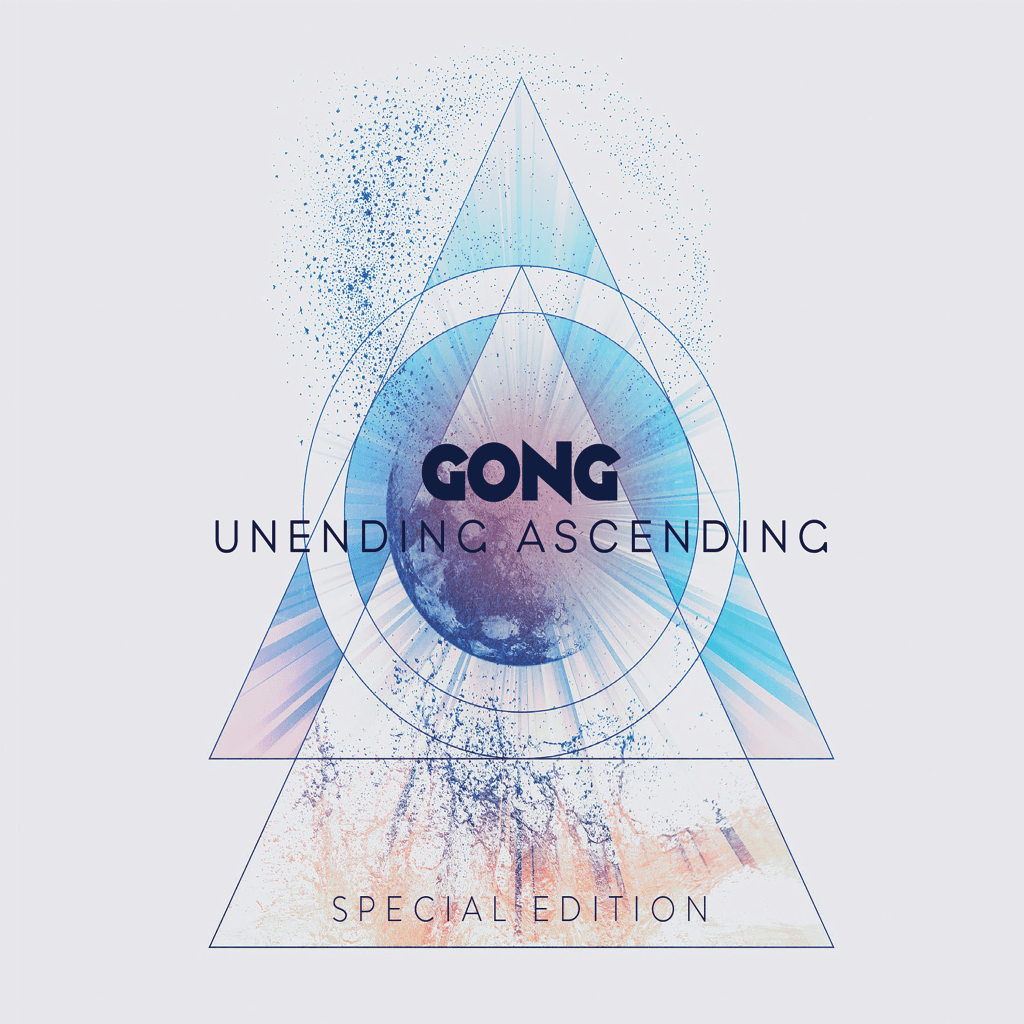
We’ve got some more dates with them and I think we’ll change things up again. I still think we need to tweak it a bit more. So, over the course of 2026, I think we we’ll have a new set with stuff from the new album. We have to tweak it because I want to be able to feel as strongly about the set we’re going to be doing this year as I did about the one we were doing when we were touring with ‘Unending Ascending’.
Kozfest
2026 will once again see Gong headline Kozfest, that little slice of space-rock infused psychedelia now in its new home in the stunning surrounds of Builth Wells in deepest mid-Wales after over a decade in various locations in Devon. Kozfest is steeped enough in Gonglore that it has a main Daevid Allen stage: Soft Machine, System 7 and Here and Now have all headlined there; whilst associated bands such as Kangaroo Moon, the Invisible Opera Company of Tibet, the Glissando Guitar Orchestra have also been regulars at the festival.
Fabio: We’ve played twice as Gong, first time still with the great Kosmik Ken. I didn’t know that he had my albums before I joined Gong! I feel Kozfest is like a small Gong Uncon in a campsite, a gathering of people that know each other like a big family. Although Gong nowadays sound a bit different from the legacy of bands connected to classic Gong, Here & Now, etc, I believe the spirit of this music is still alive with a festival like Kozfest.
Kavus: It’s amazing that Paul (Woodwright) is keeping this scene alive and bringing in lots of new blood into the thing. I think he’s doing he’s doing the Lord’s work with Kozfest, not just Paul, Snake and lots of other people involved as well. It’s such a good vibe there and I’ve always been welcome. I mean, there was one year – I think it was 2022 – I played with five different bands, solo, I played with the Utopia Strong, I played with Gong, I played as part of Sonic Trip Project, I played as the Glissando Guitar Orchestra. I love being involved in whatever capacity I can there.
Dave: Paul’s really great. I’m really impressed that he does it. I’ve done it various times with different bands. Kangaroo Moon – I love Mark Robson – he’s got a very good left hand so he does a lot of the bass normally. Graeme Clark was one of the other people I played at Kozfest with. We had a trio, me, him, and Pete Fairclough on drums which we did a couple of times.
Kavus: we’ve played in different locations. In Axminster and in North Devon near Uffculme and now where it is in Wales. It’s become it’s great for Gong to play there. Kozfest was the first show we played after lockdown in 2021. That was really really key. I feel like that one performance there at Kozfest really opened the doors to everything that Gong has been in the last three years that have followed it. We turned into a different band at that performance. I think it was having those two years of not being able to do it and just how important it was to do it. Something changed in that performance and I could trace that right back to that performance in 21. Actually, my first one was Knifeworld when it was right up on that muddy hill.
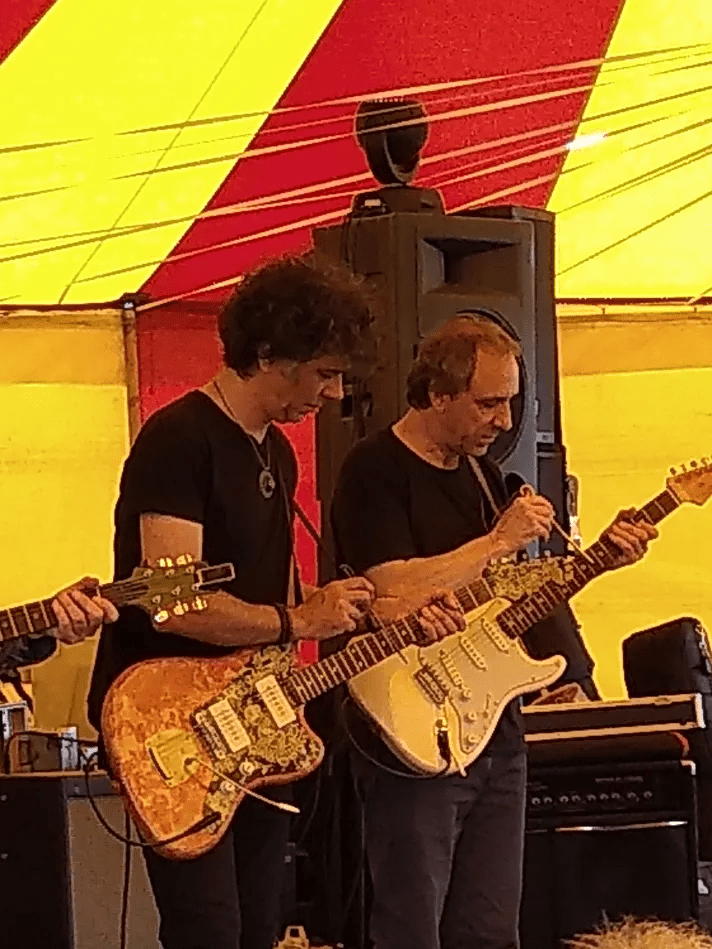
Kavus and Fabio with the Glissando Guitar Orchestra, Kozfest, 2021 – Photo: Phil Filby Howitt
At the moment, I’m only booked for Gong, but I’m always happy just to jump up with anyone. I love playing. I’m a much better performer than I am a punter, especially now I don’t drink. I just don’t know what to do with myself. I’d much rather be playing!
Solo projects
As outlined in a feature in Facelift back in 2018, the current Gong band are a multi-talented lot with all members with various fingers in other pies. All compose music away from Gong.
2025 saw Kavus Torabi cement his place as the hardest-gigging man in prog, with touring dates not just with Gong, but with The Utopia Strong, Cardiacs and with Rosalie Cunningham, plus a number of solo gigs.
Dave Sturt has recently been performing in a Jaco Pastorius role in a project called Mysterious Travellers, as he also works on the follow up to his multi-layered first solo album ‘Dreams and Absurdities’. He is also recording a second album with the astonishing trio This Celestial Engine and also collaborating with poet Mark Gwynne Jones.
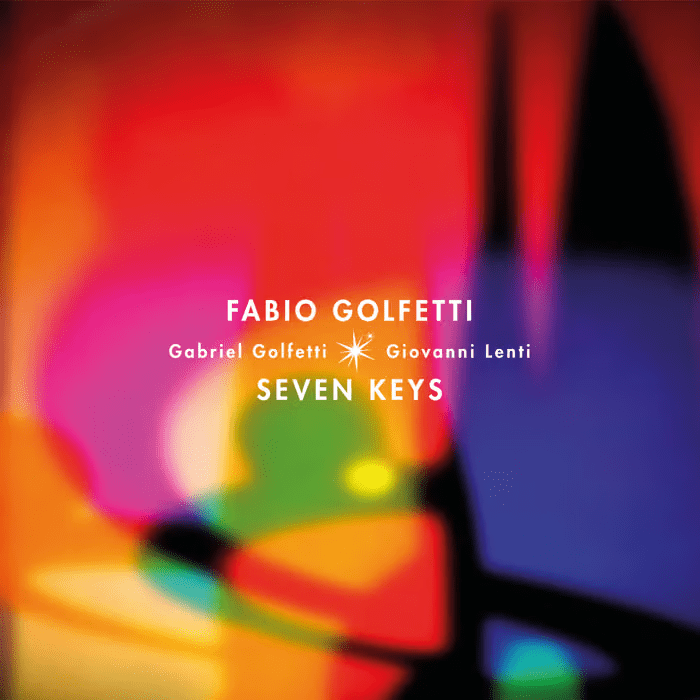
Fabio Golfetti, meanwhile was putting the final touches to his latest solo album ‘Seven Keys’ when we spoke, possibly his strongest solo album yet, which is now out (copies will be available from GAS on tour), alongside son Gabriel and fellow Stratus Luna prodigy Giovanni Lenti, whilst continuing to perform the occasional gig with seminal Brazilian trio Violeta de Outono: ‘as I’m continuously flying from Brazil to the UK and vice-versa, I’m always putting my mind into different projects. For example, when I’m in the UK, I’m almost 100% Gongmode, but of course I can do some remote work with my other projects when there’s time. Same when I’m in Brazil, I take the opportunity to do the best I can, recording, rehearsing every week with my friends of Violeta de Outono, even if we don’t have any gig, just to see each other and have dinner together.’
Ian East has a regularly gigging jazz trio and quartet in East Kent (‘my favourite musical activity when I’m not touring’), as well as involvement in the Balkantics (‘London’s original and best Balkan brass band’), and is also working on a second solo album: ‘I’m releasing my 2nd solo album this year, I’m thinking of it as the second half of ‘Inner Paths’ so that together they could become a double album. I’m using the same instrumentation, the same approach to composition and recording.’
As for Cheb Nettles, my lips remained sealed…
You should find copies of albums by Gong’s band members on the merch stall on their current UK tour, which resumes tonight in Birmingham. Alternatively:
We finished off Part 1 of the interview with Gong about their new album with Kavus Torabi and Fabio Golfetti talking about the second single from ‘Bright Spirit’, namely the glissando guitar-heavy track ‘The Wonderment’. What follows in part 2 is, in the musicians’ own words, a consideration of some of the musical components which make up the Gong sound.
Glissando guitar
As part of the interview with Fabio Golfetti for the Canterbury 2.0 features on Facelift back in 2023-24, we talked at length about the glissando guitar, the textural technique inherited from Daevid Allen which has permeated, largely uninterrupted, into the history of Gong and its wider family. A treasured personal memory is the following of Gong’s performance at Kozfest in 2022 of both Fabio and Kavus featuring with the Glissando Guitar orchestra on the traditional Sunday noon performance. I asked them both about the role of this patent ingredient within the overall Gong sound
Fabio Golfetti – photo: Phil Filby Howitt
Fabio: Once when we were rehearsing with Steve Hillage for his tours, I was checking the arrangements as to where I should play guitar and where the gliss would be, and I asked him: “where would you play the gliss in these tracks?”, and he said: “I play gliss in all tracks!!!” So the gliss is a powerful sound weapon, it has the ability to transform the mood of a song in many ways. So as we have two guitars in the band, I recorded glissando everywhere I felt it deserved.
Kavus: For the uninitiated, glissando guitar is the bowing of a guitar with a metal rod and it was developed by Daevid Allen having seen Syd Barrett do it with a Zippo lighter. He developed it. Steve Hillage then took that and went even further. I’m not calling anyone out here, but both Steve Hillage and Daevid Allen said, and I quite agree, that Fabio is the best glissando player they’ve ever heard. I think Fabio’s glissando playing is extraordinary. So, there is no point in me playing glissando on the records. I do a bit live. I do it in Utopia Strong quite a lot and I do it on my solo stuff, but you know when it comes to recording glissando, no one does it like Fabio. He’s really gone deep into it and has this extraordinary understanding of that technique.
It gives us a sound that no one else has. It’s instantly recognisable as Gong. And it does tie us in with the classic sound of Gong. Of course it’s a beautiful sound. It’s like the sound of angels singing.
In terms of it in the band I mean I know Fabio loves playing glissando and generally speaking when it comes to the riff side of things I’ve kind of got that locked down. You know I’ve always played riffs. So I think Fabio loves doing the gliss and I love the sound of it and it gives us it gives us a great way to work because you because it does take up sonically quite a lot of bandwidth. So it means just Fabio doing the gliss will affect how we arrange the music around it.
Saxes and woodwind
Ian East – Photo: Phil Filby Howitt
The music of this 5-piece is characterised not just by the sonic landscape embedded by the glissando guitar but through its sheer intricacy in adding additional lines to existing melodies and riffs produced by the band’s two guitarists. Much of this is down to the effervescent work of the highly underrated sax and flute player Ian East, who explains the process:
Ian: If, for example, I play along with an existing guitar part I begin by doubling it, then drop some notes out (so I can breathe!) and so that the phrase can flow nicely on my instrument, then I’ll add some harmonies and then maybe counter melodies, or a combination of all these things.
Then when we record I’ll decide which horn should play which part and then maybe add some more instruments if it feels that the song needs more weight at that point or a different flavour (the cooking analogy is a nice way to think about this for me!). Or if I write the part myself the process is much the same as above.
Multi-part harmonies
Kavus Torabi, Dave Sturt, Cheb Nettles, Fabio Golfetti – Gong’s four-pronged harmonisers – Photo: Phil Filby Howitt
Whilst the glissando is an indelible part of the Gong sound past and present, one feature the current Gong have made their own, is the extraordinary use of vocals, extending to three or four part harmonies. Their accuracy and impact of this on stage is stunning.
Kavus: We discovered this when Daevid was still alive when we first started touring this. We did a version of ‘I’ve been Stoned Before’ but we did it as a barbershop style rather than just me singing it, because we wanted to do something different and it was just great to do. So on that first tour we were doing this barber shop. And that’s when we realised that “hang on a minute, our voices sound nice together!” All of us really like harmony vocals. And we have we have very capable singers: Cheb is always the high voice because he can reach up there but more often than not, Cheb is the arranger because he just has such an ear for this. Gong has never really done this before. You almost only ever really have the top line of Daevid. You don’t even get even just one harmony – Gilli was doing Space Whisper and Daevid was doing the topline, but this is something we all like doing. What’s really good is that this is something we can actually pull off live, especially now with the technical side of things with in-ear monitoring. We’re able to really buzz in with one another and pull this off live. And while we won’t deliberately put in harmonies arbitrarily, I love it and I love not having to lead the thing. I love just being part of the choir!
The lyrical path of the new Gong trilogy
Much consideration, or at least attention, has been given to the lyrics of Daevid Allen which propel a mythology started back in the 1960s through until his death in 2015. Less-examined is Kavus’ own lyrical path through the Gong albums since he took on the role of lead singer.
Kavus: Well, just to quickly touch on why we think of it as being a trilogy is that ‘Rejoice! I’m Dead’ was very much our response to losing Daevid and trying to keep elements of Daevid in there. Obviously we had Didier, and old Gong in there on ‘Model Village’ and a bit of Steve Hillage on there, and Graeme Clark played some violin and we used some recordings of Daevid and we also had bits of songs that Daevid had written and a couple of his lyrics. It was a transition. Whereas ‘Universe also Collapses’ was really when it felt like it became “okay this is our Gong”. That’s why I think of this as being the start of the cycle in terms of lyrics for that.
I suppose over all three albums I’m trying to, in a poetic and hopefully non-specific way, to talk about my understanding of existence and I think a big one for ‘The Universe Collapses’ was this idea, I’m not alone in this, that everything is happening at once. Everything is happening in an instance and just this single moment and time and space is an illusion. Although that said, ‘My Sawtooth Wake’ was inspired by a guy called Crowhurst. He was a sailor, a British sailor. In fact, I was talking to Peter Hammill of all people about it. He’s a big Crowhurstian as well. So, it was inspired by that, but I wanted it to feel like a sort of spell or a ritual. It wasn’t exclusively about that, but it has this like spell-like ritual quality as well, but it was also about just the idea of drowning and dying and accepting one’s death as well.
But then ‘Unending Ascending’ became more being in praise of the moon goddess and keeping with what Daevid had told me that Gong should always be going upwards. It should always feel like it was something propulsive. And I think I think with this album I’ve been touching on, in ‘Eternal Hand’, talking about fate; talking about dreams in ‘Dream of Mine’ and ‘Fragrance of Paradise’. I’d sort of say it’s my first love song, but really it’s the first blatant love song to the universal goddess to all women, to the universe, to the feminine power – whatever you want to call it.
I think over the course of these three albums it’s been for me a realisation of something I’ve been thinking about most of my life and it’s been coming more and more together for me. I started to really articulate this a bit better when I wrote that memoir ‘Medical Grade Music’ with Steve Davis a few years ago. I think when you write something down, be it text or lyrics, once you start articulating something, writing it down, you realise things about it that you didn’t perhaps realise when they were just going around your head as circular thoughts. And what will often happen, and I know I’m not the only person to say this, is that your you’ll write words and they’ll seem like the right words, but maybe afterwards you’ll read them back six months or a year later and go, “Oh, I know what that was about there”. It’s almost like a memory of the future, or you were able to articulate something that you didn’t quite think you were doing when you were writing it. And I think I’d from a young age been really obsessed with death. Death had been a big big obsession for me. And coming to terms with, making peace with mortality has always been throughout my life, the number one project of being alive is to make peace with mortality.
And for a long time, I was an atheist. I’m not now. I had a Salvia Divinorium inspired mystical experience in my mid-30s which absolutely just dissolved all atheism and that was it. I’d made my peace with mortality and then felt it was my responsibility in a way to be able to try and write about that, if anything for my pre-35 year-old self that was terrified of the inevitability of losing this fleshy avatar. And you’ll hear me go on about it every single gig we do. I’ll just remind people of this: don’t worry about death – it’s no big deal because I’m telling the pre-enlightened me this as well. It’s because I would have loved to have said to the terrified 12-year-old me, look, don’t worry, you will figure this shit out!
And so I’d always had a thing about the things that seemed to have this kind of charge which was dreams. There seem to be something in dreams. There’s something to them. I think that there is something more than just playing out a little film, because you can feel sadness or anger or happiness or laughter in a dream. And that’s very real. You know, when you feel sadness in a dream or when you feel anger in a dream, that’s real anger, it’s not like pretend. And when you’re visited by a friend who either you haven’t seen for ages or a dead friend in a dream, it’s like you’re with them again. Let me talk about Tim Smith from Cardiacs, losing him. Even though I think about him every day and even though I can remember what it was like hanging out with him and what his voice was like, it’s not until he appears in a dream that you’re like, “Oh, no, it was this. It was this thing.” And there’s another dimension to it that you your memory will not give you. So I can’t say what there is to dreams, but there’s something to them. And the same thing with psychedelics and with music, when you get music that absolutely glows with a fluorescence, you’re going, well, there’s something to this. There’s more to the wider thing of art. There’s more than mere entertainment. And I started to realise this whole thing about like time only happening at once and that we are merely atrophying vessels of time. And it’s good that we are because we get to experience memory and music and we get to enjoy a narrative that if we were just in that single moment where time doesn’t exist we wouldn’t do.
So music can be experienced only through these atrophying decaying bodies. And that’s why death is inevitable and death is as just as natural as birth and not something to be frightened of. I’m really really rambling here, but I’m starting to see over the course of doing these Gong albums and writing that book I’m starting to make more and more of a connection between these dreams, all these things that had a charge to me that really attracted me. Dreams, music, art, death, time, consciousness, they’re all part of the same thing. There’s something to them, I think. I can’t necessarily articulate this. Well, I can’t at all articulate it in a scientific way. And I can’t particularly articulate it in any kind of great philosophical ways. I’m just some stoned goofball musician with a guitar. But I am at least able to articulate it with some poetic lyrics and some music.
We thought around the time we were coming up with Unending Ascending, I think we started to see that we should we should we should make our trilogy. Part of that second album was already having three symbols on the cover. The stars, the moon, and the water. So we saw ‘The Universe Also Collapses’ as the stars. We saw ‘Unending Ascending’ as the moon with the lunar invocation on it and we see this one as the water. And those are themes that have been going through all of them: ‘My Sawtooth Wake’ about drowning, and there have been lyrical themes hence calling it ‘Bright Spirit’ because there’s been this thing of spirit bright or bright spirit going through Gong. We’re working with themes – it’s definitely seeing this as a cycle and now with this taking a little break in taking a year off in 27. It is part of that. At least at this point I feel like we’ve said everything that we can say with this current dynamic that we have… which isn’t to say that we’re not going to say something different…
In Part 3 of this interview feature the band chat about life touring with Henge, the annual psychedelic dream festival that is Kozfest, and plans with current and future solo projects
Was it entirely coincidence that the latest chapters of the Soft Machine and Gong dynasties emerged on the 13th day in March, the same date that founder member Daevid Allen died in 2015? Is it therefore any surprise that in both cases the current bands are making a case for the strongest representations of their respective recent line-ups?
In January I carried out interviews with Gong and Soft Machine in January for Prog and Record Collector magazines respectively. But members of both bands were so generous with their time and honesty about not just their latest albums, but a number of other topics, that it seemed an excellent opportunity to share some of their additional thoughts in more depth over a few separate posts on the Facelift blog.
Facelift will shortly be publishing an interview with Soft Machine about their latest album ‘Thirteen’, but in the meantime let’s delve a little deeper into Gong’s new album ‘Bright Spirit’, which appears to herald a bit of a pause for breath after a frenetic decade of touring and recording. All members of the band spoke to me back in January (with the exception of the legendarily incommunicado Cheb Nettles) providing an opportunity for me to ask Gong where they thought they had got to with the release of their latest album.
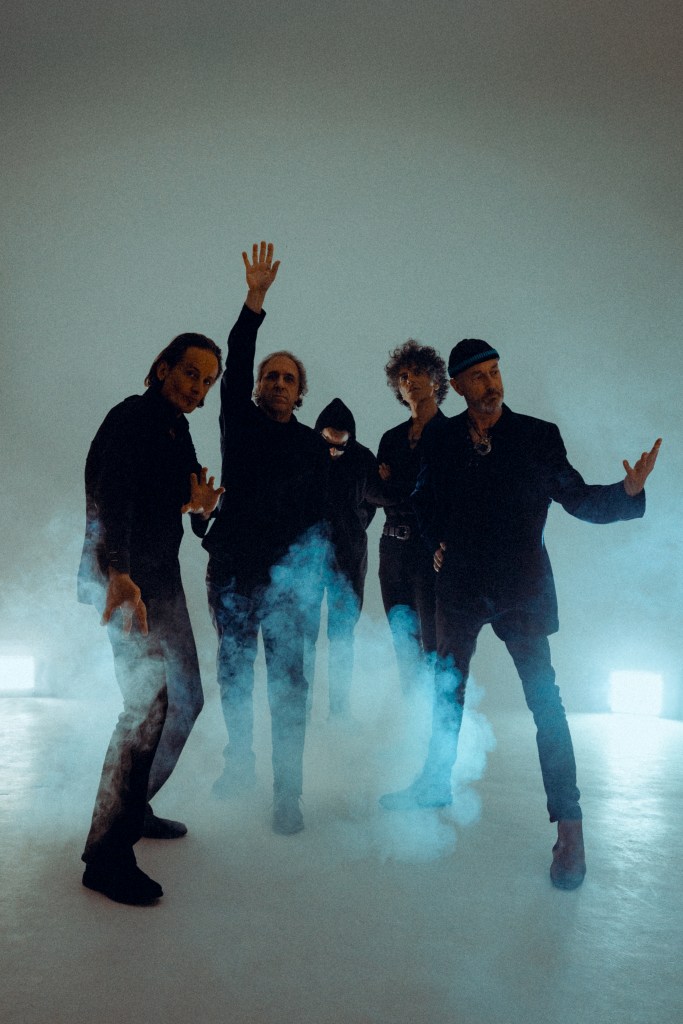
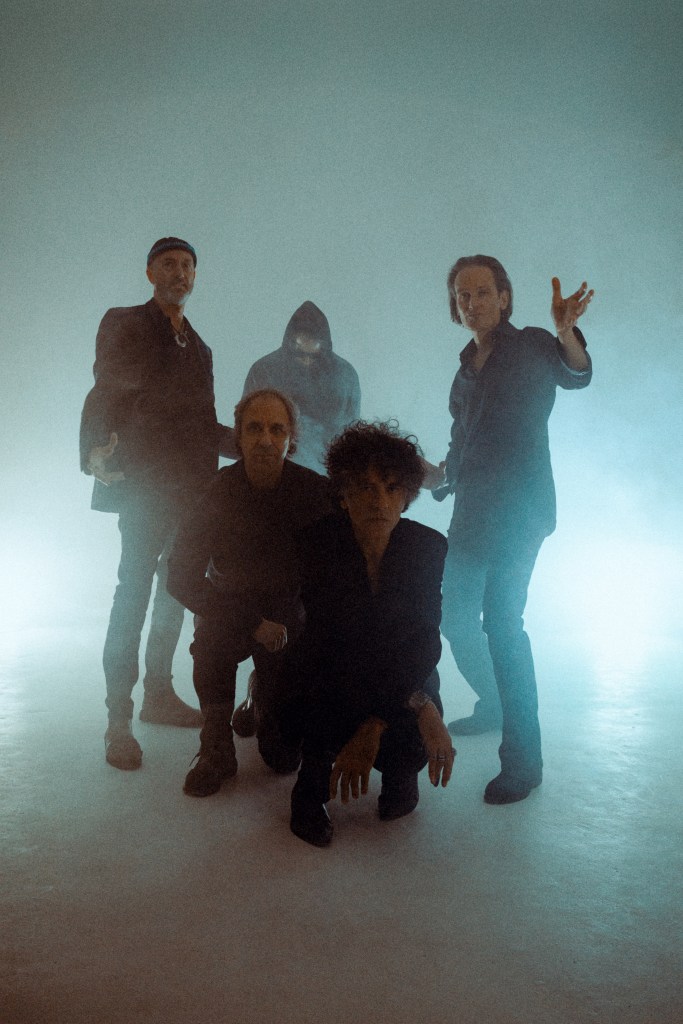
This line-up, who seemingly an aeon ago emerged from the embers of the last Daevid Allen line up of the band, are looking ahead to the conclusion of their latest joint tour with electronic madhatters Henge, plus a number of further summer European and UK dates. This multi-talented troupe of Dave Sturt (bass/vocals), Ian East (saxes and flute), Fabio Golfetti (guitar/vocals), Kavus Torabi (guitar and lead vocals) and Cheb Nettles (drums/vocals) will return, for a while at least, to their various solo and other band projects in 2027. It’s a line-up that now stands as the band’s most stable incarnation, and in ‘Bright Spirit’, puts together a seemingly more reflective, holistic album than previous ones, providing a perfect excuse for us all to take stock.
If ‘Rejoice! I’m Dead’, the first post-Daevid album, made a virtue of its members’ formidable and diverse talents, both performative and compositionally, in moving towards the band’s new reality, then ‘The Universe Also Collapses’ was grandiose, containing the epic ‘Forever Reocurring’ , the highly charged ‘My Sawtooth Wake’ and the startling ‘The Elemental’, whilst ‘Unending Ascending’ alternated between spiky riffing, Sixties-drenched psychedelic pop and the ‘Selenish’ implorations of ‘Ship of Ishtar’.
The latest project was not without its vicissitudes. Back in the spring of 2025, there were rumblings that the creative process had started to stall a little, or at least was starting to wilt under the pressure of deadlines. More of which below. But given ‘Bright Spirit’s’ rocky incarnation, it’s surprisingly at ease with itself, a coherent statement, almost a reverie of sorts, and, after the striking statements of the first two tracks, underpinned sonically by glissando guitar. It all adds up to a sense of completion of this particular cycle, a new trilogy perhaps?
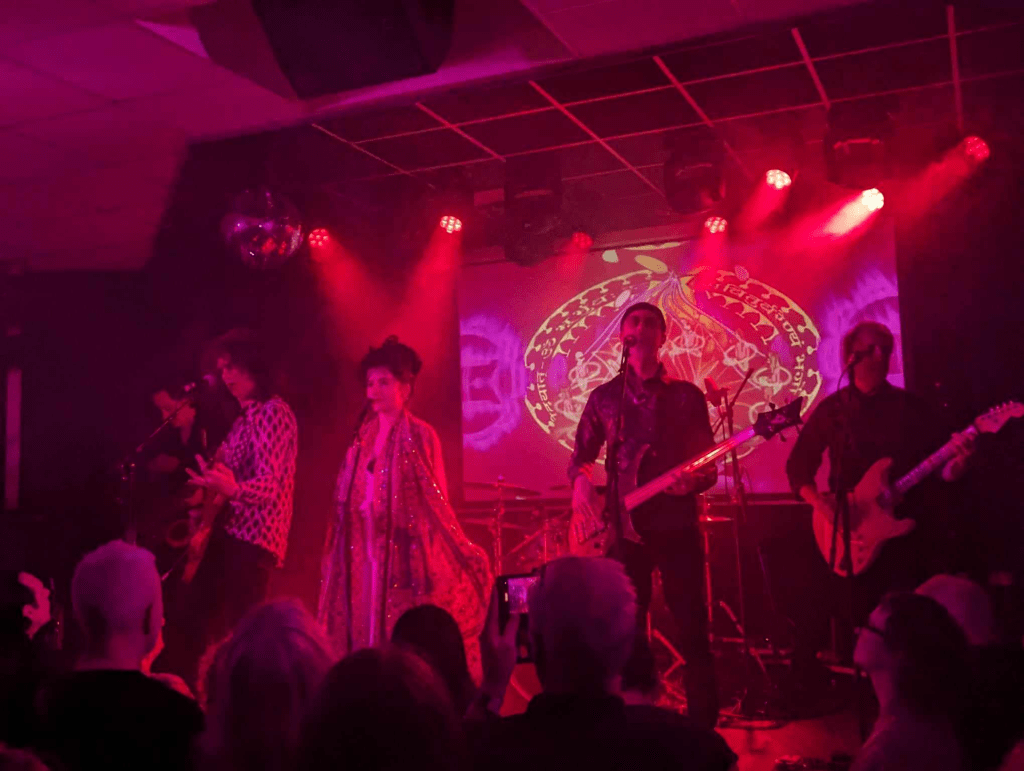
Gong at Allendale Village Hall, 2025
Kavus: my feelings towards it are bound to be completely inescapably tied up with the creation of it and how we made it and what I was thinking at the time of writing it so it’s kind of interesting to hear how it’s perceived when you haven’t been inside that that globe of craziness!
Dave: in 2024 we were doing a lot including the East Coast in America and then a massive six week European tour. We had Christmas and then we had a few months off but catching up on everything. We kind of exchanged ideas beforehand because we knew we didn’t have a lot of time.
Kavus: On ‘Unending Ascending’ some stuff came together really quickly. For ‘My Guitar is a Spaceship’, Cheb just started playing a beat. I came up with the riff and then about an hour later we pretty much had that tune as you hear it now but with different words. We managed to tour around Europe most of the stuff that appeared on the last album. We were pretty sure of how we wanted the songs to go and they were really under our skin. The recording process was very easy.
With ‘Bright Spirit’, we didn’t have that luxury. We got a month or so off to write and then we’re back in the studio again. And in that month or so, I went through some sort of interesting changes. I quit drinking before the European tour. I had turned into a raging alcoholic. No easy way of saying it. And so then I found myself in January sober um at home
I wrote ‘Fragrance of Paradise’ actually that was a tune I’d written ages ago, but finally got it over the line, but I wrote ‘Dream of Mine’ and a few other bits and pieces at the beginning of the year.
Dave: The writing sessions were quite intense and we spend days and days working on something and then decided it wasn’t and do something else. There was a lot of toing and froing. It’s always interesting the way these things develop because they always change as soon as the kernel of an idea is there and it’s just like everyone throws in ideas and then it develops through the recording as well.
Kavus: when we got back together (in early 2025), it was like, I just need a break from Gong. But we couldn’t have a break. We had this deadline. We had to do this. And as things were getting closer and closer to getting this in rehearsal and working the stuff out, it just got really fraught because we had to make a good album. I feel like everything that we do, everything I do anyway has to be better in some way or at least deeper than the thing I’ve done before. We were having to make decisions about the songwriting or about the song structures that were maybe made under pressure rather than under consideration.
Fabio: I feel that this album is like a conclusion of what we developed during these 10 years, a kind of resume of the creative process of this incarnation of Gong. Each song has its own world and connects to the ‘stone foundation’ of Gong (using Jonny Greene’s words). It seems like a wrap of ideas that we’ve been putting together and developing until this moment. It seems that it is time to turn the page and move forward to the next era.
Looking at the material that we recorded, I was very confident that it would result in a good album, and for me this album has more aspects that are closer to my personal taste in music, more meditative, melodic, and some bits reflecting the Gong of the old days, of which I’m still a fan.
I believe we called this a trilogy, first because Gong had a trilogy (in the Seventies) and this would be a kind of honouring the past, but also because this is the third album that we moulded our version of Gong starting with ‘The Universe Also Collapses’. We consider ‘Rejoice! I’m Dead’ as a transition, although it has some seeds of what we developed, we just brought individual ideas that were developed collectively. From ‘The Universe Also Collapses’, we decided to create music all together in the rehearsal room.
Dave: it is definitely the sum of these five musicians, but our experiences include being part of Gong, some of us more than others. I mean I’ve been in it 16 years since I got involved in April 2009. And then Ian was in 6 months after me… And then Fabio’s been steeped in it for longer than even though he wasn’t in the band until later, and Kavus as well was you know as a teenager really into Gong. When I joined Gong it was never like I had to do what Mike (Howlett) had played before. It was all about you. You didn’t have to be a Gong person – you have to bring something to it. When we did the ‘I See You’ album (the last with Daevid), it was a case of everyone being asked to bring ideas.
Dave Sturt, Sheffield, 2023
Fabio: I feel it’s more like a conclusion than a change of direction, I believe it’s an exploration of everything we’ve done, now let’s move to other territories!
Kavus: I would love this idea of being able to perform the entire trilogy back to back as one big thing even if it was just for a one off or two or three things, do ‘Universal Collapses’, ‘Unending Ascending’ and ‘Bright Spirit’, do it all as one thing. I like the challenge of that. We used to open with ‘Forever Reoccuring’ a lot. And it would end with with ‘Eternal Hand’. Maybe we do it like Magma did and do like a little interval between. I don’t know. I mean, I like the idea, why not? I think we could pretty much play all of it live.
Bright Spirit: An album guide
Gong performed ‘Dream of Mine’ and ‘Stars in Heaven’ during their autumn tour with Henge, and, at the time of interview were hoping to incorporate more tracks from ‘Bright Spirit’ into their spring set. Here the band talk through some of the tracks on the album. Whilst what follows is not an exhaustive guide to the riches of ‘Bright Spirit’, it does collate some of the band’s thoughts on individual tracks, starting with the extraordinary ‘Dream of Mine’:
Dream of Mine
Dave: it started with a riff from Kavus which he’d been playing for a while and there was one day I got to the rehearsal studio and he was playing that riff and I said “it wasn’t bad that!” – we were rehearsing for some gigs I think at that point. I said it’s got a real kind of Turkish vibe and because Ian is well versed in all that, I said it could be really good to kind of get Ian to like overblow it on the soprano and really push that eastern thing. That riff that was the root of it and then it kind of developed. I’ve never really talked to Kavus about whether he considers it to have an Iranian connection but he’s always for choosing strange intervals. They might have just appeared under his fingers..
Fabio: During the composition process, after Kavus brought the ‘Dream of Mine’ riff, a complementary “Egyptian” phrase came to my mind, which I called Anubis guitar!
Ian: this is a very interesting track for me. The process began with Kavus playing that riff he’d composed when we were writing together, and it immediately reminded me of the flavour of the music I play at Arabic and Balkan weddings. In those cultures there is a beautiful joyous celebratory dance music that usually accompanies the arrival of the married couple. It’s very exhilarating to experience both as a listener and a performer. The air is electric. I used to play Zourna (aka Mizmar) at weddings sometimes and this is the instrument you hear me play at the beginning of this track. I’m using the flavour and feel of that music with a similar Makam style of improvisation. Also the drums you hear at the beginning are the Davuls (aka Tapan) I bought in Turkey years ago that are also played in this wedding music. Cheb and I laid down those parts based on a drum pattern Cheb wrote to fit Kavus’ riff. It was a lot of fun! And yes we opened the gigs last November with this track although on drum kit and soprano.
Ian East, Leeds Brudenell, 2024
Kavus: I wrote the whole tune at Christmas. The previous Christmas at my girlfriend’s house in Newquay. I just brought my guitar down knowing that and I wrote the whole tune then.
I’ve always loved those sort of eastern sounding riffs. It would probably be a little bit of a reach to say that there’s a sort of Persian or Iranian influence there, but why not? I have always loved that, going right back to, for example, hearing things like ‘Stargazer’ by Rainbow when I was a kid, it was just like the best thing I’d ever heard. I always love that harmonic minor sort of stuff. It’s a funny ass riff and it’s one of those ones that when I came up with it, I thought there’s something here.
But what I wanted to say about that tune is that there’s a bit in the middle which we refer to as the payoff – the payoff bit where for me it’s as if certainly the rock side of – obviously I’ve got Utopia Strong stuff, my solo stuff but in terms of rock music, which is everything I’ve been doing since I really picked up a guitar, that payoff kind of condenses everything I’ve been trying to do rockwise my entire life as a as a singer and a composer and a player into that one little section. And I was so adamant about this, like no, “this is the payoff”. It has to go like this. It’s got this singing over this mad bit of guitar playing. And Cheb wrote the harmonies on top of it. Lyrics: ‘ You really got to keep your secret closer’. When I heard the final mixback of it because we had to and froed – “this needs to go up. This needs to go down”. When I heard the mixback, I actually started crying. And that’s what I meant: if I get hit by lightning tomorrow that one little bit of payoff that is what I’ve been trying to articulate musically for the last 50 years or whatever. I was very happy about that, not that anyone would even know. I can sleep easy now. Cheb was a tub thumper on that one. He was like, “Yeah, come on!’ So, I was really glad when it got made.
Mantivule
Fabio: ‘Mantivule’ came from just Kavus playing around with rhythmic delays, a classic Steve Hillage style echoed in many artists, like Manuel Göttsching, Steffe, Ed Wynne… also myself..
Kavus: it was actually one or two things we’ve not done before. One – it was an instrumental, and two – it was using the dotting technique. Do you know about dotting? So what dotting is when you play with a delay, but you play against it. So you’ve got the way that say for example Brian May would use a delay where he kind of plays with it. So it sounds like a big orchestra, but if you play against it, you sort of bounce against, I think you’re like playing in triplets against it. Steve Hillage uses it a lot. Steffe uses it. Ed Wynne uses it a great deal, you know, and I remember reading an interview with Ed Wynne probably from the 90s talking about dotting and he says, “Yeah, it turns you as a guitar player into a human sequencer”, which is a great way of putting it. And I’ve always done bits of dotting right back to my old metal space rock band. But in a way it is, for want of a better word, a space rock cliche or a trope. So we we’d never actually done it before with Gong, but I had that kind of dissonant dotty thing and in band practice turned into this thing and it was one of those ones where I was just like “ah fuck it. Let’s do it. Let’s do it”. I know it’s almost a bit of a Gong/ space rock/ Steve Hillage cliche but we’ve never done it and I love dotting. So let’s do our dotting track.
Kavus Torabi, Sheffield, 2023
Fabio: On ‘Mantivule’, the chord progression of course is the echo classic Gong which instantly deserved a gliss. Being a big Steve fan, during the overdubs at home, I thought… hum my hands were itching to squeeze a “snake guitar solo” in this part (before the break) and I did. Later Kavus found a place for his solo too, so I was imagining how his approach would be.
Kavus: ‘Mantivule’ is just a made up word. I had an idea for a song title, ‘Mantivule’s Blacklist’. I’ve got some weird compulsive obsession to make up band names and song titles. And ‘Mantivule’s Blacklist’ was just one that had been around for ages. So it was a working title. It was called that for ages and I was trying to think of a better name for it and I couldn’t come up with one and then Ian at the last moment said ‘I don’t like blacklist – it doesn’t sound very Gong’. Point taken. So we just called it ‘Mantivule’ and I like the mystery – what is Mantivule? Who is Mantivule? Is it is it an adjective? Is it a verb?
It’s one we want to play live. But what is so good about the way that that song ended up is that when I came up with it originally, I was hearing my part as being not exactly the top line, but I was hearing everything as relating to what was happening with the dotting thing which keeps going through the whole track. It’s changing meter, but I keep going. But as the song developed recording wise, that dotting thing just became much more just the foundation and the parts that got built up on top of it. And in fact, hats off to everyone, but especially Ian. Ian started composing these hooks and these melodies on top of it. I stopped listening to what my part is doing, listening to it as a whole, it’s like there’s no way that any one of us individually, I think no way one person could have composed this track, this is truly a band composition, and you can hear all five members’ different takes. I think Cheb’s drumming is just ridiculous – he’s done like these mad roto overdubs and everybody’s just bringing their own flavour to it. And it ends up being this thing.
I think that this more than anything we’ve ever done is the sound of all five of us, just making this strange thing there. There are harmonic decisions and melodic decisions I would never have come up with. And I love it. It’s really exciting and it’s extremely psychedelic because you just can’t hear where’s the focus here? You listen to the drums and bass it’s doing that thing, but then you listen to what Fabio is doing and it’s mental. So it’s a real surprise to me that one.
I wanted to put ‘Mantivule’ as the first single! I thought that will really fuck with people because they won’t be expecting this, you know, a seven or eight minute instrumental!
Stars in Heaven
Kavus: Cheb wrote the bulk of what became ‘Stars in Heaven’. He’s a much more articulate singer than me. So much of what we do comes from him. So many of other people’s parts are written by Cheb. In this band, so many of the arrangements are written by him as well. ‘Stars in Heaven’ was the first one to really get together mixwise. And I thought, this is the obvious choice for a single.
Eternal Hand
Fabio: ‘Eternal Hand’ was an improvisation over an orchestral glissando loop and a guitar arpeggio.
Kavus: ‘Eternal Hand’ we’d already written around the time of the last album, the bulk of it. We felt it was too similar to ‘Asleep Do We Lay?’ So on the last album, that one got shelved. And then Cheb brought in what became ‘Choose Your Goddess’, which is very very different indeed. Thank God he did. It’s such a different vibe. So we said, “Oh, well that one’s for the next album.”
The Wonderment
Kavus: On the last album, the first single we dropped was ‘Tiny Galaxies’. I absolutely love that tune. It’s a kind of 60s sounding poppy tune. And it’s like, people are going to be like, oh, what’s happened to Gong? Are we really going to drop the 60s sounding poppy tune? But there it was. So once we got ‘Stars In Heaven’ out (the first single from ‘Bright Spirit’), I said, “Guys, given how eclectic the album is, I think we should drop ‘The Wonderment’ next”, because they were going, “Oh, maybe we do a radio edit. We maybe we’ll do a radio edit of ‘Dream of Mine’”. Let’s just do ‘the Wonderment’! Because I honestly think people aren’t used to hearing this side of what we do. And we’ve never done anything like that before. And I certainly didn’t do it to placate the people who say, “Oh, there’s no synth in Gong anymore.” It was just that I had this synth and I just wanted to play it all over the new record because I love it. I feel like it’s actually it wasn’t a cynical move but I do feel like already now people have heard it and gone “oh, so Gong are doing stuff like this as well” and while I don’t think it necessarily sounds like old Gong, I mean Fabio sounds probably more like something like Ashra Tempel, once you get Ian involved and Ian playing … and of course with the gliss – so that was based completely on a glissando slide.
Fabio: ‘The Wonderment’ was constructed over my glissando sequence, which I recorded in just one take at the end of the sessions, because I felt that we should have a pure gliss track.
Kavus: We recorded the basic sort of, for one of a better word, rock tracks. Then we did a couple of interludes and one interlude was just this little tune that Cheb had written. We played a variation on the middle bit of ‘Stars in Heaven’ but with a different feel. So we just played that for four minutes and just got a recording of us playing that. And then Fabio said, “Look, I’ve come up with this gliss cycle. Maybe we could use it as an interlude.” So he played this gliss cycle for about 4 minutes. When I was having my meltdown in April 25, I had to put down what became ‘Stars in Heaven’ because I just was getting nowhere with the melody and the words. I couldn’t get the words right. I’ve got pages and pages, this book behind me where I’m just trying to get the right words. I couldn’t do it. And so I thought, well, I need to need to use my time productively – I’ll see if I can do anything with this gliss cycle. A couple of years ago I got given this little monophonic synth called an Arturia Microbrute and it’s all over the new last Utopia Strong album, the first album I’ve played synth on with them, and it’s all over my forthcoming solo album. And it’s all over this Gong album.
So when I look back on this period of my life, that’s when I first got that got given that Microbrute. And so I heard this gliss cycle and I just came up with this synth sequence to go over it which I recorded and thought that’s quite nice. I just left it on the drive. I don’t think I uploaded it or anything. And then after we got back from America and we’re looking at the album, I listened back to it with fresh ears and straight away I heard that vocal melody, “Spirit Bright”. So I sang that vocal melody down. Then I harmonised it. And then it was like, “Oh, hang on. This kind of sounds like a song now.” We’d got the first half which is like instrumental. Then we’d got this bit of singing. I’d just bought this Telecaster and it’s like, “Oh, maybe I’ll do a maybe I could do a solo at the end.” I played it to Fabio because it was his his gliss cycle. I said, “Fab, I’ve made a song out of it. Maybe you won’t like it. What do you think?” And Fabio got it straight away and said, “This is exactly the kind of thing I’m into. This is like this sounds like Ashra Tempel”. So, we uploaded it and Dave put his ebow bass on it. Cheb put some percussion swells and then Ian played some sax and played along a bit with some of my melodies at the end.
And the next thing, because it wasn’t like pulling teeth, this song came out of nowhere really, and I started going, “man, this is my new favourite!”, because it was just so unexpected.
In Parts 2 and 3 of the interview, the band consider their approach to vocals, the glissando guitar, lyrics and talk about Henge, Kozfest and their future solo projects


 The Canterbury scene(zine) continued....