Thirteen – an interview with Soft Machine – part 3

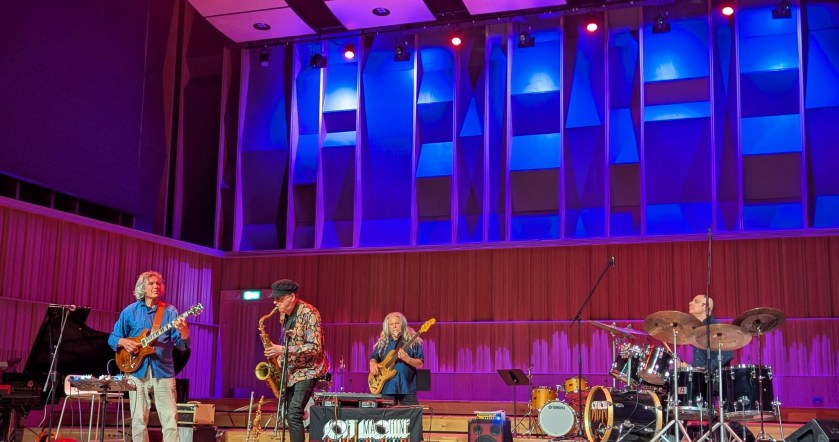
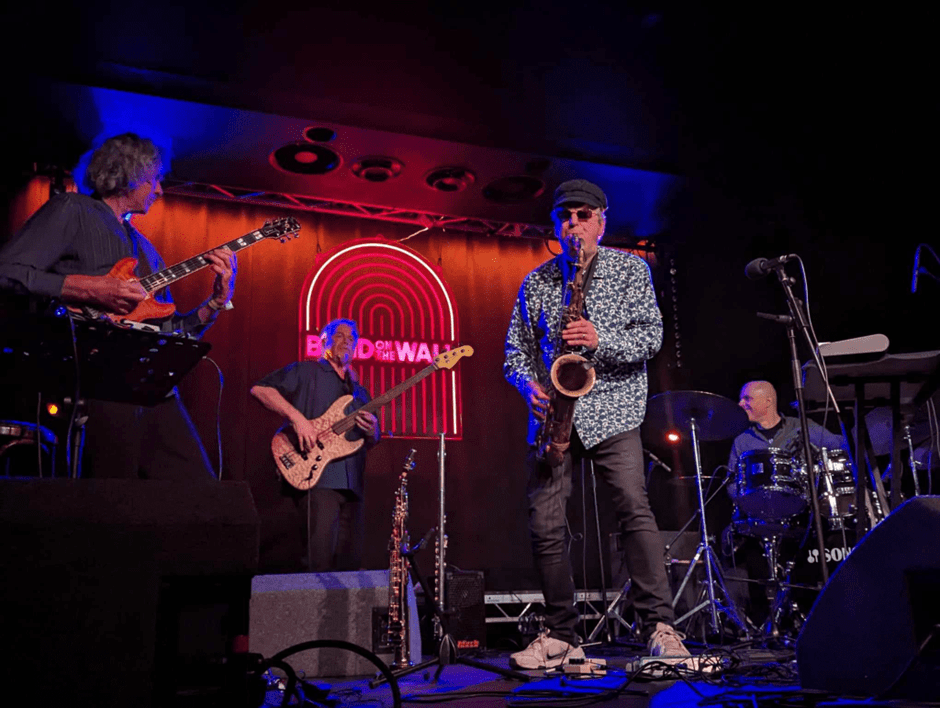
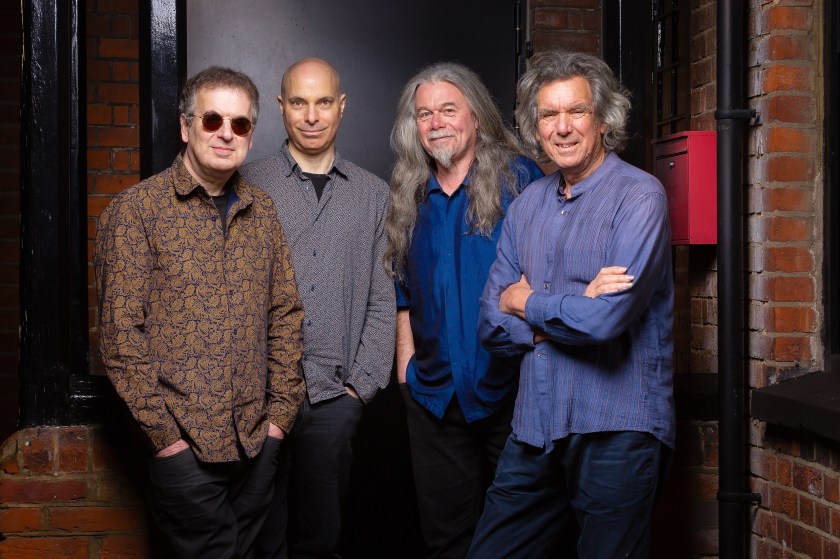
Soft Machine: Theo Travis, Asaf Sirkis, Fred Baker, John Etheridge – GD Corporate Photography

In the third part of Facelift’s Soft Machine interview, we speak to all four members of the band about how they individually came to join the band, including a diversion into Fred Baker’s extensive intertwining with the Canterbury scene; the lowdown on the band’s virtuoso rhythm section, and some vignettes from recent American tours. Quotes here from interviews carried over the past few months, with additional material from an interview with Theo Travis for the prospective Hugh Hopper biography ‘Dedicated To You But You Weren’t Listening’.

Part 1 of the interview talking through ‘Thirteen’ track by track is here

Part 2 where the band talk in more depth about the album and Soft Machine in 2026 is here

Joining Soft Machine

The four current band members have found different routes into joining Soft Machine: John Etheridge joined in the mid Seventies as a replacement for Allan Holdsworth; Theo Travis had spent a number of years with Gong before joining Soft Machine Legacy but also had connections with all of the other band’s members; Fred Baker depped for Hugh Hopper in the Noughties before officially joining the band earlier this decade; and Asaf Sirkis was one of the many drummers initially commandeered to fill the considerable seat of John Marshall. Each musician has their own story about joining:

Asaf: I joined Soft Machine around 2016 when I had the honour of subbing for the late, great John Marshall, who couldn’t travel as often. By late 2022, when John retired, I officially joined the band. Being asked to play regularly was a thrill. Composing and performing with Soft Machine has been a wonderful experience. I love that we tour often, and with each tour, the band’s sound continues to evolve.
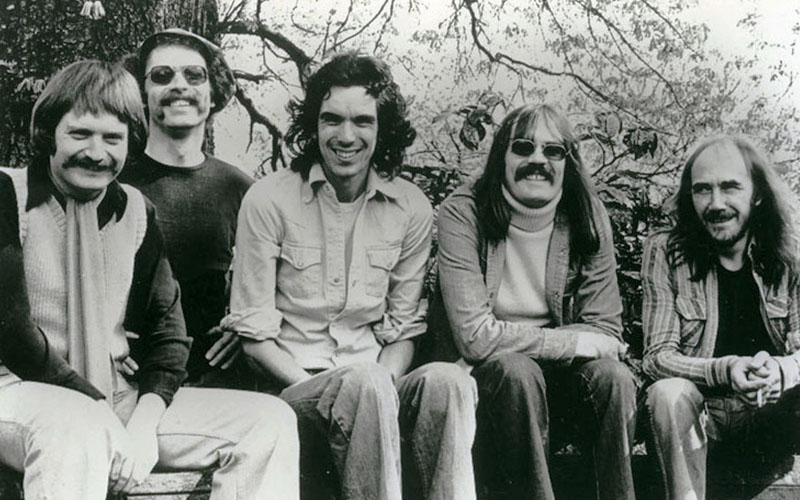
Soft Machine in 1975, John Etheridge third from left – image from Soft Machine official website

John: I wasn’t interested in Soft Machine in the early 70s – they didn’t have a guitar player. And then when Holdsworth joined I got interested and I went to see them about two months before I joined. I went down to the Rainbow and they were playing opposite Larry Coryell’s band and it was Holdsworth and Ratledge, Marshall, Babbington and Jenkins. I saw that and then next thing, lo and behold a couple of months later I’m bloody in it. Christ, I’ve got to do those guitar solos!

I had a way of playing that was different (from Holdsworth) but it was the same area that I was in. Though I felt like I was the right man for the job, I’m very glad that I wasn’t able to imitate that because I probably would have done! I was more of a sort of John McLaughlin man. So I kind of did it my way there. Again, people say, “Oh, you had your own style.” You I said, “Well, that’s just the only way I could play.”

And there were like two or three like (‘Hazard Profile’) in the set.. And I remember once I wasn’t feeling like it and the set was over in 25 minutes. “Oh, bloody hell. I’ve got to play and play and play.” So it certainly got my sort of longevity up.

Fred: I played with Soft Machine Legacy between 2008 and 2009. I had a tour pulled with Phil (Miller) – I was supposed to be doing a duo thing in America – we couldn’t get the visas – the gigs were there –  usual problem! Birgit (Fred’s partner) said, ‘oh John’s trying to get you, can you please tour with Soft Machine?’ and I said ‘John, I’m fine, I can do all these dates, I’d love to!”

Theo Travis had already established relationships with all 3 of the other members of the band: John Marshall, John Etheridge and Hugh Hopper.

Theo: The first time I met and did anything with Hugh, I think it was the King of Hearts in Norwich. It was a Burning Shed night of improvs and stuff and I did a set with Hugh and Bernard Wostheinrich.

There was a gig at the Stables in Wavendon. Elton (Dean) was in a coma and the gig was long-fixed and they just said, “could you do the gig?” Obviously they hoped that Elton would recover and be back. It was curious, it was Hugh who called, me, not John (Etheridge) or John (Marshall). Given that I’d known John and John for ages, I was surprised in a way. So then I did the rehearsal and the Stables gig and then Elton passed away and next week was the Pizza Express and I played on from then, there were quite a few other gigs in the diary in early spring and late summer.
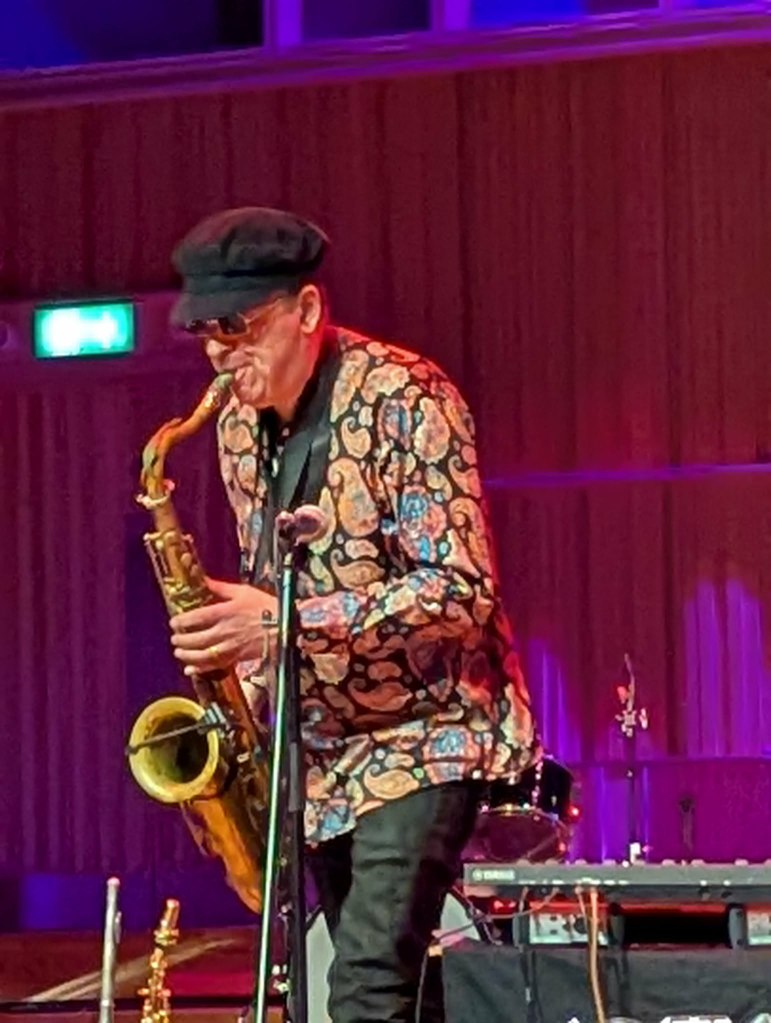
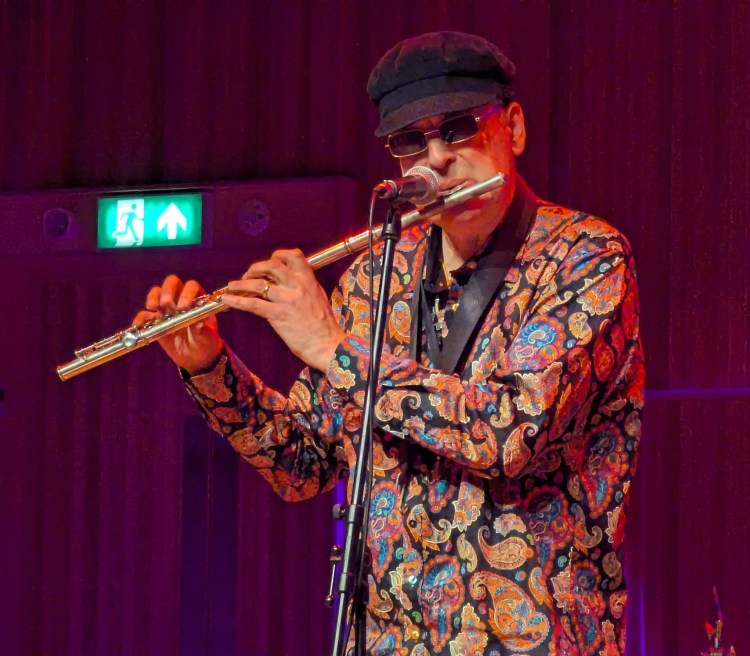
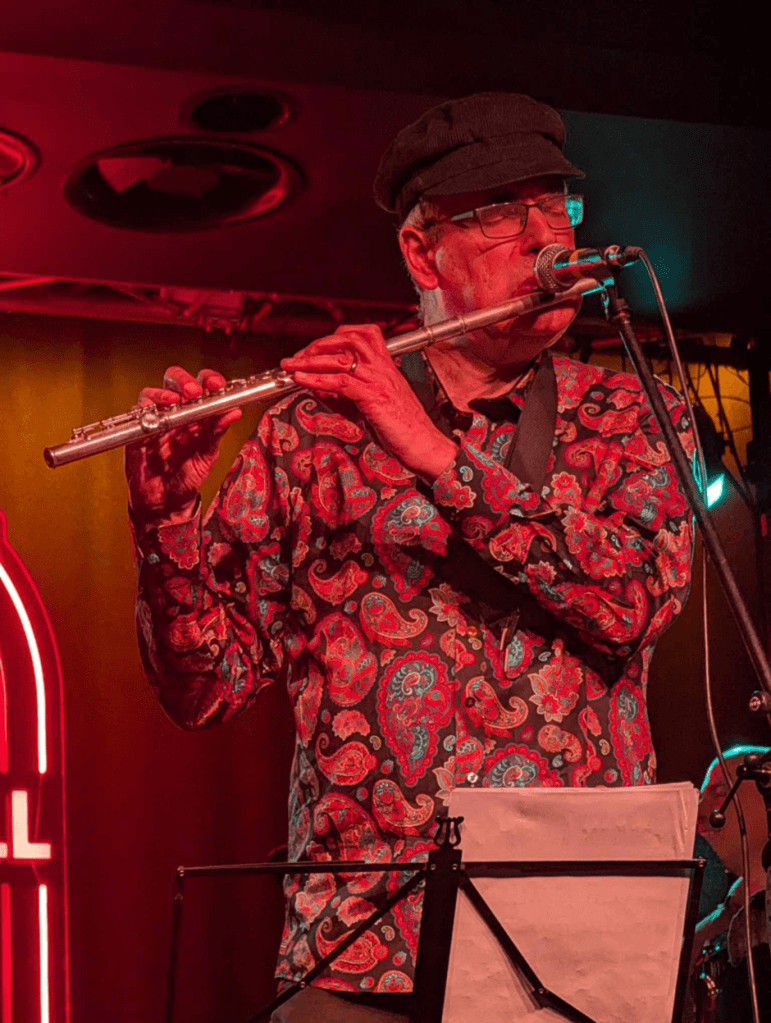
Theo Travis, Birmingham April 2026 – Photo PFH

John Marshall I met just before the ‘View From The Edge’ (solo) album. I knew Jeff Clyne, and Jeff had said “why not ask John Marshall?”, which I did and we had those rehearsals and did those recordings. So that would have been early ‘ 94. John Etheridge I’d done some jazz gigs around London and then I’d done some gigs in his band, and then I’d asked him to guest on the ‘Secret Island’ album which was in ‘96. So I’d done a lot with John from around ‘95 which is 10 years before Soft Machine.

Fred’s Canterbury connections

When Fred Baker joined Soft Machine he had already played with a number of Canterbury scene illuminati, including Elton Dean, Pip Pyle and Phil Miller in In Cahoots. But in fact his connections to Soft Machine musicians goes back much further.
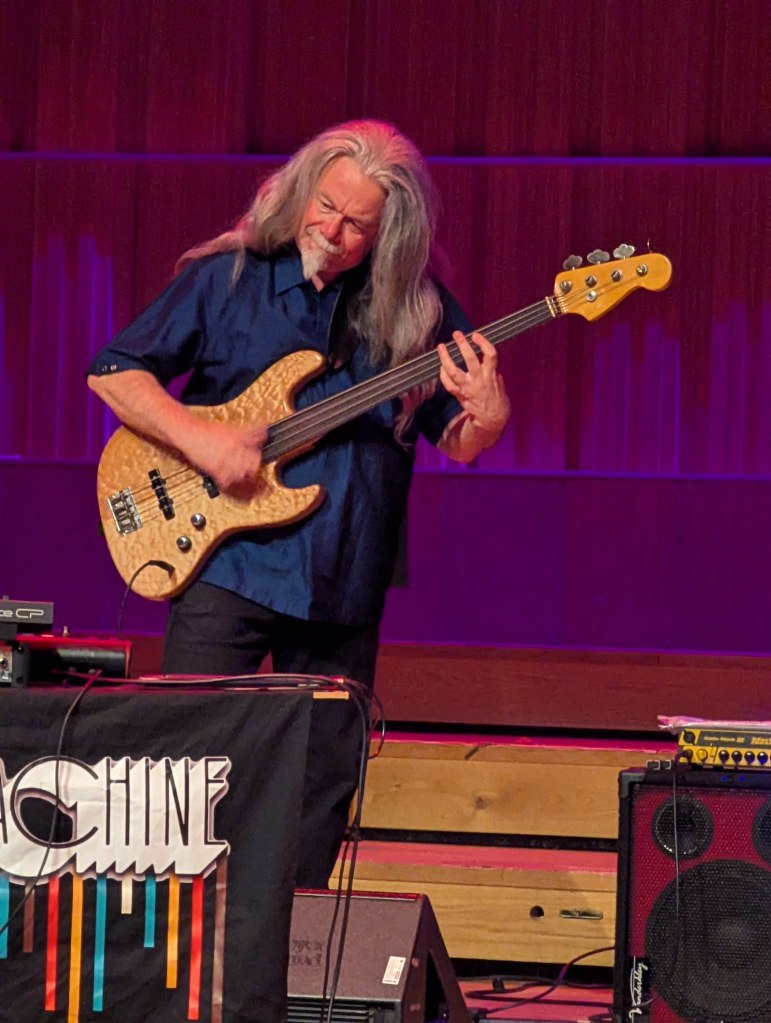
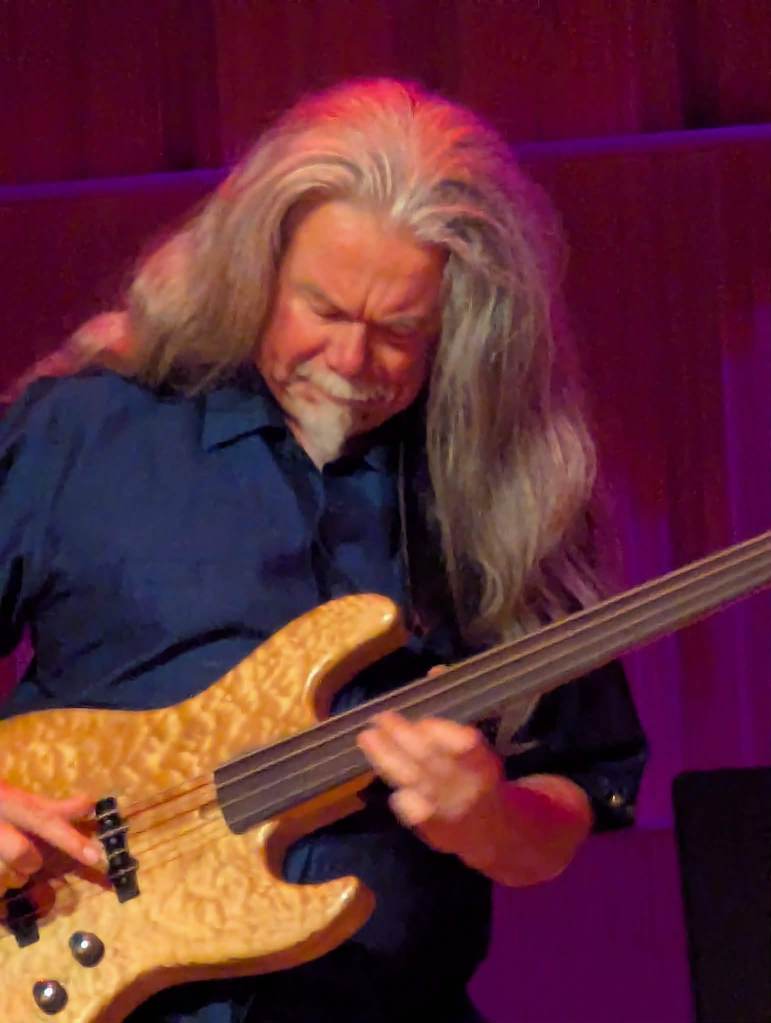
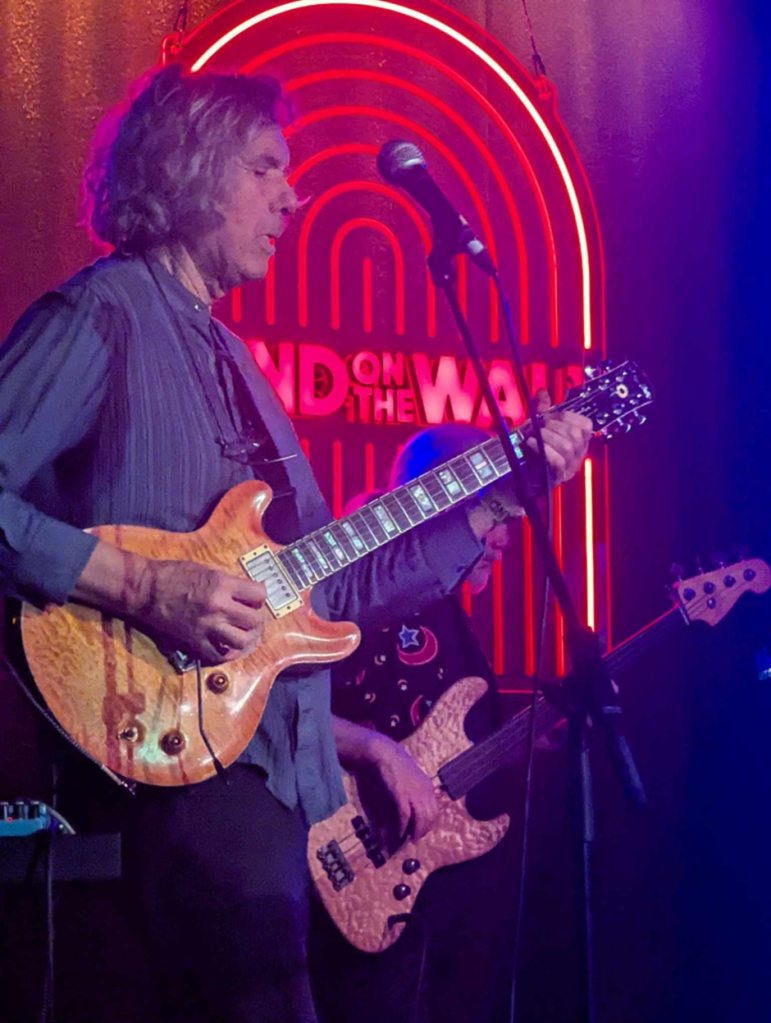
Fred Baker, Birmingham April 2026 – Photo: PFH

Fred: in the late 70s I went on the some of the music courses down at the Stables in Wavendon. That’s where I met first met John, and a few days before, Allan Holdsworth, but Allan didn’t want to do it after a few days and did a bit of a runner and so they asked John to do it!

I was playing acoustic guitars and these guys came up to me. I was watching a lecture because I was just like an assistant tutor. It was great, It helped me get by with money and stuff. They said, “Oh, can you come and play?” (with Allan). I said, “Well, I want to listen to this lecture that Mike Gibbs is talking about!”.

So I got on there and I think I played classical guitar with Allan. It was a whole day while he could just play and talk. Then they asked John to come up and that’s how I met John. I ended up playing with him and then six months later Ric Sanders (also ex-Soft Machine) and him were looking for a bass player to play this tour back in 1980-1981 and somebody says, “oh I know this great bass player, some friend of mine in Birmingham”. I was studying classical guitar and composition at the college in 1979, at what is now the Conservatoire, it was the old Birmingham School of Music.

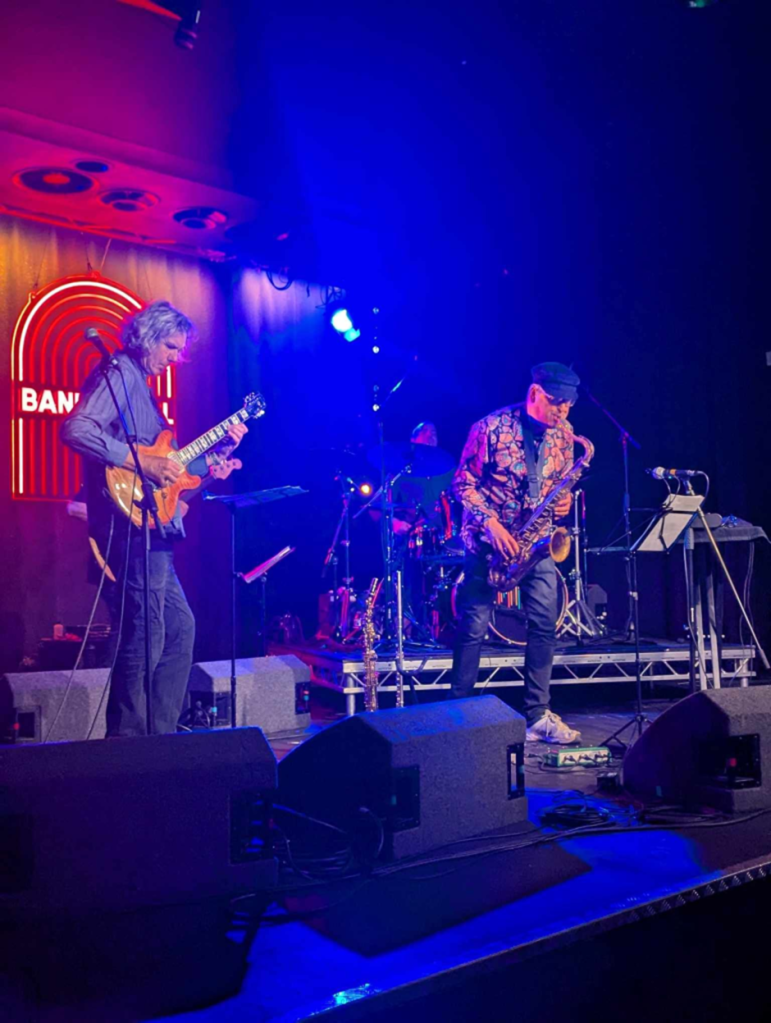
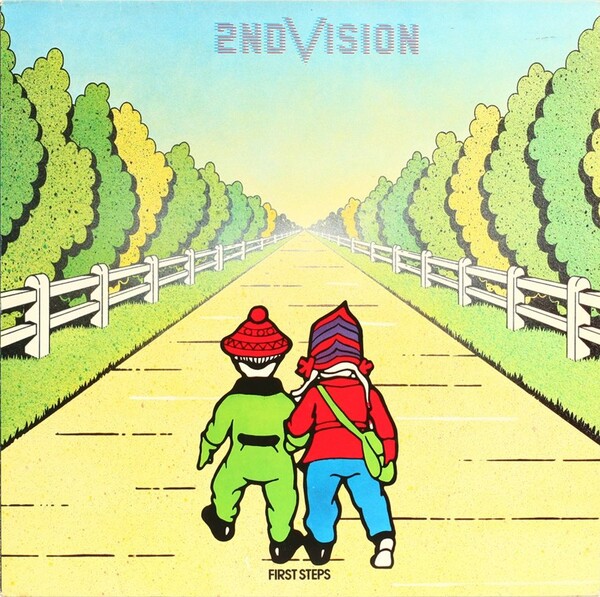
I was at this party. I’m just playing something on my acoustic guitar. And Ric said to me, “What are you doing next year?” And I was just a young guy 18/19, just doing me stuff and that’s how I ended up getting the gig with John when it was the Etheridge/Sanders group playing basically music from ‘2nd Vision’. And that was first time I came to Manchester, Band on the Wall.

It was progressive jazz funk rock. It was quite unique. I always thought it was a bit ahead of its time in some ways, some of the compositional ideas that Ric and John put together, that was their kind of thing after they left Softs.
We did this disastrous gig to launch the whole tour that year. It’s all recorded for BBC at Camden Roundhouse. I’m sure somebody sabotaged all the gear!

It must have been a few years later that I was doing a thing with Harry Beckett because Harry invited me to do BBC sessions with him and Elton was on it. Phil (Miller) was looking for a bass player –  they couldn’t find any because it’s difficult to play Phil’s music – they were struggling so they tried a few people out and Elton said, ‘why don’t you try Freddy’. And so it’s thanks to Elton really I ended up playing with Phil. I had that long time relationship with Elton and Pip, all those years.

I first joined Phil Miller’s band after Hugh left to do his own projects – he got very busy. He used to come and see me to see how I was getting on playing. That’s how I made friends with Hugh. But the other thing was: that gig I thought was a disaster – I didn’t know that Elton and Phil were in the audience! It came out years later. And they said “we thought you were good!”. So there’s ‘Baker’s Treat’, Elton wrote that for me, they used it on the first Soft Machine Legacy album (‘Live in Zaandam’)  And Hugh even says, “Oh, it’s a dedication to our mate.”

When Theo was young I was teaching with John and Jeff Clyne was there also. Theo came on as a student and we saw this sax player and we’re all saying ‘I want to have him, I want to have in my band’.

The rhythm section

Fred Baker is one half of a powerhouse rhythm section, the other being drummer Asaf Sirkis. Each member of the band talks about this pair’s impact, individually and collectively.

John: When we were picking people,  Fred was an obvious shoo-in really because I played with him for years. We had a lot of great drummers playing with us and the Asaf decision was definitely right, but Leonardo (Pavkovic) was quite a bit behind that as well. I mean, we all loved Asaf, but we’d had six or seven great great drummers playing with us when John had been ill, and we had to kind of decide. I’m absolutely sure we made the right decision on every level!
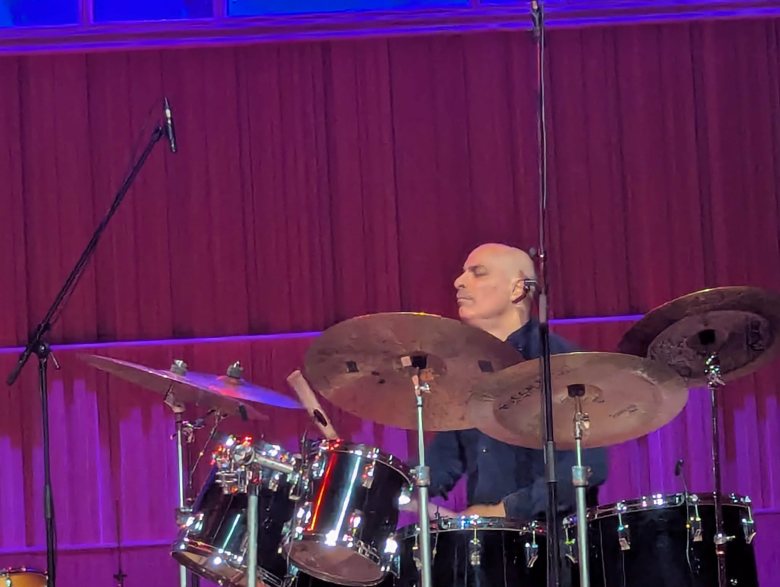
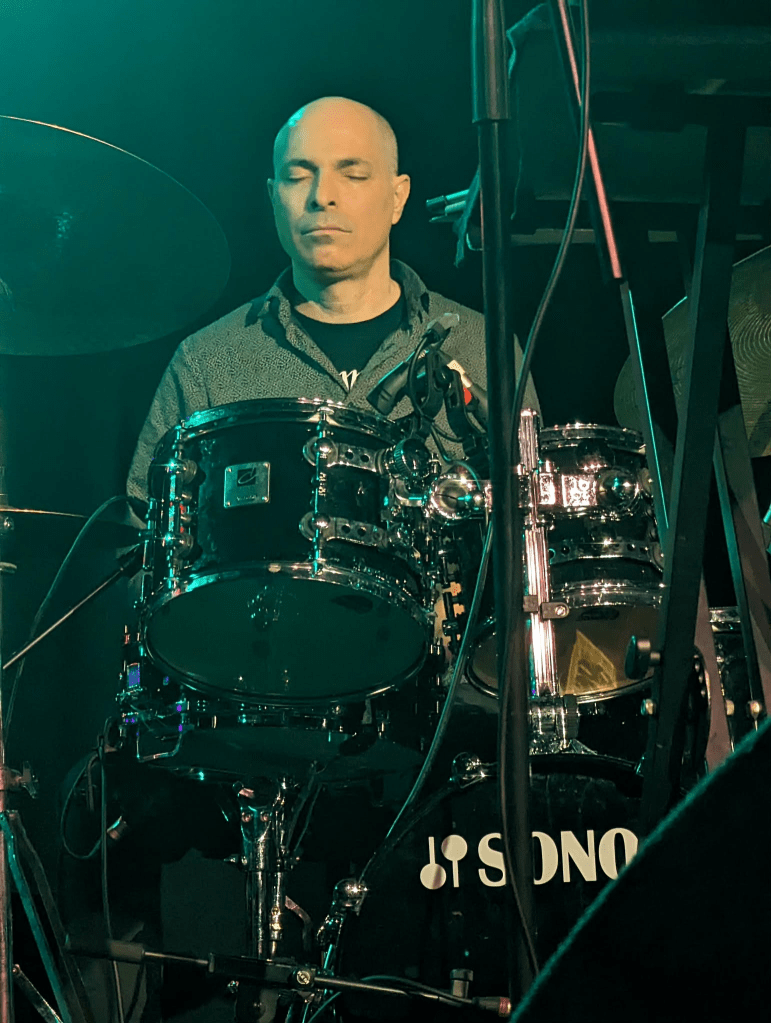
Asaf Sirkis, Birmingham April 2026 – Photo: PFH

Asaf: Playing with Fred is a treat every time. He is such a creative musician and I feel that we work well as a rhythm section providing a solid but flexible ground for the band to play on.

Theo: Fred and Asaf is just a different beast to Fred and John (Marshall) or John and Roy (Babbington). There was this kind of feeling that they can do kind of anything and I should write stuff to justify that.

Obviously John Marshall is a brilliant player and has made amazing contributions to music and to Soft Machine and everything. Asaf is a very different generation. He’s a post click track generation where his timing not only is great on the click and in the studio but he studies the whole Indian Carnatic thing which is totally getting inside the complicated changing time signatures and having a total handle on that. But perhaps unlike many people who are very good with click tracks or very accurate in the studio, he’s also a very kind of melodic player and a comfortable free improviser. Often the more a drummer or musician’s into free improv, the less precise their technical skills are because their world is open, everything’s open, everything’s free. But Asaf absolutely does both and loves both and studies both. You can study forever, but he’s very much immersed in both worlds.

Fred is similar really – amazing facility, amazing time but he’s also broad-minded. Some people with his sort of technique wouldn’t particularly warm to the idea of a kind of thunderous overdrive, but he makes a bass sound like a Harley Davidson! He does it brilliantly. There’s this feeling that they could do anything.

Fred and Asaf are a great team. They’re a great rhythm section. They’re both very musical and they’re both very broad-minded. I don’t think there was a single thing that was presented to them that they did other than went, “Yeah, great. How about this? And like this, and what do you think of this?” They’re very up for it.

And their compositions are great. They both offered even more than these ones. I kind of became clear that I was the producer, not sure how. I think I just put more time into it really. and was kind of really keen on steering it. So both Asaf and Fred suggested or submitted tunes and I just chose ones that I thought would work best for the band and for the album.

John: John Marshall was an extraordinary physically powerful drummer in his heyday. Asaf is an extremely active percussionist – he really is active in the sense of being a very busy player which for us is perfect, that’s what we want – it’s very important. When I think about our rhythm sections – they’re not ‘nailing it down’ rhythm sections, that doesn’t suit the Soft Machine. We want people obviously with some virtuosity but also with a kind of commitment to something in the left field. Obviously we’re not completely left field, but the combination of Fred and Asaf is not a traditional rhythm section. That’s what we don’t want. Soft Machine never had one. Even in the days of Babbington and Marshall in the 70s. So it’s about what you might call character personality. Asaf is obviously a virtuoso and he plays with lots of people. He’s got this tremendous kind of commitment to percussion and playing and he’s always practicing which is great. It really gets me going like that, that’s important for me personally and you can hear it from the album. I’d say he doesn’t play like John Marshall but as it’s he’s like as if it was John Marshall in the 70s. Loads of creativity…

Fred: Asaf’s incredible, just as Robert (Wyatt) said. He’s just so up for the music and the joy of all that, having good fun with it, putting serious work into it but it’s like when I sit back and listen to the music, they’re the people I would put in if I wanted something that was the feel of the group. So creative as well and with compositions which are unique which goes back to the Robert thing.

I think we sorted out some of the times  on some of the early difficult stuff because he’s so fantastic with the Carnatic, Indian system of music. To get those difficult time frames, it’s better sometimes than trying to count. Everybody’s doing odd times, counting numbers. You can actually get 15/8 to feel right. You’re not chancing it. It’s still free, but it’s tightened up. I don’t know how to describe it…

Leonardo Moonjune

The story of Soft happenings over the last two decades is very much intertwined with that of Leonardo Pavkovic of MoonJune Records who celebrate their 25th anniversary this summer with a festival in Teramo, Italy featuring both Gong, Soft Machine and Steve Hillage (as well as Beppe Crovella and Michel Delville performing a selection of pieces collectively known as ‘What’s Rattlin’’).
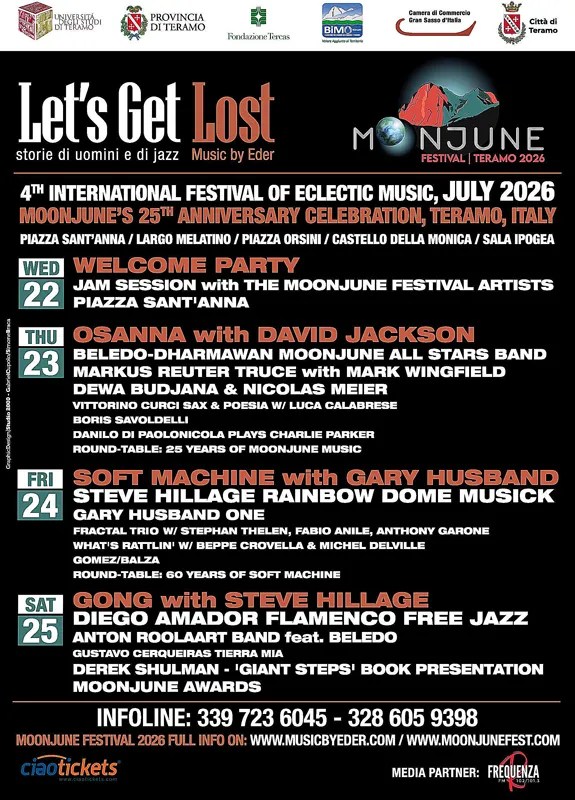
John: To recap: he put us together. It was his idea in 2004/2005 to reform this thing which didn’t take a lot of persauding. He’s been a kind of inspiration ever since, sort of keeping it rolling, thinking up ideas. He’s always been there, and always his enthusiasm is tremendous, you know, and he’s sort of he’s almost a Spengali., somebody who puts people together. This is him. This is what he does. So he’s put together this festival in Teramo in Italy. There’ll be kind of various events. We’ve got Gary Husband playing with us.

He’s a  powerful inspirational figure. We owe him a lot and we’re very glad that he’s sort of around really. It wouldn’t happen without him.

Fred: Leonardo – bless you! He was one of the guys that got the whole thing together in the first place. I remember when the band was getting together Soft Works, you know, with Elton (plus Hugh Hopper, John Marshall and Allan Holdsworth). I obviously knew Elton very well and then Allan and John when it all got together through that connection

American adventures

In 2023/4 Soft Machine undertook tours of the United States which were memorable for a number of reasons, both good and bad. The band’s struggles with visas meant that Fred Baker, at the last minute was unable to travel in 2023, meaning that Uruguayan-born multi-instrumentalist Beledo stepped in (and was namechecked on ‘Beledo Balado’ on ‘Thirteen’).
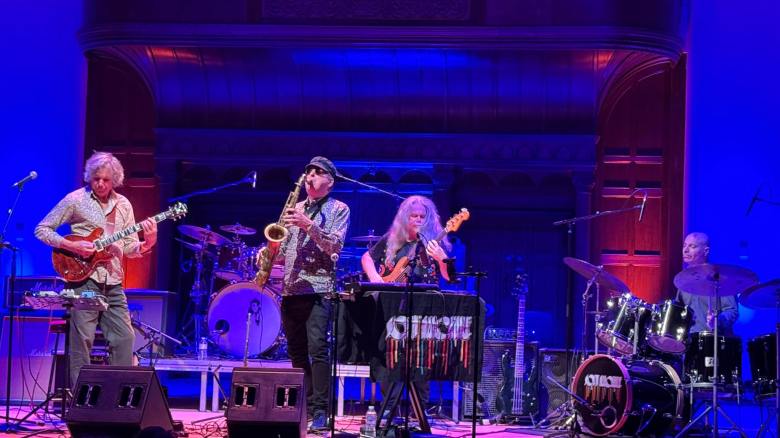
Soft Machine – Cadogan Hall 2025 – Photo: Chris Parkins

Fred: It was just getting the visas. The others got sorted out, it was all right because they had recently had some visas so it went through quicker, but mine was a completely new visa because I’ve not been anywhere near America for over 10 years, so it’s like your off the books. It’d be even trickier now. In the end I got it within seconds but it was a nightmare. The second tour was OK – the middle bit wasn’t quite right, but we still did that East coast one, it was good. Canada was great. People loved it in America – absolutely love the band. It’s just financially difficult to do. Nice clubs, theatres, gigs, And it really went down well. I remember Quebec. We did two things there. That was great.

We had a big van, like American size, shiny! We had all the hire gear – most bands are doing that, taking little modules and touring now. It’s so crazy trying to find the cheapest way to the cost efficiency of it all because in America there’s always a charge for every little thing.

Some distances weren’t too bad, some were a few hours, but there was a few long ones, six, seven hours and that and then I think a long one to get up to the border. But in general, it was good. Apart from when John and Asaf had to get their van back down to from Canada they did it in shifts. It was amazing. They actually did it.

I was fascinated by it. I think because of knowing each other for so long we could cope with it –  I think a young band would probably collapsed at the first because of the difficulties with everything – the finance.

John was an absolute star – he was doing a lot of the driving. Thanks to John and Theo a lot of things materialize. Putting the credit card up against guarantees. The other thing was we all got ripped off with things like credit cards, at hotels and things, scamming your numbers. I couldn’t believe it. I had to redeem them when I got back. Somebody tried it at one of these dodgy hotels.

John: Me driving a van, 77 years old! No, no, I’m 76. Driving a van from Quebec City via Washington to Trenton, New Jersey, long wheel-based transit with no proper GPS with a compromised credit card in America going through the various borders. I mean, that’s a story….

I asked Fred what sort of audiences came to see the band and musicians

Fred: I found it really amazing. They said we’ve got all your stuff with Phil (Miller) and  jazz things with Harry (Beckett) and  all this stuff. Genuine. You know the guys came from all sorts of places to get to some of the smallest gigs.. Like the one in LA, the Baked Potato. That’s amazing. One of the smallest places, but everybody plays there. The night before we were playing there, Alex Acuna was in there. You get these little pockets, then the normal kind of theaters and music clubs, you know, the big clubs, you know, sort of like Ronnie Scotts.

Whilst there are currently no American gigs on the roster, Soft Machine will be touring ‘Thirteen’ extensively within Europe throughout the rest of the year, including gigs in Italy, Portugal, France, Netherlands, Austria, Hungary and Switzerland as well as UK dates scattered throughout 2026.

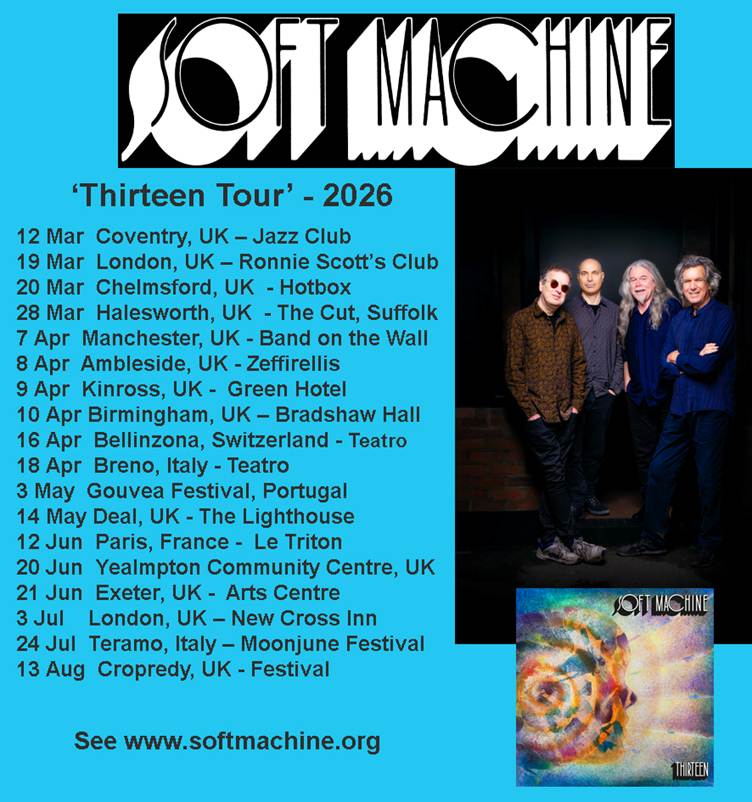
Full dates at https://softmachine.org/touring/on-tour
Thirteen – an interview with Soft Machine – part 2

In the first part of Facelift’s interview with Soft Machine, band members took us through their new album ‘Thirteen’ track by track. In part two, they talk about the current status of the Soft Machine band and the creative processes that led towards the album.

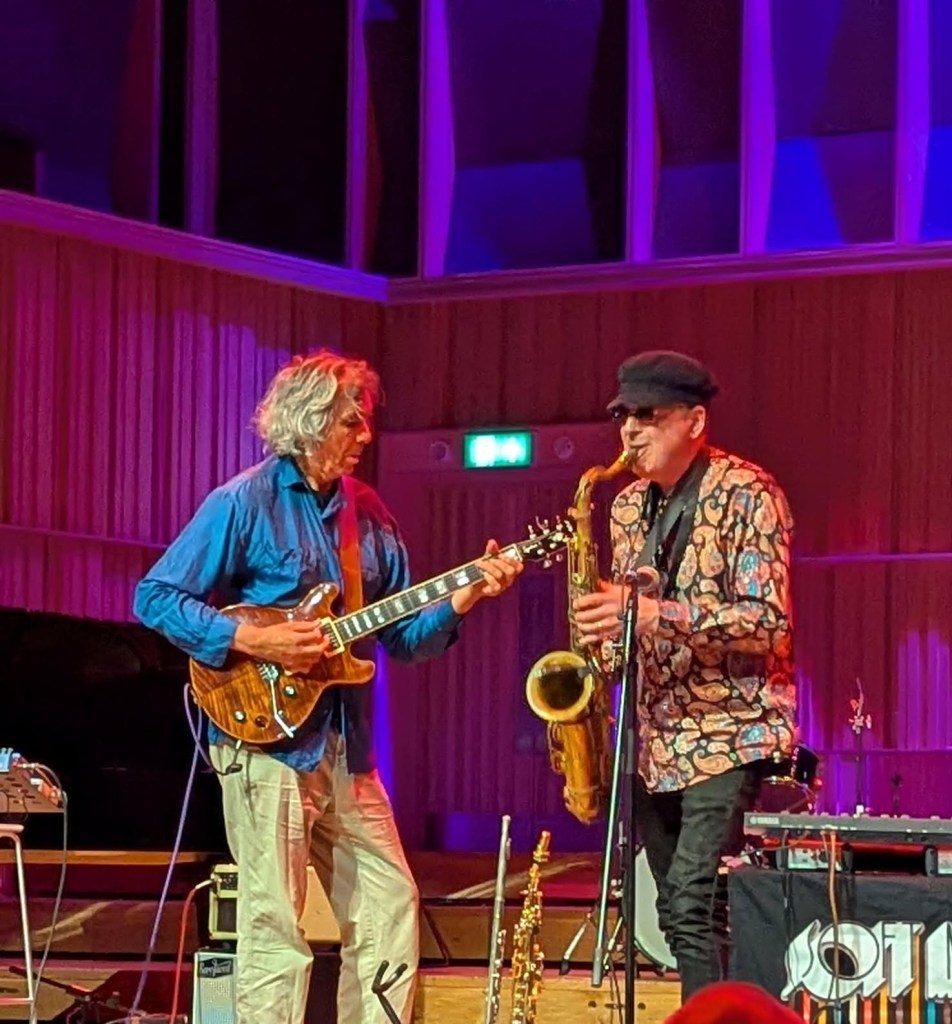
John Etheridge/Theo Travis, Birmingham Bradshaw Hall 10 April 2026 – Photo: Phil Filby Howitt

Soft Machine Now

Theo: One of the things Sid Smith mentions in his sleevenotes is something John Marshall used to say, which is that whenever new people join the band there was this feeling that the music begins here. And this is why the Soft Machine eras, when people try and join it all up and say well “this isn’t like Kevin Ayers songs”, it was never intended – they’re almost like different chapters, different bands. OK, there was a Mike Ratledge connection right up to ‘75 but they were very much different chapters. There was this approach which I think possibly was something of the era, which was “no we’re looking forward – everything looks forward”, and new people if they bring stuff, then the music begins here.

Elton (Dean) was very much of that world and I think Hugh (Hopper) was of that world and I think it’s probably fair to say that when I joined, because I’m such a fan of music from ‘66 to ‘75, I was interested in the past stuff and quite keen to bring back some of the older tunes and also incorporate some of the older Soft Machine ways if you like, like bringing in more of the fuzz bass or on the last album ‘Fell to Earth’ was quite Syd Barretty in a way. I really liked the fact Soft Machine was bang in the middle of all that and wanted to bring it back  – it wasn’t a retro thing but it was a kind of broadening..

Soft Machine, as you, know covers so many bases, and has done so in all its different periods. One of the joys and excitements is dipping into the flavours of different periods from Daevid, who I knew obviously very well through Gong, to the more kind of Robert Wyatt-focused thing with whimsy, to the whole fusion and combinations of stuff.

John: I think, on this album and in the band we’ve got elements that are in the common domain and we’ve got elements that aren’t. And I think that’s the essence – you can’t if people don’t get anything to hook on to. But if you’re too much in the mainstream it’s just tedious.

Fred Baker – Photo: Phil Filby Howitt

There’s a few things that I always think of when you talk about the history of Soft Machine. First of all, like any band of that era, the Soft Machine went through tons of changes between say ’66 and ‘67 when it was born. When I joined in ‘75 and onward there were big changes very regularly. It was a critic who said, and I really picked up on this at the time, he said, “each iteration of Soft Machine had its own value and quite a high value, most of them, but it bore no resemblance to the iteration that followed”. So each bit of Soft Machine stands pretty well on its own. If you think of my era with (Karl) Jenkins, (John) Marshall and  (Roy) Babbington, it really has hardly anything to do with Kevin Ayers. There’s some continuity there but I used to imagine, I used to think of it like the Politburo or something, or politics where the new government comes in and goes ‘the old government was crap’ so when I was in Soft Machine, the kind of Robert Wyatt/Kevin Ayers era was absolutely taboo to even talk about.

So I think what we did –  it started with in 2004 when we got back together, thanks to Leonardo Pavkovic, who always needs a mention because he put something back together again, and so he put Elton Dean, John Marshall, Hugh Hopper and myself in a room basically and it sort of turned out okay. People who couldn’t stand each other back in the day found that actually they were they were okay, that they could get on. What I’d say has developed in the last 20 years is that the Soft Machine we have now reflects a lot of those eras – unself-consciously but I think we pick up on a lot of the stuff and certainly in my sense it’s nothing to do with museum curation or research really. So if we see something like ‘Joy of a Toy’ or if we do some of our improvisations which really refer to the early UFO kind of Syd Barrett-cum-Robert Wyatt days, and then of course we quite often play Ratledge tunes or something that refers to the ‘Third’ era when we do ‘Facelift’.

We do them in our own way and of course you have to  – what’s very important to remember is Soft Machine was basically a keyboard and saxophone band (although Theo plays quite a lot of keyboard now). But basically when we reformed in 2004/5 I was filling the role of the keyboard player so it meant that every time we played a tune it would sound different anyway.

Asaf Sirkis – Photo: Phil Filby Howitt

That’s very important for me – not to try and sound like the past, but the spirit – and there definitely is a spirit of Soft Machine – it’s a very strong feeling I have when I’m playing with the band. I feel like a different person than when I’m playing in other contexts. It may be just me tapping into my 26–year old self or something. I just feel differently. The intensity of the work is different and the commitment of everybody’s playing is different and I really think it’s a sort of spirit of place, spirit of Soft Machine. It really kind of is there and it’s one of the reasons why I’ve continued. It’s nothing to do with historical loyalty.

You’ve seen the gigs – they’re not that big time, nobody’s going “oh it’s Soft Machine at the Albert Hall, I’m going to go and see Kevin Ayers and Robert Wyatt”. Everyone knows what’s going on. But there’s something about the spirit of Soft Machine which really informs me when I’m in the band and I think perhaps informs the others. Certainly all the years that John Marshall was in and we’d get substitute drummers in. A lot of them I know quite well from other contexts, but they’d just play their arses off! And I thought, “there’s something about the atmosphere of our band that people feel liberated”. They’d go hell for leather! There is a kind of restraint and then you get with Soft Machine: “Hey, here we go!” Same thing with my playing. I don’t play in any way like I play with the Soft Machine in other things!

One comment I put to all the band was that once they changed their name to Soft Machine from Soft Machine Legacy before the ‘Hidden Details’ album, it was like a releasing of the shackles – perhaps invoking a responsibility to live up to their new shortened name

John: It’s all unconscious. It really shouldn’t have been called ‘legacy’ from the start as there was Elton Dean, myself, Hugh Hopper, and John Marshall (all former Soft Machine members). A lot of the promoters in Europe just dropped the Legacy thing. But when we officially we weren’t the Legacy anymore it did sort of somehow concentrate the atmosphere. Certainly since then I think it has coagulated an atmosphere around the band. The problem with Legacy was like, “is this a tribute band or something?” If you’re playing in the small theatres in Britain, every other band will be a tribute band anyway. They’re going, “Oh, it’s a tribute to Soft Machine”. We get reasonable, nice size audiences. Nothing amazing. And I’m okay with that because I quite understand the original guys aren’t there. I mean, I’m there from the 70s. It was, in 2005: Elton, Hugh, John, but now it’s just me.

Soft Machine at Birmingham Bradshaw Hall – Photo: Phil Filby Howitt

I’m perfectly happy that audiences are compact because I’m doing it selfishly. I just want to play. I want to play this music in this band. I’ve found it really satisfying the last few years.

‘Thirteen’ is the best album I’ve been on and this is the best band I’ve ever been in… Soft Machine. Which is not bad after 55 years in the business!

Thirteen – the lowdown

‘Thirteen’ has gained plaudits as a major statement, an album of scale and complexity, or put simply, the best music the band have produced at least since the project was resurrected as Soft Machine Legacy in the mid 2000s.

Theo: to be honest it was an ambition of mine for about a year – knowing what Asaf and Fred can do, I thought, “I reckon we can make the best Soft Machine album since ‘Third’”. There’s a lot of great Soft Machine albums, but obviously ‘Third’ is the one. Talk about setting yourself a challenge!

It’s good to set yourself a challenge because you try a bit harder! It was a kind of quiet first time vision: let’s try and make something that’s as good as that. So with this album, and I’d probably include the last album too  – and looking back at the Soft Machine catalog, I’m conscious of wanting to kind of kind of incorporate it or at least make a lineal connection, so this album feels very contemporary.

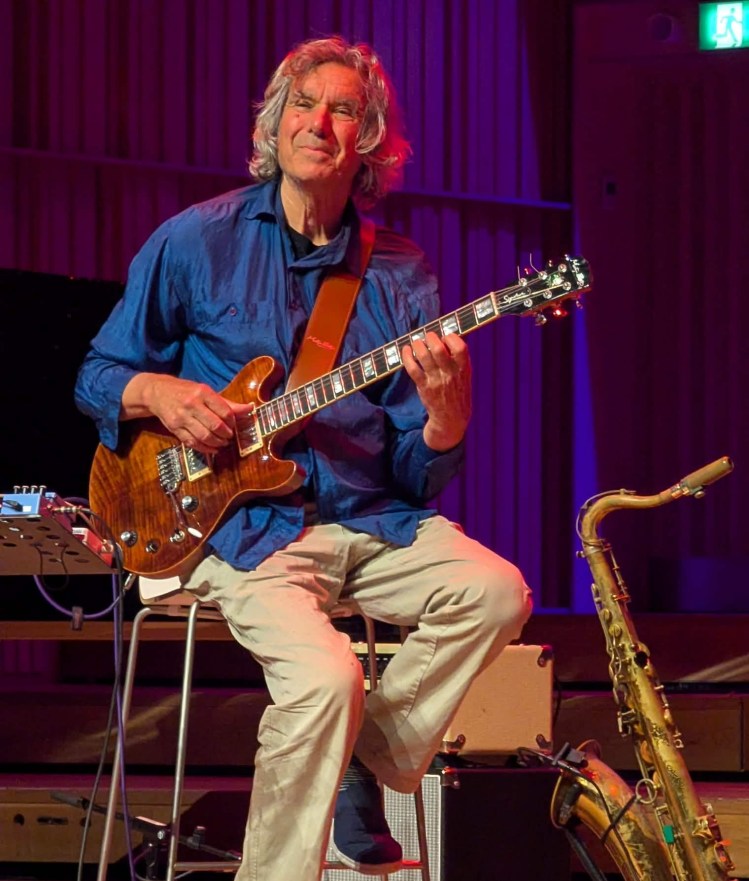
John Etheridge – Photo: Phil Filby Howitt

It was recorded very cleanly. Some things were on a click track, but having ‘Daevid’s Special Cuppa’, the whole flavour of that track is, probably more ‘67 Floyd than early Soft Machine. Having the fuzz bass is definitely a Hugh Hopper thing. Having the electronics is definitely a Mike Ratledge thing. It’s almost like, well, this is Soft Machine. Soft Machine is this whole very broad musical world and anything in the whole broad musical Soft Machine is Soft Machine. Therefore, it’s quite good to mine those areas: and what other bands do contemporary electronica, psychedelic glissando and full on kicking fusion and pre-improv!  And it’s almost like there’s a license or permission to do it because it’s Soft Machine and there’s an awareness of where Soft Machine comes from, and the Soft Machine musical worlds –  plural – that are there to bring forward into the modern day. I see it as a continuum. Yes, it’s a new thing and we’re all of today, but Soft Machine is a continuum and I think it’s a good thing to be aware of that and link its history into today.

Fred: I think this album for me has got the whole spirit of the past. I kind of went back and looked at everything, early things. I thought how much I actually liked that kind of real creative spirit. There’s that idea that some people never wanted to play the old stuff but I really like everything from each era. ‘Softs’ and then ‘Bundles’– John and Allan’s guitar was really good, but there’s those mid jazz rock things bits in between too on ‘4’ and everything else.

John: We took it to Andrew Tulloch who’s our sound guy and does the mixing and the mastering and he’s extremely finicky. So he managed to make it sound pretty clean and sort of precise, as if it’s been put together sort of quite carefully. But the recording process for us is really quick. Apart from ‘The Longest Night’ where we did that in sections. That was a composition of Theo’s I think he’d had around for a long time.

Fred: It was just about getting the right spirit – it’s like the atmosphere of the recording studio has actually gone down and changed things. Rew (Lemer, son of keyboard player Pete) is a great engineer – I’ve known him since he was young. I think everything: the compositions, the balance of material, the improvisation – I think we’ve really got something special to give people. It’s not done on a giant budget now. We just get on with it.  We’re probably over budget! But I’m so pleased it’s come out and it’s getting a good response in all sorts of different areas. It’s not a tribute band. That’s the thing I always feel: that they’re looking on the other side: Elton and Hugh and everybody – we’re keeping the music happening….

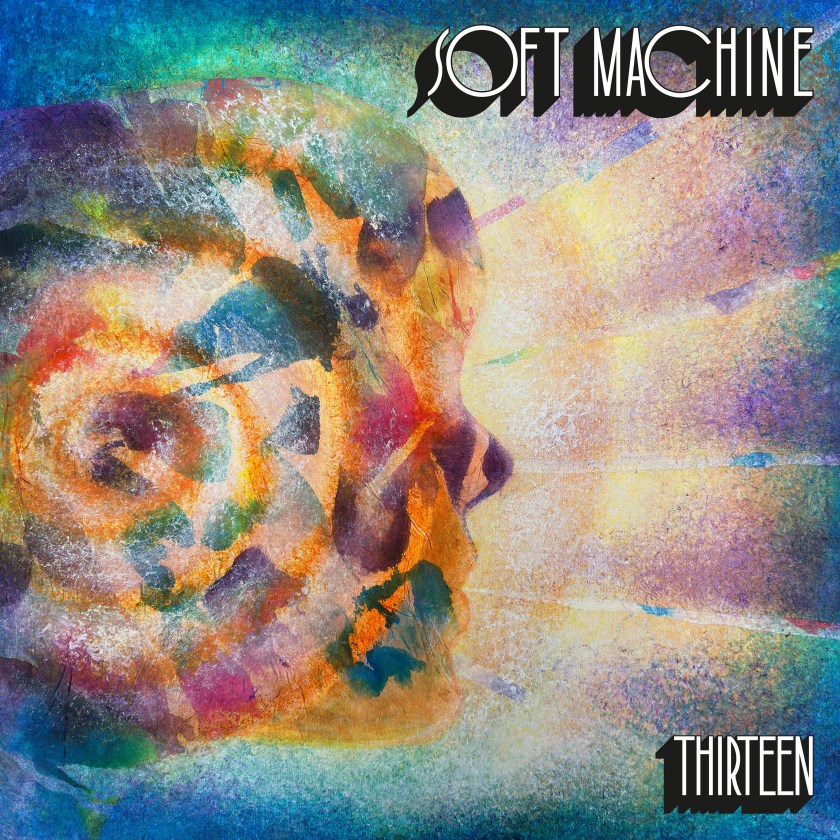
Thirteen – the album cover

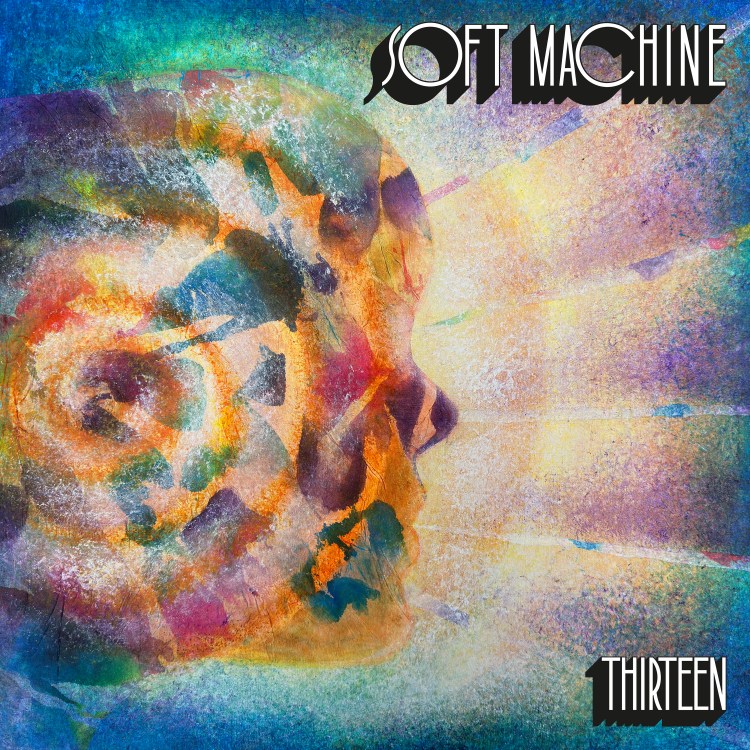
Theo: I was very keen on getting a good cover and I tried a few things and then had an idea which was a silhouette and slightly psychedelic feel. I spoke to someone and they said “look we know this artist, Esra Kizir Gokcen”, an established professional painter. She writes and is involved in music, “why don’t you see if she would you commission her to do something along this style but in her own way”.

We did that and she actually gave a couple of ideas, sort of drafts if you like, and we chose one and then she went on and did the real thing and I think it excelled. It was basically everything I wanted, which was, a kind of colourful nod to 1967, but not too obviously trying to be psychedelic, trying to be contemporary. I like the silhouette thing. Yes, there’s a nod to Soft Machine ‘7’, but that one’s square and boxy, and this one painted, the colours are beautiful, and it’s all paint on canvas. And there’s a kind of slight air of mystery. Obviously you don’t see the face but a lot of the Soft Machine albums including wheels and everything on ‘Volume 1’, but the strange thing on front of Soft machine ‘Volume Two’ and the body on Soft machine ‘6’  and ‘7’ and because the title Soft Machine comes from the William Burroughs book which means that the human body. Sometimes it’s nice to have a kind of directional connection and so I wanted to do that. And sometimes if you get a cover that’s hits the mark, the music clicks in with the cover.

Thirteen – the choice of album title

The album’s accompanying press release makes much of the title’s name, well beyond it being simply a resurrection of the Soft Machine’s numbering of their albums. The original Soft Machine run was 13 years (1966-78), and the album was released on 13 March, which had its own resonance…

Theo: chronologically the title came relatively late. So all the music was written and I think recorded, possibly even mixed before we decided on the album title.

13 is an interesting one because the first thing people say is ‘unlucky for some’ and then I looked into it. I spoke to someone else about the number 13. They went, “Oh, yes, but in other cultures it’s a number of rebirth.” And then it was a kind of coincidence that there are 13 tracks on the album. And then it was a coincidence that ‘The Longest Night’ was the longest track probably for 50 years at 13 minutes.

Theo Travis – Photo: Phil Filby Howitt

And then I thought, okay, well, if you’re going to call it ‘Thirteen’, it’s quite a bold statement because people go, “Oh, you can’t,  that’s classic Soft Machine.” And again, thinking about that, well, the last two albums that were numbers, were ‘6’ and ‘7’. Which add to 13! And then I looked up, Daevid Allen, it’s quite a thing having him on it after 60 years. And his birth and death dates were 13th of January and 13th of March. And I mentioned all this to John. He went, “Oh, that’s it. That’s it.” So, we’ve called it that.

And I do feel again it’s a kind of ambitious thing. I feel it needs to be needs to be good enough to justify, reclaim, a bit like you said, the Soft Machine name but if we’re going to start reclaiming the numbers, this has got to be something and I feel this is…

In Part 3 of the interview we explore how each of the current members of Soft Machine joined the band, revisit a recent American tour, and talk in depth about the phenomenal rhythm section of Asaf Sirkis and Fred Baker

Thirteen – an interview with Soft Machine – part 1

It was patently obvious on first hearing the new Soft Machine album ‘Thirteen’, back in the autumn of 2025 that this was something of a landmark release for the band.

It’s the first entirely under the individual and collective compositional talents of the quartet of John Etheridge (guitar), Theo Travis (saxes, flute, keyboards), Fred Baker (bass) and Asaf Sirkis (drums), a high calibre, high energy quartet you will have hopefully seen under the Soft Machine banner in the last 3 or 4 years.

Although interviews with all 4 members were carried out back in January for an article for May’s Record Collector, and further added to during the spring, what you’ll see on the Facelift blog over the next couple of weeks is a collation of thoughts about various topics such as the band’s thoughts about ‘Thirteen’; how each member joined the band; their prior exposure to Soft Machine music; what they think about the current project and in particular its remarkable rhythm section; and thoughts about a recent, memorable American tour.

With ‘Thirteen’ released on March 13th (of course), and as the band are due to begin a short UK tour next week, showcasing some of their new material, it seemed appropriate to start this set of posts by letting the band guide you through their thoughts on individual tracks from ‘Thirteen’:

Lemon Poem Song (Sirkis)

Asaf Sirkis’ first composition for Soft Machine is a crisp, incisive opening statement, with Sirkis, Baker and Etheridge all to the fore.

John Etheridge: I love ‘Lemon Poem Song’. That was wasn’t solely my idea to put that first (on the album) but I was very keen. I think the first sounds you hear on an album are so important. They almost define what the album’s about. And that I think really worked because it’s not ordinary, but it’s not extremely out there. It’s a really good opener, I think.


Theo Travis: ‘Lemon Poem Song’ was Asaf’s – to me the harmony feels slightly like the Who. I hear ‘Quadrophenia’ – but it’s not! I like tracks that are not generically anything, and the fact that they’re a little bit unusual but appealing is a kind of Soft Machine thing.


Asaf Sirkis: the idea for the title started as misheard lyrics, but later on kind of grew a meaning of its own; something along the lines of ‘when life gives you lemons, don’t make lemonade, write a poem instead!’

Asaf Sirkis

Open Road (Travis)

‘Open Road’ was debuted during Soft Machine’s previous UK tour, it’s a grandiose, anthemic piece, fuelled by Travis’ powerful tenor soloing and containing a minor, unexpected diversion…

Theo: You can’t play mellotron without it being ‘Strawberry Fields’! It’s a real mellotron, it’s not a sample. Steven Wilson’s actual mellotron. You jump into that world. It’s like, “oh my god what’s ‘Strawberry Fields’ doing there!” As a flute player I am playing literal sample of flutes on tape – I could have recreated it using real flute harmonies. But obviously the mellotron flute is its thing and it is own character and you know puts you in that world and refers to that and instantly it’s a whole other thing. We do it live with a sample. So we’re not carrying a mellotron round for those 16 bars!

Improvs (Seven Hours/Which Bridge Did You Cross/Pens To The Foal Mode) (various)

A number of tracks dispersed throughout Thirteen further blur, as with other recent Soft Machine albums, the boundaries between the written and the spontaneous.

Theo: Both ‘Seven Hours’ and ‘Which Bridge Did You Cross’ are basically improvised at the beginning and then lead into the melody. We did quite a few free improvisations. There’s some more on the side 4 for the vinyl too. I selected ‘Pens To The Foal Mode’ because it’s got a quality about it. Although it’s a free improv, unlike several free improvs, I can listen to it over and over and it still seems interesting. Sometimes a free improv, because of the nature of it, is in the moment and that’s great – things happen. But by the time you’ve heard it two or three times, you go, okay, well, you know, this is the noise bit and this is this bit.

But ‘Pens To The Foal Mode’, it’s got a bit of a groove and it’s got a kind of strange harmonic thing and the flute loops at the beginning and the end, all done in real time. So, it’s got this sort of unusual quality of being freely improvised but very listenable and a bit strange but quite concise. It just does a lot of things in a short space of time that are quite unique in a way, which is feels like quite a Soft Machine sort of thing to do.

It started with this kind of rhythm thing that John came up with and then a kind of sort of lolloping groove. Then Fred got into it and then Asaf, and it’s not even like a common groove. It’s just its own thing. The feel is not swing. It’s not free. It’s not Latin. It’s not a rock thing. There was something that just seemed very concise, unusual, super coherent for a free impro, so although it’s a short track I think it certainly does something special.

John Etheridge/Theo Travis

Waltz for Robert (Sirkis)

This beautiful ballad, featuring the flute of Theo Travis, is likely to be one of your instant hook-ins to ‘Thirteen’.

Asaf: This piece is dedicated to Robert Wyatt. I first discovered Soft Machine in my late teens through the album ‘Bundles’, and around the same time, I became aware of Robert’s and Holdsworth’s work. Their music was truly unique and left a deep impact on my own musical journey. Robert’s work, in particular, was special to me. Meeting him and experiencing his kindness inspired me to write this tune in his honour. I met Robert several times and keep in touch with him occasionally. He guested on one of Gilad Atzmon’s tracks which I played on back in the early 2000’s and he also wrote liner notes to my album ‘Solar Flash’.

For me ‘Waltz For Robert’ captures Robert’s vibe in the way I feel and hear it. I’m very happy to say that he liked the piece and even wrote a comment on my channel.

John: Asaf’s got two or three compositions from the album. I like them because particularly because it’s the left fieldness of them in the sense that he’s not (primarily) a pianist. And he sits down and he comes out with his chords and I say, “What’s that chord?” He says, “I don’t know. It’s just those notes”, and that’s brilliant to me because it’s a person with a lot of musical gifts who’s composing in a medium that he’s not globally fluent in.

You know this is what Picasso had to do. Picasso started doing I think it was sculpture or wood carvings and things he found it difficult, because he found painting so easy. But Asaf composed a few things at the piano: he just figures out some chords that sound good to him. And I think that’s a very valid way of composing, you know, because if you’re gifted, come up with stuff that’s not in the everyday, not in the common domain.

The Longest Night (Travis)

The centrepiece of the album is Theo Travis’s 13 minute epic ‘The Longest Night’, a piece of huge complexity and progression, which, to these ears manages to rival the tranquillity of ‘Kings and Queens’, whilst incorporating organ sounds reminiscent of Hugh Banton (performed here by Travis’ bandmate in Double Talk, Pete Whittaker). It also provides a platform for a cataclysmic John Etheridge guitar solo. In different ways, ‘The Longest Night’ seems like the crowning glory for both Travis the composer and Etheridge the soloist.

Theo: the melody on ‘Longest Night’ was just from my head really. There was no idea of anything except again despite it being a big long complicated progressive thing. I wanted there to be a strong melody in the head that beginning and end to bookend it.

Fred: (Theo’s) flute playing is just absolutely gorgeous, man. Absolutely. He’s got everything he wanted on this. I think that’s what he feels as well. I’ve watched Theo’s career develop – and we’re always joking that he’s out progged himself! That composition is such an epic.

Theo Travis

Theo: There’s a couple of Double Talk things that are tricky. This is probably more tricky actually. Yeah, it’s pretty well the most ambitious thing.
(with regards to Pete Whittaker’s contribution on keyboards)
there’s a lot of complicated things in ‘Longest Night’ So, particularly that one, I thought we needed a keyboard player for that track. Pete’s brilliant. I play with him a lot. John plays with him, too, and and I knew for that section in the middle where I wanted to just kind of space out into kind of organ textured world, and pull the bars and things that real organs have. It was a no-brainer to ask him.

(so would the band perhaps play The Longest Night live, perhaps using Theo’s keyboards?)


Theo: it’s too hard for me to play! Plus, I’d want to do it live with a saxophone. And thirdly, that whole middle section which goes into the organ thing where he does all his stops – I don’t know what he’s doing! We would need a fifth person. Also it’s actually part electronics and partly Fender Rhodes putting it through various sound processing to get it into sync with the wave synthesis. So even a live key player wouldn’t do that. It could be done live, but it would be a whole performance to set yourself up to do it.

(in relation to John Etheridge’s solo being potentially his best)

John: I kind of sneakingly thought that myself! And as I said it was all (recorded) live. In fact in that solo I can remember that at one point I queued them to finish the solo, the rhythm section and they didn’t see me so I had to carry on!

Theo: it builds carefully from one to the other in a very clear narrative to use a story analogy. It’s really something special.

Fred: It’s great. It really kind of builds and takes you somewhere. He’s always had this magic thing. That’s the thing I always love with all those players like John, Allan (Holdsworth), Phil (Miller) in particular when they play. They’ve got this sound that they really control and just get every angle in.

Disappear (Sirkis)

‘Disappear’ is a further beautifully ethereal piece from the pen of Asaf Sirkis.

Theo: ‘Disappear’ was composed by Asaf. This was a first take job. He suggested just giving it another flavour and it comes out of that – just a lovely melody, lovely atmosphere. He wrote it on piano and he plays it on piano. It’s nice to have that aspect of Asaf’s compositional abilities.

Asaf: the idea for the title for that piece came from a conversation we had on the road, in the band’s van, about re-incarnation and the concept that a soul cannot re-incarnate in another body unless it is completely forgotten by anyone that had any connection to it. I found that idea fascinating.

Green Books (Etheridge)

John Etheridge

Green Books sees John Etheridge at his strutting, funky best as a composer.

John: I was a bit iffy about ‘Green Books’ when I presented it. What I do is I sit down and it sort of came out. Sometimes I have to say there’s a slight sort of contrivance about what I write. Perhaps I said, “well perhaps we should have a track that’s got some sort of funk element!”

I wanted it to be kind of mechanical. I kind of like that idea, but not too mechanical because I never want the Soft Machine to be nailed locking the tune. I always seem to end up writing tunes like this that are kind of obliquely atonal.
It’s sort of slightly nasty, slightly mean, and then you go into this sort of middle section which is expansive. And that’s why I love Theo. It’s a very complicated chord sequence. So I said, “Theo, you can blow on the way out”, but even me who’d written it, I try and play over those chords and play the right notes for the chords. And either he decided or I said, “Just go for it.” So he just goes potty at the end.

I’m not really egotistical about my compositions. If somebody says my solo is lousy, I’m mortified. But if somebody says, “My composition’s not very good, is it?” I go, “Well, oh right, okay.” I asked them a few times. I said, “Do you think this is okay, this tune?” They went, “Yeah, yeah, yeah, yeah. It’s great. Great.” So, I like that!

Beledo Balado (Etheridge)

‘Beledo Balado’ is named after the Uruguayan musician who underpinned Soft Machine’s tour of the United States back in 2023, depping for Fred Baker.

John: This ballad is slightly formulaic in the sense that for the last two or three albums I’ve written ‘Stars Apart’ and ‘Broken Hill’ and I find sad tunes come very easily to me. Because I’m quite easily melodic and I’m also gloomy. So I can tap into sort of sadness very easily.

The title was decided post-hoc. I write a tune. And what I normally do, is look at a book of poetry or something like that and find a little quote which fits, like ‘Broken Hill’. But this one I suddenly thought, I think because it was a ballad – I wanted to do it because Beledo is such a great bloke. I haven’t told him yet, I hope it’s all right!

Interestingly enough Hugh Hopper was roadying for soft machine and then played bass, right? Beledo roadied for us in the US when Fred Baker couldn’t get his visa. So, Leonardo (Pavkovic, of MoonJune Records) went through a string of virtuoso suggestions of Californian bass players to do the job and we went, “No, no, no. I mean, those guys are incredible, but with us, no.” Anyway, Beledo, who’s fabulous, and also a very good pianist said, “Yeah, I’ll play bass.” He did a wonderful job for the bit of the tour that we managed to salvage because Fred never made it. And he played really good with Asaf, just musical bass. He did a lovely job and as they say, a friend of the show!

Time Station (Travis)

The effects Theo Travis uses on saxophone on Time Station are utilised to produce soprano sounds akin to a trumpet.

Theo: It’s a wahwah. Soprano sax through a wahwah. And then in the solo there’s a Miles kind of vibe because Miles Davis often used to play trumpet with a wahwah, it would have that kind electronic thing again, sort of 70s So putting a sax through a wah pedal again it’s bit odd but it’s kind of cool. So that’s what that was.

Turmoil (Baker)

One of the more startling tracks on ‘Thirteen’ is Fred Baker’s astonishing composition ‘Turmoil’ which recalls some of the more outlandish effects of his epic solo piece ‘Inner Demons’, allowing all members of the band to fully let rip.

Fred: People ask me about that track. When I came back from America and the world seemed to be going mad I just thought, “I’m really kind of wound up” and just came up with this idea. I wanted to make it as heavy and dirty as possible.

Theo: it’s an absolute beast. It’s brilliant. So, it’s completely Fred and it’s got that whole connection with the Hugh Hopper fuzz thundery thing

John: Theo stuck out a PR video of us playing Fred Baker’s ‘Turmoil’ tune. And of course, I couldn’t remember us doing it, but there we are. We’re all playing away and the camera’s on everybody and it’s all completely real and we’re just playing in the studio. It looks bizarre because we’ve all got screens around each other!

Fred: I’m glad on my piece everybody plays almost breaking their instruments. It’s like World War III!

Theo: Fred has this amazing facility but he’s also broad-minded. Some people with his sort of technique wouldn’t particularly warm to the idea of a kind of thunderous overdrive, but he can make a bass sound like a Harley Davidson!

Fred Baker

Daevid’s Special Cuppa (Travis)

The final track on the album is perhaps the most unexpected. Since their resurrection as Soft Machine Legacy in the new millennium, and more recently as simply Soft Machine, the band have resolutely incorporated an interpretation from the 60s and 70s repertoire on each album. ‘Thirteen’ breaks that mould in producing entirely original tracks, albeit that two reference former members (Robert Wyatt and Daevid Allen). ‘Daevid’s Special Cuppa’ goes one step further in utilising previously unheard glissando guitar from the latter as the bedrock of a piece which also sees Theo Travis play doudouk, an instrument associated with fellow Gong musician Didier Malherbe.

Theo: this wasn’t particularly about the 60th anniversary (of Soft Machine), but it was definitely an appreciation of Soft Machine’s roots. I knew Daevid well. He had this effect of being a kind of musical catalyst and he was very creative. Basically anyone around him he wanted to encourage them to do stuff and that’s what it was like with Gong. He very much wanted people to bring in compositions and you know it was a cooperative thing. I wasn’t there, but I can just imagine when he arrived from Australia, in the Sixties, this wild Beatnik from planet Saturn with all his crazy ideas and all his creativity and all his love of words and love of jazz and love of improv. The change from the Wilde Flowers into Soft Machine with its old concept, it would have been the combination of Daevid and the others, particularly Robert probably.

I had this unused recording (of glissando guitar) and thought, “wouldn’t it be great to have Daevid on the Soft Machine now”, because he didn’t even make it to the Soft Machine ‘Volume 1’. What a beautiful thing to have him on a Soft Machine album proper.

Daevid Allen playing glissando at Gong Uncon 2006 (with Fabio Golfetti) – Photo: Edneia Golfetti

Sonically his glissando guitar is glorious, so I thought if I can build it up from the glissando guitar using the four of us, and turn it into something that becomes cool, then that’s what I want to do.

The process was: I had a bunch of glissando guitar recordings from Daevid that I then basically put into my Logic software, worked out a kind of broad tempo, thought, “what am I going to do with this?”, this 67/68 psychedelia world. And then I went for the rhythm. I wanted to have a kind of tomtom rhythm (evoking) underground UFO psychedelic all-nighters. So a kind of hypnotic rhythm and a bassline that just went on with that. And then I wanted a focus, and I was very keen on this album to really have melodies that grab you, whether it was that track or a free improv track or whether it’s a long complicated proggy track. I think there’s something essential and of core importance about having strong melodies because that’s the thing that you remember in a way. That’s the thing that focuses a track.

So I wanted to have a good melody. And given that we already had glissando guitar, we weren’t going to have John doing kind of guitar chords. So we’ve got this melody that’s soprano sax and electric guitar in harmony on this whole tune, and it’s just a melody beginning to end. John got that lovely tremolo guitar sound and then I had to get some doudouk in! Again, if you’re just going for a track, you want to hit someone in the solar plexus. You’ve got this gorgeous glissando, you got a strong melodic hypnotic thing, it’s just a little bit of, icingy marzipanny cherry.

I had the whole thing demoed on my studio and then in the studio proper. I think they did it all in one but we replaced guitar, the bass and the drums and it was the original doudouk from my studio.

We don’t know what’s going to happen with the future of Soft Machine albums. No one ever does really. But obviously the fact that Daevid was there right at the beginning and to then have the Daevid track right at the end of this one, you know, there’s a kind of symmetry

John: I don’t think I ever spoke to Daevid, but I saw Theo playing with him with Gong. And I do remember going to see them and Daevid was 64 and I was so impressed that he could still play. I at the time was 50 and I thinking, “Wow, this guy’s 64 and he’s moving around the stage!” I always liked his vibe.

You said that our paths never crossed but they did, because I was playing briefly with a band called the Global Village Trucking Co. And we did a double header tour with Gong. And I was the last person to see Daevid Allen associated with that Gong because it was about the third gig in. We went on. I saw Daevid Allen peering through the curtains at us and then went backstage at the end of our set and they said, “Daevid’s disappeared. Where’s Daevid?” Gone. Daevid’s gone…

Carol Ann/ extra tracks (various)

Fans buying vinyl or Japanese CD copies can expect a few additional treats

Theo: We did actually record one old Soft Machine tune with the idea of probably using it on the album a very different arrangement. We recorded a completely different arrangement of ‘Carol Ann’ from Soft Machine ‘7’. That lovely melody. The originals is keyboards and bass. No saxophone, no drums, certainly no guitar.

It’s a beautiful tune and we recorded it with soprano sax lead, chords on the guitar and with bass and with drums. We had so much stuff including the free improvs and the question was really what to leave off, because when you record stuff obviously you want to make sure you’ve got lots of good stuff. But once you recorded stuff and you think it’s good it’s quite hard to leave it off, even though I think ideally we would like the album to be you know bit shorter – 50 minutes or something. I like preciseness. But literally going through every track, we couldn’t work out what to leave off. So we left off ‘Carol Ann’.

But on the vinyl, side four is all the bonus tracks. ‘Carol Ann’, the first track on the vinyl. So anyone who gets the vinyl, they get these bonus tracks. They get ‘Carol Ann’, they get some improvs, they get a solo guitar, an alternative take of ‘Seven Hours’. And again, maybe that’s a good thing. It’s a kind of bold statement of intent. It’s like we’re here. We’re doing our thing, so on the core album not to have an old track reworked.. Again, it feels quite confident.

Thirteen is available at:

https://softmachine-moonjune.bandcamp.com/album/thirteen
https://softmachine7.bandcamp.com/