
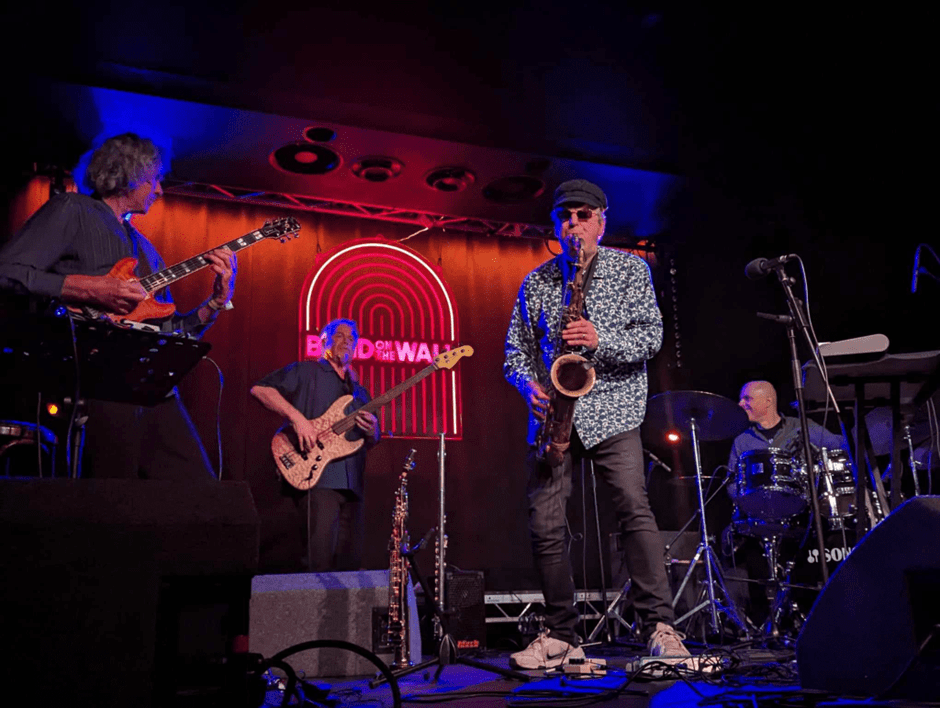
It was patently obvious on first hearing the new Soft Machine album ‘Thirteen’, back in the autumn of 2025 that this was something of a landmark release for the band.
It’s the first entirely under the individual and collective compositional talents of the quartet of John Etheridge (guitar), Theo Travis (saxes, flute, keyboards), Fred Baker (bass) and Asaf Sirkis (drums), a high calibre, high energy quartet you will have hopefully seen under the Soft Machine banner in the last 3 or 4 years.
Although interviews with all 4 members were carried out back in January for an article for May’s Record Collector, and further added to during the spring, what you’ll see on the Facelift blog over the next couple of weeks is a collation of thoughts about various topics such as the band’s thoughts about ‘Thirteen’; how each member joined the band; their prior exposure to Soft Machine music; what they think about the current project and in particular its remarkable rhythm section; and thoughts about a recent, memorable American tour.
With ‘Thirteen’ released on March 13th (of course), and as the band are due to begin a short UK tour next week, showcasing some of their new material, it seemed appropriate to start this set of posts by letting the band guide you through their thoughts on individual tracks from ‘Thirteen’:
Lemon Poem Song (Sirkis)
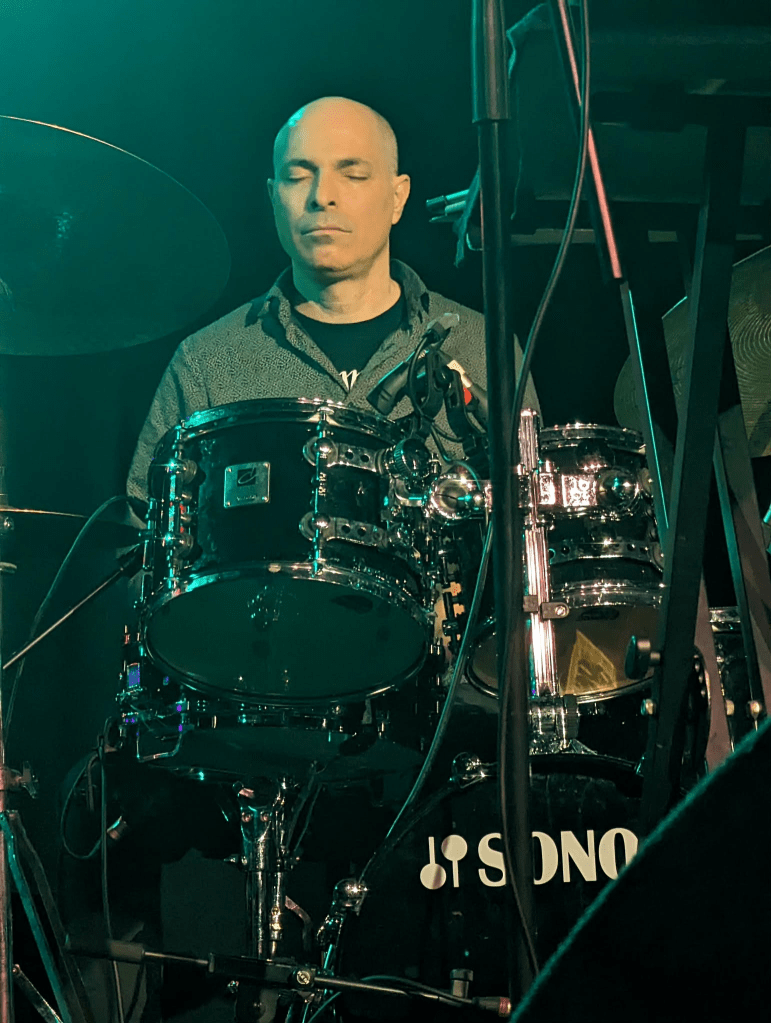
Asaf Sirkis’ first composition for Soft Machine is a crisp, incisive opening statement, with Sirkis, Baker and Etheridge all to the fore.
John Etheridge: I love ‘Lemon Poem Song’. That was wasn’t solely my idea to put that first (on the album) but I was very keen. I think the first sounds you hear on an album are so important. They almost define what the album’s about. And that I think really worked because it’s not ordinary, but it’s not extremely out there. It’s a really good opener, I think.
Theo Travis: ‘Lemon Poem Song’ was Asaf’s – to me the harmony feels slightly like the Who. I hear ‘Quadrophenia’ – but it’s not! I like tracks that are not generically anything, and the fact that they’re a little bit unusual but appealing is a kind of Soft Machine thing.
Asaf Sirkis: the idea for the title started as misheard lyrics, but later on kind of grew a meaning of its own; something along the lines of ‘when life gives you lemons, don’t make lemonade, write a poem instead!’
Open Road (Travis)
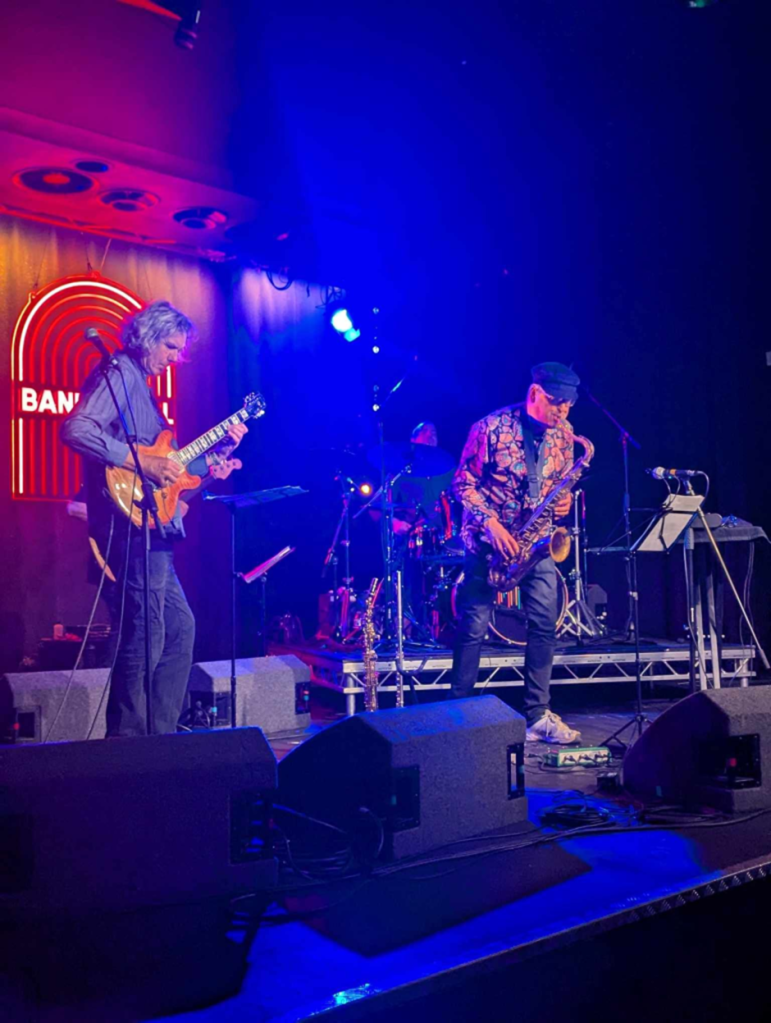
‘Open Road’ was debuted during Soft Machine’s previous UK tour, it’s a grandiose, anthemic piece, fuelled by Travis’ powerful tenor soloing and containing a minor, unexpected diversion…
Theo: You can’t play mellotron without it being ‘Strawberry Fields’! It’s a real mellotron, it’s not a sample. Steven Wilson’s actual mellotron. You jump into that world. It’s like, “oh my god what’s ‘Strawberry Fields’ doing there!” As a flute player I am playing literal sample of flutes on tape – I could have recreated it using real flute harmonies. But obviously the mellotron flute is its thing and it is own character and you know puts you in that world and refers to that and instantly it’s a whole other thing. We do it live with a sample. So we’re not carrying a mellotron round for those 16 bars!
Improvs (Seven Hours/Which Bridge Did You Cross/Pens To The Foal Mode) (various)
A number of tracks dispersed throughout Thirteen further blur, as with other recent Soft Machine albums, the boundaries between the written and the spontaneous.
Theo: Both ‘Seven Hours’ and ‘Which Bridge Did You Cross’ are basically improvised at the beginning and then lead into the melody. We did quite a few free improvisations. There’s some more on the side 4 for the vinyl too. I selected ‘Pens To The Foal Mode’ because it’s got a quality about it. Although it’s a free improv, unlike several free improvs, I can listen to it over and over and it still seems interesting. Sometimes a free improv, because of the nature of it, is in the moment and that’s great – things happen. But by the time you’ve heard it two or three times, you go, okay, well, you know, this is the noise bit and this is this bit.
But ‘Pens To The Foal Mode’, it’s got a bit of a groove and it’s got a kind of strange harmonic thing and the flute loops at the beginning and the end, all done in real time. So, it’s got this sort of unusual quality of being freely improvised but very listenable and a bit strange but quite concise. It just does a lot of things in a short space of time that are quite unique in a way, which is feels like quite a Soft Machine sort of thing to do.
It started with this kind of rhythm thing that John came up with and then a kind of sort of lolloping groove. Then Fred got into it and then Asaf, and it’s not even like a common groove. It’s just its own thing. The feel is not swing. It’s not free. It’s not Latin. It’s not a rock thing. There was something that just seemed very concise, unusual, super coherent for a free impro, so although it’s a short track I think it certainly does something special.
Waltz for Robert (Sirkis)
This beautiful ballad, featuring the flute of Theo Travis, is likely to be one of your instant hook-ins to ‘Thirteen’.
Asaf: This piece is dedicated to Robert Wyatt. I first discovered Soft Machine in my late teens through the album ‘Bundles’, and around the same time, I became aware of Robert’s and Holdsworth’s work. Their music was truly unique and left a deep impact on my own musical journey. Robert’s work, in particular, was special to me. Meeting him and experiencing his kindness inspired me to write this tune in his honour. I met Robert several times and keep in touch with him occasionally. He guested on one of Gilad Atzmon’s tracks which I played on back in the early 2000’s and he also wrote liner notes to my album ‘Solar Flash’.
For me ‘Waltz For Robert’ captures Robert’s vibe in the way I feel and hear it. I’m very happy to say that he liked the piece and even wrote a comment on my channel.
John: Asaf’s got two or three compositions from the album. I like them because particularly because it’s the left fieldness of them in the sense that he’s not (primarily) a pianist. And he sits down and he comes out with his chords and I say, “What’s that chord?” He says, “I don’t know. It’s just those notes”, and that’s brilliant to me because it’s a person with a lot of musical gifts who’s composing in a medium that he’s not globally fluent in.
You know this is what Picasso had to do. Picasso started doing I think it was sculpture or wood carvings and things he found it difficult, because he found painting so easy. But Asaf composed a few things at the piano: he just figures out some chords that sound good to him. And I think that’s a very valid way of composing, you know, because if you’re gifted, come up with stuff that’s not in the everyday, not in the common domain.
The Longest Night (Travis)
The centrepiece of the album is Theo Travis’s 13 minute epic ‘The Longest Night’, a piece of huge complexity and progression, which, to these ears manages to rival the tranquillity of ‘Kings and Queens’, whilst incorporating organ sounds reminiscent of Hugh Banton (performed here by Travis’ bandmate in Double Talk, Pete Whittaker). It also provides a platform for a cataclysmic John Etheridge guitar solo. In different ways, ‘The Longest Night’ seems like the crowning glory for both Travis the composer and Etheridge the soloist.
Theo: the melody on ‘Longest Night’ was just from my head really. There was no idea of anything except again despite it being a big long complicated progressive thing. I wanted there to be a strong melody in the head that beginning and end to bookend it.
Fred: (Theo’s) flute playing is just absolutely gorgeous, man. Absolutely. He’s got everything he wanted on this. I think that’s what he feels as well. I’ve watched Theo’s career develop – and we’re always joking that he’s out progged himself! That composition is such an epic.
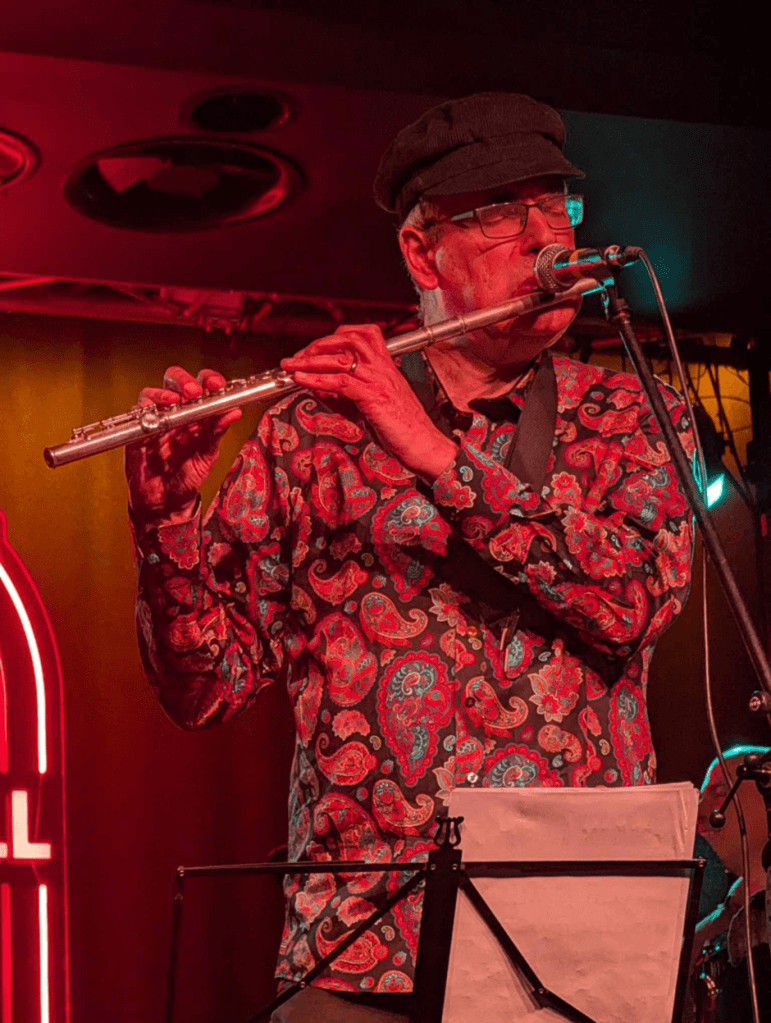
Theo: There’s a couple of Double Talk things that are tricky. This is probably more tricky actually. Yeah, it’s pretty well the most ambitious thing.
(with regards to Pete Whittaker’s contribution on keyboards)
there’s a lot of complicated things in ‘Longest Night’ So, particularly that one, I thought we needed a keyboard player for that track. Pete’s brilliant. I play with him a lot. John plays with him, too, and and I knew for that section in the middle where I wanted to just kind of space out into kind of organ textured world, and pull the bars and things that real organs have. It was a no-brainer to ask him.
(so would the band perhaps play The Longest Night live, perhaps using Theo’s keyboards?)
Theo: it’s too hard for me to play! Plus, I’d want to do it live with a saxophone. And thirdly, that whole middle section which goes into the organ thing where he does all his stops – I don’t know what he’s doing! We would need a fifth person. Also it’s actually part electronics and partly Fender Rhodes putting it through various sound processing to get it into sync with the wave synthesis. So even a live key player wouldn’t do that. It could be done live, but it would be a whole performance to set yourself up to do it.
(in relation to John Etheridge’s solo being potentially his best)
John: I kind of sneakingly thought that myself! And as I said it was all (recorded) live. In fact in that solo I can remember that at one point I queued them to finish the solo, the rhythm section and they didn’t see me so I had to carry on!
Theo: it builds carefully from one to the other in a very clear narrative to use a story analogy. It’s really something special.
Fred: It’s great. It really kind of builds and takes you somewhere. He’s always had this magic thing. That’s the thing I always love with all those players like John, Allan (Holdsworth), Phil (Miller) in particular when they play. They’ve got this sound that they really control and just get every angle in.
Disappear (Sirkis)
‘Disappear’ is a further beautifully ethereal piece from the pen of Asaf Sirkis.
Theo: ‘Disappear’ was composed by Asaf. This was a first take job. He suggested just giving it another flavour and it comes out of that – just a lovely melody, lovely atmosphere. He wrote it on piano and he plays it on piano. It’s nice to have that aspect of Asaf’s compositional abilities.
Asaf: the idea for the title for that piece came from a conversation we had on the road, in the band’s van, about re-incarnation and the concept that a soul cannot re-incarnate in another body unless it is completely forgotten by anyone that had any connection to it. I found that idea fascinating.
Green Books (Etheridge)
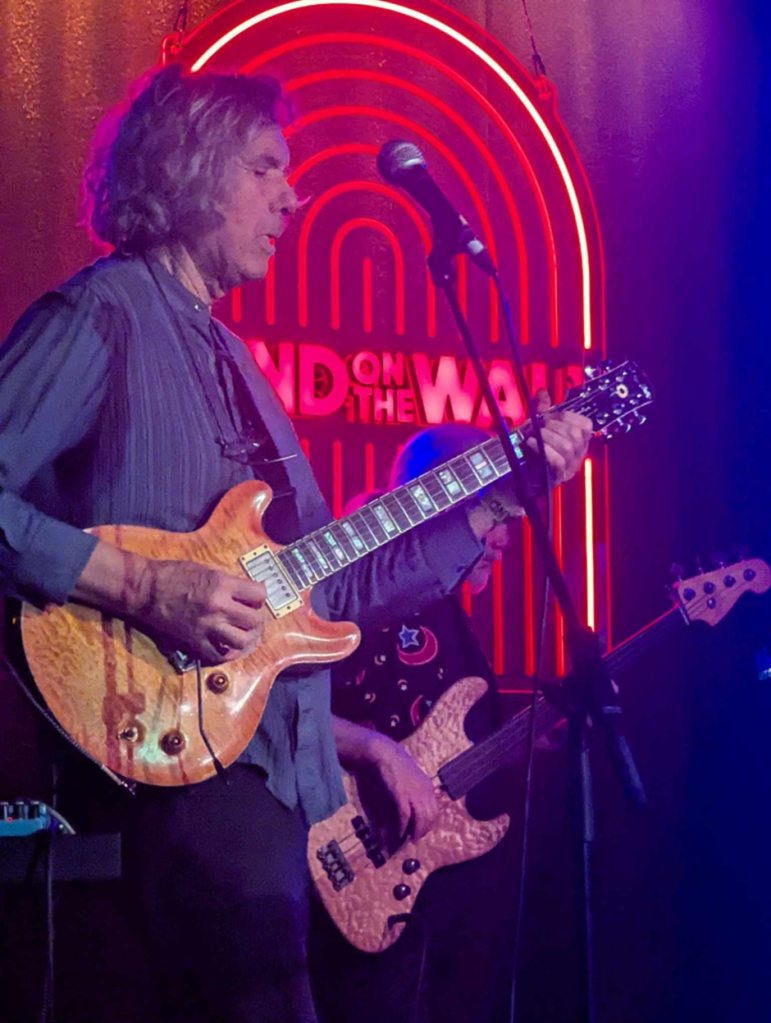
Green Books sees John Etheridge at his strutting, funky best as a composer.
John: I was a bit iffy about ‘Green Books’ when I presented it. What I do is I sit down and it sort of came out. Sometimes I have to say there’s a slight sort of contrivance about what I write. Perhaps I said, “well perhaps we should have a track that’s got some sort of funk element!”
I wanted it to be kind of mechanical. I kind of like that idea, but not too mechanical because I never want the Soft Machine to be nailed locking the tune. I always seem to end up writing tunes like this that are kind of obliquely atonal.
It’s sort of slightly nasty, slightly mean, and then you go into this sort of middle section which is expansive. And that’s why I love Theo. It’s a very complicated chord sequence. So I said, “Theo, you can blow on the way out”, but even me who’d written it, I try and play over those chords and play the right notes for the chords. And either he decided or I said, “Just go for it.” So he just goes potty at the end.
I’m not really egotistical about my compositions. If somebody says my solo is lousy, I’m mortified. But if somebody says, “My composition’s not very good, is it?” I go, “Well, oh right, okay.” I asked them a few times. I said, “Do you think this is okay, this tune?” They went, “Yeah, yeah, yeah, yeah. It’s great. Great.” So, I like that!
Beledo Balado (Etheridge)
‘Beledo Balado’ is named after the Uruguayan musician who underpinned Soft Machine’s tour of the United States back in 2023, depping for Fred Baker.
John: This ballad is slightly formulaic in the sense that for the last two or three albums I’ve written ‘Stars Apart’ and ‘Broken Hill’ and I find sad tunes come very easily to me. Because I’m quite easily melodic and I’m also gloomy. So I can tap into sort of sadness very easily.
The title was decided post-hoc. I write a tune. And what I normally do, is look at a book of poetry or something like that and find a little quote which fits, like ‘Broken Hill’. But this one I suddenly thought, I think because it was a ballad – I wanted to do it because Beledo is such a great bloke. I haven’t told him yet, I hope it’s all right!
Interestingly enough Hugh Hopper was roadying for soft machine and then played bass, right? Beledo roadied for us in the US when Fred Baker couldn’t get his visa. So, Leonardo (Pavkovic, of MoonJune Records) went through a string of virtuoso suggestions of Californian bass players to do the job and we went, “No, no, no. I mean, those guys are incredible, but with us, no.” Anyway, Beledo, who’s fabulous, and also a very good pianist said, “Yeah, I’ll play bass.” He did a wonderful job for the bit of the tour that we managed to salvage because Fred never made it. And he played really good with Asaf, just musical bass. He did a lovely job and as they say, a friend of the show!
Time Station (Travis)
The effects Theo Travis uses on saxophone on Time Station are utilised to produce soprano sounds akin to a trumpet.
Theo: It’s a wahwah. Soprano sax through a wahwah. And then in the solo there’s a Miles kind of vibe because Miles Davis often used to play trumpet with a wahwah, it would have that kind electronic thing again, sort of 70s So putting a sax through a wah pedal again it’s bit odd but it’s kind of cool. So that’s what that was.
Turmoil (Baker)
One of the more startling tracks on ‘Thirteen’ is Fred Baker’s astonishing composition ‘Turmoil’ which recalls some of the more outlandish effects of his epic solo piece ‘Inner Demons’, allowing all members of the band to fully let rip.
Fred: People ask me about that track. When I came back from America and the world seemed to be going mad I just thought, “I’m really kind of wound up” and just came up with this idea. I wanted to make it as heavy and dirty as possible.
Theo: it’s an absolute beast. It’s brilliant. So, it’s completely Fred and it’s got that whole connection with the Hugh Hopper fuzz thundery thing
John: Theo stuck out a PR video of us playing Fred Baker’s ‘Turmoil’ tune. And of course, I couldn’t remember us doing it, but there we are. We’re all playing away and the camera’s on everybody and it’s all completely real and we’re just playing in the studio. It looks bizarre because we’ve all got screens around each other!
Fred: I’m glad on my piece everybody plays almost breaking their instruments. It’s like World War III!
Theo: Fred has this amazing facility but he’s also broad-minded. Some people with his sort of technique wouldn’t particularly warm to the idea of a kind of thunderous overdrive, but he can make a bass sound like a Harley Davidson!
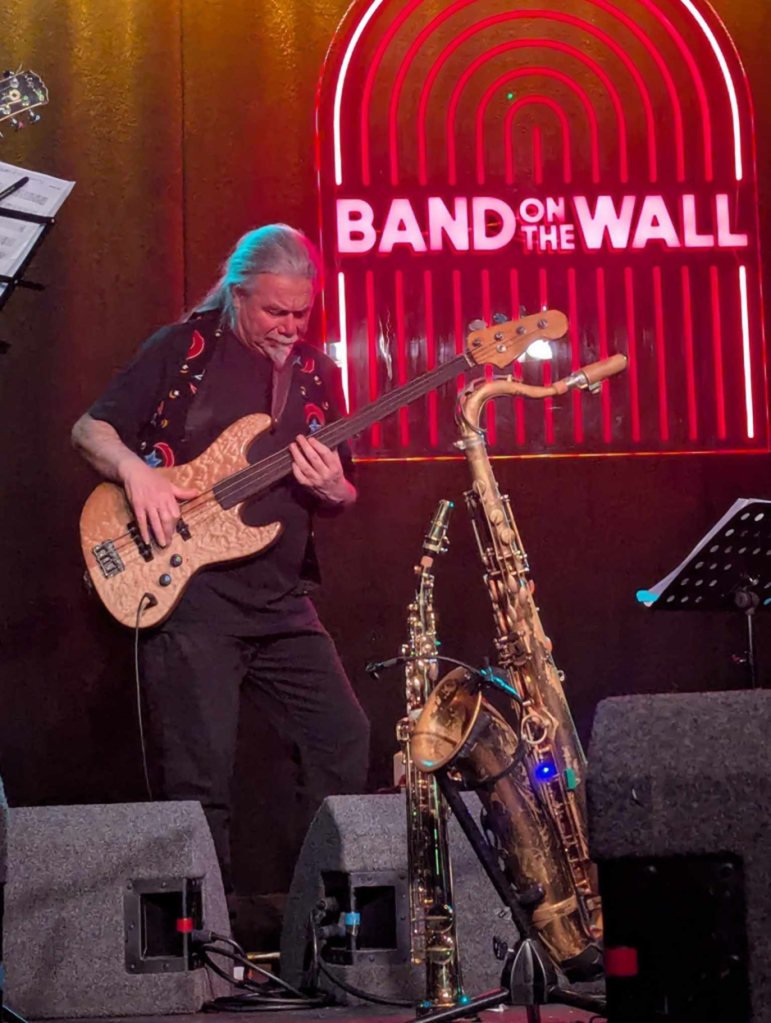
Daevid’s Special Cuppa (Travis)
The final track on the album is perhaps the most unexpected. Since their resurrection as Soft Machine Legacy in the new millennium, and more recently as simply Soft Machine, the band have resolutely incorporated an interpretation from the 60s and 70s repertoire on each album. ‘Thirteen’ breaks that mould in producing entirely original tracks, albeit that two reference former members (Robert Wyatt and Daevid Allen). ‘Daevid’s Special Cuppa’ goes one step further in utilising previously unheard glissando guitar from the latter as the bedrock of a piece which also sees Theo Travis play doudouk, an instrument associated with fellow Gong musician Didier Malherbe.
Theo: this wasn’t particularly about the 60th anniversary (of Soft Machine), but it was definitely an appreciation of Soft Machine’s roots. I knew Daevid well. He had this effect of being a kind of musical catalyst and he was very creative. Basically anyone around him he wanted to encourage them to do stuff and that’s what it was like with Gong. He very much wanted people to bring in compositions and you know it was a cooperative thing. I wasn’t there, but I can just imagine when he arrived from Australia, in the Sixties, this wild Beatnik from planet Saturn with all his crazy ideas and all his creativity and all his love of words and love of jazz and love of improv. The change from the Wilde Flowers into Soft Machine with its old concept, it would have been the combination of Daevid and the others, particularly Robert probably.
I had this unused recording (of glissando guitar) and thought, “wouldn’t it be great to have Daevid on the Soft Machine now”, because he didn’t even make it to the Soft Machine ‘Volume 1’. What a beautiful thing to have him on a Soft Machine album proper.
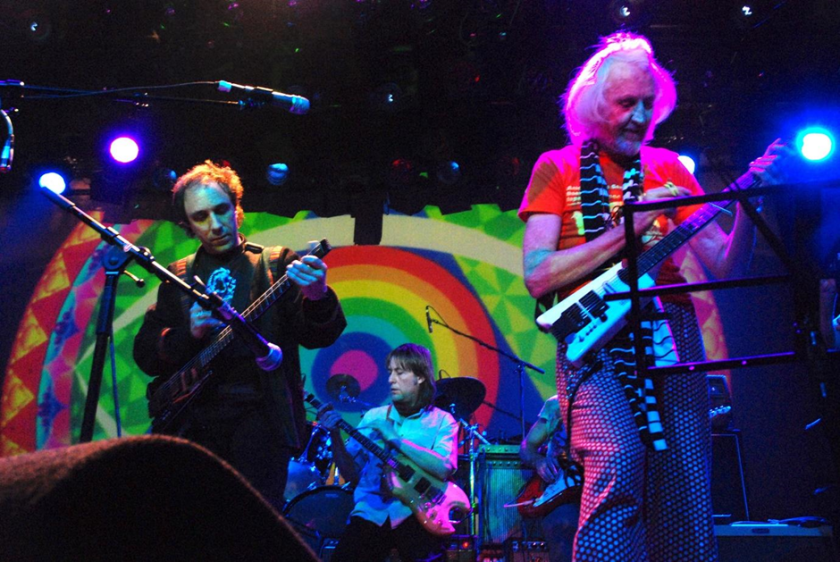
Sonically his glissando guitar is glorious, so I thought if I can build it up from the glissando guitar using the four of us, and turn it into something that becomes cool, then that’s what I want to do.
The process was: I had a bunch of glissando guitar recordings from Daevid that I then basically put into my Logic software, worked out a kind of broad tempo, thought, “what am I going to do with this?”, this 67/68 psychedelia world. And then I went for the rhythm. I wanted to have a kind of tomtom rhythm (evoking) underground UFO psychedelic all-nighters. So a kind of hypnotic rhythm and a bassline that just went on with that. And then I wanted a focus, and I was very keen on this album to really have melodies that grab you, whether it was that track or a free improv track or whether it’s a long complicated proggy track. I think there’s something essential and of core importance about having strong melodies because that’s the thing that you remember in a way. That’s the thing that focuses a track.
So I wanted to have a good melody. And given that we already had glissando guitar, we weren’t going to have John doing kind of guitar chords. So we’ve got this melody that’s soprano sax and electric guitar in harmony on this whole tune, and it’s just a melody beginning to end. John got that lovely tremolo guitar sound and then I had to get some doudouk in! Again, if you’re just going for a track, you want to hit someone in the solar plexus. You’ve got this gorgeous glissando, you got a strong melodic hypnotic thing, it’s just a little bit of, icingy marzipanny cherry.
I had the whole thing demoed on my studio and then in the studio proper. I think they did it all in one but we replaced guitar, the bass and the drums and it was the original doudouk from my studio.
We don’t know what’s going to happen with the future of Soft Machine albums. No one ever does really. But obviously the fact that Daevid was there right at the beginning and to then have the Daevid track right at the end of this one, you know, there’s a kind of symmetry
John: I don’t think I ever spoke to Daevid, but I saw Theo playing with him with Gong. And I do remember going to see them and Daevid was 64 and I was so impressed that he could still play. I at the time was 50 and I thinking, “Wow, this guy’s 64 and he’s moving around the stage!” I always liked his vibe.
You said that our paths never crossed but they did, because I was playing briefly with a band called the Global Village Trucking Co. And we did a double header tour with Gong. And I was the last person to see Daevid Allen associated with that Gong because it was about the third gig in. We went on. I saw Daevid Allen peering through the curtains at us and then went backstage at the end of our set and they said, “Daevid’s disappeared. Where’s Daevid?” Gone. Daevid’s gone…
Carol Ann/ extra tracks (various)
Fans buying vinyl or Japanese CD copies can expect a few additional treats
Theo: We did actually record one old Soft Machine tune with the idea of probably using it on the album a very different arrangement. We recorded a completely different arrangement of ‘Carol Ann’ from Soft Machine ‘7’. That lovely melody. The originals is keyboards and bass. No saxophone, no drums, certainly no guitar.
It’s a beautiful tune and we recorded it with soprano sax lead, chords on the guitar and with bass and with drums. We had so much stuff including the free improvs and the question was really what to leave off, because when you record stuff obviously you want to make sure you’ve got lots of good stuff. But once you recorded stuff and you think it’s good it’s quite hard to leave it off, even though I think ideally we would like the album to be you know bit shorter – 50 minutes or something. I like preciseness. But literally going through every track, we couldn’t work out what to leave off. So we left off ‘Carol Ann’.
But on the vinyl, side four is all the bonus tracks. ‘Carol Ann’, the first track on the vinyl. So anyone who gets the vinyl, they get these bonus tracks. They get ‘Carol Ann’, they get some improvs, they get a solo guitar, an alternative take of ‘Seven Hours’. And again, maybe that’s a good thing. It’s a kind of bold statement of intent. It’s like we’re here. We’re doing our thing, so on the core album not to have an old track reworked.. Again, it feels quite confident.
Thirteen is available at:
https://softmachine-moonjune.bandcamp.com/album/thirteen
https://softmachine7.bandcamp.com/

 The Canterbury scene(zine) continued....