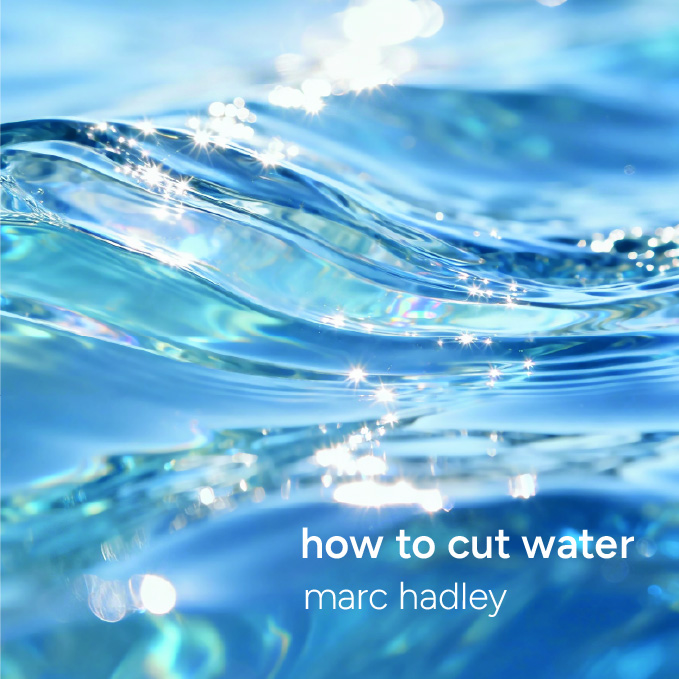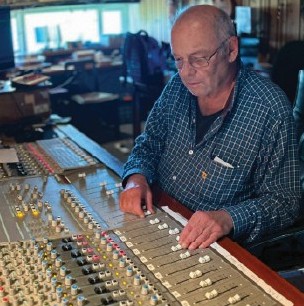
Facelift’s latest interview feature is with saxophonist, flautist, pianist, vocalist and composer Marc Hadley on the release of ‘How To Cut Water’, the first complete album he has released under his own name, a project of diversity and complexity with a definite Canterbury twist.
It includes the last known recordings of Phil Miller, as well as contributions from Jack Monck, Fred Baker, Richard Sinclair, Billie Bottle, Peter Lemer plus a whole host of musicians from Marc’s Cornish base and beyond, in a variety of different guises. In an extensive interview Marc explains his connections to Phil, the genesis of the various strands of the project and takes us through the album track by track.
I first encountered Marc at the Phil Miller memorial concerts at the Vortex in London back in January 2019. This extraordinary event, cultivated by Phil’s widow, Herm Mew and fellow musician Alex Maguire (amongst numerous others), assembled a small army of musicians who had collaborated with Phil to play his music from a number of different eras and denominations. Marc’s playing impressed me enormously on both tenor sax and flute.
We met not long afterwards, somewhat incongruously, in a pub in Oldham. Marc was on a trip up north, I’d nipped out over lunch between teaching and we spent an hour chewing the fat in a rather seedy boozer which had never recovered its aroma after the smoking ban. We’ve stayed in touch since – Marc is one of the more eloquent posters on Facebook, we’d had a couple of near misses on my trips down to his resident Cornwall, and he wrote an extremely insightful piece about Aymeric Leroy’s Canterbury biography ‘L’Ecole de Canterbury’ in its original French incarnation – Marc is a fluent French speaker and musicologist.
Marc’s connection to Phil Miller will be known to many readers here via the Relatives, that pan-London/Netherlands/Cornish outfit which united Marc with Jack Monck (Phil’s ex-colleague in Delivery), Willem Jan Droog and others – Facelift reviewed their last album ‘Virtually‘, back in 2018. Phil later guested with the band. Marc explains the connections, which started with Henk Weltwreden, the Dutch author who has an indelible link to supporting Canterbury music, particularly Hatfield and the North and its successors – Henk gave a eulogy at Phil Miller’s funeral).
Phil and Henk were great pals and Henk had this friend called Willem (Jan Droog). They’re both from Vlaardingen outside Rotterdam. Willem was an architect at the early stage stages of his career at that point – we’re going back to about 1988/1989. So Willem’s got to do an architecture course in London and he needs somewhere to stay. Via Henk, Willem calls Phil and Phil goes, “Well, Jack, he’s in Hackney. He’s got a house. He’s got a spare room which he rents out. Ask Jack.”
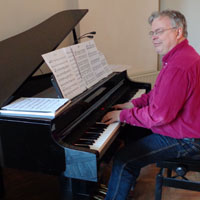
Willem ended up lodging with Jack and he’s there for a couple of months and it emerges that Willem’s got an interest in Canterbury and jazz and world – similar interests to Jack. Jack wrote songs. William didn’t write songs but wrote music. They thought “let’s collaborate”. One of the results of that collaboration was ‘Amazonia’ (the last track on ‘How To Cut Water’).
Things began to develop. Willem and Jack thought, “let’s do a band”. Willem has some mates in Rotterdam. And Jack asked me, “do you want to get involved in this thing? It’s going to involve going over to Holland and then playing gigs”. Definitely! So that’s how it all happened.
I was already playing with Jack. Jack had a band called the Chan Monck Band which was a vehicle for him writing his songs with his then girlfriend Amy Chan. A band doing Jack and Amy’s original material but quite within the Canterbury genre, which was probably what attracted me to it.
So what was Phil’s connection with all this?
Phil was a kind of facilitator, observer, spectator. He was there in the background. The Relatives had this hiatus and then started up again and by that point Phil had done his album ‘Conspiracy Theories’. That was a major album, in terms of the work and the extent of it. And it cost a lot of money because there was a lot of material there and there were a lot of very high-end musicians. I think by the end of that process Phil kind of felt, well, that’s about the biggest shot that I’ve got. And I don’t think he was up for trying to do In Cahoots anymore after that. So basically I think 2012 found Phil at a loose end. And the Relatives were going to do some gigs in Holland.
So Jack said, “well do you want to come along play guitar then?” So much to our surprise he said yes. So he came along to Rotterdam and we rehearsed a set with him and then went out and played. There are live recordings from that point. What happened after that was the emphasis of the Relatives shifted down to my end of the world (Marc lives in Penwith in Cornwall). I’d been working with a Falmouth-based drummer and bass player called Damian Rodd, who’s very very good, and had a studio. So, Jack was very into Damian’s drumming, which is very kind of fusion, very kind of sophisticated, in the pocket. So, Jack started doing some groove tracks with Damian. And then I said, “Well, I’ve got some stuff, too”.
Willem was still within the fold. So basically we decided to do another Relatives album which was ‘Virtually’ but really the centre of gravity had shifted away from Holland to Cornwall. So ‘Virtually’ mainly involved people from Cornwall if anybody else was involved.
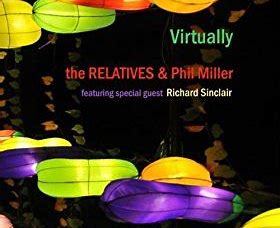
It was the ‘Virtually’ sessions which provided one of the crown jewels of ‘How To Cut Water’, Marc’s classic track ‘On My Mind’’, featuring both Phil Miller and Richard Sinclair. More of which later… But before delving into ‘How To Cut Water’ in more detail, let’s continue the story of how it came about…
The genesis of this project was that the Relatives stopped being – we were no more after that (‘Virtually’). And Jack and Phil were just getting together at Phil’s place in Hackney trying out ideas. Phil had some things that perhaps he thought would be suitable for a little band that would not have a need to have a big production behind it – just a quartet really.. And Jack had some material. And so Phil was starting to help out with the arrangements of those things at Jack’s. And then I got roped in again! So I was commuting up there from Cornwall and then I found a drummer that I knew in London who by coincidence had played with Steven Miller (Phil’s brother) back in the day – Paul Dufour, who sadly died (in 2022). We were regularly meeting up in Phil’s flat. We actually got a couple of sets together. We became gig ready and we did a studio demo to help us get some gigs. There were four tracks produced from that and one of them made it onto ‘How to Cut Water’ as the bonus track.
More of which to come … In the meantime let’s talk through some of the tracks individually:
There But For The Grace of God Go I/The Note Whisperer
The opening track of the album is arguably its strongest: ‘There But For The Grace of God’ is a piece which will stay long in your head, and recalls both the music and lyrics of Hatfield and the North. The opening bars contain a theme which is reprised on track 6 ‘The Note Whisperer’, which is the most tangible reference of all to the Phil Miller connection.
That song I wrote quite a while ago. It does come from a sort of a personal place. It was about one or two people that I knew, reflecting on the fact that there’s actually quite a fine line in life between being kind of okay and not being okay. And so my path crossed with a number of people where they had fallen through the cracks and I was there trying to maybe rescue them. So that’s the personal side of the song. I think it was a kind of quite Hatfieldesque song anyway. And then I brought it into this project.
There are recordings of it with Phil playing. Phil had injected an appropriate guitar feel. Slightly funky, slightly jazz feel. Phil had made some suggestions about the arrangement and crucially I’d written ‘The Note Whisperer’ as well. The opening theme of ‘For The Grace’ is actually the main theme of ‘The Note Whisperer’. Phil and I were working on ‘For The Grace of God’. I’d written that theme. He said, ‘that’s a nice bit of writing, sounds a bit like Alan Gowen’. And then he helped me put it together in a sort of time frame because the technical problem was that it had a kind of halftime sort of feel. It was quite a slow piece of music and after the intro it needed at some point to suddenly double up time. And that is actually what happens. So, you’ve got that opening theme played on guitar and then it has to link and then go into the groove. We worked that problem out in the rehearsals because we played it live. Phil said, you know, let’s have it in 2/4 time going into occasional bits of 3/4. And then he created the right chord to transition into the first bit of the verse of ‘Grace’. So, the tune is mine but Phil made it work.
And then the other thing is that Phil likes things to have a written ending, so not something that just waffles out but introduces a new musical idea and finishes. And so the ending that the song is like what Phil wanted. And then of course I’ve then tagged on about a minute of waffle to the end of it as I’ve gone off into a weird Canterburian cathedral on skunk or something!
As for ‘The Note Whisperer’, as Marc explains, it resurrects the opening theme of the album and reprises them in a stunning miniature, sung by Kath Buckler. Regarding Marc’s lyrics, I’d had previous conversations with him about the Canterbury scene’s preponderance lyrically towards the self-referential, the Hatfieldsesque/Canterbury notion of words used often being incidental or presented as an accoutrement to the music. This surfaces later on ‘Secret Island’ where one line teases:
Avalon you may find in this song
But you’re looking for meaning
Where it doesn’t belong
but on ‘The Note Whisperer’ brings it even closer to home, where, following the opening gambit
Notes
can be difficult to
string together
…
just like herding cats
it follows with a disarming second verse dedicated to Phil Miller
Phil
had a way of speaking
wordlessly that
they could understand,
argued patiently
till they all agreed
to be organised
dressed in uniform
on a paper shore….
Few can master the art
of whispering to- them
steering close to the wind
writing the perfect chart.
Marc explains:
Lyrically, I didn’t know it when I was young but as I learned more about the whole (Canterbury) genre and everything – I would say Robert Wyatt, that thing about sort of being a stream of consciousness sometimes and just talking about what I’m feeling and thinking, and then that ends up being a song.
So, it’s Robert and it’s Pip. And of course, Pip wrote in the same sort of way. I think Pip was even more charming. I mean, Robert was always quite serious. But Pip would just write. He had the knack of just writing about anything that comes into his head and then making it work musically. So Pip was, I think an absolute genius. Of course Robert’s an absolute genius, but Pip as well. And of course, so when Richard’s doing those songs for which we know and love him, for the Hatfields, it’s Pip’s words mainly. Sometimes it’s Dave’s words.
I think the other reference would be from the Hatfields. I forget – it’s Dave I think: “I have managed my Ps and Qs”, and there’s a sort of whole series of plays of words on notes and how they’re being used. So in fact, if you wanted to know my influence there, for ‘The Note Whisperer’, it would be Dave and the kind of elegiac, madrigal, choir/quiet bits on Hatfields with the Northettes and those arrangements. It’s ‘Mumps’, isn’t it? And ‘Fitter Stokes’. And so, that’s the influence there.
This seemed an appropriate moment to talk about Phil himself and his clear influence on Marc:
I think going back to the Relatives and ‘Virtually’ things really started to come alive for me when I took this bit of jazz funk that I’d written which was ‘Spaghetti’. I was hearing it as kind of like ‘Aigrette’ or something from the first Hatfield album, rather like a Phil tune and the backing for it again rather like Hatfield in the North in that kind of funky jazz mode. ‘Spaghetti’ passed into the Relatives project and then Phil played guitar tracks on it, and it came back from Phil sounding like a Phil Miller track. There were bits that were like some of the good Caravan bits and I’d done the flute and that was a bit Jimmy Hastingsish. ‘Spaghetti’ with Phil, it just turned into like a real Canterbury track. And I was totally delighted. I think basically I was writing the sort of things that is a nexus between me and Phil. Phil liked my playing, my sax playing, but also when I started writing, running my ideas past him, he very often just adopted them, and said “yes, I like this, I like what you’ve written”. And he put his own sort of stuff into it. So that was me and Phil collaborating. It’s all I could have dreamt anybody would have put into them. I’ve got that sort of feeling now with Fred (Baker). Because when I went when I went to add Fred into ‘Yours For a Fiver’ Fred reproduced what Phil had wanted the guitar to do in the arrangement on the dots. And so he did some solos and Fred bloody shredded it. I’m so glad that Fred did it because Fred is in my humble opinion the equal of any guitarist. I think the majority of people who hadn’t heard those Phil and Fred albums with ‘Double Up’ – the majority of people believe Fred to be a bassist which he of course is. I’m one of those people that, having worked with Fred, I believe him to be a guitarist!
I think the nexus between me and Phil when we actually started, being together and playing music together, the nexus there was jazz. Because although Phil’s music was very much his own, I think what really thrilled him and what motivated him to play the guitar was that he absolutely loved jazz of all kinds. He would have listened to Django, he would have listened to all the blues of course – he was really into George Benson. I think in a way these side projects that he got involved with gave him the opportunity to do jazzy things.
I had some interesting conversations with him and I’ve got recorded interviews with him actually as it goes because at one point I was wanting to do a book on Canterbury. And I did some interviews with Phil and we were sort of going back to the origin of some of the stuff which I first heard him do in the Hatfields and things like ‘Underdub’. He was into Charlie Parker. He listened to Bebop. And so when you hear ‘Underdub’, that’s Phil’s version of Charlie Parker. In his eyes I was a proper jazz musician. So there you go.
There was also a personal connection with Phil stretching back to the 1970s and Marc’s student days.
Absolutely. I mean, this is my school, my sixth form. I mean, I’m one of the people from Jonathan Coe’s ‘The Rotters’ Club’. Me and my friends back at school had a band and there was an band of older boys who were kind of doing jazzy prog rock. And that was King’s College School, Wimbledon. In fact, the band of older boys that influenced me and my friends, they were called Zeitgeist and their keyboard player was a chap called Steve Franklin, who actually ended up in In Cahoots!
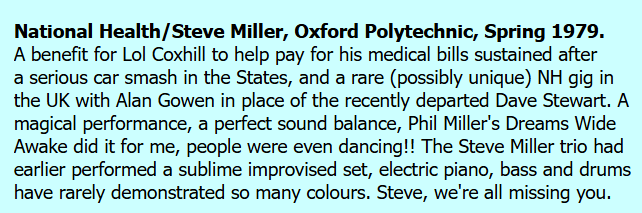
And then of course when I left school and I went to Oxford and I was into the Oxford alternative scene and I was then in touch with Maddie Coxhill, daughter of Lol. So when we were trying to get people to come do benefit gigs and festivals, Maddie knew them all. So I was I was able to ring Dave Stewart and say “would you bring National Health to play for a festival benefit?”, and then when Lol had a nasty accident and lost his front teeth I roped National Health in – by this time with John Greaves and Alan Gowen – that version. And Steve Miller. So I was more than a fan. I was actually booking those people in in on the Oxford scene.
Yours For A Fiver
‘Yours For A Fiver’ is an instrumental which starts with Fred Baker’s beautiful harmonics on guitar. To these ears it conjures up images of some of Phil Miller’s work with Short Wave, but also recalls elements of In Cahoots, appropriately enough as it contains contributions not just by Fred but also Cahoots’ erstwhile keyboard player Peter Lemer.
That band played a couple of sets which were generated by ourselves and then Phil died. After that I was left with this kind of legacy of some rather good song ideas – some of Phil’s. One of which was of course ‘Yours For a Fiver’ which at that point was called ‘Thing in Five’ because Phil hadn’t actually decided what to call it. We did play that track pretty much as you hear it on record. We didn’t have the keyboard part, but Phil had actually written the keyboard part. So what Pete Lemer plays is what Phil had written. Some of the ideas that were left over from that band, Phil’s last band, if you will, that was unfinished business for me.
On My Mind
‘On My Mind’, even though it had previously appeared on The Relative’s ‘Virtually’, may well be the crown jewel from this very fine album. A classic ballad, it could be hand-made for Richard Sinclair’s patent crooning, but contains so much more… Marc’s flute flecks, a grinding Phil Miller solo, the wonderfully mellow flugelhorn of Robin Pengelly, the later backing vocals of Angeline Morrison, and a full-throated tenor solo from Marc himself, who explains the Richard connection:
It was virtually finished, but I tried some singers. It hadn’t really worked out with people I’d tried. And then Phil said, “Well, I’ve got to have some discussion with Richard on the phone to Italy. I’ll mention this song and see if he’s up for singing.” That conversation happened and then Phil got back to me and said, “well actually Richard likes the song and he’s up for singing it”. So that happened in a rather winding twisting way..
Incidentally it’s been re-released by Richard as well for a compilation which is being sold in Japan. It’s a bonus track. I wanted to have it there in the end because it’s the last recording with both Richard and Phil together. And also I thought because Robin (Tyndale-Biscoe) who’s produced speciality is in mastering. And so I thought well if I include ‘On My Mind’ it’ll get remastered. It probably sounds slightly better than the original sound did.
The other thing was I wanted to have Richard and Phil on the album. When I got all the tracks together and everything was all mixed and finished, I started trying to work out what order to put them in. And so I used a very simple sort of media player on the laptop to just put a playlist together and try different orders and whatnot.
And I just found that by putting ‘On My Mind’ in after ‘Yours For a Fiver’, it just worked. Those two things wanted to be together. Because those two things are both very much Phil and very much Canterbury in miniature and so the combination of having those two together I just think is a killer.

Green World/Secret Island/Away With The Fairies
Compositionally, Marc moves a little away from the Phil Miller axis with three tracks. Lyrically, they expound areas which might appear light in tone but have underpinning serious messages, whilst Marc’s vocals on ‘Green World’ and ‘Away With The Fairies’ have more than a passing resemblance to Richard Sinclair, who of course appears elsewhere on the album.
It’s funny you should say that! I would say I think that ever since I was a teenager I’ve always wanted to sound like Richard!
‘Green World’ is Marc’s ditty of impending environmental disaster, where he memorably goes off melody to wryly and self-deprecatingly note:
… it’s no longer just
a case of well-meaning liberal animal-lovers deciding to buy
their organic vegetables from the local farmers market …
‘Green World’ is actually a Relatives song. I wrote right back in 1988/89. And then it never got recorded again. Then I added some bits in and recorded it in the form that you hear it on the album.
Obviously, it’s a serious topic. The other thing I would say about that is going to be a three minute single, I intend to release it probably online rather than as a physical product. But I intend to release it as something where the proceeds are going to partly go to an organisation that is trying to save the planet… man.
‘Secret Island’ was a song I originally wrote as an instrumental and it’s on a sort of ECM style jazz record that I did in 1998. It was just a violin theme with a piano accompaniment and then it turned into a song later on and it ended up in the set with Phil and Jack and Paul. So ‘Secret Island’ was again an arrangement which Phil had an involvement in and that we did play live and there are recordings of it..
‘Away with the Fairies’ is partly autobiographical but I’m referencing a book which really inspired me which I really loved – ‘Jonathan Strange and Mr Norrell’ by Susanna Clarke. It’s an extraordinary novel of 18th or 19th century England – a story about the interface between a kind of parallel England and fairyland. It is a strand of British folklore and legend that there is beneath us or above us or under the hills – a parallel world of beings but they’re not like us, they exist on another plane. Then you’ve got things like the Wild Hunt and all the folklore that there is and there’s stories about people that have encounters with the fairies. The fairies are completely amoral. They just look at things differently than we do and they don’t care about us in the sense that you know their morality is completely other. There’s stories of the fairies in which people go to they interact with the fairies for maybe what seems like a day or two and then they return and they find that you know dozens or even hundreds of years have passed.
It’s a bit of a trip – it’s also a kind of cautionary tale. It’s about being careful who you get impressed by and where you go because it’s not exactly how it’s painted in the brochure: you might find there’s no way back. And I think that talks about various things in our alternative lifestyle. There’s kind of like drugs and madness and things where you go down that road.
I think so many of us have been there … ‘there but for the grace of God’. And then the style of the song – that’s very nodding towards Caravan and ‘Land of Grey and Pink’. Sort of consciously I just went 60s psychedelia weirdness , Caravan’s ‘9 Feet Underground’. And actually an interesting world in that is the groove section, the solo section bassline of Jack’s – the strange thing about ‘Fairies’ is actually although it sounds like quite acid rock or maybe Caravan the groove is actually straight ahead swing jazz. And I really like that. The bassline I used Jack came up with and it was a song we used to do in the Relatives called ‘Impossibility’. So that one actually was quite new relatively and has no connection with Phil. It was written after Phil’s death.
Calyx
I put it to Marc, that his one-man interpretation of Calyx on sax and keyboards sounded very much like a product of the COVID pandemic, when a number of highly talented multi-instrumentalists found a space to introspectively interpret some of their own formative influences. Marc makes this analogy:
It’s like: there’s a book that you’ve got. You’ve got no nowhere to go and the only thing you’ve got to do is to read that book. So you read the book – maybe you read the book a lot of times. It’s like a desert island disc. If you’re on that desert island with your desert island disc, well, that’s your record. You’re going to be playing that over and over again, aren’t you? So, it better be a good record.
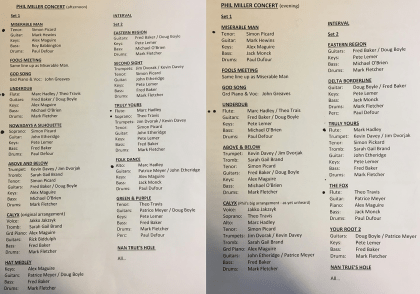
I got a bit obsessed with ‘Calyx’ during lockdown. In fact I turned ‘Calyx’ into a full movement suite. And Jack talked me out of recording it. The interesting thing about ‘Calyx’ is it’s in 5/4 again. I mean there’s 4/4 bits and 3/4 bits but basically ‘Calyx’ is in 5/4. Which connects to the Cornish music of Neil Davey and Hilary Coleman and those people that you hear on ‘Amazonia’ I play in their band Skillywidden. And 5/4 is a Cornish folk thing. I sort of slightly rewrote it to extend it into a longer piece. Now, that did not surface into this album. But one day I just decided – I got some good Prophet sounds are very spacey and atmospheric. I thought I’m going to play ‘Calyx’ in the way that I’ve rewritten it. I’m just going to sit down at the keyboard, put the recorder on and just play. And that’s what came out. And then I sort of added another synth track onto it with a slightly reverse tapey backwards thing. Having done that, I then borrowed a baritone sax from a friend of mine. I just decided that ‘Calyx’ was going to be good played on the baritone. And so basically I improvised the backing track – just played it down in one take. And then I got the baritone sax and I then blew over that – one or two takes and that is ‘Calyx’. The work on it was done in 2020. The actual recording there was probably more like no more than a couple of years ago.
Sky
Sky is another track with a Phil Miller connection, a deliciously sleazy jazz number which features the compositional and bass playing talents of Jack Monck, as well as Marc’s wonderful soprano playing .
That’s also the Relatives and it’s Jack. So that goes again a long way into the past. I think I’ve played ‘Sky’ with Jack ever since I’ve known him, which is about 40 years. I kind of rewrote it. So the tune, the chords largely, but all the kind of jazzy African-ish, all that stuff I wrote. And then I ended up using, not only a kind of orchestral, I was thinking Gil Evans and stuff like that, ‘Birth of the Cool’ – I thought, “oh, that’s something that Phil was really into”. And then I got hold of a Mini Moog, so it’s kind of got this sort of late 60s fusion Chick Corea/Herbie Hancock sound. I just discovered that some of these things from the 70s they’re just classic, they don’t age. So ‘Sky’ is a mashup but it was from the Relatives.
Amazonia
‘Amazonia’ is the grand concept piece of the album which also appears as the last listed track. It has a cast of dozens and has quite a story behind it, both in terms of its components, its lyrics and its development:
‘Amazonia’ was also something that I considered unfinished business. Because it was written right back at that point when Willem first went to stay with Jack, I believe. Willem’s the basic writer of the melody. Jack wrote the words. And then I sort of did an awful lot of rewriting and arranging for ‘How To Cut Water’. I am the third writer, if you will.
It was recorded at least twice in two different versions by the Relatives. Why did it get recorded so many times? I thought personally it was a fascinating composition. Something about it was just really unusual and didn’t fit into anything I could think of. I really worked on it a lot, not only back in the 80s, late ’80s, but later on as well. I thought “‘Amazonia’, this is like a story waiting to be told”.
Originally in Jack’s mind it was a story of the end of a relationship. ‘Amazonia’ the title was Willem’s – he had a penchant for South America. But the actual music of ‘Amazonia’ is not remotely Latin! And Jack’s words are about more really about Africa actually. And then in my mind I thought well “Amazon – what is that?” Okay, it’s a river in Brazil but also it was something from classical Greek legend – the Amazons were a tribe of warrior women, , the historical basis we’re not sure, but really I think we are talking about the people of North Africa, the Tamuzight, the Berbers, the indigenous inhabitants of North Africa and the Atlas mountains particularly. So then I started thinking about a story in which a young person has to leave the Atlas Mountains, and is possibly sold as a slave and comes to perhaps 16th or 17th century England and ends as a household servant and thinking of their home country from which they came.
So it’s a story of migration and exile. Of the sadness of knowing that there’s a place that you came from and you’ll never get back there. You’re completely withdrawn from that and placed into another culture and context. So that is the story that I created for ‘Amazonia’. And I slightly rewrote the chorus so that it would tell that story.
It’s interesting because there’s a flavour there, real echoes of 18th century oratorio, or Handel, Purcell. I was working with choristers from Truro Cathedral in my educational role and there was one particular young singer who I thought had a really great voice and the nexus between her and me was her singing teacher in Truro. who’s called Annabella Waite, who’s the sister of Veryan Weston.
Annabelle helped me coach Maddie (Martin) to sing the song. And Annabelle was fascinated by the words. She said “these words are so enigmatic and evocative of something.” I think it for me it was also evocative of alchemy and these images from alchemical texts where you see exotic creatures like lions and unicorns and strange landscapes and I wanted to create a setting that was as rich and exotic as that.
So it starts off in a kind of very early medieval drone with a kind of medieval style instrumentation and then I bring the bouzouki in and that gives it a kind of Mediterranean feel. And the arrangement of the song itself uses counterpoints and it’s baroque. And then I’ve got the strings in. And so then we’re into a kind of 17th century vibe. And then it just takes off into – there’s a wonderful bouzouki solo where so we’re into the kind of a folk modal – I brought a kind of Indian… I made up my own raga! I’m proud of that. That’s sort of symphonic writing really, isn’t it?
The journey is not only geographical, it’s through time. So, we bring the Hammond organ in, and then the sax comes in. And so we’re then into jazz land. And so we’re going along in in a jazz vibe instead. And then we get through the out chorus which I brought in a completely different singer to fill the jazz role, the soul role, and so that was Renee (Crouch) from Penzance who has that kind of voice.
Bringing her into it was the suggestion of the co-producer for that track, Dare Mason. Dare used to work at the Townhouse in London and he did all sorts – he did the recording of Soul II Soul’s ‘Back to Life’. He had some platinum discs with a band called the Blow Monkeys. And he worked with Culture Club. The technical accomplishment of ‘Amazonia’ belongs to Dare Mason of VIP Lounge Studios.
And then we go into the last section and I brought in um Robin Pengelly, the best trumpeter in Cornwall. Who played ‘On my mind’ and he played with the relatives. so Robin’s a kind of connection back to the Relatives. The drummer is actually an old pal of mine called Michele Drees and she played with the Relatives too at one point. Michele is a respected drummer on the London scene in her own right and an author in her own right as it were. She’s from Cornwall, originally from around Helston, Gweek, on the river there.
It took a year. It’s the most complicated, probably the greatest amount of tracks ever I’ve ever used on anything, the largest number of instruments I’ve ever used on anything. Real strings. In fact everything is real in that track. So I’ve never done anything like that before and I doubt if I’ll do anything like that again!
Fat Cats
This is the ‘hidden track’, buried some way beyond ‘Amazonia’ and emerging as a stripped-down, bluesy counterpoint to the grandioseness of the former. It also resurrects some old relationships:
That was a thing of Jack’s that had quite a long genesis. The basic groove he wrote ages and ages ago, and we used to jam with it in the Relatives. It was called ‘Ultramarine’ originally. And it didn’t have lyrics. In the latter Phil Miller period, Jack pulled it out as a thing to work on and then I think Phil may have suggested a lyric, to give it a kind of a solid top line. Anyway, Jack wrote some lyrics and then it became ‘Fat Cats’ and it is a great funky groove. It made it into our live set and it got recorded in that form that you hear it. I was thinking, I’d like to sort of go into a full production mode on that, but by the time I’d done all the other things, I mean, frankly, I’d run out of time and money. I thought, well, I’ll just use that studio demo that sounds passably good. And also of course it’s Phil Miller’s last recording session, and so I thought that would be nice to put on the album as a sort of a piece of archive material for people – here’s something that you will never otherwise hear. And you’ll hear Phil kind of playing in perhaps a style that people would wouldn’t be used to hearing, just kind of doing quite a casual one chord jam sort of thing. You don’t hear Phil doing that that much. In a way the whole story, Phil – it sort of ended the way it began. So it went full circle on itself and it ended up with Phil and Jack kind of playing the blues.
Thanks to Marc for taking the time to speak to me at length about ‘How To Cut Water’. You can buy the album and other merchandise at https://marchadley.bandcamp.com/album/how-to-cut-water
whilst Marc’s website, giving further details about the project, including lyrics, is at https://marchadley.co.uk/